31 CFR Part 212 is the federal regulation, titled Garnishment of Accounts Containing Federal Benefit Payments, that tells every bank and credit union what to do when a garnishment order arrives against an account into which federal benefits have been directly deposited. Its purpose, in its own words, is to protect "Federal benefits from garnishment by establishing procedures that a financial institution must follow" (31 CFR 212.1). In plain words it asks five things: examine the order within two business days, review the deposits of the two months before the review date, protect the benefit amount it finds, notify the account holder within three business days, and keep records for two years. It forbids three: charging a garnishment fee against protected funds, reviewing or garnishing the same account again on the same order, and tracing benefits between accounts. Botminds' Garnishment & Levy Processing carries out the five steps with agents and two specialists' signatures on every order.
31 CFR Part 212 in five steps, and who does each in Garnishment & Levy Processing
Agent
1. Examine the orderWithin 2 business days: is a Notice of Right to Garnish Federal Benefits attached by the United States or a state child support agency? If so, stop and follow customary procedures.
Never: Act on the account before this check.
Agent
2. Review each accountWithin 2 business days: find benefit payments coded "XX" and "2" posted during the two-month lookback.
Never: Trace funds between accounts.
A person decides
3. Protect the amountSet the lesser of those benefits and the balance at review; leave it fully available; freeze only the excess under state law.
Never: Freeze or charge a fee against the protected amount.
A person decides
4. Notify the account holderWithin 3 business days of the review, when funds above the protected amount remain: eleven required items.
Never: Enclose anything unrelated to the order.
Agent
5. Keep the recordsAt least 2 years from receipt: enough to show each step was done.
Never: Discard the batch headers and computations behind the decision.
What is 31 CFR Part 212, and who wrote it?
It is an interagency rule written jointly by the Treasury Department and the four agencies that pay the benefits: the Social Security Administration, the Department of Veterans Affairs, the Railroad Retirement Board and the Office of Personnel Management. It was issued as an interim final rule on February 23, 2011, effective May 1, 2011, and finalized on May 29, 2013, effective June 28, 2013 (Fiscal Service guidelines). It can be changed only the same way: "by a rulemaking issued jointly by Treasury and all of the benefit agencies" (212.12).
The federal benefits it protects were exempt from creditors long before 2011. What the rule added was a procedure, because an exemption the customer has to claim in court after the freeze leaves the money out of reach for as long as the claim takes. The Federal Reserve's examination handbook describes the problem the agencies set out to solve: the direct deposit of benefits and changes in collection practice "have led to an increase in the freezing of accounts containing federal benefit payments" (Federal Reserve Consumer Compliance Handbook).
31 CFR Part 212 at a glance
5agencies
wrote it jointly: Treasury, SSA, VA, RRB and OPM, and only all five can amend it
2011
effective May 1, as an interim final rule; final rule effective June 28, 2013
11items
a notice to the account holder must contain (31 CFR 212.7(b))
2years
minimum record retention, counted from receipt of the order (31 CFR 212.11)
What benefits are protected from garnishment under 31 CFR 212?
Benefits paid by four agencies, and only when they arrive by direct deposit with the Treasury's coding. The rule lists SSA benefits (Social Security and SSI), VA benefits, Railroad Retirement Board benefits and OPM benefits, each tied to the statute that already made it exempt (212.2(b)): 42 U.S.C. 407 for Social Security, 38 U.S.C. 5301(a) for veterans, 45 U.S.C. 231m(a) for railroad retirement and 5 U.S.C. 8346 for civil service annuities, among others. The model notice translates that into seven items a customer will recognise: Social Security, Supplemental Security Income, veterans benefits, railroad retirement, railroad unemployment insurance, Civil Service Retirement System and Federal Employees Retirement System benefits.
Treasury marks each covered payment in the ACH batch header so a bank need not guess. The Fiscal Service's guidelines publish the descriptions banks will see, and they make the coding visible: the same Social Security payment that once read "SOC SEC" now reads "XXSOC SEC".
How protected benefit payments are marked in the batch header
| Benefit | Company Entry Description, positions 54–63 | What it pays |
|---|---|---|
| Social Security | XXSOC SEC | Social Security benefit |
| Supplemental Security Income | XXSUPP SEC | SSI benefit |
| Veterans Affairs | XXVA BENEF | Compensation and pension, DIC, burial |
| Railroad Retirement Board | XXRR RET | Railroad retirement benefit |
| Railroad Retirement Board | XXRR UISI | Railroad unemployment insurance |
| Office of Personnel Management | XXCIV SERV | Civil Service retirement benefit |
Step one: what is a Notice of Right to Garnish Federal Benefits?
It is a short certificate, worded by the rule itself, that the United States or a state child support agency attaches to its own garnishment order, telling the bank that the benefits procedure does not apply. The rule prescribes its wording in Appendix B; the key sentence notifies the garnishee "that the procedures established under 31 CFR part 212 for identifying and protecting Federal benefits deposited to accounts at financial institutions do not apply to this garnishment order" (31 CFR Part 212, Appendix B).
Step one is to look for it before anything else, within two business days. If it is there, the bank follows its "otherwise customary procedures" and skips steps two to four (212.4(b)). If it is not, the bank must run the review, whoever the creditor is (212.4(c)). Two order types sit outside this step altogether. IRS levies are not covered, though the rule's definition of a garnishment order includes levies by states and municipalities; the Fiscal Service's answer is direct: "Tax levies issued by the Internal Revenue Service are not subject to the Final Rule" (Fiscal Service FAQ). And a child support order without the notice is treated like any creditor's. The child support bank levy process follows that order type in full.
Step two: review the account, once, on its own facts
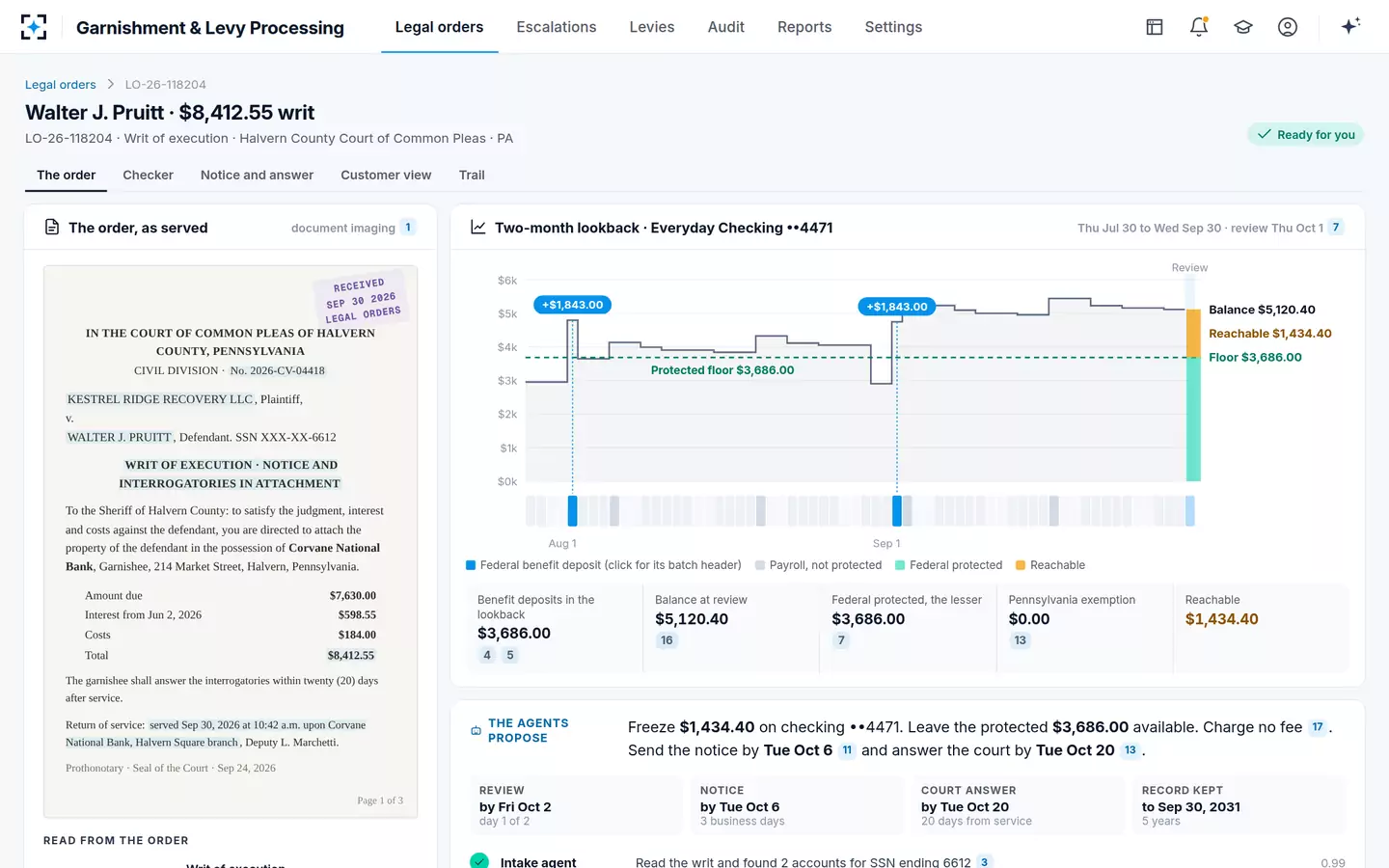
The account review is the search of each of the debtor's accounts for coded benefit payments posted during the lookback period, the two months before the review date. It is due within two business days of receiving the order and enough information to identify the account holder, or by a later date the creditor allows for a large batch (212.5(a)). It comes before any other action that could affect the account (212.5(e)).
The review ignores the things a person would naturally want to weigh. It is performed "without consideration for any other attributes of the account or the garnishment order", including commingled funds, a co-owner, several beneficiaries or programs, the balance if above zero, instructions in the order, and the kind of debt (212.5(d)). Each account is reviewed separately, and the bank may not follow benefits from one account into another (212.5(f)). The lookback dates, which trip up hand calculations at month ends and weekends, are worked through in how to test a garnishment protected amount.
One account's two-month review, with the benefit deposits and the floor
Step three: protect the amount, and let the customer use it
The protected amount is the lesser of the coded benefits found and the account's balance when the review is performed. The bank must establish it "immediately" and give the account holder "full and customary access" to it; the customer does not have to claim anything first (212.6(a)). Once established, the amount is treated as exempt by law and cannot be challenged in the garnishment (212.6(c)). Only money above it is handled under the bank's ordinary procedures and state law, which usually means a freeze (212.6(d)).
The freeze is defined broadly. Any action "to seize, withhold, or preserve funds, or to otherwise prevent an account holder from drawing on or transacting against funds in an account" counts (212.3). A bank that leaves the protected amount on the books but blocks debit card use on the whole account has frozen it; the OCC reads "full and customary" access to mean the account holder should keep debit card access to the protected amount (OCC Comptroller's Handbook, citing 78 FR 32104).
Step four: notify the account holder, with eleven items
A notice is owed when three things are true: a benefit payment posted during the lookback, the balance was above zero and a protected amount was set, and funds above that amount remain (212.7(a)). It must go out "within 3 business days from the date of account review", in "readily understandable language", directly to the account holder or a fiduciary who receives their mail, and with nothing in the envelope but documents about the order (212.7(b), (e), (f)).
The eleven items every 31 CFR 212 notice must contain
- The bank received an order against the account holder
- The date the order was served
- A short explanation of what garnishment is
- The bank's duty to protect balances up to the protected amount when benefits were deposited in the last two months
- The account the order reaches, and the protected amount set
- Any duty under state law to freeze other funds, and the amount frozen
- Any garnishment fee the bank took, and how much
- The list of federal benefits the rule covers
- The right to claim a further exemption above the protected amount, and how
- The right to consult an attorney or legal aid
- The creditor's name, and how to contact it if the order says
Using the model is optional, but it is a safe harbor of its own. Appendix A says that "Although use of the model notice is not required, a financial institution using it properly is deemed to be in compliance with § 212.7." The bank may amend the notice "to integrate information about a State's garnishment rules and protections" (212.7(d)), and may send one notice covering several accounts (212.7(g)).
Step five: keep records that prove each step
The bank must keep records of the account activity and its actions on each order, enough to show it complied, for at least two years from the day it received the order (212.11(b)). The OCC tells examiners that the bank decides what documentation to keep (OCC Comptroller's Handbook), but the practical test is whether an examiner can rebuild the decision: the order with its receipt time, the batch headers of each counted payment, the balance at the moment of review, the computation, the notice and its mailing date. A record of only the outcome proves nothing about the steps.
The business-day clocks in 31 CFR Part 212, from receipt of a creditor's order
- Examine the order and review the account2 bd
- Send the notice3 bd after review
- Examine the order and review the account2 bd
- A fee may come only from new non-benefit deposits5 bd after review
The three things 31 CFR 212 forbids
Each prohibition is a line an examiner can test from the file with a yes or no: was a fee posted against the protected amount, was the same order reviewed twice, did a hold grow after the review date, was a transfer from the benefit account followed into savings. The fee line also runs through IRS levies and state law, which is followed in garnishment fee on a bank account.
What 31 CFR 212 forbids, and what it still allows
Forbidden: Charging or collecting a garnishment fee against the protected amount (212.6(h)).
Still allowed: A fee from non-benefit deposits made within five business days after the review, up to their amount. Part 212 does not bar a fee from other unprotected funds; state law may.
Forbidden: Reviewing again when the same order is served again, or continuing to freeze later deposits (212.6(f), (g)).
Still allowed: A new review when a new or different order is served against the same account holder.
Forbidden: Following benefits from one account into another to protect or to freeze them (212.5(f)).
Still allowed: Reviewing each account on its own deposits and setting a separate protected amount for each.
Forbidden: Requiring the account holder to assert an exemption before using the protected amount (212.6(a)).
Still allowed: The customer claiming further exemptions above the protected amount through the court or creditor.
The repeat-action rule surprises new specialists most. The bank "shall not continually garnish amounts deposited or credited to the account following the date of account review" (212.6(g)), so a creditor who wants later deposits must serve a new order. A system that re-runs the review every night, or a hold that grows with each deposit, breaks the rule.
What is the 31 CFR 212.10 safe harbor?
Section 212.10 protects a bank that complies in good faith from four kinds of liability. During the two-day examination and the review period, it is not liable to the creditor or under state law for account activity it did not stop. When it protects benefits or freezes the excess, or follows a federal or child support notice, it is not liable to the creditor for the protected amount or to the account holder for the frozen amount (212.10(b)). It is not liable for optional information it adds to the notice in good faith. And it is not liable for bona fide errors despite reasonable procedures, for customary clearing and settlement adjustments such as a returned deposit or a debit card transaction that settles higher than it was authorized, or for honoring a dated written instruction from the account holder, given after service, to use protected funds to pay the order (212.10(d)).
The phrase that matters operationally is "reasonable procedures". The rule does not define them, so a bank has to be able to show that its procedure was built to catch the errors it now claims were bona fide: a lookback date miscounted, a payroll credit taken for a benefit, a co-owner's deposit missed. In the solution, each protected amount is computed twice, the second time blind from the core's posting journal; a difference of a cent sends the order to a person, and every hold and notice carries a maker's and a checker's signature.
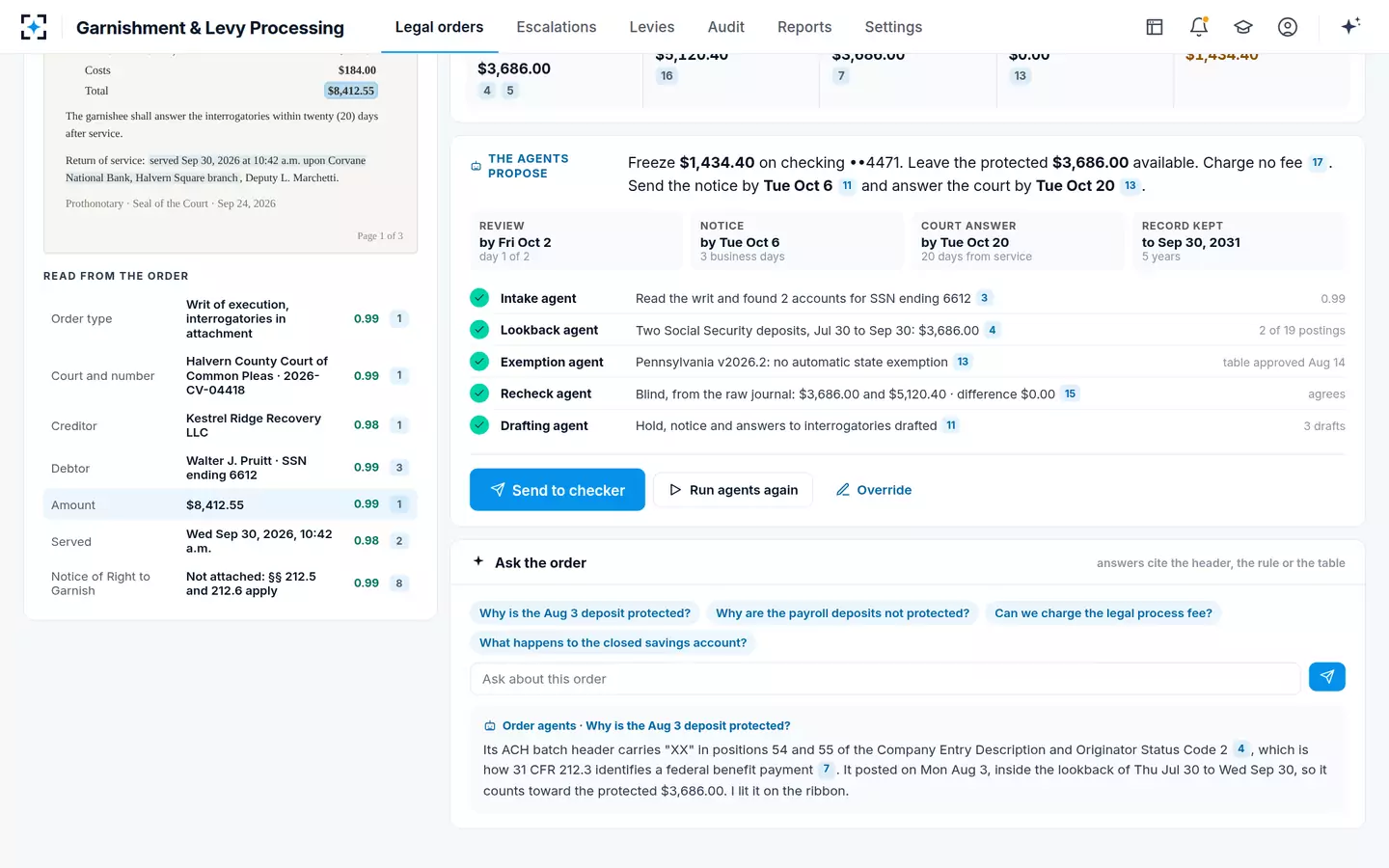
Asking the order why a deposit is protected, with the rule cited
Does 31 CFR 212 apply to credit unions?
Yes. The rule covers every "bank, savings association, credit union, or other entity chartered under Federal or State law to engage in the business of banking" (212.3), and the National Credit Union Administration is among the federal banking agencies that enforce it. One credit union difference survives: the OCC's handbook notes that the rule "does not limit a federal credit union's right to exercise its statutory lien authority against the protected amount in a member's account" (OCC Comptroller's Handbook).
How state law fits around 31 CFR 212
State law fills every gap the rule leaves and may protect more. A state law is preempted only where a bank cannot comply with both, and the rule says expressly that a state requirement "to protect benefit payments in an account from freezing or garnishment at a higher protected amount than is required under this part is not inconsistent" (212.9(b)). The Fiscal Service gives an example: in a state with a $3,000 minimum protected amount, an order for $2,500 against an account holding $2,750 that the bank decides not to act on does not trigger the federal procedure at all (Fiscal Service FAQ). Which state's law applies is its own question, followed in what states prohibit bank account garnishment.
To see the five steps and the three prohibitions applied to a full order, screen by screen, start from Garnishment & Levy Processing.
Questions people ask
Does 31 CFR 212 apply to IRS levies?
No, and the difference runs deeper than the review. An IRS levy follows the tax code: the bank holds the levied deposits for 21 calendar days and surrenders them on the first business day after the hold unless the IRS releases the levy (26 CFR 301.6332-3(c)(1)). The tax code also sets aside the Social Security Act's anti-garnishment clause for its own levies (26 U.S.C. 6334(c)), so Social Security sitting in the account has no shield of its own against one; the clock is traced in the IRS levy 21-day rule.
Does 31 CFR 212 protect benefits paid by paper check?
Not through the bank's automatic review. The rule covers benefit payments made by direct deposit with the Treasury's coding, and the Fiscal Service tells banks they are not responsible for identifying benefits paid by Treasury check. The benefits may still be exempt, but the account holder has to claim the exemption.
When does a bank not have to send the 31 CFR 212 notice?
When no benefit posted during the lookback, when the balance was zero or below, or when the protected amount used up the whole balance so nothing was frozen. The rule's first and fifth protected-amount examples both end with no notice required for that last reason.
Does 31 CFR 212 cover economic impact payments?
The Fiscal Service notes that the second round of economic impact payments, under the Coronavirus Response and Relief Supplemental Appropriations Act of 2021, is exempt from garnishment and generally treated like covered benefits, with some differences, and advises banks to consult counsel.
Can a bank rely on the "XX" code alone?
Not quite. The Fiscal Service warns that a commercial payment could also carry "XX" in positions 54 and 55, so banks should confirm the "2" in the Originator Status Code, or check the description against the published list of benefit types, before treating a deposit as protected.