A legal process fee, or garnishment fee on a bank account, is the charge a bank makes to its customer for processing a legal order, often listed as a legal order processing fee in the deposit agreement. Banks may charge it, within limits that differ by order type. Under Treasury's rule a bank "may not charge or collect a garnishment fee against a protected amount" of federal benefits (31 CFR 212.6(h)). Under an IRS levy it may not take the fee out of what it surrenders. Under some state laws it may not charge one when the account cannot lawfully be restrained. The fee earns a bank little; charged in the wrong place, it becomes a violation an examiner counts, and fee practices sat inside a $10 million CFPB order in 2022. Botminds' Garnishment & Levy Processing applies the limits as locked settings, so the fee decision on each order is computed and shown to two specialists rather than remembered.
What garnishment-related fees cost one bank in a single CFPB order
Can a bank charge a garnishment fee? Yes, within four limits
A bank can charge a garnishment fee where its account agreement provides for one and no law forbids it, and four limits do most of the work. First, never against a protected amount of federal benefits. Second, under that same rule, a fee on later deposits only within five business days and only from non-benefit money. Third, under an IRS levy, never by reducing the levy proceeds. Fourth, whatever the state adds; New York, for one, forbids any fee when the bank cannot lawfully restrain the account.
The Treasury rule defines the fee broadly enough to catch every variant: "any service or legal processing fee, charged by a financial institution to an account holder, for processing a garnishment order or any associated withholding or release of funds" (31 CFR 212.3). A release fee, a research fee or a hold fee charged because of the order all count.
What is a legal order processing fee?
It is the bank's own charge for handling the order, set in its fee schedule and deposit agreement, not a cost the court or the creditor imposes. The IRS manual puts it matter-of-factly: "Many banks charge their customers a fee for processing levies" (IRM 5.11.4.4.3). The rule treats the fee as part of what the customer must be told: the notice under 31 CFR 212.7 must state "The amount of any garnishment fee charged to the account", and the model notice has a column for it.
No agency publishes a survey of what banks charge, so this guide gives no market figure. The fictional sample bank in the solution charges $125.00 on orders where a fee is allowed and its policy does not waive it. The amount matters less than where it is taken from, which is what the rules govern.
Can a bank charge a fee on protected funds? Never, and only briefly on what comes after
No. The rule's text is short and absolute: "The financial institution may not charge or collect a garnishment fee against a protected amount." It allows one exception for money that arrives later: the bank "may charge or collect a garnishment fee up to five business days after the account review if funds other than a benefit payment are deposited to the account within this period, provided that the fee may not exceed the amount of the non-benefit deposited funds" (31 CFR 212.6(h)).
Treasury's guidelines give the arithmetic. "An account contains a protected amount of $500 on the date of the account review, which constitutes the entire balance of the account. Two (2) business days later $50 in non-benefit funds are deposited in the account. The financial institution can impose a garnishment fee not exceeding $50" (Fiscal Service guidelines). On day six, or out of a benefit deposit, the answer is nothing. The agencies considered loosening the rule and declined: they "believe that financial institutions should not be permitted to collect a fee from the protected amount and, therefore, have not amended that provision" (Fiscal Service FAQ).
One sample account at review: the fee may not touch the protected share
Checking ending 4471, balance $5,120.40
- Protected: two Social Security deposits, $3,686.00 · 72%
- Frozen for the writ, $1,434.40 · 28%
Can a bank take its levy fee from IRS levy proceeds?
No. The IRS manual is direct: "The bank is not entitled to reduce the levy proceeds to collect the fee." Its examples settle the arithmetic. With a $1,000 levy and $1,500 in the account, "The bank must send $1000 and collect its fee from the other $500." With $800 in the account, "The bank must send $800 (plus interest)" (IRM 5.11.4.4.3). The fee waits for money the levy does not reach.
The IRS also has a letter for banks that get this wrong. Letter 4030(CG) "informs the financial institution that a charge against levy proceeds is contrary to the provisions of the Internal Revenue Code and failure to remit an amount equal to the service charge may result in the Service filing a suit for failure to honor a levy." Under the tax code, a person who fails to surrender levied property can be personally liable for its value and, without reasonable cause, a penalty of 50 percent on top (26 U.S.C. 6332(d)). The 21-day sequence around the surrender is laid out in IRS levy 21 days.
Where a garnishment fee may come from, by order type
| Order | Fee against protected benefits? | Fee from the money surrendered? | Fee from other funds? | Source |
|---|---|---|---|---|
| Creditor writ, benefits in the lookback | Never | Subject to state law | From non-protected funds; from new non-benefit deposits only within 5 business days, capped at those deposits | 31 CFR 212.6(h); Fiscal Service FAQ |
| Creditor writ, no benefits in the lookback | Not applicable | Subject to state law | As the account agreement and state law allow | 31 CFR 212.5(b); state law |
| IRS notice of levy | Not applicable: the rule does not apply to IRS levies | Never: proceeds may not be reduced | Yes, from money the levy does not reach | IRM 5.11.4.4.3 |
| State child support levy with the federal notice | Not applicable: customary procedures | Subject to state law | As state law allows | 31 CFR 212.4(b) |
| New York restraining notice the bank cannot lawfully apply | Not applicable | Not applicable | No fee at all | CPLR 5222(j) |
When state law forbids the fee: New York's rule and the out-of-state orders
States can be stricter than the federal rule, and the federal rule says so: state law that protects more is not inconsistent with it if the bank can comply with both (31 CFR 212.9(b)). New York's civil practice law is the clearest fee example. When a bank "served with a restraining notice cannot lawfully restrain a judgment debtor's" account, "the banking institution shall charge no fee to the judgment debtor regardless of any terms of agreement" (CPLR 5222(j)).
The phrase "regardless of any terms of agreement" is the important one. A fee schedule does not override it, and the CFPB's 2022 findings show the same principle working through a different door: fees charged after processing orders the bank should not have processed. In its order the Bureau found that the bank "charged legal order processing and, sometimes, attorneys' fees to Consumers' frozen or held Deposit Accounts" after out-of-state notices, and that affected consumers "have paid at least $592,000 in Garnishment-Related Fees" because of notices from states that restrict out-of-state garnishment (CFPB consent order).
What did the CFPB find about garnishment fees?
Twice in 2022 the CFPB tied garnishment fees to garnishments that should not have happened, and ordered them refunded. The Bank of America order required the bank "to refund at least $592,000 in, or cancel, associated unlawful garnishment-related fees and pay a $10 million civil money penalty" (CFPB). Its definition of the fees covered is wide: "legal order processing fees, attorneys' fees, overdraft fees, insufficient funds fees, or account maintenance fees" assessed after processing such a notice.
In its Supervisory Highlights for fall 2022 the Bureau reported that examiners identified unfairness risks at multiple institutions from policies that may have resulted in "processing garnishments in violation of applicable state prohibitions against out-of-state garnishment", and in state exemptions going unapplied. Supervision directed institutions to "refund any garnishment-related fees assessed to account holders in connection with certain out-of-state garnishment orders" (CFPB Supervisory Highlights, Issue 28). The pattern in both is that the fee is rarely the violation on its own; it is the measurable harm attached to a wrong decision earlier in the order.
The garnishment fee limits, in numbers
$0
garnishment fee allowed against a protected amount of federal benefits (31 CFR 212.6(h))
5days
business, after the review, in which a fee may be taken from new non-benefit deposits, capped at those deposits
3,700+
out-of-state notices one bank processed from restricting states without telling the court, per the CFPB
$1,000
cap on an IRS reimbursement claim for bank charges caused by an erroneous levy (IRM 5.11.4.9.1)
Are garnishment fees refundable?
A fee charged where a rule forbids it has to come back, and the route depends on the rule. A fee taken against protected benefits is a violation of 31 CFR 212.6(h), which the federal banking agencies enforce; the examiners' worksheet asks "Does the financial institution refrain from charging or collecting a garnishment fee against the protected amount?", and in expanded procedures a "no" is a violation (OCC worksheet). Fees tied to unlawful out-of-state garnishments were refunded under the CFPB's order and supervisory directions above.
When the IRS caused the error, the customer has a route of its own. The IRS may reimburse bank charges caused by an erroneous levy, including fees the bank charged for "Processing the levy" and "Bad check charges directly caused by the levy"; the claim "must be filed within one year after the fees are charged and is limited to $1,000", on Form 8546 (IRM 5.11.4.9). That money comes from the government, not the bank, but a bank's customers will ask the bank first, and the desk should know the answer.
Why waiving by rule is cheaper than deciding by hand
The fee decision looks trivial and is not. To charge correctly on one creditor writ, a specialist must know whether a protected amount was set, which deposits arrived in the next five business days and whether they were benefits, which state's law governs and whether it bars a fee, and whether the order was even lawfully processed. Each check takes time, and the revenue at stake on each order is the fee itself. A wrong answer in the bank's favor is a violation; a wrong answer in the customer's favor is a lost fee.
Five questions a garnishment fee policy should answer before any fee posts
- Was a protected amount established on this account?
If yes, nothing comes from it. Many banks find it simpler to waive the fee on any order with a protected amount.
- Is the fee coming from new money, and is it a benefit?
Only non-benefit deposits, only within five business days of the review, and never more than those deposits.
- Is this an IRS levy?
Then the levy proceeds go to the IRS in full; collect any fee from funds the levy does not reach.
- Which state's law applies, and does it bar or cap the fee?
The account holder's state may differ from the issuing court's; New York bars a fee when the bank cannot lawfully restrain.
- Will the notice show the fee?
The 31 CFR 212.7 notice must state the amount of any garnishment fee charged; a fee that cannot be explained there should not be charged.
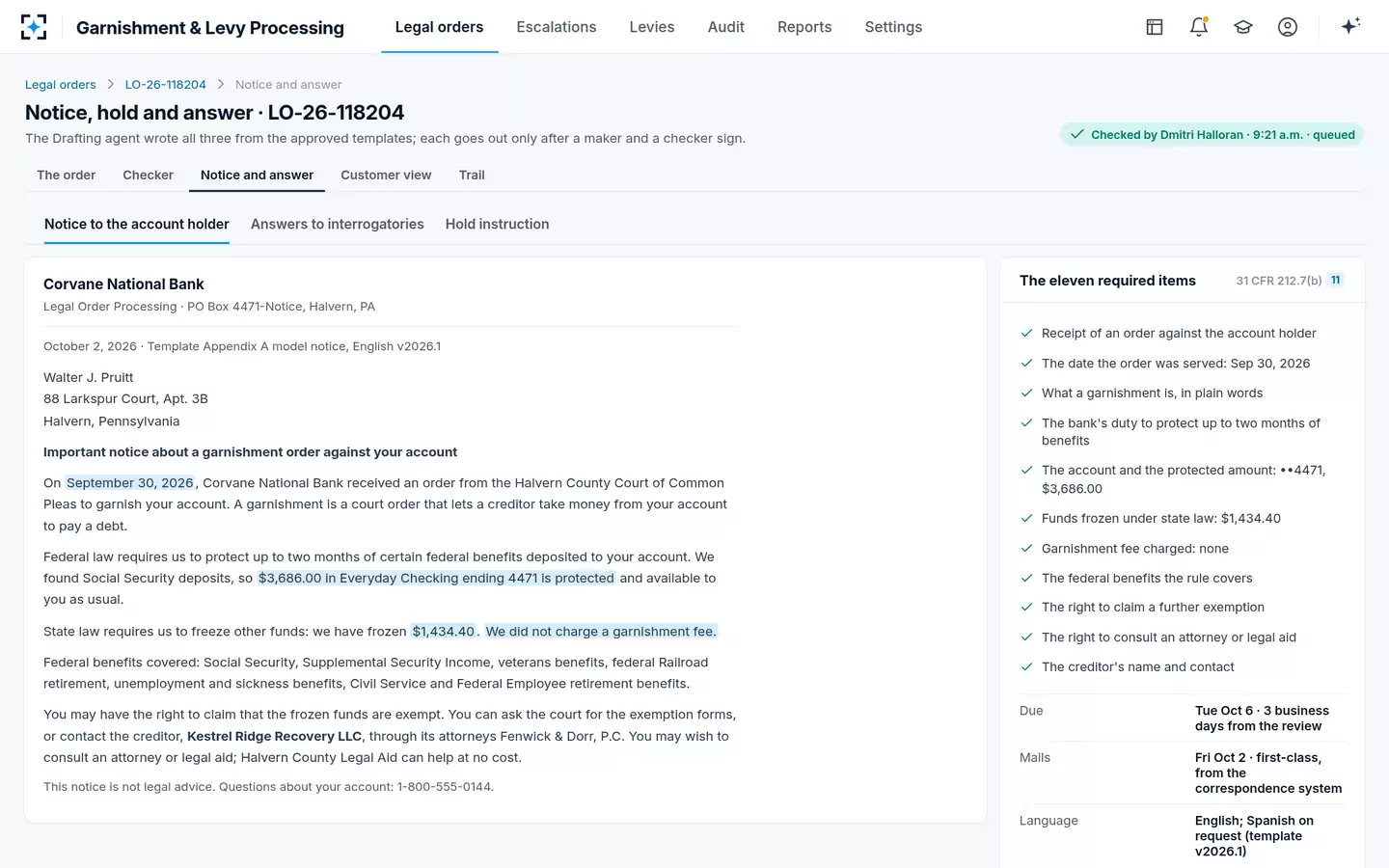
That is why the fictional sample bank in the solution waives its $125.00 fee on any order with a protected amount, under its policy LP-4, and locks the setting so no specialist can charge it by hand. The economics are easy to state. The fee recovers part of the desk's cost on orders where it is allowed; the downside of one wrong fee is a refund, an examination finding and, in the worst public case, a share of a $10 million penalty.
Where Garnishment & Levy Processing puts the fee decision
In the solution the fee is a computed line in the plan, not a step a specialist remembers. The plan for each order states the fee and why: on the sample writ, "Charge no fee", because a protected amount was set. The maker approves it, the checker sees it beside the evidence, and the notice drafted from the rule's Appendix A model carries it as one of the eleven required items.
The fee is one of the eleven items on the notice, stated and checked
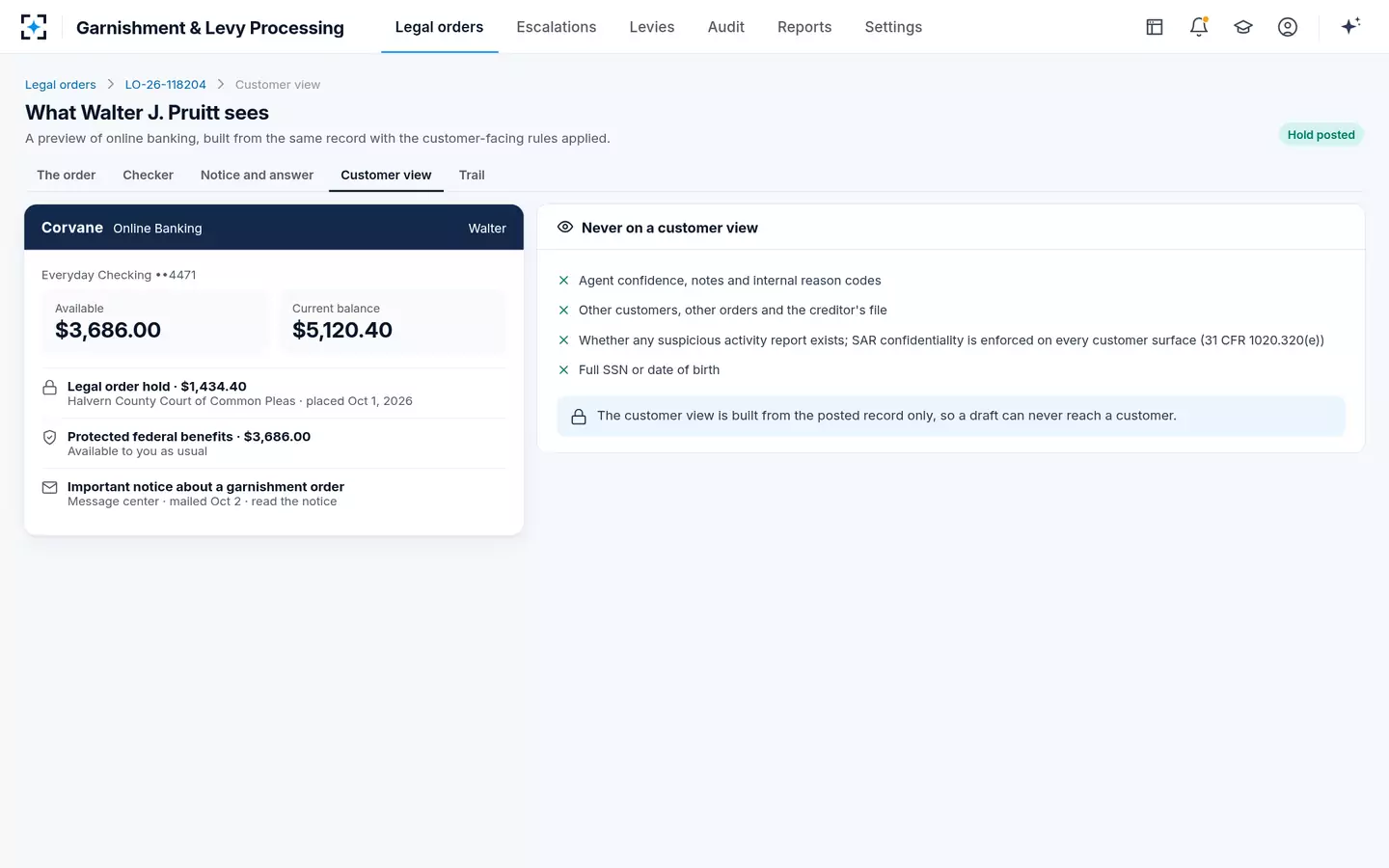
The customer sees the same outcome. The online banking view shows the protected amount as available, the hold as a separate line, and no fee, and it is built from the posted transaction only, so a draft plan never reaches the customer.
What the customer sees: protected funds available, the hold, and no fee
Fees are the cheapest error to make and the easiest to prevent, which is why they belong in the system's rules rather than in a specialist's memory. To see the rest of the order the fee depends on, start from Garnishment & Levy Processing, or read how the out-of-state cases arise in what states prohibit bank account garnishment.
Questions people ask
How much is a bank levy processing fee?
Each bank sets its own in its fee schedule and deposit agreement, and no federal agency publishes a survey of the amounts. What the rules control is where the fee may come from: never from protected federal benefits, never from IRS levy proceeds, and not at all in New York when the bank cannot lawfully restrain the account.
Can a bank charge a garnishment fee if the account only has Social Security in it?
Not against the protected amount, which on such an account is usually the whole balance. The bank may take a fee only from non-benefit money deposited within five business days after the review, up to the amount of that money, under 31 CFR 212.6(h).
Does the notice have to mention the fee?
Yes. One of the eleven required items in 31 CFR 212.7(b) is "The amount of any garnishment fee charged to the account". The rule's model notice includes a "Garnishment fee charged" column in its account summary.
Can a bank charge a fee for releasing a garnishment hold?
The federal rule's definition of a garnishment fee includes fees for "any associated withholding or release of funds", so a release fee is subject to the same limits: never against a protected amount. State law and the account agreement decide the rest.
Can the bank charge an overdraft fee caused by a garnishment hold?
Federal rules do not address it directly, but the CFPB's 2022 order counted overdraft and insufficient-funds fees among the "Garnishment-Related Fees" that had to be refunded where the underlying garnishment was unlawful. A bank should treat fees that follow from a hold as part of the same decision.