The lender is responsible for refunding GAP insurance to the borrower, even though it holds none of the money and did not sell the product. The dealer kept the markup, the administrator holds the cost, and the borrower paid both of them through a loan the lender financed — but the lender is the only one of the four parties that can see the loan end, and supervision has settled on that as the deciding fact. Botminds' GAP and Service Contract Refunds is built around the consequence: pay the borrower the whole refund first, then recover each administrator's share and the dealer's retained share afterwards, and never let a recovery dispute touch the borrower's money.
This page follows the money. Where it sits before a cancellation, who owes what after one, how large each share is on published figures, what it costs to get the answer wrong, and who answers for it at an examination.
What a cancelled add-on is worth, and to whom
60.1%
of a GAP price kept by the dealer as markup, in a large national dealer data set
$3,196
average spent on add-ons with a new vehicle, among borrowers who bought any
$29.0M
in redress ordered for unrefunded GAP premiums in a single consent order
93.5%
of that redress was owed in states with no statute requiring a refund
The last two numbers belong together and are the most useful pair on this page. Of nearly $29 million ordered as redress for unrefunded GAP premiums, $27.1 million was owed to borrowers in jurisdictions with no statute requiring the refund, against $1.9 million where a statute did. A refund programme organised around "which states make us" is, on that evidence, addressing about one-fifteenth of its exposure.
Who is responsible for refunding GAP insurance?
Start with what each party actually has, because the duty follows from it.
Three parties, and why only one of them can start a refund
The dealer
- Holds
- The markup — on the published data, the larger half of a GAP price and roughly 45% of a service contract price.
- Can see the loan end
- Nothing after the deal funds. It has no feed of payoffs, repossessions or total losses.
- Owes, after a cancellation
- Its retained share, recovered by chargeback against future funding.
- Carries which risk
- Commercial. The lender can net it from the next deal, or litigate the dealer agreement.
The administrator
- Holds
- The product cost, and the obligation to perform the contract.
- Can see the loan end
- Only what it is told. It learns of a cancellation when a request arrives.
- Owes, after a cancellation
- The unearned part of its own share, quoted on request, often from a national form.
- Carries which risk
- Contractual, and in some states statutory: Florida makes the service agreement company "responsible for full refunds to the consumer".
The lender or servicer
- Holds
- No part of the price. It financed it and collected the payments on it.
- Can see the loan end
- Everything. The payoff, the repossession sale and the total-loss settlement all post on its own system.
- Owes, after a cancellation
- On the supervisory record: the refund itself, in every state, whether or not it can recover.
- Carries which risk
- Supervisory. Unfair practice findings, remediation across the back book, and a consent order.
The contract usually says something different. Refund obligations "usually are governed by the terms of the GAP contract executed between the borrower and the originating dealer, with GAP contracts sometimes requiring that the borrower make a written request to the originating dealer for a GAP refund" (Wells Fargo consent order, 2022). On paper, then, the duty sits with the dealer and the trigger sits with the borrower. In practice the dealer has no way of knowing the loan ended and the borrower has no way of knowing a refund exists, so the paper arrangement reliably produces no refund.
Supervision closed the circle from the information side. Toyota Motor Credit "required that consumers affirmatively request refunds from the Dealer or product administrator, even though Toyota Motor Credit already had (or could reasonably obtain) all the information it needed to provide consumers the refunds to which they were entitled" (consent order, 2023). Examiners then generalised it: servicers must ensure refunds "either by ensuring that dealers or administrators provided refunds or by providing the refunds themselves". Either route is allowed. Neither route is optional.
How much of the GAP price does the dealer keep?
More than half, on the only large published data set in this area. The National Consumer Law Center analysed dealer cost against consumer price across a national sample and reported that "the average markup for GAP was 151% (an average markup of $378 over the dealer's average cost of $251)", while "the average dealer markup for service contracts was 83% (an average markup of $859 over the dealer's average cost of $1,032)" (Auto Add-Ons Add Up, 2017, 2012 transactions).
Where the price of an add-on sits before anyone cancels anything
GAP, average price $629
- Dealer markup $378 · 60.1%
- Dealer cost $251 · 39.9%
Service contract, average price $1,891
- Dealer markup $859 · 45.4%
- Dealer cost $1,032 · 54.6%
One sample case: three products, $4,339
- Kept by the dealer $2,599 · 59.9%
- To the three administrators $1,740 · 40.1%
Two things follow for a refund programme. The first is that a refund request sent only to the administrator can, at best, recover the minority of what the borrower paid: on a GAP waiver the administrator never had three-fifths of the money. The second is that the dealer's share is also the share with no natural route home, because the dealer is not party to the cancellation and has no reason to volunteer.
NCLC also recorded the price spread that makes the markup visible: "consumers in our data set who bought GAP at the dealership paid on average $629", against one credit union's "flat fee of $275 on all new and used vehicles it finances up to $100,000 in value." The product is the same product. What differs is what sits on top of it, and what sits on top of it is what a refund has to claw back.
What is a dealer chargeback on a cancelled product?
A chargeback is the lender reclaiming the dealer's share of a product the borrower has cancelled, normally by netting it from the dealer's next funding rather than by invoicing. It is an ordinary mechanism in indirect lending — the same mechanism already exists for early payoffs generally. Dealer and lender contracts "include a 'clawback' period, typically the first three to six months of the loan, during which the dealer bears prepayment risk. If the consumer prepays during the clawback period, the dealer refunds the entire dealer reserve to the lender" (NBER working paper 28136, not peer reviewed).
That matters because it removes the usual objection. A lender that nets a dealer reserve back on an early payoff already has the plumbing, the contractual right and the operational habit to net an add-on share back as well. Add-on chargebacks are not a new relationship with the dealer; they are an existing one applied to a second kind of refund. With at least 80 percent of auto loans obtained through dealers on the same paper's estimate, the relationship is there to use.
What a chargeback is not is a precondition. It settles between two businesses with a contract, a funding relationship and lawyers. The borrower has none of those, and no stake in the argument.
Should the lender pay the borrower before it recovers?
Yes, and the consent orders said so in terms that left little room. Wells Fargo had to ensure unused GAP was "refunded to the borrower, regardless of state law", and then: "Nothing in this Consent Order prevents Respondent from seeking reimbursement for refunds from any other party." That order has since been terminated, but the logic it wrote down has not changed: the refund and the recovery are two separate transactions with two different counterparties, and only one of them has a deadline.
Pay first, recover after — and what each step may never do
Agent
Event watcherReads payoffs, repossession sales and total-loss settlements as they post, opens a case and starts the clock on the event date.
Never: Never closes a case.
Agent
Contract readerReads the itemization and every product form for price, term, administrator, method, fee and state addendum.
Never: Never adds a product that is not on the contract.
Agent
Refund calculatorApplies each contract’s method and the state rule, citing the source of every input.
Never: Never uses a method the contract or the rule table does not name.
A person decides
The refund specialist approvesOne refund, for all products, with the meaning of the approval recorded.
A person decides
The borrower is paid in fullBy the lender, to the account the payments came from, inside the deadline.
Agent
Administrator cancellerSends the cancellation requests, compares each quote with the calculation and drafts a dispute for any difference outside tolerance.
Never: Never delays the borrower’s refund for a quote.
Agent
Dealer chargeback trackerWorks out the dealer’s retained share and nets it from the next funding.
Never: Never holds the borrower’s refund waiting on a dealer.
In the sample case the arithmetic of that order is visible. The borrower receives $1,259.60. The lender then recovers $443.00 from three administrators — $122.90, $294.24 and $25.86 — and $816.60 from the dealer, which had kept $2,599 of the $4,339 it charged for the three products. Two-thirds of the recovery is the dealer's share, and all of it happens after the borrower has the money.
Who owes what, product by product, after the borrower has been paid
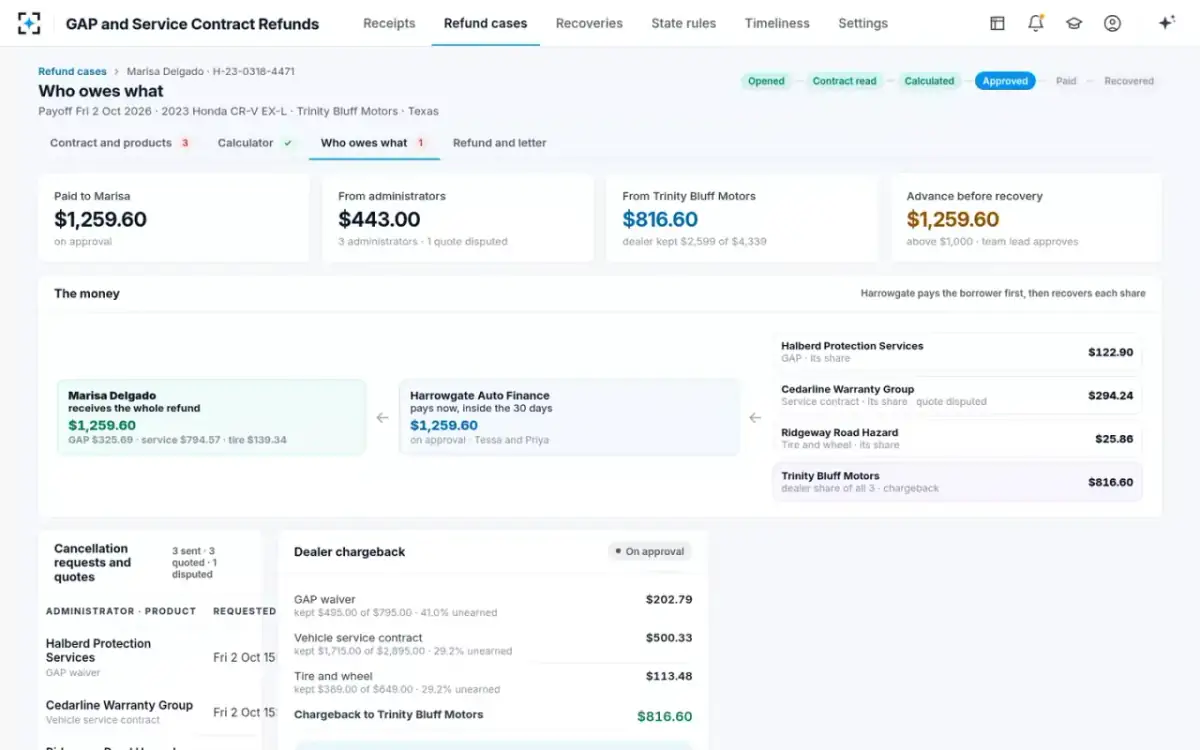
The three ways a refund gets settled, and what each costs
Three settlement models, judged by what they cost the borrower
| Model | How it works | What the borrower experiences | What the lender carries |
|---|---|---|---|
| The borrower chases | The contract requires a written request to the dealer or administrator. Nothing happens otherwise. | Usually nothing at all: most borrowers never learn a refund exists. | Supervisory risk across the whole back book, and a lookback when it is found. |
| The lender waits, then pays | A case opens, cancellation requests go out, the lender pays once the quotes return. | Weeks to months of delay, and a refund sized by whatever the administrator sent. | Deadline risk, plus the quote error it has adopted as its own figure. |
| The lender pays, then recovers | The lender calculates from the contract, pays in full inside the deadline, then recovers each share. | One payment, on time, with the calculation shown. | Funding for a few weeks, and two business-to-business recoveries it can pursue at its own pace. |
Model two is where most careful lenders sit, and it is the one worth arguing against hardest, because it looks responsible. Waiting for the administrator's quote feels like verification. It is not: the quote is what one party is willing to send, and what the borrower is owed is what the contract and the state require. Adopting the quote as the figure is how a national cancellation form, with the wrong fee on it, becomes the lender's own calculation error. How to calculate a GAP refund shows the check that replaces it.
What getting it wrong costs
Price the exposure from the published record rather than from a model. Wells Fargo's "failure to follow Texas regulations between 2017 and 2020 resulted in Respondent failing to make timely GAP fee refunds due to nearly 90,000 borrower accounts, resulting in remediation of more than $25 million" — about $278 an account, for lateness alone, in one state over three years. Toyota Motor Credit's order required $27,085,792 and $1,876,723 of GAP redress in two classes of jurisdiction, $3,011,749 for unearned credit life, accident and health premiums, an $8,000,000 fund plus $1,964,864 for consumers whose cancellations were obstructed, and "not less than $52,022" for at least 116 service agreement refunds a system fault had mis-calculated.
Read the last of those beside the first. The $52,022 figure is the small one, and it is the instructive one: a flaw found in an internal audit in June 2019, half-fixed, with the identified consumers not remediated and no check for others. The gap between a $52,000 problem and a $60 million order is mostly the decision not to look.
There is a second, quieter cost on the repossession side. A refund that has not been credited inflates the deficiency balance, so the lender is collecting on, reporting and sometimes selling a figure it knows to be wrong. Examiners put it exactly that way: the practice "results in inflated payoff and deficiency balances". Where the days go traces how long that usually lasts.
Who answers for it at an examination
The lender, including for the parts it delegated. The published examination module makes delegation an explicit question: "Determine whether the servicer uses a service provider in connection with optional products and, if so, how the servicer ensures that these providers effectively manage compliance with Federal consumer financial laws applicable to the product or service being provided" (Automobile Finance Examination Procedures). "The administrator handles refunds" is not an answer to that question; it is the premise of it.
Florida makes the same point from the other end, for service agreements: the company "remains responsible for full refunds to the consumer on canceled service agreements", even where it pays them through the selling agent. Responsibility in this chain is cumulative rather than transferable — which is why the only durable design is one where the party that can see the event is the party that pays.
One refund, three products, one approval — and the recovery kept separate
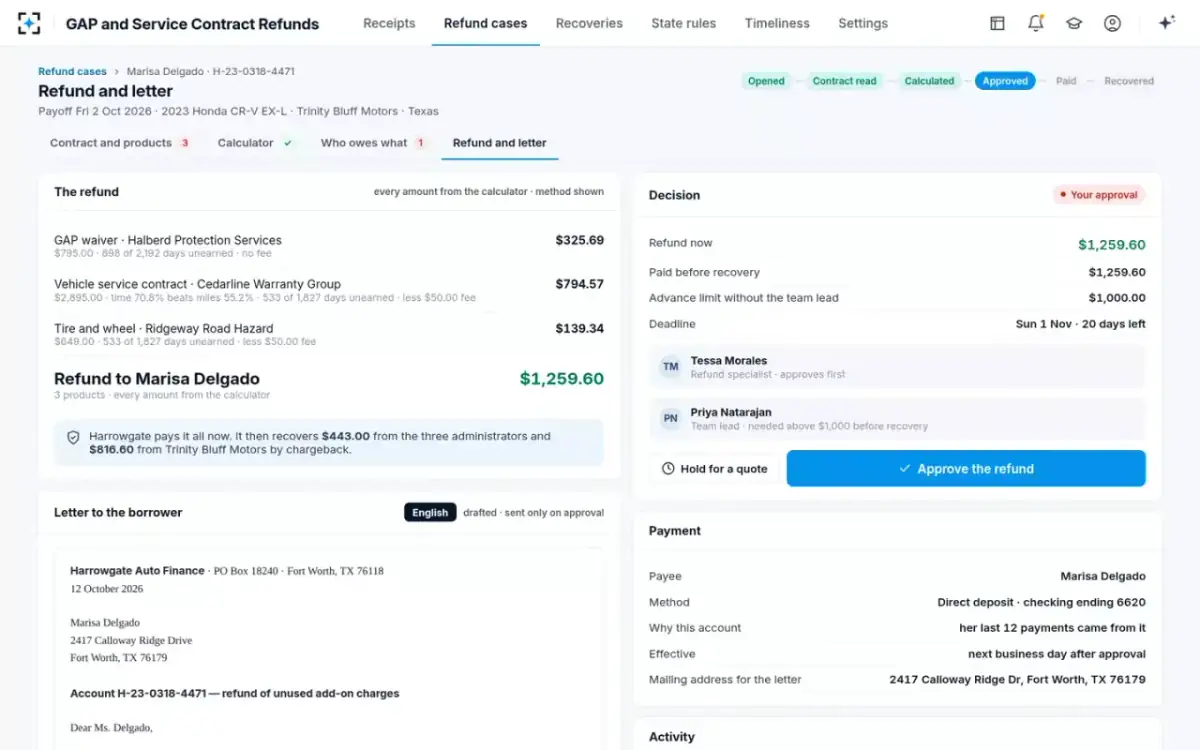
The organising principle is worth stating plainly, because it is the whole argument of this page in one line: the borrower is owed one number by one party, and everything else is bookkeeping between businesses. Ancillary product refunds sets out which products reach that number, and the state statutes set out what each one caps.
Questions people ask
Who pays a GAP insurance refund?
The lender or servicer pays the borrower, on the supervisory record, in every state. It then recovers the administrator's share and the dealer's retained share separately. The contract may name the dealer or administrator as the refunding party, but examiners have found that a lender holding the payoff date and the contract must ensure the refund happens — by making others pay it, or by paying it itself.
Does the dealer or the administrator refund GAP?
Both hold part of the money, so both owe part of it back. The administrator holds the product's cost and quotes the unearned portion of its own share. The dealer holds the markup, which on published data is the larger part of a GAP price, and returns it by chargeback against future funding. Neither is in a position to notice that the loan has ended.
How much of the GAP price does the dealer keep?
On the largest published data set, about 60 percent: an average markup of $378 over an average dealer cost of $251. Service contracts run lower, around 45 percent of the price. Those are 2012 transactions from a national sample and will not match any particular deal, but they explain why a refund sought only from the administrator comes back short.
What is a dealer chargeback on a cancelled product?
The lender reclaiming the dealer's share of a cancelled add-on, usually netted from the dealer's next funding rather than invoiced. The same mechanism already exists for early payoffs, where a dealer typically returns the whole reserve if the loan prepays inside a clawback period of three to six months.
Should the lender pay the borrower before it recovers?
Yes. The two consent orders on the point, both since terminated, required the refund regardless of state law while expressly preserving the lender's right to seek reimbursement from any other party. Holding a borrower's money pending a commercial recovery turns the borrower into the financier of a dispute they are not part of, and it is an avoidable cause of a missed deadline.
Who answers for a missed refund at an examination?
The lender, including for work it delegated. The published examination module asks specifically how a servicer ensures that its service providers manage compliance, so pointing at an administrator describes the question rather than answering it. Florida's statute takes the same line for service agreements, leaving the company responsible for full refunds even when it pays them through an agent.