There is no one GAP refund law to look up. A GAP waiver and a vehicle service contract sold on the same afternoon, in the same dealership, on the same car, are regulated by two different statutes with different refund methods, different caps on what may be deducted and different deadlines — and the statute that covers one of them in Washington covers neither of them the same way in Florida. Above all of that sits a federal standard that does not come from a statute at all. Botminds' GAP and Service Contract Refunds calculates every refund against a versioned state rule table owned by compliance, and cites the row it used on the case, because the alternative is a national form applied to fifty jurisdictions.
This guide reads the operative text of three statutes — Washington, Florida and Texas — and sets out what differs, what never differs, and what a lender has to hold to answer an examiner. It does not publish a fifty-state count, for a reason given plainly below.
Three states, three different answers to the same cancellation
Washington
RCW 48.110.075(4) · Motor vehicle service contracts
- Method
- Pro rata "based upon either elapsed time or mileage"
- What may be kept
- Cancellation fee not exceeding $25
- Free look
- Full purchase price inside 30 days if no claim; $25 may be charged from day 10
- The clock
- 10% penalty added to any refund not paid within 30 days of return of the contract
Florida
Fla. Stat. § 634.121(3) · Motor vehicle service agreements
- Method
- Not less than 90% of the unearned pro rata premium, less claims paid
- What may be kept
- Free look: administrative fee up to 5% of the gross premium
- Free look
- 100% of gross premium less claims paid, inside 60 days
- The clock
- Lender-initiated cancellations valid only if the agreement authorises them
Texas
Tex. Fin. Code ch. 354 · Debt cancellation agreements (GAP waivers)
- Method
- The method the agreement names — commonly pro rata, or pro rata less a fixed fee
- What may be kept
- Whatever the approved agreement states; never "fully earned" at inception
- Free look
- Full refund inside the first 30 days if no total loss has occurred
- The clock
- Measured from the earliest of four named dates, including prepayment in full
Is there a federal GAP refund law?
Not in the form most people expect. No federal statute says "a lender must refund an unearned GAP fee within N days". What exists is narrower and broader at once.
Narrower: the Truth in Lending Act does require that "if a consumer prepays in full the financed amount under any consumer credit transaction, the creditor shall promptly refund any unearned portion of the interest charge to the consumer", and bars the Rule of 78 on precomputed credit with a term "exceeding 61 months" (15 U.S.C. § 1615). That is about interest, not about the price of an add-on, and quoting it for the latter is a common and expensive mistake.
Broader: the prohibition on unfair, deceptive and abusive acts or practices. Examiners used it to find that servicers acted unfairly "by failing to ensure consumers received refunds of unearned premiums for add-on products upon early termination of their auto loans in all states, either by ensuring that dealers or administrators provided refunds or by providing the refunds themselves" (Supervisory Highlights, Issue 35). The corrective action went further still: servicers put in processes to refund "in all states, including those that do not mandate such refunds."
So the honest summary is that state law tells you the method, the cap and the paperwork, and federal supervision tells you that the duty exists anyway. A rule table that only lists states with a mandate is answering the smaller question.
Why a GAP waiver and a service contract are regulated separately
The two products look alike on an invoice and are nothing alike in law. A vehicle service contract is a promise to repair a car, so states regulate it as a service contract — usually through the insurance department, with registration, reserve or reimbursement-insurance requirements, mandated contract terms and a statutory free look. A GAP waiver is not a promise about the car at all; it is a term of the credit agreement under which the holder agrees to waive part of the balance. Several states therefore regulate it through the finance or credit code instead, as a debt cancellation agreement.
Texas is the clearest example. Its chapter 354 governs "debt cancellation agreements", the forms are reviewed by the Office of Consumer Credit Commissioner rather than the insurance regulator, and the refund terms are written as required contents of the agreement. A compliance team that files GAP under "insurance" in its own policy will look in the wrong statute and find nothing.
Two consequences follow for a refund programme. The first is that one product can be refundable on terms the other is not, on the same cancellation. The second is that a rule table needs two rows per state, not one — and the solution's table is built that way, GAP and service contract separately, with the rule note and the source for each.
Washington: pro rata, a $25 cap and a penalty for a late service contract refund
Washington writes the whole arithmetic into the statute, which makes it the clearest text to learn the shape from. On a motor vehicle service contract, "every provider shall permit the service contract holder to return the contract within 30 days of its purchase if no claim has been made under the contract, and shall refund to the holder the full purchase price of the contract unless the service contract holder returns the contract 10 or more days after its purchase, in which case the provider may charge a cancellation fee not exceeding $25."
After the free look, the method is named: the provider "shall refund the purchase price pro rata based upon either elapsed time or mileage computed from the date the contract was purchased and the mileage on that date, less a cancellation fee not exceeding $25" (RCW 48.110.075(4), as amended in 2025). Then comes the sentence that changes behaviour.
A 10 percent penalty shall be added to any refund that is not paid within 30 days of return of the contract to the provider.
RCW 48.110.075(4)(c)
A priced deadline is worth more than an unpriced one. It converts "we are a bit behind on cancellations" into a number that appears in a reconciliation, and it gives a servicing team the argument it needs internally for a thirty-day service level. That is why the solution's default refund deadline is thirty days from the event rather than from a request: it is the strictest common standard, and meeting it everywhere is simpler than tracking where it bites.
Florida: 60 days at full price, then 90% of the unearned premium
Florida's motor vehicle service agreement statute takes a different shape. The free look is longer and more generous: "Any service agreement is cancelable by the purchaser within 60 days after purchase. The refund must be 100 percent of the gross premium paid, less any claims paid on the agreement. A reasonable administrative fee may be charged not to exceed 5 percent of the gross premium paid by the agreement holder."
After those sixty days the arithmetic changes in a way that matters to lenders specifically: "If, after 60 days, the service agreement is canceled by the service agreement holder, lender, finance company, or creditor, the insurer or service agreement company shall return directly to the agreement holder not less than 90 percent of the unearned pro rata premium, less any claims paid on the agreement" (Fla. Stat. § 634.121(3)).
Two details are easy to miss. First, the statute names the lender as a party who may cancel — but adds that "cancellations initiated by lenders, creditors, or finance companies are only valid if authorized by the terms of the service agreement", so a servicer's standing cancellation process depends on a clause in a document it did not write. Second, the refund goes "directly to the agreement holder", and "the service agreement company remains responsible for full refunds to the consumer on canceled service agreements" — the obligation does not transfer by being delegated to a selling agent.
Texas: what the GAP refund law requires an agreement to say
Texas regulates the timing rather than the arithmetic, and it does it by fixing the date the refund is measured from. Its regulator quotes the statute directly: under § 354.007(a), a "refund or credit of the debt cancellation agreement fee must be based on the earliest date of: (1) the prepayment of the contract in full before the original maturity date; (2) a demand by the holder for payment in full of the unpaid balance or acceleration; (3) a request by the retail buyer for cancellation of the debt cancellation agreement; or (4) the total denial of a debt cancellation request based on one of the exclusions listed in Section 354.003, except in the case of a partial loss of the covered vehicle."
Read that list against how refund programmes usually behave. Three of the four dates are events the lender sees and the borrower may not: a payoff, an acceleration, a denied claim. Only the third is a request. A programme whose clock starts at a customer contact is, in Texas, measuring from the wrong date on most of its files — and that is not a theoretical risk. Wells Fargo's consent order records that its "failure to follow Texas regulations between 2017 and 2020 resulted in Respondent failing to make timely GAP fee refunds due to nearly 90,000 borrower accounts, resulting in remediation of more than $25 million" (consent order, 2022). One state, one date, 90,000 accounts.
The rest of chapter 354 fills in the contract terms: the agreement must state its refund method, and the two common ones are pro rata and pro rata less a fixed cancellation fee; it may not say the fee is fully earned at inception; it must give a full refund inside the first 30 days where no total loss has occurred; and it must say that cancelling requires a written request "to the seller, the holder, or the administrator" (OCCC Advisory Bulletin B16-2).
What changes state to state, and what never does
Reading the three statutes as a rule table would hold them
| The question | Washington | Florida | Texas |
|---|---|---|---|
| Which product is covered by this text | Motor vehicle service contracts | Motor vehicle service agreements | Debt cancellation agreements, i.e. GAP waivers |
| Free-look length | 30 days, no claim made | 60 days | 30 days, no total loss |
| What may be kept in the free look | Up to $25 from day 10 | Up to 5% of the gross premium | Nothing; the refund is full |
| Method after the free look | Pro rata by elapsed time or mileage | At least 90% of the unearned pro rata premium | The method the agreement names |
| Cancellation fee | Capped at $25 | None named after the free look; at least 90% of the unearned premium goes back | As stated in the approved agreement |
| What the clock runs from | Return of the contract to the provider | Cancellation | The earliest of four named dates |
| Penalty for being late | 10% added to the refund | Not specified in this section | Not specified in this section |
What never changes is more useful than the differences. In all three states the refund is measured from a date, not from a conversation. In all three the method is fixed by a document rather than chosen by whoever is working the file. In all three something is capped — the fee, the retention, or the ability to call a fee fully earned at inception. And in none of them does the obligation evaporate because the borrower did not ask.
What may be deducted from one $2,895 service contract, by regime
That third bar is the everyday failure. Nobody set out to over-deduct; an administrator computed from the page it always computes from. How to calculate a GAP refund works the whole arithmetic through, fee included.
Why this page does not publish a fifty-state count
The figure most often repeated — that some specific number of states require a refund when a service contract or GAP waiver is cancelled — traces back to industry surveys rather than to government or academic research. Counts of that kind also go stale quickly: Washington's service contract section was last amended in 2025. So this page quotes the statutes it has read and says nothing about the forty-seven it has not.
The practical answer does not need the count anyway. The two consent orders written on this point required refunds "regardless of state law": Toyota Motor Credit had to deliver accurately calculated GAP refunds "within 45 days of notice of cancellation" for products its affiliate administered and within 60 days for third-party administered ones, and Wells Fargo had to ensure unused GAP was "refunded to the borrower, regardless of state law" (2023, 2022). Both orders have since ended — the Bureau lists each as terminated, Toyota's on 12 May 2025 (CFPB, CFPB) — but the supervisory finding beneath them, that failing to ensure refunds "in all states" was unfair, is still the published record. Whether a state mandates a refund changes the method and the cap. It is a weak reason to decide whether you pay one.
Keeping a state rule table that survives an exam
The examiner's own question list is published, and it reaches the rule table directly: "Determine how refunds of unused optional products or services are processed after the loan is prepaid or the loan is terminated (e.g., after repossession or total loss). Does the servicer's process consider state law requirements for refunds?" (CFPB Automobile Finance Examination Procedures). The question is not whether a table exists. It is whether the process consulted it.
The table every refund is calculated against, with the rule note on each row
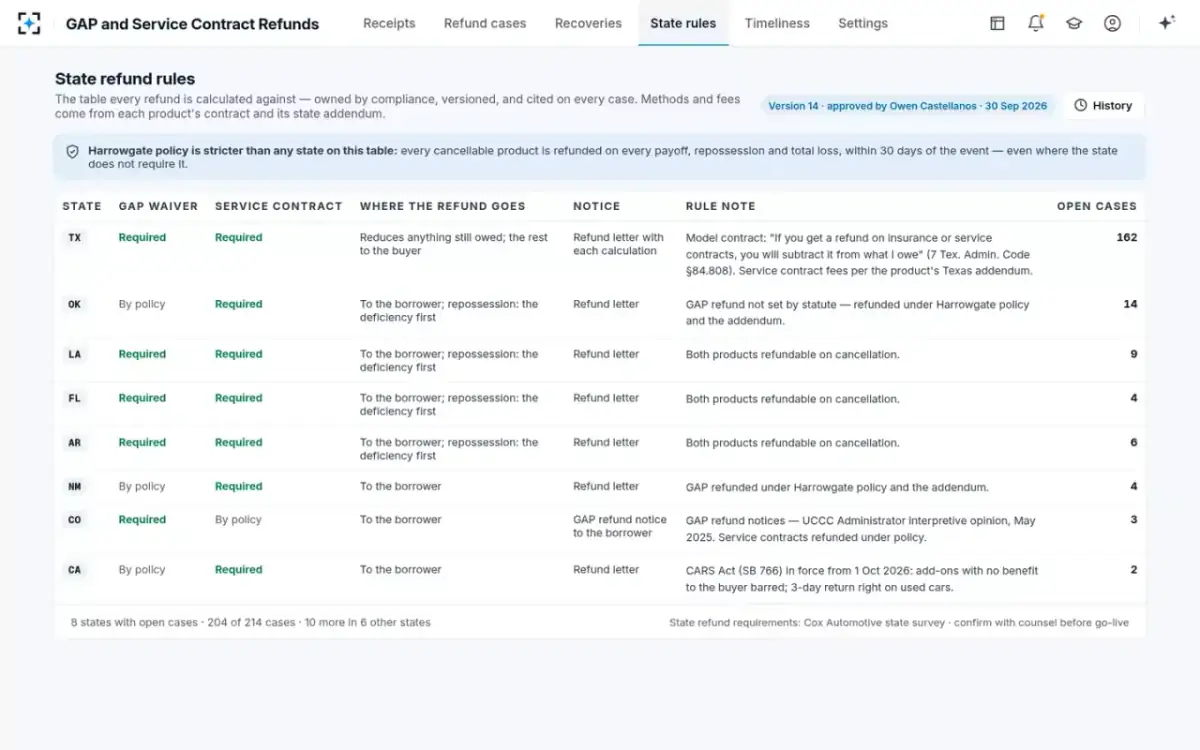
Six things a defensible state rule table holds
- Two rows per state, not one
A GAP waiver and a service contract are different products under different statutes. One row forces a wrong answer on one of them.
- The method, the cap and the clock, separately
These three move independently. Washington caps the fee and prices the delay; Texas fixes the date and leaves the fee to the agreement.
- A citation on every row
The statute or rule, by section. A row whose source is "as advised" cannot be checked, and a reviewer will ask.
- A version, an owner and a date
Rules change — Washington amended its service contract section in 2025. A case has to say which version produced its figure.
- A rule for states with no mandate
Examiners found it unfair to leave refunds to the states that mandate them, so the table needs a default, not a blank.
- The contract beats the table where the contract is more generous
The statute sets a floor. A contract promising a fuller refund is the term the borrower bought.
One last point of discipline. A rule table is only as good as the moment it is consulted, and the moment that matters is the calculation, not the policy review. A refund computed from a national form and then checked against the table afterwards will pass the check about as often as the form happens to be right. Ancillary product refunds sets out the obligation the table is serving, and who owes the money explains why a correct table still leaves three parties to settle with.
Questions people ask
Which states require a GAP refund?
Enough of them that the question is the wrong one. States regulate GAP waivers and service contracts through different statutes, and the requirements differ in method, fee cap and timing rather than in whether a refund is owed at all. More to the point, federal examiners have treated a failure to ensure refunds in all states, including those with no mandate, as unfair, so a state-by-state switch invites an examination finding.
What is the Texas GAP refund law?
Texas treats a GAP waiver as a debt cancellation agreement under chapter 354 of the Finance Code. The agreement must state its refund method, may not call the fee fully earned at inception, must give a full refund inside the first 30 days where no total loss has occurred, and must measure the refund from the earliest of four dates — prepayment in full, a demand or acceleration, the buyer's cancellation request, or a total denial under an exclusion.
Is there a penalty for a late service contract refund?
In Washington, yes: a 10 percent penalty is added to any refund not paid within 30 days of the contract's return to the provider. Most states do not price the delay in the statute. Federal supervision prices it a different way, through remediation and consent orders — one lender repaid more than $25 million over late GAP refunds in a single state.
Do GAP waivers and service contracts follow the same law?
No, and assuming they do is a reliable source of wrong refunds. A service contract is regulated as a promise to repair the car, usually by the insurance regulator. A GAP waiver is a term of the credit agreement and is often regulated by the finance or credit regulator instead, as a debt cancellation agreement. Different statutes, different methods, different free-look periods.
What is a free look period on a service contract?
A window just after purchase in which the buyer may cancel and get the whole price back, provided no claim has been made. Washington sets 30 days and lets a provider keep up to $25 if the contract comes back on day 10 or later. Florida sets 60 days and allows an administrative fee of up to 5 percent of the gross premium.
Does a lender have to refund in a state that does not require it?
On the published supervisory record, yes. Examiners treated the failure to ensure refunds "in all states" as an unfair practice, and the corrective action extended refunds to states with no mandate. The two consent orders in this area, both since terminated, required refunds regardless of state law, while leaving the lender free to seek reimbursement from the dealer or administrator afterwards.