The TILA itemization of amount financed is the written breakdown Regulation Z requires of what makes up the amount financed on a closed-end credit contract: proceeds paid to the consumer, amounts credited to the consumer's account, and "any amounts paid to other persons by the creditor on the consumer's behalf", where "the creditor shall identify those persons" (12 CFR § 1026.18(c)). On a retail installment contract for a car, the amounts paid to others include every optional product the dealer sold: GAP, service contracts, tire and wheel, key and appearance protection. That makes the itemization more than a disclosure. It is the only complete, signed list of the add-ons on a loan, and when the loan ends early it is the list every refund has to be reconciled against, because the servicing system's list is derived from it and can be shorter. Botminds' GAP and Service Contract Refunds reads the itemization and each product form on every payoff, repossession and total loss, and refunds what the contract shows, not only what servicing holds.
The contract lines, prices and companies in the examples are fictional sample data from the solution; the rule text and supervisory findings are real and linked where they appear.
Why the itemization carries so much of an auto lender's refund risk
71.8%
of non-servicemember auto loans, 2018–2022, financed at least one add-on product
75.4%
on used-vehicle loans, where add-on purchases were most common
2years
Regulation Z's minimum for keeping evidence of compliance with its disclosure rules
What does TILA require in the itemization of amount financed?
A separate written breakdown of the amount financed in at least four categories, given with the other disclosures or offered on request. Section 1026.18(c)(1) requires "a separate written itemization of the amount financed, including" the proceeds distributed directly to the consumer, amounts credited to the consumer's account with the creditor, "any amounts paid to other persons by the creditor on the consumer's behalf", and the prepaid finance charge. Some payees may be described generically, "public officials or government agencies, credit reporting agencies, appraisers, and insurance companies"; every other third party "must be identified by name", in the words of the official interpretation.
The commentary gives a creditor two ways to comply. It may tell the consumer that a written itemization "will be provided on request", or it may "provide an itemization as a matter of course"; either way it must be provided "at the same time as the other disclosures required by § 1026.18, although separate from those disclosures". Section 1026.18(c) "establishes only a minimum standard", and creditors may add categories, reorder them or include amounts that are not part of the amount financed. On auto retail installment contracts the itemization is usually printed under the federal disclosure box or on an attached schedule, and its total equals the amount financed in that box.
The itemization categories, and what each one means for an add-on refund
| Regulation Z category | On an auto retail installment contract | What a refund needs from it |
|---|---|---|
| § 1026.18(c)(1)(i) Proceeds to the consumer | Rarely used on a vehicle sale | Nothing |
| § 1026.18(c)(1)(ii) Credited to the consumer's account | Cash price less down payment and trade-in, or negative equity paid off | The vehicle side of the deal, not the products |
| § 1026.18(c)(1)(iii) Paid to others, payee identified | Tag and title fees, insurance, and each optional product with its company | The product, its price and the company that holds the unearned money |
| § 1026.18(c)(1)(iv) Prepaid finance charge | Usually none on a retail installment contract | Nothing |
Why "the creditor shall identify those persons" matters for refunds
Because the payee is the company that holds the unearned money. A line that says a borrower paid $649 for a product, with no company named, records a price and gives nobody to cancel with, nobody to ask for a quote and nobody to recover from. A line that names the administrator starts the refund chain: from the itemization to the product form, from the form to the term, method and fee, and from those to the amount owed.
Examiners have found the payee missing. Supervisory Highlights Issue 35 reports that auto loan originators "violated Section 1026.18(c)(1)(iii) of Regulation Z because the itemization of the amount financed disclosures failed to identify the payee for optional products purchased by the consumer", and that the entities "did not identify (or bought retail installment sales contracts that did not identify) the payee" (CFPB Supervisory Highlights, Issue 35). The parenthesis is the part an indirect lender should read twice: buying the contract does not move the finding to the dealer.
The commentary also covers the share the seller keeps. Where a sum is added to a third party's fee, "such as for an extended warranty or a service contract", and retained, the creditor "may reflect that the creditor has retained a portion of the amount paid to others", for example with "(we may be retaining a portion of this amount)". That retained portion is the dealer's share a lender later recovers by chargeback when the product is cancelled, which is why it matters who keeps what, worked through in who is responsible for refunding GAP insurance.
Why the servicing file is not the same list
Because it is copied from the contract by people and systems at funding, and a copy can drop a line. The itemization is signed by the borrower; the list of products in the servicing system is whatever was boarded. The two match on most loans, and the loans where they do not are the ones whose refunds never start.
Two lists of the same borrower's add-ons
The servicing file: Boarding at funding, from the dealer's funding sheet or a data feed.
The contract's itemization: The dealer, at signing, as a Regulation Z disclosure the borrower signs.
The servicing file: The products the boarding process had a field for.
The contract's itemization: Every amount paid to others, each with its payee.
The servicing file: A product from an unfamiliar administrator, an addendum boarded separately, a restructured deal with two contracts.
The contract's itemization: Rarely incomplete; the risk is a missing payee, which is itself a finding.
The servicing file: Refunds the products it knows about.
The contract's itemization: Shows the products the borrower actually paid for.
The servicing file: A derived system list.
The contract's itemization: The signed contract.
The ways a line falls out are ordinary rather than sinister. A dealer sells four products and reports three on the funding sheet. A product comes from a company whose paper the lender rarely sees, so there is no field for it. A deal is restructured and the second contract is the one boarded while the first is the one scanned. None of these is visible at funding, when the money goes out correctly; each is visible only at the end of the loan, when the missing product's refund is not paid. No regulator or research body publishes how often it happens, because the only way to count it is to read every contract against every file.
How many products can one itemization carry?
Often several, from several companies. A national data set from one third-party add-on provider analysed by the National Consumer Law Center found that "33% of products sold were service contracts, 26% were GAP, 15% were various warranty-type products, and 9% were Etch" (NCLC, Auto Add-Ons Add Up, 2017). The long tail beyond GAP and service contracts is where a servicing system is most likely to lack a field.
The mix of add-on products in one national data set
Reading one itemization for a refund
A refund desk needs five facts for each product: the product, the price, the payee, the term and the form behind it. The first three are on the itemization; the term and the method come from the product form the itemization points to by naming its company. On the sample contract, line 4 of the itemization listed three optional products.
Line 4 of one sample itemization, read for a refund
| Product | Price | Payee named | In servicing? | Refund on a trade-in payoff |
|---|---|---|---|---|
| GAP waiver | $795.00 | Yes | Yes | Pro rata, from the product form |
| Vehicle service contract | $2,895.00 | Yes | Yes | Greater of time or miles used, less a $50 Texas fee: $794.57 |
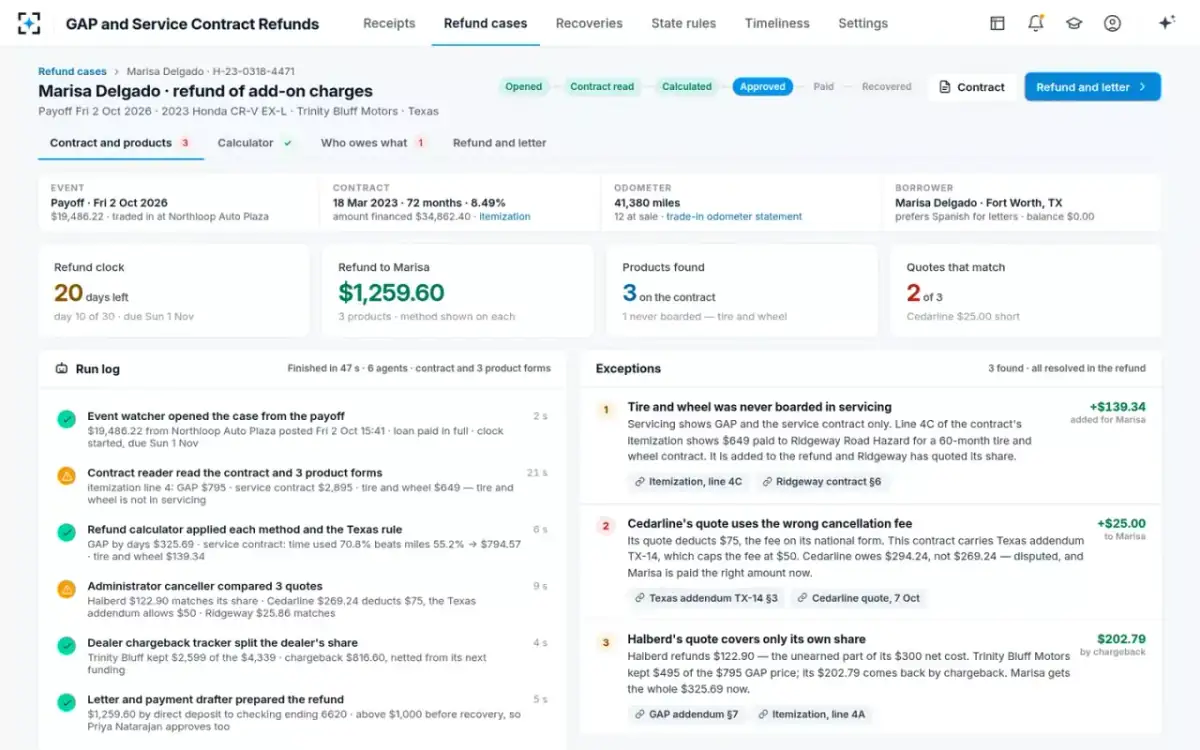
| Tire and wheel | $649.00 | Yes | No | $139.34, found only by reading the contract |
The table shows why the itemization is read first and the product forms second. The itemization says which products exist and who holds the money; the forms say how much of it comes back. The arithmetic for each method, pro rata by days, the greater of time or miles, and the cancellation fee, is in GAP refund calculation for lenders.
The contract read on the case in GAP and Service Contract Refunds: three products where servicing knew two
What should compliance test on the itemization?
Two directions, at two moments. At origination or purchase, that every optional product appears as its own line with its price and a named payee, so the disclosure meets § 1026.18(c)(1)(iii). At the end of every loan, that every product on the itemization is on the refund, and that every product in servicing has a signed line behind it.
Five itemization tests for an auto lender
- Every optional product has its own line and price
Two products bundled on one line cannot be cancelled, calculated or recovered separately, and each has its own term.
- Every non-generic payee is named
The finding examiners made; for an indirect lender it applies to contracts it buys as well as those it writes.
- Retained portions are disclosed as the commentary allows
So the dealer's share is known before a cancellation makes it a chargeback.
- Every product on the contract is in servicing, checked at the end of the loan
The reconciliation that finds the refunds no payoff process would have paid.
- Every product in servicing has a signed line
The reverse question: a charge with no line behind it is a different and worse problem.
Keeping the contract image matters as much as reading it. Regulation Z requires a creditor to retain evidence of compliance for two years after disclosures are required, and the agencies may require longer; a refund owed at the end of a 72-month loan depends on a document signed six years earlier. For portfolios a lender buys, the contract images are part of what it buys. The Wells Fargo order found that until July 2021 the bank did not ensure refunds for "the loans it did not originate but subsequently owned and serviced" (CFPB consent order, Wells Fargo, 2022), the loans where the itemization is least likely to have been read at boarding.
What should an indirect lender check at funding?
That the itemization it is buying will support a refund five years later. An indirect lender does not write the contract, but examiners named entities that "bought retail installment sales contracts that did not identify" the payee, so the funding review is where the lender either accepts the dealer's itemization or sends it back.
Four checks do most of the work. Each optional product appears on its own line with its own price, rather than bundled into a single "service contracts" figure. Each line names the company that issued the product, so the cancellation and the quote have an address. The product form for each line is in the funding package, because the form carries the term, the method and the fee the itemization does not. And every product on the itemization is boarded into servicing with the same price and company, so the servicing list starts complete rather than being repaired at payoff.
None of these checks is new to a funding desk; most already confirm the amount financed against the disclosure box. The difference is reading the paid-to-others lines as future refund obligations rather than as amounts that only need to add up. A lender that boards every product at funding still reads the contract at payoff, because restructures and addenda change the list after funding, but it finds far fewer gaps when it does.
Where GAP and Service Contract Refunds reads the itemization
When a payoff, repossession sale or total-loss settlement posts, the solution's contract reader opens the retail installment contract, reads the itemization and each product form, and reports every product on the contract that servicing does not hold, with the line it came from. The refund calculator then works each product from its own terms under the lender's versioned state rule table, and a refund specialist approves the refund for every product the borrower paid for. Reading the itemization on every case is a setting, on by default, that the lender's servicing leaders control.
It does not fix the origination disclosure; a missing payee is a finding for the team that buys or writes the contract. What it changes is the end of the loan, the moment the itemization's list becomes money owed. The broader obligation across products and events is in ancillary product refunds; to see the contract read on your own payoffs, start from GAP and Service Contract Refunds.
Questions people ask
Is the itemization of amount financed required on every loan?
Regulation Z lets the creditor either provide it as a matter of course or tell the consumer it is available on request, with a space to request it. Auto retail installment contracts commonly print it as a matter of course with the other disclosures.
Must the itemization name the company behind each add-on?
Yes, for third parties other than the generic categories the rule lists, such as public officials and insurance companies. Examiners found originators violating § 1026.18(c)(1)(iii) when optional products appeared without their payee.
Can a dealer's retained share be shown on the itemization?
The official interpretation allows the creditor to indicate that it has retained a portion of an amount paid to others, for example on a service contract, with wording such as "we may be retaining a portion of this amount".
Why read the contract if servicing already lists the products?
Because the servicing list is copied from the contract and can be incomplete. On the sample payoff a tire and wheel product on the itemization had never been boarded; reading the contract added $139.34 to the borrower's refund.
How long must the itemization be kept?
Regulation Z sets two years for evidence of disclosure compliance, but a lender that refunds add-ons at the end of a 60- or 72-month loan needs the contract for the life of the loan and its refund.
Does an indirect lender answer for a dealer's itemization?
For the supervisory finding, yes: examiners named entities that "bought retail installment sales contracts that did not identify" the payee. Many indirect lenders check the itemization at funding for exactly that reason.