Ancillary product refunds are the unearned part of add-ons such as GAP waivers, vehicle service contracts, tire and wheel and key protection, owed back when the auto loan they were financed on ends early. The CFPB has said plainly who answers for them: examiners found servicers "engaged in unfair acts or practices by failing to ensure consumers received refunds of unearned premiums for add-on products upon early termination of their auto loans in all states, either by ensuring that dealers or administrators provided refunds or by providing the refunds themselves" (CFPB Supervisory Highlights, Issue 35). For a lender the work is hard because the obligation crosses three companies and three events, the products were sold by a dealer, priced by an administrator and often never fully loaded into servicing, and every refund has its own method, fee and state rule. Botminds' GAP and Service Contract Refunds opens a case when a payoff, repossession sale or total-loss settlement posts, reads every product from the contract, calculates each refund from its own terms, and pays the borrower before the lender recovers from the administrators and the dealer.
The people, vehicles, dealers and contracts in the examples are fictional sample data from the solution. The supervisory findings and orders are real and linked where they appear.
The size of the add-on book behind every early payoff
70%+
of auto buyers in the CFPB's servicemember study financed at least one add-on product
$3,000+
average spent on add-ons with a vehicle, new or used, by servicemembers in the same study
1.6M
repossessions estimated for 2024, each one an early termination that can owe refunds
What do lenders owe on ancillary products when an auto loan ends early?
The unused portion of what the borrower paid, applied the right way for the event. The CFPB describes the mechanics: "Upon early termination, the account generally is eligible for a pro rata refund of the prepaid premiums for the unused portion of the products – often called 'unearned' premiums. In the default scenario, the refund amount should be applied to any deficiency balance, and the borrower receives any remaining refund amount. For early payoffs, the full amount of the refund should go to the borrower."
Two features make it a lender's obligation rather than a dealer's or an administrator's courtesy. The servicer controls the event and the payoff figure, so a refund it does not start is a refund the borrower cannot reasonably obtain. And state law is a floor, not the limit: in response to the findings, "servicers implemented processes to ensure consumers receive refunds of unearned premiums for ancillary products in all states, including those that do not mandate such refunds", and "identified and remediated consumers from all states who did not receive such refunds". The CFPB's examination procedures ask the same question of every servicer: "Determine how refunds of unused optional products or services are processed after the loan is prepaid or the loan is terminated (e.g., after repossession or total loss). Does the servicer's process consider state law requirements for refunds?" (CFPB Auto Finance Examination Procedures).
Which ancillary products refund, and on which events?
It depends on what each product is attached to. The CFPB divides add-ons into credit products, which "cease to provide any benefits when the loan is terminated", and vehicle products, which "relate to the vehicle itself" and "may continue to provide benefits after the loan is terminated". A credit product owes a refund on any early termination; a vehicle product owes one when the vehicle is gone or the borrower cancels.
Ancillary products against the three early-termination events
| Product | Family | Early payoff | Repossession | Total loss |
|---|---|---|---|---|
| GAP waiver or GAP insurance | Credit | Unearned part refunds to the borrower | Refund applied to the deficiency, remainder to the borrower | Not refunded: the product performs and pays its claim |
| Credit life and disability | Credit | Unearned premium refunds | Unearned premium refunds | Unearned premium refunds |
| Vehicle service contract | Vehicle | Continues with the car unless cancelled | Refunds; the CFPB treats it as of no value once repossessed | Refunds from the date of loss |
| Tire and wheel, key, appearance, maintenance | Vehicle | Continues unless cancelled | Refunds per the product terms | Refunds per the product terms |
The total-loss column hides the most work, because two settlements run at once on the same balance: the GAP claim, and the refunds on vehicle products that reduce what the claim must cover. That sequence is worked through in vehicle service contract refunds after a total loss.
What supervisors and enforcement have found
Failures at every step a refund passes through, and remediation measured in tens of millions. Supervisory Highlights Issue 35 records servicers that did not ensure refunds in every state; that "miscalculated the refund amount due", for example by using "the date of a deficiency notice for making a pro rata calculation instead of the date of the repossession", or by relying "upon calculations performed by third parties that were not consistent with the terms of the add-on product contract"; and that applied refunds late, "an average of 84 days after the post-repossession sale of the vehicle sale, with at least one up to 423 days afterwards", with another matter's delays ranging "from 150 days to 664 days".
Days from repossession sale to refund in two supervisory matters
Consent orders put numbers on it. The Wells Fargo order of 2022 found that until July 2021 the bank did not ensure that borrowers on loans it bought and serviced received the GAP refunds they were eligible for after early payoff or repossession, and that its failure to follow Texas regulations between 2017 and 2020 meant "failing to make timely GAP fee refunds due to nearly 90,000 borrower accounts, resulting in remediation of more than $25 million" (CFPB consent order, Wells Fargo, 2022). The Toyota Motor Credit order of 2023 found unfair practices in "failing to ensure consumers received refunds of payments they had made for certain add-ons that had become void and worthless" and "failing to provide refunds owed to consumers who canceled their vehicle service agreements", with a $12,000,000 civil money penalty (CFPB consent order, Toyota Motor Credit, 2023). The full set of published findings, and the file that answers each, is in CFPB GAP refund findings.
Where do ancillary product refund programmes fail?
At the hand-offs. A refund passes through five steps, and each one is owned by a different desk or a different company. The failures examiners describe map onto them almost one for one.
Five steps from an early termination to a refunded borrower
Agent
Notice the eventA payoff, repossession sale or total-loss settlement posts, and a refund case opens with the clock running.
Never: Waits for the borrower to ask.
Agent
Find every productRead the retail installment contract's itemization and each product form, not only the servicing file.
Agent
Calculate each refundFrom the product's own method and fee, the state rule, and the event date and odometer.
Never: Takes an administrator's quote on trust.
A person decides
Approve and payA refund specialist approves; the payment goes to the borrower, or to the deficiency first after a repossession.
A person decides
RecoverThe team lead watches what comes back from each administrator and, by chargeback, from the dealer.
The second step is where money disappears without anyone deciding anything. On the sample trade-in payoff, the contract's itemization listed three products, GAP at $795, a service contract at $2,895 and tire and wheel at $649, but servicing knew of two. The tire and wheel product had never been boarded, so no payoff process would ever have refunded it; read from the contract it added $139.34 to the borrower's refund. Why the contract and the servicing file differ, and what Regulation Z requires the contract to show, is in TILA itemization of amount financed.
The fourth step carries a design choice with large consequences: whether the lender pays the borrower before it has recovered the dealer's and administrators' shares. A lender that waits for every party is running its refund clock on other companies' schedules. Who owes what, and how the lender recovers it, is in who is responsible for refunding GAP insurance.
One payoff, three products, paid on day ten of thirty
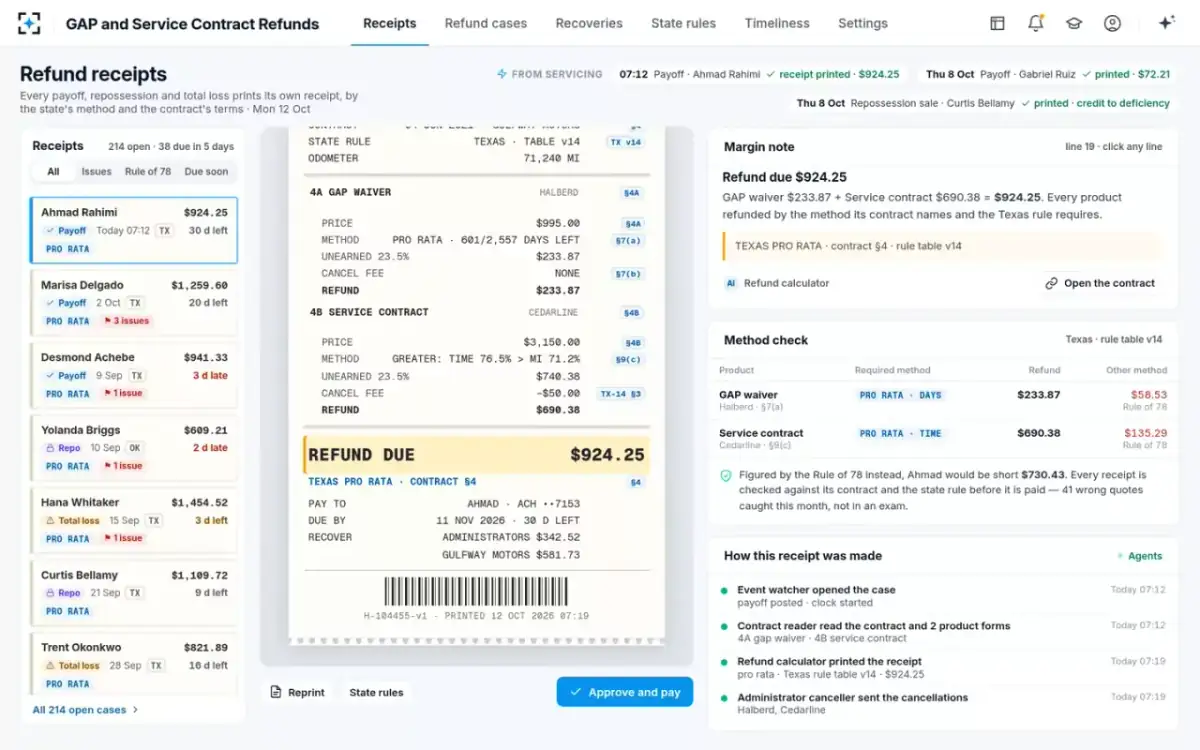
A borrower traded in a 2023 Honda CR-V and paid off the loan on a Friday afternoon: $19,486.22 from the trade-in dealer posted at 15:41. The case opened at that moment with a 30-day deadline under the lender's policy. The contract reader found three products where servicing had two; the service contract refunded pro rata by the greater of time used or miles used, and time won at 70.8% against 55.2%, so the refund was $2,895 × 533 ÷ 1,827 = $844.57, less a $50 fee.
That fee was the catch. The administrator's quote deducted $75 from its national form, but the contract's Texas addendum caps the fee at $50, so the administrator owed $294.24, not $269.24. The borrower received the whole $1,259.60 by direct deposit to the account the last twelve payments came from, ten days after payoff. The lender then recovered $443.00 from the three administrators and $816.60 from the selling dealer, which had kept $2,599 of the $4,339 it charged for the products, netted from the dealer's next funding.
A payoff posts and its refund receipt prints itself in GAP and Service Contract Refunds
How should a lender measure its refund programme?
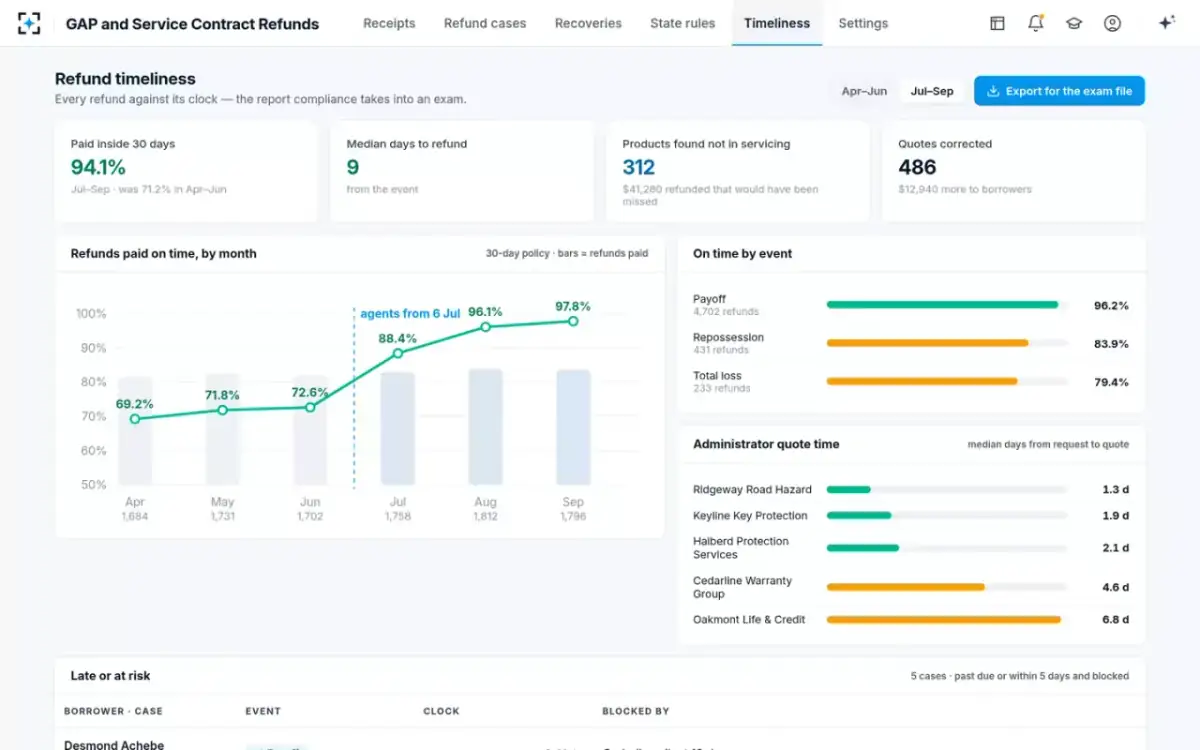
By time to the borrower, by accuracy against the contract, and by coverage of every product on every event. The sample lender paid 71.2% of refunds inside its 30-day policy in the quarter before the agents, with refund specialists working about 60 cases a day and three companies' arithmetic on each. Those figures are the baseline, not a target, and the measures below are the ones that show whether the programme would survive an examiner's lookback.
Six measures for an ancillary product refund programme
- Refunds paid inside the policy deadline, by event
Payoff, repossession and total loss separately: the repossession tail is where the published delays sit.
- Products found on the contract that servicing did not hold
Every one is a refund the old process would never have paid.
- Administrator quotes that differ from the lender's calculation
Above a tolerance the lender sets, with the reason: wrong fee, wrong date, wrong method.
- Refunds in states with no refund statute
Proof the programme follows the contract everywhere, not only where a law compels it.
- Recovery outstanding from administrators and dealers
Kept off the borrower's clock, but owned by someone and aged.
- A compliance sample of approved refunds
The sample lender's compliance reviewer re-checks 5% of approved refunds each week against the rule table.
Refunds paid inside 30 days by month and event, for the exam file
What a lookback costs if the programme was missing
Every early termination in the review period, in every state, recalculated from the contract. The supervisory response to the all-states finding was that servicers "identified and remediated consumers from all states who did not receive such refunds", which means reconstructing the product list, the event date, the odometer and the method for loans that may have been paid off years earlier. The Wells Fargo remediation for one state's rule over four years ran to more than $25 million across nearly 90,000 accounts.
The reconstruction is harder than the payment. Regulation Z requires a creditor to keep evidence of compliance with its disclosure rules for two years, and administrators' and dealers' records are outside the lender's control. A programme that keeps each refund's inputs, method, fee, rule and approval on the case from the day it opens is the cheapest lookback a lender will ever run, because it never has to be run.
Where GAP and Service Contract Refunds fits
The solution's agents watch the servicing system for payoffs, repossession sales and total-loss settlements, open a case with the refund clock, read the contract's itemization and product forms, calculate each refund under the versioned state rule table the compliance team owns, check each administrator's quote against the lender's own figure, and draft the borrower letter and payment. A refund specialist approves each refund with the meaning of the approval recorded; above $1,000 paid before recovery, the team lead approves the advance.
It does not decide what the law requires in a state, set the refund deadline or choose whether to pay before recovering; those are settings the lender's compliance and servicing leaders own. What it changes is that no early termination goes without a case, and no product on the contract goes without a refund. To see the receipts on your own payoffs, start from GAP and Service Contract Refunds.
Questions people ask
Are ancillary product refunds required where state law is silent?
The CFPB's examiners treated failure to ensure refunds "in all states" as unfair, and servicers responded by refunding in states that do not mandate it and remediating borrowers in every state. The refund right usually comes from the product contract itself; state law adds methods, fees and deadlines.
Who owes the refund, the lender, the dealer or the administrator?
Each holds part of the price, but supervisors expect the servicer to ensure the borrower is refunded, by making sure the dealer and administrators pay or by paying itself. Many lenders pay the borrower first and recover the other shares by chargeback and administrator settlement.
Does a repossession refund go to the borrower?
It is applied to any deficiency balance first, and the borrower receives any remainder, as the CFPB describes. The calculation should run from the repossession date; examiners found servicers using the date of a deficiency notice instead.
Should a lender rely on the administrator's refund quote?
Not without checking it. Examiners found servicers relying on third-party calculations inconsistent with the product contract; on the sample case the administrator applied a $75 fee where the Texas addendum capped it at $50.
How fast should ancillary product refunds be paid?
No federal rule sets a number of days, but examiners treated average delays of 84 days after a repossession sale as unfair. The sample lender's policy is 30 days from the event, and its baseline before automation was 71.2% paid inside it.
What happens to the dealer's share of a refunded product?
The dealer typically kept a large part of the price as its commission and owes it back on cancellation. On the sample payoff the dealer had kept $2,599 of $4,339, and owed $816.60, which the lender netted from the dealer's next funding.