What the CFPB has found about GAP refunds is published, specific and unusually operational: nine findings in a single auto finance supervisory report, plus two consent orders that turn the same failures into dated obligations. They cover charging for products the borrower never agreed to buy, financing products that were void on the day they were sold, losing the payee, making cancellation deliberately hard, refusing cancellations the contract allowed, not refunding at all, refunding the wrong amount, refunding far too late, and carrying on collecting payments after a total loss. Botminds' GAP and Service Contract Refunds exists because each of those is answerable with an artefact, and because a refund programme assembled from spreadsheets and goodwill holds almost none of them.
This page is written for the compliance reviewer and the internal auditor who have to answer a request for files rather than a request for policies. The findings below are quoted from the report itself; the artefact column is our reading of what each one asks a file to contain. None of it is legal advice, and the fact that an artefact answers a finding on paper does not mean a programme that holds it is compliant.
The published record on add-on refunds, in four numbers
9
separate findings on add-on products in one examination report
$60.0M
ordered against one lender: $48.0M of consumer redress across six classes and a $12.0M civil money penalty
$25.0M
or more remediated at one bank for GAP fee refunds owed late to nearly 90,000 borrower accounts
116
accounts behind a separate $52,022 finding in the same order — the same failure, four orders of magnitude smaller
The last two numbers are the pair worth sitting with. Ninety thousand accounts and one hundred and sixteen accounts appear in the same body of enforcement for substantially the same defect: a refund calculated or delivered by a process nobody was checking. Scale is not what gets found. Evidence is.
What has the CFPB found about GAP refunds?
Nine things, set out in order in section 2.4 of the report. They are worth reading as a sequence rather than a list, because they walk the product's whole life: how it was sold, how it was disclosed, how it could be cancelled, whether it was refunded, whether the figure was right, whether it arrived, and what happened to the payments in the meantime. A programme can fail at any one point and pass everywhere else.
The nine findings, in the examiner's own words
Quoted below in the report's order, each paired with the thing a file has to hold to answer it. Two patterns are worth noticing as you read. The first four are about the sale and the disclosure, and they are the ones a servicer inherits by buying somebody else's paper. The last five are about the refund itself, and they are entirely the servicer's own.
The nine findings, and the artefact each one asks a file to hold
| # | What examiners found | The artefact that answers it |
|---|---|---|
| 1 | Servicers "collected and retained amounts for optional add-on products that consumers did not agree to purchase", with no procedures "to ensure or verify that consumers authorized these purchases". | Every charged product matched to a signed line on the contract, in both directions — nothing charged that was not signed, nothing signed that was not refunded. |
| 2 | Products that "are void, and therefore lack any value to the consumer, if the vehicle has a salvage title" were financed anyway, after title checks were suspended for certain dealers. | The title-history check, with its date and result, kept with the deal rather than with the dealer. |
| 3 | Originators "violated Section 1026.18(c)(1)(iii) of Regulation Z because the itemization of the amount financed disclosures failed to identify the payee for optional products purchased by the consumer". | An itemization naming an administrator against every product — the only thing that makes a cancellation addressable. |
| 4 | Servicers required consumers "to make two in-person visits to a dealership to cancel contracts for add-on products", one to see a general manager and one to collect the cheque. | A cancellation route that a case can record: who asked, on what date, by what means, and what happened next. |
| 5 | Contracts "allowed for cancellation with a pro rata refund within the first year, but the servicers denied consumers’ cancellation requests". | The clause granting the right, quoted on the case, beside the decision taken against it. |
| 6 | Servicers failed "to ensure consumers received refunds of unearned premiums for add-on products upon early termination of their auto loans in all states". | A case opened by the event itself, in every state, with an outcome on it — including the outcome "nothing was owed, and here is why". |
| 7 | Refund amounts were miscalculated — for example "the servicers used the date of a deficiency notice for making a pro rata calculation instead of the date of the repossession". | The method named by the contract, the dates it was measured between, and every input with the document it came from. |
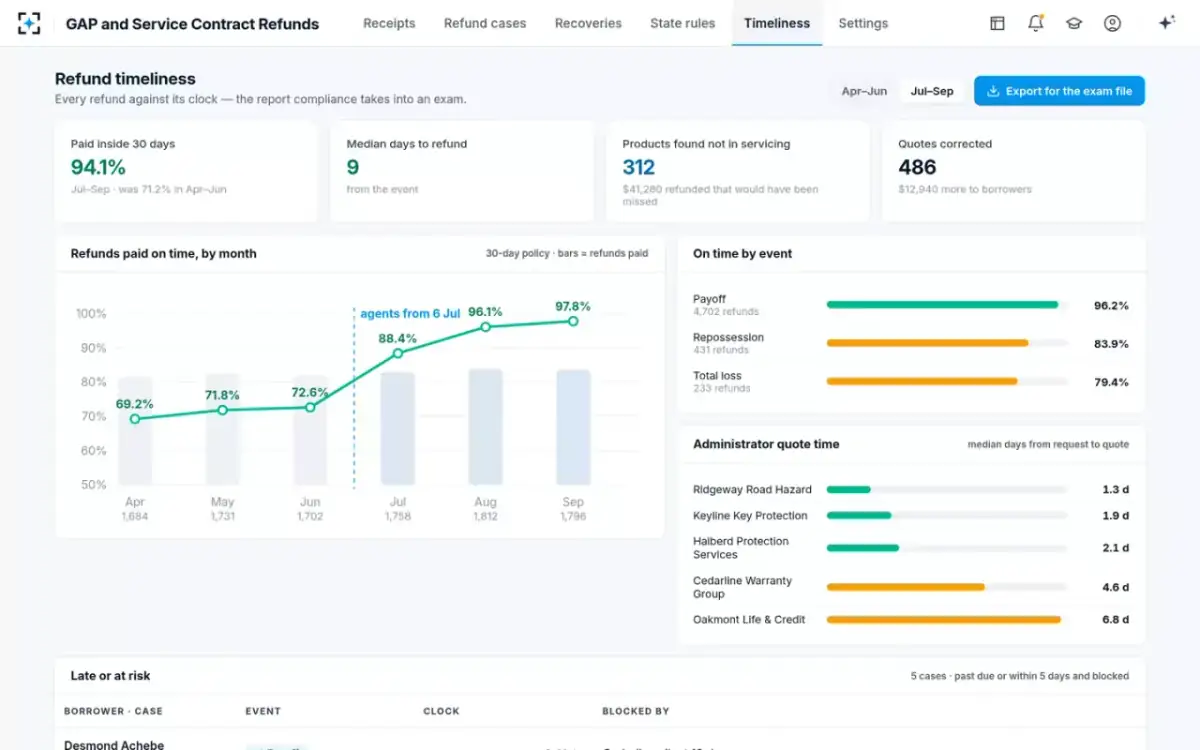
| 8 | Refunds were applied late: in one matter "an average of 84 days after the post-repossession sale", in another "the refund delays ranged from 150 days to 664 days". | A clock started by the event, not by a request, with a dated payment at the end of it and a report of what missed. |
| 9 | Servicers kept "collecting monthly payments even after they knew the GAP waiver would cover the outstanding balance, and then failing to accurately reimburse consumers who made these payments". | The date of loss recorded on the account, with every payment taken after it listed, returned and reconciled. |
What links them: a calculation nobody can reproduce
Eight of the nine describe something that was not written down at the time it happened. The authorisation that was never verified. The title check that was skipped. The payee that was left off. The visit that was required but not disclosed. The cancellation that was refused with no recorded reason. The state where no case was ever opened. The date the pro rata was measured from. The day the money moved. In every one of them the lender could not, afterwards, show its working.
That is why a refund programme is an evidence problem before it is an arithmetic problem. The arithmetic is easy — a term, a date, a price, a fee — and a competent analyst gets it right most of the time. What a competent analyst does not do, at sixty cases a day, is record which clause named the method, which document gave the odometer reading and which version of the state rule table was in force when the figure was printed. Two years later that is the entire question.
Examiners also found the problem travelling through third parties: servicers "rely upon calculations performed by third parties that were not consistent with the terms of the add-on product contract". Taking an administrator's quote as the answer is not delegation of the arithmetic. It is delegation of the evidence, to a party with the opposite interest. How a refund is calculated works the methods through one contract and shows what checking a quote involves.
What a defensible refund file holds
A file that answers all nine findings is not long. It is specific. Everything in it is dated, sourced and reproducible without asking anybody what they remembered.
A refund file as examiners found it, and the same file answering the finding
What the file held: A borrower rang, or an administrator sent something.
What it needed to hold: A payoff, repossession sale or total-loss settlement posted, and opened the case itself.
What the file held: The products the servicing system knew about.
What it needed to hold: Every product on the contract’s itemization, with the ones servicing did not hold named as such.
What the file held: The administrator’s quote, or custom.
What it needed to hold: The clause of this contract, quoted, and the version of the state rule table applied.
What the file held: A spreadsheet, rekeyed.
What it needed to hold: The event date from the posted transaction and the odometer from a signed statement, each citing its document.
What the file held: The date the refund was issued.
What it needed to hold: The event date, the deadline, the day it was paid, and the gap, reportable across the whole book.
What the file held: Approved in a queue.
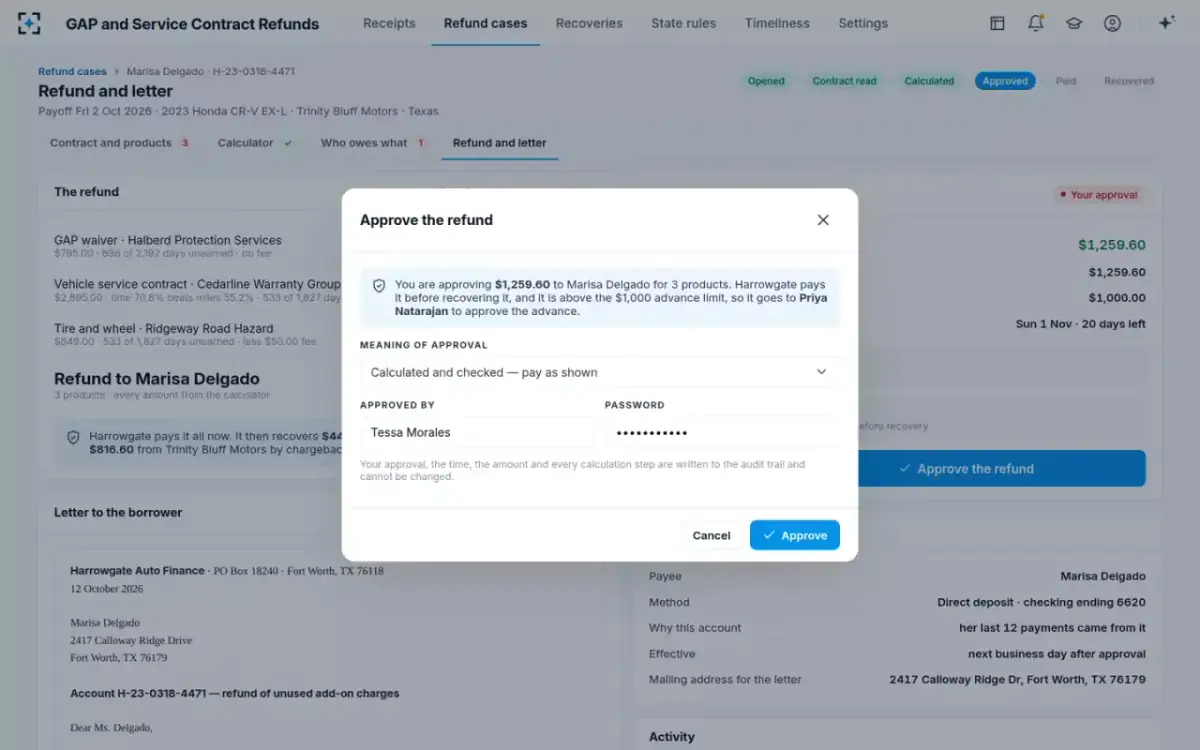
What it needed to hold: A named person, the time, the amount and the meaning of the approval, unchangeable afterwards.
What GAP and Service Contract Refunds exports for the examination file
The two consent orders, and the deadlines they set
Supervisory findings describe what went wrong. Consent orders say what a named lender must do, and these two remain the closest thing the market has to a published standard for refund timing — even though the Bureau has since terminated both (Toyota Motor Credit, 12 May 2025; Wells Fargo).
The Toyota Motor Credit order of 20 November 2023 sets two clocks for credit products: consumers must receive accurately calculated refunds of unearned premiums "within 45 days of notice of cancellation" where the lender's own affiliate administers the product, and "within 60 days" where a third party does. For vehicle service agreements it sets a third: "No later than 30 days following cancellation of the Vehicle Service Agreement," the administrator must remit the refund "to either the consumer or lienholder/lessor, if applicable".
The same order explains, in a single sentence, why the products were worth nothing once the loan ended: GAP and credit life products "become void and worthless when the consumer terminates the underlying Vehicle Financing Contract early … since no balance remains for these products to potentially pay off". And it prices the consequence. Six classes of redress total $48.0 million, with a $12.0 million civil money penalty on top.
What one consent order ordered, class by class
The smallest bar is the instructive one. The order records that the lender "learned of the issue following a June 2019 audit, but failed to resolve one of the two flaws it discovered, neglected to remediate consumers it identified as having received incorrect refund amounts, and declined to examine whether the issue had affected additional consumer accounts." Finding a defect is not the risk. Finding it and leaving it is.
Do lenders have to refund regardless of state law?
On the evidence of both orders, yes — the phrase appears in both, though both have since been terminated. Toyota Motor Credit had to deliver its refunds "regardless of state law". Wells Fargo's order said it "must maintain a policy and practice designed to ensure that the unused portion of GAP contracts that Respondent finances, or that are otherwise assigned to Respondent, are refunded to the borrower, regardless of state law."
The supervisory finding says the same thing without the phrase: servicers were directed to implement processes ensuring refunds "in all states, including those that do not mandate such refunds". And the Wells Fargo order preserves the obvious corollary — "nothing in this Consent Order prevents Respondent from seeking reimbursement for refunds from any other party". Recovery from a dealer or an administrator is allowed; waiting for it is not what the borrower's clock is for. What the state statutes actually say reads three of them closely, and explains what a rule table is still for once the federal standard sits above it.
How to run a lookback without breaking the current queue
Every lender that reads these findings arrives at the same question: how far back do we have to look, and who is going to do it while the daily book keeps arriving. The honest answer to the first half is that the population is defined by the defect, not by a calendar — if cases were only opened when borrowers asked, the population is every early termination in the period; if the method was wrong on one product family, it is every case carrying that product.
The second half is the part that sinks lookbacks. A review done by the same people who work the queue stops the queue, and a review done by a separate team produces a second method and a reconciliation between them. The way out is to run the historic population through the same process the live queue uses, so both produce the same artefacts and the lookback's output is a list of cases rather than a report about cases.
Running a refund lookback so the result is defensible
- Define the population from the defect, not the date
Say in writing which failure you are testing for and which events could carry it. A date range picked for convenience is the first thing an examiner will push on.
- Rebuild from the contract, not from the old calculation
Re-reading the itemization finds the products the original process never saw. Recomputing the old figure only confirms the old inputs.
- Use one method for history and for today
Two methods mean a reconciliation, and a reconciliation is where a lookback stalls. Run the old cases through the live process.
- Pay before you recover
The borrower is owed by the lender. Chargebacks to dealers and claims on administrators are a separate workstream that must never hold a payment up.
- Report timeliness by month, event and administrator
The remediation is the easy half. The examiner’s next question is whether the thing that caused it has stopped, and that is a trend, not a total.
- Sample the live queue while the lookback runs
A programme that fixes the past and drifts in the present has produced evidence against itself.
How much a late refund costs
There are three prices, and only one of them is the refund. The first is the money itself, remediated with interest and administration: more than $25 million at one bank for GAP refunds owed to nearly 90,000 accounts under Texas rules. The second is the knock-on harm, which has its own tariff — $150 per inaccurate negative credit marker in the Toyota order, $6.0 million in total, which is roughly forty thousand markers placed against people who had paid. The third is the penalty, $12.0 million in that order, and the standing obligation to report on the fix for years afterwards.
Against that, the operational cost of doing it properly is small and mostly fixed: a trigger on the servicing feed, a reader that opens the contract, a calculation that cites its clause, and a clock. The examination manual states the expectation in one line — examiners will "determine how the servicer monitors optional products attached to loans or leases, including cancelling the products and providing refunds in a timely manner, where applicable" (Automobile Finance Examination Procedures). Monitoring is a system word. It is not something a queue does.
Where this solution helps is narrow and worth stating plainly: it opens the case, finds every product, calculates with the source of each input, keeps the clock and leaves the file. Where it does not help is equally plain. It cannot make an administrator answer, it cannot invent a method a contract never named, and it cannot refund a product that was never on the contract in the first place. Who actually holds the money sets out the three parties and what each can be made to do.
The approval GAP and Service Contract Refunds records on every refund
Questions people ask
What has the CFPB found about GAP refunds?
In its auto finance supervisory report it set out nine findings on add-on products: charging for products consumers did not agree to buy, financing products void on salvage vehicles, itemizations that failed to name the payee, onerous cancellation requirements, refusing contractual cancellations, failing to refund unearned premiums at all, miscalculating refunds, applying them very late, and continuing to collect payments after a total loss.
What was the Toyota Motor Credit consent order about?
Among other things, refunds of unearned add-on premiums. It orders $48.0 million of consumer redress across six classes and a $12.0 million civil money penalty, and sets delivery deadlines — 45 days for affiliate-administered GAP, 60 days where a third party administers it, 30 days for a vehicle service agreement refund — to be met regardless of state law. The Bureau terminated the order on 12 May 2025.
What did Wells Fargo pay for late GAP refunds?
Its 2022 consent order records that a failure to follow Texas regulations between 2017 and 2020 left nearly 90,000 borrower accounts without timely GAP fee refunds, remediated at more than $25 million. The order, since terminated, also required a standing policy ensuring unused GAP portions are refunded to borrowers regardless of state law, while expressly allowing the bank to seek reimbursement from others.
What is an unfair act or practice in a refund?
In these findings, conduct that caused substantial injury consumers could not reasonably avoid and that was not outweighed by countervailing benefits — for example not refunding unearned premiums at all, refunding the wrong amount, or applying refunds so late that borrowers were kept from money they were entitled to. Several of the nine were instead framed as abusive, which turns on taking unreasonable advantage of a consumer's inability to protect their own interests.
What does a defensible refund file hold?
The event and its date, every product read from the contract itself, the clause that named the method, the version of the state rule applied, each input with the document it came from, the deadline and the date paid, and a named approval with its meaning. Anything that cannot be rebuilt two years later without asking somebody what they remembered is not yet evidence.
How do you run a refund lookback?
Define the population by the defect rather than by a convenient date range, rebuild each case from the contract instead of recomputing the old answer, run history through the same process as the live queue so there is only one method to defend, pay borrowers before chasing dealers and administrators, and report timeliness by month so the fix is visible as a trend rather than a total.