When a car buyer finances GAP coverage, a service contract or another add-on, the whole price is paid on day one and folded into the loan. If the loan ends years early, because the car is traded in, repossessed or wrecked, part of that price was never used. That unused part belongs to the borrower, and the lender is expected to see that it comes back, by the method the contract names and the rule the state sets.
This guide is for the people who work, check or pay for those refunds: payoff and refund specialists, servicing managers, compliance and audit teams at banks, credit unions and auto finance companies, dealer relations and funding teams, and the leaders deciding whether to automate the work. No background needed.
Imagine you are a refund specialist at an auto finance company in Fort Worth, Texas. It is Monday, October 12, 2026. On Friday, October 2, Marisa Valdivia traded in her 2023 Honda CR-V and the dealer paid off her loan: $19,486.22, three and a half years into a 72-month contract signed March 18, 2023. Her account shows two add-ons, a $795 GAP waiver and a $2,895 service contract. Texas gives you 60 days to refund the GAP fee; your own policy says 30.
You open the contract. Line 4 of the itemization, the page that lists every amount financed, shows a third product: a $649 tire and wheel contract, line 4C, that nobody ever entered in the servicing system. Then the service contract company's cancellation quote arrives. It took a $75 fee from its standard national form. The Texas addendum stapled to Marisa's contract says $50.
What the servicing record shows
Products
GAP · service contract
Service contract fee
$75, from the quote
Refund
$1,095.26
What the contract says · line 4
Products
GAP · service contract · tire and wheel
Service contract fee
$50, Texas addendum
Refund
$1,259.60
$164.34 short$1,259.60 owedthe tire and wheel refund plus the $25 the quote overcharged.
Each product refunds by its own method: the GAP waiver by days left (898 of 2,192); the service contract by time used or miles driven, whichever is larger (here time: 70.8% of its five years); the tire and wheel by days left less a $50 fee. Most of the $1,259.60 is sitting with the dealer, Trinity Bluff Motors, which kept $2,599 of the $4,339 it charged. If you wait for the dealer, Marisa waits too.
Careful refund work finds the product nobody entered in the servicing system and the fee nobody checked, and pays the borrower before chasing the money back.
What happens to add-on charges when an auto loan ends early
The products, the rules, the arithmetic, the money trail between dealer, administrator and lender, and what examiners and attorneys general have found, explained without selling anything. If you are new to auto finance servicing, start here.
01 · In plain words
Why a borrower is owed part of the GAP and service contract price when a car loan ends early
Most people who buy a car on credit sign one long contract at the dealership: the retail installment contract. Besides the car, it often finances a few extras that the dealer's finance office sells in the same sitting. The common ones are a GAP waiver, which cancels what is still owed if the car is stolen or totaled and the insurance check falls short; a vehicle service contract, often called an extended warranty, which pays for repairs; and smaller products for tires and wheels, lost keys, dents or paint.
Each add-on has a price, and the whole price goes into the loan on day one. The borrower then pays it back, with interest, month by month.
Those extras are sold for a period: 72 months of GAP, five years or 75,000 miles of repairs. Loans rarely run their full term. People trade cars in, refinance, sell them, fall behind and lose them to repossession, or crash them. When the loan ends early, a GAP waiver has nothing left to protect, because the debt is gone, and a service contract on a car the borrower no longer has is worth nothing to them.
The part of the price that covered the months that will never happen is called the unearned part, and the borrower has a right to it back.1
Getting it back is harder than it sounds. The dealer sold the product and kept a share of the price. A separate company, the administrator, runs the product and holds the rest. The lender, who bought the contract from the dealer and collects the payments, sees the payoff first but did not sell anything.
Each product has its own cancellation terms, its own refund method and its own fee, and each state adds its own rules. Examiners at the Consumer Financial Protection Bureau (CFPB), the federal regulator for consumer loans, have said plainly that the lender must make sure the refund happens, "either by ensuring that dealers or administrators provided refunds or by providing the refunds themselves".1
So someone at the lender has to notice the loan ended, find every product on the contract, ask each administrator to cancel, check the number that comes back, pay or credit the borrower, and then collect from the administrator and the dealer. Done well, the borrower gets the right amount within weeks. Done carelessly, the refund is late, short, or never paid at all, and a supervisory examination or a state attorney general eventually counts every one.
The life of one add-on, in five steps
The dealer sells it with the carMarisa's contract finances $4,339 of add-ons: GAP $795, a service contract $2,895, tire and wheel $649.
The lender funds the contractIt pays the dealer for the car and the add-ons; the dealer sends each administrator its cost and keeps the rest.
The loan ends earlyA trade-in pays the loan off on October 2, 2026, three and a half years into six.
The refund is worked out and paidEach product by its own method and the state's rule: $1,259.60 in all. This is where products get missed and quotes go unchecked.
The lender recovers its money$443.00 back from three administrators, $816.60 charged back to the dealer.
Step 4 is the subject of this guide. The people, companies and figures in this example are fictional.
Four GAP refund surprises, from dealer shares to the Rule of 78s
The lender answers for a product it never sold
Examiners found it unfair when servicers failed to ensure refunds "in all states", and servicers changed their processes to refund "in all states, including those that do not mandate such refunds".1
Most of the money is with the dealer
In one consumer group's dataset, dealers marked GAP up 151% over their cost, so about 60% of the price stayed at the dealership.2 The administrator can refund only what it received.
The administrator's quote can be wrong
Examiners found servicers relying on third-party calculations "not consistent with the terms of the add-on product contract", and providers deducting fees the contract did not allow.1,3
The federal ban on the Rule of 78s covers interest only
The Rule of 78s counts most of a price as used in the early months, so it refunds less. Federal law bars it for refunding interest on long precomputed loans, where the interest is added to the balance at signing.4 The method for an add-on's price comes from the product contract and state law.
Unearned premium, administrator, pro rata and chargeback explained
Unearned premium
The share of an add-on's price that covered time or miles that will never be used. Also called the unearned fee or charge.
Administrator
The company that runs an add-on product: issues it, pays its claims and processes cancellations. Sometimes called the obligor or provider.
Pro rata
Refunding in proportion: if 41% of the term is left, 41% of the price comes back, less any allowed fee.
Chargeback
Taking back from the dealer the share of a cancelled product's price that the dealer kept, often from its next funding.
Which add-ons lose their value at a payoff, a repossession or a total loss
In shortProducts that protect the loan, such as GAP and credit life, end the moment the loan ends, whatever the reason. Products that protect the car, such as a service contract, can keep going after a payoff if the borrower keeps the car, but end when the car is repossessed or totaled. The event decides which products are owed a refund and where the money goes.
The CFPB sorts add-ons into two groups. Credit products "will assist with the remaining loan balance owed by the consumer under certain circumstances; these products cease to provide any benefits when the loan is terminated." Vehicle products "relate to the vehicle itself; these products may continue to provide benefits after the loan is terminated."1 The same report adds that vehicle products such as service contracts "terminate upon default, when the borrower no longer possesses the vehicle."1
Credit products end with the loan; car products end with the car
What happens to each common add-on at each way a loan can end early
Can continueEnds; refund duePays its benefit, then ends
Payoff or trade-inRepossessionTotal lossGAP waiverEnds; refund dueEnds; refund duePays its benefit, then endsCredit life or disabilityEnds; refund dueEnds; refund dueEnds; refund dueVehicle service contractCan continueEnds; refund dueEnds; refund dueTire and wheelCan continueEnds; refund dueEnds; refund dueKey replacementCan continueEnds; refund dueEnds; refund due
Our reading of the sources1,5 · A car product kept after a payoff can still be cancelled for a refund on request; after a trade-in the borrower no longer has the car, so it is usually cancelled. Check each contract.
Show the numbers
Payoff or trade-in
Repossession
Total loss
GAP waiver
Ends; refund due
Ends; refund due
Pays its benefit, then ends
Credit life or disability
Ends; refund due
Ends; refund due
Ends; refund due
Vehicle service contract
Can continue
Ends; refund due
Ends; refund due
Tire and wheel
Can continue
Ends; refund due
Ends; refund due
Key replacement
Can continue
Ends; refund due
Ends; refund due
Where the refund goes depends on the event
Payoff or trade-in
To the borrower
"For early payoffs, the full amount of the refund should go to the borrower."1 The loan is closed, so the money is paid out, usually by check or to the account the payments came from.
Repossession
To the balance first
"In the default scenario, the refund amount should be applied to any deficiency balance, and the borrower receives any remaining refund amount."1 A late or missing credit inflates the deficiency the borrower is chased for.
Total loss
Into the GAP claim
The insurer pays the car's actual cash value, GAP waives most of the shortfall, and refunds from other cancelled products reduce what is left. Examiners found servicers collecting monthly payments for months after a total loss that GAP would cover.1
Why a GAP waiver is worth nothing after a payoff
A consent order against one captive lender (a carmaker's own finance company) put it in a sentence: GAP and credit life products "become void and worthless when the consumer terminates the underlying Vehicle Financing Contract early … since no balance remains for these products to potentially pay off."5
The same order found the company charged payoff amounts that included GAP premiums "based on the full term", and before October 2021 "required that consumers affirmatively request refunds from the Dealer or product administrator, even though Toyota Motor Credit already had (or could reasonably obtain) all the information it needed".5
The lender knows when a loan pays off. The borrower, who traded the car in on a busy Saturday, usually does not know a refund exists, let alone whom to ask. The CFPB's 2022 report said consumers "may be unaware that they paid unearned premiums, let alone that the amount could be refunded upon payoff."6
A GAP waiver and GAP insurance are different legal things. A GAP waiver (in Texas law, a debt cancellation agreement) is a term of the credit contract: the holder agrees to cancel part of the debt. GAP insurance is a policy from an insurer. States regulate them under different laws, with different refund methods.7,8 The rule table a lender keeps needs to know which one each contract carries.
03 · The rules and their dates
Federal pressure on add-on refunds, 2022 to 2026: findings that stand, orders that ended, a rule that died
Status as of October 2026
In shortNo federal statute says "refund the unearned GAP fee within 30 days". The duty comes from contracts, state laws and the ban on unfair practices, which the CFPB applied in a series of supervisory reports (its Supervisory Highlights) and several enforcement actions from 2022 to 2024. Since 2025 the two big consent orders have been terminated, the FTC's CARS Rule has been vacated and withdrawn, and the CFPB has shrunk. The findings still describe what examiners and state attorneys general look for.
The supervisory record built up from 2022 to 2024, then federal pressure eased
Nov 2022Supervisory Highlights 28
Servicers failed to ensure refunds after early payoff, yet obtained them after repossession.
Dec 20, 2022Wells Fargo consent order
Unrefunded GAP fees; refund 'regardless of state law'.
Oct 2023Supervisory Highlights 31
More than $20 million remediated; fees deducted that contracts did not allow.
Nov 20, 2023Toyota Motor Credit consent order
$48 million redress, $12 million penalty; refund clocks of 45 and 60 days.
Jan 4, 2024FTC CARS Rule published
Would have banned add-ons with no benefit. Never took effect.
Oct 2024Supervisory Highlights 35
Nine add-on findings; refund delays of 150 to 664 days in one matter.
Nov 26, 2024USASF Servicing judgment
$10 million penalty in a case that included unrefunded GAP.
Jan 27, 2025CARS Rule vacated
Fifth Circuit: the FTC skipped the advance notice step.
Jan–May 2025Orders end
Wells Fargo order ends in January; CFPB terminates Toyota's on May 12; CFPB leaves the Credit Acceptance suit in April.
Jul 4, 2025CFPB funding cut
Cap cut from 12% to 6.5% of the Fed's 2009 operating expenses.
New York and other states: $60 million in cash and more than $630 million of debt relief; buyers to be contacted about add-ons outside the showroom and offered a way to cancel.
Oct 1, 2026California CARS Act
Valueless add-ons barred; three-day return right on used cars of $50,000 or less.
Ensure the refund in every state, calculate it by the contract, apply it promptly, stop collecting after a covered total loss.1,6,3
In force; findings published 2022–2024
CFPB auto finance exam procedures
Examiners "determine how the servicer monitors optional products … including cancelling the products and providing refunds in a timely manner" and whether the process "consider[s] state law requirements for refunds".20
August 2019 edition, current
Auto larger participant rule
Puts nonbank auto lenders with more than 10,000 originations a year under CFPB supervision.21
2015 rule in force; an August 8, 2025 advance notice asks whether to raise the threshold
15 U.S.C. §1615
"Promptly refund any unearned portion of the interest charge"; no Rule of 78s for precomputed credit over 61 months.4
In force since 1992; interest only
Regulation Z §1026.18(c)(1)(iii)
The itemization of the amount financed must name the payee of each add-on. Examiners found it missing.1
In force
FTC CARS Rule, 16 CFR 463
Would have barred charges for add-ons with no benefit and required express informed consent.10
Vacated January 27, 2025; withdrawn February 12, 202612,17
State statutes and rules
Method, fee caps, deadlines, penalties; see the next section.
In force; Texas amended 2023, Colorado statute in force 2024, California 2023 and 2026
What the CARS Rule would have done, and why it matters that it did not
The FTC's Combating Auto Retail Scams Rule, published January 4, 2024, would have made it unlawful for dealers to charge for an add-on "if the consumer would not benefit from" it, and to charge for any item without the buyer's "Express, Informed Consent".10
Its effective date was postponed during the legal challenge. On January 27, 2025, the Fifth Circuit vacated it because the FTC had not issued an advance notice of proposed rulemaking, a step its own statute requires; the court did not rule on the substance.12 On February 12, 2026 the FTC withdrew the rule to conform to the decision.17
The rule was aimed at the sale. Refunds after an early payoff were never its subject. Its fate matters to refund teams for another reason: it would have given every dealer the same national standard for documenting what was sold and at what price. Without it, the paperwork on file is whatever each dealer and each state requires, which is one reason refund work starts from the contract image and its itemization.
Two claims to correct. Older articles describe the CARS Rule as delayed. It is withdrawn.17 And some say the CFPB's orders on add-on refunds are in force: Wells Fargo's 2022 order ended in January 2025 and the CFPB terminated Toyota Motor Credit's on May 12, 2025.13,15 The findings behind them remain the clearest public statement of what regulators expect.
How far the CFPB has shrunk since 2025
6.5%
the CFPB's funding cap since July 2025, down from 12% of the Federal Reserve's 2009 operating expenses.16
the cut the bureau set for its supervisory "events", with the focus moved to banks.16
Congressional Research Service, August 2026
Federal supervision has thinned. Besides the funding cut, which a July 2025 law made, the Congressional Research Service counted one new public enforcement action by the bureau in the first 18 months of the administration.16
The bureau withdrew from its suit against Credit Acceptance in April 2025.14 The New York Attorney General kept the case going, and on September 17, 2026 New York and a coalition of other states announced a settlement: $60 million in cash restitution and more than $630 million of debt relief, plus about $15 million in penalties to the states (New York's release rounds the total to $700 million). Among the settlement's terms, the lender must contact buyers outside the dealership to explain any add-ons they bought and offer a way to cancel them.18
State attorneys general, state regulators and private class actions now carry more of the weight that federal supervision used to.
04 · State refund laws
GAP and service contract refund laws by state: methods, fee caps and clocks in five states
In shortStates regulate GAP and service contracts separately, and differently. Some write the method, the fee cap and the deadline into the statute; others make the contract state its method. A dealer-software company counted 41 states requiring a refund for at least one of the two products as of October 2020; California and Colorado have added GAP statutes since. A lender's rule table needs a row per state and per product.
Washington and Texas service contracts carry the whole refund in law; Texas GAP leaves the method to the contract
What five state texts set for a refund after cancellation or early termination
Not in the textContract decidesSet by law
Refund requiredMethodFee capDeadlineTexas GAP waiverSet by lawContract decidesNot in the textSet by lawTexas service contractSet by lawSet by lawSet by lawSet by lawColorado GAPSet by lawContract decidesSet by lawSet by lawWashington service contractSet by lawSet by lawSet by lawSet by lawFlorida service contractSet by lawSet by lawSet by lawNot in the text
Our reading of the sources7,22,23,24,25,8 · Texas GAP: the agreement must state its method, usually pro rata or pro rata less a fixed fee. Colorado: pro rata, or another method the administrator approves. Florida: no deadline in §634.121(3); check the rest of the chapter.
Show the numbers
Refund required
Method
Fee cap
Deadline
Texas GAP waiver
Set by law
Contract decides
Not in the text
Set by law
Texas service contract
Set by law
Set by law
Set by law
Set by law
Colorado GAP
Set by law
Contract decides
Set by law
Set by law
Washington service contract
Set by law
Set by law
Set by law
Set by law
Florida service contract
Set by law
Set by law
Set by law
Not in the text
State and product
Method
What may be kept
Clock
Texas GAP waiver (Finance Code ch. 354)
The agreement must state it; "the two most commonly used methods are: (1) the pro rata method, and (2) the pro rata method minus a fixed cancellation fee". Never "fully earned" at inception.7
A fixed fee if the agreement states one; no refund owed under $522
The holder (whoever now owns the contract, usually the lender) refunds within 60 days of termination, or within 30 days tells the administrator (and dealer) to refund within 30 more22
Texas service contract (Occupations Code §1304.1581)
Full refund within 30 days of purchase; after that, prorated by "mileage, time, or another reasonably applicable measure" stated in the contract, less claims paid23
"A reasonable cancellation fee not to exceed $50"23
Paid before the 46th day after notice, or a 10% penalty for each month unpaid23
Colorado GAP (C.R.S. §5-9.3-106, since January 1, 2024)
Pro rata, or a method the administrator approves, when GAP is a contract term8
After notice from an assignee (a lender that bought the contract), the original creditor refunds within 30 days; if not, the assignee pays and is reimbursed within 458
Washington service contract (RCW 48.110.075)
"Pro rata based upon either elapsed time or mileage"24
Within 60 business days the holder refunds, or instructs the administrator in writing; a buyer may recover three times the GAP charges for violations26,27
The clocks, side by side
Where a statute or an order sets a refund clock, it runs 30 to 60 days
Days allowed to refund an add-on after cancellation, notice or termination
Texas GAP: holder refunds after early termination60 days
Toyota order: third-party GAP and credit life60 days
Texas service contract: before the penalty startsrefund due before the 46th day45 days
Toyota order: its own GAP administrator45 days
Washington service contract30 days
Colorado GAP: creditor, after an assignee's notice30 days
Toyota order: vehicle service agreements30 days
Source22,5,23,24,8 · The Toyota order was terminated on May 12, 2025; its clocks are shown as a benchmark.
Show the numbers
Rule
Days
Texas GAP: holder refunds after early termination
60 days
Toyota order: third-party GAP and credit life
60 days
Texas service contract: before the penalty starts
45 days
Toyota order: its own GAP administrator
45 days
Washington service contract
30 days
Colorado GAP: creditor, after an assignee's notice
30 days
Toyota order: vehicle service agreements
30 days
How many states require a refund
A 2020 industry count found 41 states requiring a refund for GAP, a service contract or both
States by the products their laws require refunds for, information as of October 2020
41of 50 states
Both GAP and service contracts18
GAP only13
Service contracts only10
Neither, by that count9
Source28 · A dealer-software company's count; confirm current law with counsel. California (GAP, 2023) and Colorado (GAP statute, 2024) have changed since.
Show the numbers
Part
Value
Both GAP and service contracts
18
GAP only
13
Service contracts only
10
Neither, by that count
9
That count came from a company selling refund-recovery software, dated "Information as of October 2020", and it lists 31 states for GAP, 28 for service contracts and 18 for both.28 It is useful as a picture of how uneven the map is, and too old to be a rule table. California has required automatic GAP refunds since 2023, and Colorado moved its GAP rule from regulation into statute, in a 2023 law that took effect January 1, 2024.26,8
Federal supervision also makes the count less decisive: examiners pushed servicers to refund "in all states, including those that do not mandate such refunds."1
Texas measures the refund from the earliest of four dates. Under Finance Code §354.007(a), a GAP refund is "based on the earliest date of: (1) the prepayment of the contract in full … (2) a demand by the holder for payment in full … or acceleration; (3) a request by the retail buyer for cancellation …; or (4) the total denial of a debt cancellation request".22 Three of the four are events the lender sees first. A refund process that starts its clock when the borrower calls is measuring from the wrong date on most files.
The 2023 Texas change that split the money in law
Since September 1, 2023, Texas spells out who refunds what. A holder that is not the selling dealer must either refund "an appropriate amount" within 60 days of the termination, or within 30 days send written instructions to the administrator and the dealer, who then have 30 days to refund "an amount proportional" to what each received.
A holder may rely in good faith on the administrator's computation of the amount waived, but must correct a known error "within a reasonable time" and may seek reimbursement from the responsible party.22 The administrator's share and the dealer's share are now separate obligations on the face of the statute.
Texas's model contract language shows where a refund goes while a balance remains. One of the Finance Commission's model clauses reads: "If you get a refund on insurance or service contracts, or other contracts included in the cash price, you will subtract it from what I owe."29 On a payoff nothing is owed, so the refund goes to the buyer; on a repossession it reduces the deficiency first.
05 · The arithmetic
How to calculate a GAP or service contract refund: by days, by miles and by the Rule of 78s
In shortFour inputs decide a refund: the price the borrower paid, the term, how much of it was used, and the fee the contract allows. Pro rata refunds the unused share evenly. The Rule of 78s front-loads the earning, so it refunds far less in the middle of a term. Some service contracts measure use by time or miles, whichever is greater. Each product follows its own contract.
Pro rata by days: Marisa's GAP waiver
Step
Working
Result
Term
March 18, 2023 to March 18, 2029, 72 months
2,192 days
Used
March 18, 2023 to the payoff on October 2, 2026
1,294 days
Left
2,192 − 1,294
898 days, 41.0%
Unearned price
$795.00 × 898 ÷ 2,192
$325.69
Fee
The GAP addendum charges none on a payoff
$0.00
Refund
$325.69
The example is fictional. Counting in days avoids a question months raise: whether the month the payoff fell in counts as used.
The greater of time or miles: her service contract
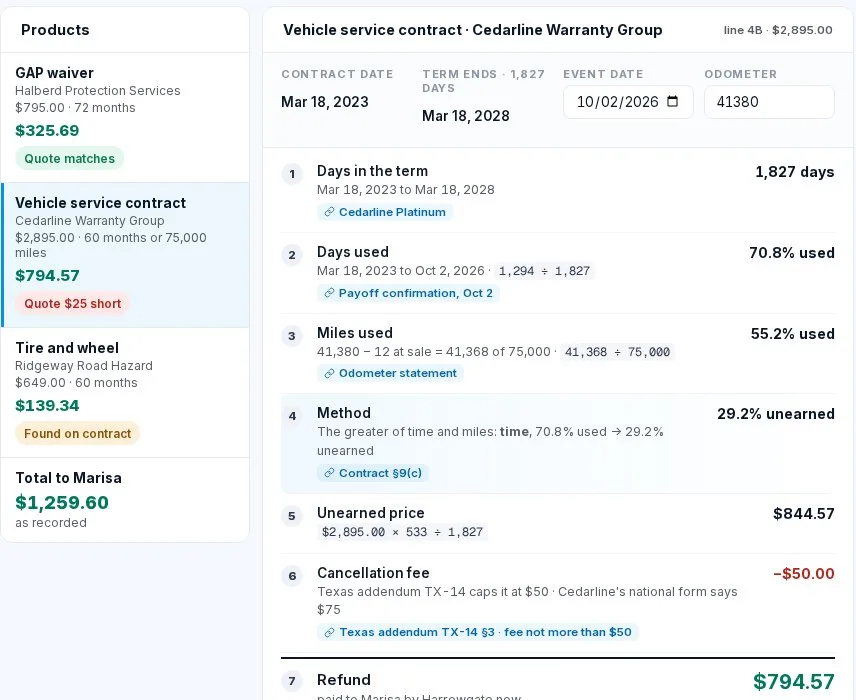
Many service contracts end at a date or a mileage, whichever comes first, and refund by whichever measure of use is larger. Marisa's ran five years or 75,000 miles. By time she had used 1,294 of 1,827 days, 70.8%. By miles she had driven 41,368 (41,380 on the trade-in odometer statement less 12 at sale), 55.2% of 75,000. Time is greater, so the unused share is 533 of 1,827 days: $2,895 × 533 ÷ 1,827 = $844.57, less the $50 fee her Texas addendum allows, gives $794.57.
The odometer reading matters: had she driven 60,000 miles, miles would govern and the refund would fall. A federal rule already produces a reliable reading at most changes of ownership. The seller of a vehicle must disclose "the odometer reading at the time of transfer (not to include tenths of miles)", sign it and print their name.30 A trade-in or an auction sale therefore leaves a signed mileage figure for the refund to use.
The Rule of 78s, and what it does to a refund
The Rule of 78s (also called the sum-of-the-digits method) takes its name from a 12-month loan: the digits 1 to 12 add up to 78. It treats the first month as earning 12 parts of the price, the second 11, and so on, so most of the price is "earned" early. For a 72-month product with k whole months left, the refund share is k(k+1) ÷ (72 × 73). With 30 months left, Marisa's GAP waiver would refund 930 ÷ 5,256 = 17.7% of its price, $140.67, against 41.0% and $325.69 by days.
Halfway through a 72-month term, the Rule of 78s refunds a quarter of the price; pro rata refunds half
Share of the price refunded, by months elapsed, before any fee
Pro rataRule of 78s
0%25%50%75%100%0%0%
0122436486072
Illustrative · replace with your own numbers · The arithmetic of each method for any 72-month product; months elapsed on the bottom axis.
Show the numbers
Pro rata
Rule of 78s
0
100%
100%
12
83.3%
69.6%
24
66.7%
44.7%
36
50%
25.3%
48
33.3%
11.4%
60
16.7%
3%
72
0%
0%
By the Rule of 78s, Marisa would get $371.83 of the $1,259.60 her contracts promise
Her three refunds by each method, after the contracts' fees
Rule of 78sPro rata, as her contracts require
GAP waiver$141$326
Service contract$221$795
Tire and wheel$11$139
Fictional example from this guide · The fictional example's figures as the screens in Part B show them, rounded to the dollar: $140.67, $220.52 and $10.64 against $325.69, $794.57 and $139.34, $887.77 less in all.
Show the numbers
Rule of 78s
Pro rata, as her contracts require
GAP waiver
$141
$326
Service contract
$221
$795
Tire and wheel
$11
$139
Is the Rule of 78s allowed?
For interest, federal law answered in 1992. When a consumer pays a loan off early, the creditor "shall promptly refund any unearned portion of the interest charge", and for any precomputed consumer credit of a term "exceeding 61 months" the refund must use "a method which is at least as favorable to the consumer as the actuarial method", which rules out the Rule of 78s.4
That section speaks of the interest charge only. The price of a GAP waiver or a service contract is governed by the product contract and state law, and most of the texts in the previous section require or describe pro rata.7,23,24,8
A credit insurance certificate may still name the Rule of 78s, and whether a state allows it is a question for its insurance rules. The method must be the one the contract names and the state permits, and a refund team should be able to show both.
The industry case for front-loaded earning is that claims are front-loaded too: one GAP administrator told the Wyoming Legislature in 2020 that "about 70% of GAP claims occur within the first 24 months of the term" in its data, and proposed a modified Rule of 78s.31 Whatever the merits, the refund owed today is the one the borrower's contract and state law specify.
The fee is the quietest error
The fee is a small number taken from a different page than the rest of the calculation. An administrator operating nationally quotes from its standard form; the contract the borrower signed may carry a state addendum with a lower fee, or none.
In the fictional example the administrator took $75 from its national form; the Texas addendum on Marisa's contract allows $50, and Texas law caps a service contract cancellation fee at "a reasonable cancellation fee not to exceed $50".23 Examiners have found exactly this: service providers deducting fees "that were not authorized under the add-on product contract".3
06 · Who holds the money
The money trail from the dealership to the administrator, and the way back after a cancellation
In shortAt funding the lender pays the dealer the whole add-on price. The dealer keeps its markup, often more than half, and sends the rest to the administrator. On cancellation the administrator refunds only its share; the dealer's share comes back by chargeback. A lender that pays the borrower only after both have paid makes the borrower wait on the slowest party.
Six hops: the price goes out through the dealer and comes back from two directions
1Sale
The buyer finances $4,339 of add-ons in the retail installment contract, with the car.
Dealer's finance officeDay 0
2Funding
The lender buys the contract and pays the dealer the amount financed, add-ons included.
LenderDays 1–10
3Remittance
The dealer sends each administrator its cost, $1,740 in all, and keeps $2,599.
DealerMonthly
4Early termination
A trade-in pays off the loan; every product on the contract must be cancelled.
ServicingOctober 2, 2026
5Refund
The borrower receives $1,259.60, or a deficiency is reduced after a repossession.
LenderInside the deadline
6Recovery
Administrators return $443.00; the dealer is charged back $816.60, often from its next funding or a dealer reserve.
Administrators, dealerWeeks to months
Fictional example from this guide · The fictional example's amounts.
Show the numbers
Step
What happens
Who
Time
Sale
The buyer finances $4,339 of add-ons in the retail installment contract, with the car.
Dealer's finance office
Day 0
Funding
The lender buys the contract and pays the dealer the amount financed, add-ons included.
Lender
Days 1–10
Remittance
The dealer sends each administrator its cost, $1,740 in all, and keeps $2,599.
Dealer
Monthly
Early termination
A trade-in pays off the loan; every product on the contract must be cancelled.
Servicing
October 2, 2026
Refund
The borrower receives $1,259.60, or a deficiency is reduced after a repossession.
Lender
Inside the deadline
Recovery
Administrators return $443.00; the dealer is charged back $816.60, often from its next funding or a dealer reserve.
Administrators, dealer
Weeks to months
How the dealer's share is set
Add-on prices are rarely fixed. The National Consumer Law Center studied a dataset of add-on sales and found that in 2012 the average dealer markup on GAP was 151%, "an average markup of $378 over the dealer's average cost of $251", and on service contracts 83%, $859 over a cost of $1,032.2 Some dealers marked GAP up by 300% or more.2
On an average GAP sale the dealer kept 60% of the price; on a service contract, 45%
Average dealer cost and markup in one consumer group's 2012 dataset
Dealer's cost, paid to the providerDealer's markup, kept
GAP$251$378
Service contract$1,032$859
Window etch$58$189
Source2 · Shares are our arithmetic from the published averages. Older data; markups vary widely by dealer.
Show the numbers
Product
Dealer's cost, paid to the provider
Dealer's markup, kept
GAP
$251
$378
Service contract
$1,032
$859
Window etch
$58
$189
The split matters on the way back. The administrator refunds the unearned share of what it received. The dealer's unearned share must be recovered from the dealer. In the fictional example, the administrators' cost was $1,740 of the $4,339 charged, so most of Marisa's refund sits with the dealer:
Of Marisa's $4,339 in add-ons, the dealer kept $2,599, so the dealer owes most of the refund
Each product's price, split between the administrator's cost and the dealer's share
Administrator's shareDealer's share
GAP waiver, $795$300$495
Service contract, $2,895$1,180$1,715
Tire and wheel, $649$260$389
Fictional example from this guide · Refund owed by the administrators: $443.00; by the dealer, by chargeback: $816.60.
Show the numbers
Product
Administrator's share
Dealer's share
GAP waiver, $795
$300
$495
Service contract, $2,895
$1,180
$1,715
Tire and wheel, $649
$260
$389
Who pays the borrower first
Contracts often route refunds through the dealer, and supervisors have seen the result. One bank's GAP contracts sometimes required "that the borrower make a written request to the originating dealer for a GAP refund"; until July 2021 the bank did not ensure refunds on the loans it bought from dealers (it refunded where it determined state law required it), while obtaining refunds "when it would benefit Respondent", in defaults and repossessions.9
Its order required refunds "regardless of state law" and added that "nothing in this Consent Order prevents Respondent from seeking reimbursement for refunds from any other party."9
The CFPB's 2022 report described the tool lenders already had: after repossessions, servicers obtained refunds "either by obtaining the refunds directly or by debiting reserve accounts servicers had established for dealers."6 A lender that can net a chargeback from the dealer's next funding or reserve can pay the borrower first and recover afterwards. The question is whether it does so for payoffs too, where the refund lowers nothing it is owed.
07 · Repossessions and total losses
Add-on refunds after a repossession or total loss shrink a balance the borrower still owes
In shortAfter a repossession, add-on refunds reduce the deficiency balance before anything goes to the borrower, so a missing or late refund inflates what the borrower is asked to pay and what is reported to the credit bureaus. After a total loss, GAP pays most of the shortfall, other products are cancelled, and payments collected after the loss must be returned correctly. Both events are where examiners found the worst delays.
A deficiency is what the borrower still owes after the repossessed car is sold and the proceeds are applied. The CFPB's 2025 study of nine lenders' data found the average deficiency, among borrowers left with one, fell from $10,747 in December 2019 to $7,971 in December 2021 as used-car prices rose, then climbed to $11,340 by December 2022.32
The average deficiency after a repossession passed $11,000 in 2022
Average balance left after the repossessed car was sold, among borrowers with a deficiency, in dollars
10,747Dec 2019
7,971Dec 2021
11,340Dec 2022
Source32 · CFPB auto finance data pilot, nine lenders; nominal dollars.
Show the numbers
Month
Average deficiency
Dec 2019
10,747
Dec 2021
7,971
Dec 2022
11,340
Unearned add-on premiums are one of the credits that should reduce that number. Examiners found refunds miscalculated when servicers "used the date of a deficiency notice for making a pro rata calculation instead of the date of the repossession", which counts weeks of extra "use" against the borrower, and refunds applied "an average of 84 days after the post-repossession sale".1 One bank's order covered "more than $246 million in remediation for repossession-related harm involving nearly 850,000 borrower accounts", alongside its GAP findings.9
The total loss sequence
The insurer declares a total loss and pays the car's actual cash value to the lender.
The GAP administrator works the claim: the balance at the date of loss, less the insurance payment, less amounts the waiver excludes. Texas requires an agreement to say plainly whether each exclusion is total or partial, never both for the same situation.7
Other products are cancelled. Service contract, tire and wheel and credit products end with the car; their refunds often reduce the balance the GAP claim covers, so they need to reach the GAP administrator before the claim settles.
Payments made after the loss are returned. Examiners found servicers "collecting monthly payments even after they knew the GAP waiver would cover the outstanding balance", then refunding them miscalculated.1
Anything left over goes to the borrower, with a letter that shows each amount.
Check each GAP agreement: what it deducts for cancelled products, and whether the lender or the administrator collects those refunds.
08 · What examiners found
Nine ways add-on refunds failed in the CFPB's 2024 auto finance report
In shortThe October 2024 special edition of Supervisory Highlights devoted a section to add-ons with nine findings that follow a product's life, from a sale without consent to refunds that were missing, wrong or very late. Six of the nine are about cancellation and refunds. The delays it reports run from weeks to almost two years.
Examiners found add-on refunds delayed up to 664 days; Texas allows a holder 60
Refund delays in two supervisory matters (the first counted from the repossession sale), beside the Texas GAP deadline
Longest delay, second matter664 days
Longest delay, first matter (after the repossession sale)423 days
Shortest delay, second matter150 days
Average delay, first matter (after the repossession sale)84 days
Longest delay, first matter (after the repossession sale)
423 days
Shortest delay, second matter
150 days
Average delay, first matter (after the repossession sale)
84 days
Texas GAP refund deadline, for comparison
60 days
Finding (Issue 35, §2.4)
What examiners saw
What a refund file must show
2.4.1 Charges without consent
Refinance loans had to carry a minimum of "tangible benefits", add-ons among them; recorded calls never explained them1
The signed consent for each product
2.4.2 GAP on salvage titles
GAP financed on cars whose title history voided it1
A title check before funding
2.4.3 No payee on the itemization
Regulation Z requires the payee of each amount; it was missing1
Payee per product on the itemization
2.4.4 Two trips to cancel
Borrowers had to visit the dealership twice, once to see the general manager1
A cancellation path that takes one request
2.4.5 Cancellations refused
First-year pro rata cancellation rights not honored1
Each request and its outcome
2.4.6 No refund at all
Refunds not ensured "in all states" after payoff, repossession or total loss1
A case opened for every early termination
2.4.7 Wrong amount
Deficiency-notice date used for the repossession date; third-party calculations inconsistent with the contract1
Every input with its source, checked against the quote
2.4.8 Too late
84 days on average after a repossession sale; 150 to 664 days in another matter1
The event date, the deadline and the paid date
2.4.9 Payments after a total loss
Monthly payments collected after GAP would cover the balance; refunds miscalculated1
The loss date and every payment after it
The same findings, three years running
The 2024 report repeated what the bureau had said before. In 2022 it reported servicers failing "to ensure consumers received refunds for unearned fees related to add-on products" after early payoffs while collecting them after repossessions.6 In 2023 it reported servicers remediating consumers "more than $20 million" and service providers deducting fees "that were not authorized under the add-on product contract".3 Each time the remedy was the same: remediate, then build a process that refunds without waiting for the borrower to ask.
One captive lender's order shows how such failures hide in systems. From April 2018 to January 2019, "flawed system logic" miscalculated service contract refunds; the company "learned of the issue following a June 2019 audit, but failed to resolve one of the two flaws it discovered, neglected to remediate consumers it identified as having received incorrect refund amounts, and declined to examine whether the issue had affected additional consumer accounts."5
09 · What it has cost lenders
Redress, penalties and settlements for unrefunded GAP and service contract charges
In shortPublic actions put prices on missed refunds: more than $25 million for one bank's Texas GAP accounts, $48 million of redress at a captive lender, more than $20 million remediated across supervised servicers in one year, $4 million from two Colorado credit unions. The money is paid per borrower, across years of payoffs, plus a penalty.
Unrefunded GAP premiums were the largest single redress item in a $48 million order
Toyota Motor Credit consent order, November 20, 2023, redress by type
GAP premiums not refunded$27.1M
Fund for refunds based on first attempt to cancel$8M
$150 per wrong negative credit report$6M
Credit life and disability premiums not refunded$3M
Refunds from the first attempt to cancel$2M
GAP premiums in a statutory state$1.9M
Service agreement refunds (at least)$52K
Source5 · A $12 million civil penalty was added. The CFPB terminated the order on May 12, 2025.
Show the numbers
Redress
Amount
GAP premiums not refunded
$27.1M
Fund for refunds based on first attempt to cancel
$8M
$150 per wrong negative credit report
$6M
Credit life and disability premiums not refunded
$3M
Refunds from the first attempt to cancel
$2M
GAP premiums in a statutory state
$1.9M
Service agreement refunds (at least)
$52K
Action
What it found about refunds
Money
Status in 2026
Wells Fargo, CFPB, Dec 20, 2022
Did not ensure GAP refunds on early payoff; Texas failures 2017–2020 left "nearly 90,000 borrower accounts" without timely refunds9
"Remediation of more than $25 million" for Texas GAP9
Two patterns repeat. The populations are large because the defect is in a process: failing to follow one state's regulations reached nearly 90,000 accounts.9 And the remedy reaches back years, so a lender that finds the defect itself should expect to remediate every affected payoff since the defect began, with interest where its regulator expects it. The Toyota order's history is the warning: finding a flaw in an audit and not fixing it was itself part of the case.5
10 · The market
How common add-ons are, what they cost, and how long auto loans now run
In shortAmericans owe $1.7 trillion on auto loans. In the CFPB's data from nine lenders, more than 70% of borrowers bought at least one add-on, and those who bought a service plan paid about $3,000 for it. Loan terms keep stretching, which leaves more unearned premium on the table whenever a loan ends early.
$1.71T
of auto loan debt at June 30, 2026, after $211 billion of new loans in the quarter.34
New York Fed, Q2 2026
70%+
of borrowers in the CFPB's data bought at least one add-on with their vehicle, 2018–2022.35
CFPB auto finance data pilot
69.5 mo
average new-vehicle loan term in early 2026; 35.6% of new loans ran longer than six years.36
Experian, Q1 2026
More than 70 in 100 borrowers financed at least one add-on
70+ in 100
borrowers in the CFPB's nine-lender dataset who bought at least one add-on product with their vehicle, 2018–2022
borrowers in the CFPB's nine-lender dataset who bought at least one add-on product with their vehicle, 2018–2022
70 of 100
A service plan cost about three times as much as GAP
Average price paid by servicemember borrowers who bought each kind of add-on, 2018–2022, in December 2022 dollars
Warranty, service or maintenance plan$2,983
Other add-ons$1,115
GAP product$952
Source35 · The CFPB reports these averages for servicemembers and says non-servicemembers' costs by category were similar.
Show the numbers
Add-on
Average price
Warranty, service or maintenance plan
$2,983
Other add-ons
$1,115
GAP product
$952
Longer terms raise the stakes. A product sold for 72 or 84 months on a loan that ends after three years leaves roughly half its price unearned. Experian put the average new-vehicle term at 69.48 months and the used-vehicle term at 67.73 months in the first quarter of 2026, with 35.55% of new-vehicle loans longer than six years, up from 30.83% a year earlier.36
How many loans end early, and how big the average refund is, are not published by any regulator. A refund-recovery vendor writes that "approximately 75%" of auto loans are paid off early, citing Experian, and puts its average GAP refund at $380 from its own data.37 Treat those as one vendor's figures. Your own servicing data will tell you the real numbers for your book in an afternoon: count last year's payoffs, repossessions and total losses on contracts that carried an add-on.
What nobody publishes. No public figure exists for how many add-on refunds go unpaid, how often administrator quotes are wrong, how many products are never entered in servicing systems, or how long refunds take across the industry. The supervisory reports describe examples from examined companies, and they do not estimate the market.1
11 · How teams do it today
Who works an add-on refund today, the hand-offs, and where the weeks go
In shortA payoff desk or refund specialist notices the event, pulls the contract, asks each administrator to cancel, waits for quotes, credits or pays the borrower, and passes the dealer's share to whoever handles chargebacks. Much of the elapsed time is waiting: for someone to notice, and for quotes to come back. Teams run it in house, outsource it to a recovery service, or use administrators' portals.
Who works an add-on refund: specialist, team lead, compliance, dealers
RS
Refund or payoff specialist
Opens the case, reads the contract, requests cancellations, checks quotes and sets up the refund, often for dozens of cases a day.
Cares about: three companies' arithmetic and one deadline.
TL
Payoffs and refunds team lead
Approves refunds, especially those paid before the money is recovered, and any override of a calculated amount.
Cares about: the borrower paid first, the recovery tracked after.
CR
Compliance reviewer
Keeps the state rule table, samples approved refunds, answers examiners and attorneys general.
Cares about: the method, the fee and the rule, written on the file.
CS
Customer service
Takes the "where is my refund?" calls.
Cares about: the amount, the date and the reason on the first call.
DR
Dealer relations, funding and accounting
Raise chargebacks, net them from dealer funding or reserves, and age what administrators still owe.
Cares about: receivables that do not age past 90 days.
Six hand-offs from payoff to a closed refund, two outside the lender
Six hand-offs between the payoff and a closed refund, two of them outside the lender
1Notice the event
A payoff, auction sale or insurance settlement posts. Someone has to see that the contract carried add-ons.
ServicingDay 0 to weeks
2Find every product
Pull the contract image and its itemization; match each product to an administrator, term, method, fee and state addendum.
Refund specialistHours
3Cancel and request quotes
Send each administrator the event date and odometer through its portal, email or form.
Refund specialistDays
4Check and calculate
Compare each quote with the contract's method and fee; fix the date, the miles, the fee.
Refund specialist, complianceHours
5Credit or pay, and write
Credit the deficiency or pay the borrower; send a letter that shows the amounts.
Team lead, paymentsDays
6Recover
Collect each administrator's share; charge back the dealer's share from funding or a reserve.
A payoff, auction sale or insurance settlement posts. Someone has to see that the contract carried add-ons.
Servicing
Day 0 to weeks
Find every product
Pull the contract image and its itemization; match each product to an administrator, term, method, fee and state addendum.
Refund specialist
Hours
Cancel and request quotes
Send each administrator the event date and odometer through its portal, email or form.
Refund specialist
Days
Check and calculate
Compare each quote with the contract's method and fee; fix the date, the miles, the fee.
Refund specialist, compliance
Hours
Credit or pay, and write
Credit the deficiency or pay the borrower; send a letter that shows the amounts.
Team lead, payments
Days
Recover
Collect each administrator's share; charge back the dealer's share from funding or a reserve.
Accounting, dealer relations
Weeks
Noticing the payoff and waiting for quotes: where refund time goes
Half of a hand-worked refund's elapsed time is waiting: for someone to notice, then for quotes
An illustrative 26-day payoff refund, by stage, in days
Noticing the eventFinding the productsCalculatingWaiting on quotesQueue, letter, approval, payment
A payoff refund worked by hand4 days3 days4 days9 days6 days
Illustrative · replace with your own numbers · No public dataset measures this. Time ten of your own refunds from event to payment, stage by stage.
Show the numbers
Noticing the event
Finding the products
Calculating
Waiting on quotes
Queue, letter, approval, payment
A payoff refund worked by hand
4 days
3 days
4 days
9 days
6 days
Refund desks, refund-recovery services or administrator portals
In house
A refund desk with spreadsheets
Full control and knowledge of each dealer. Depends on people noticing events and keeping a state table current; quality varies with workload.
Outsourced
A refund-recovery service
Connects lenders, administrators and dealers and processes cancellations. The lender still owns the outcome: examiners found servicers relying on third-party calculations that did not match the contracts.1
Software
Servicing modules and administrator portals
Faster requests and quotes for products already entered in the servicing system. A product missing from the servicing record, or a quote from the wrong form, passes straight through unless something reads the contract.
The CFPB's exam procedures ask how refunds "are processed after the loan is prepaid or the loan is terminated (e.g., after repossession or total loss)" and whether a service provider is used and overseen.20 Each way of working needs an answer to both.
Part B · See it working
Botminds GAP and Service Contract Refunds at an indirect auto lender in Fort Worth
Part A described the work without naming a product. This part shows how Botminds does it, at a fictional indirect auto lender in Fort Worth, Texas, that services 182,400 accounts. Every company, person, number and document on these screens is sample data.
12 · One payoff, start to finish
Marisa Valdivia's early payoff: three add-on refunds calculated, $1,259.60 approved and refunded ten days after payoff
In shortThis is the example from the top of the page, inside the product. Six software agents open the case when the payoff posts, read the contract and three product forms, calculate each refund by its own method and the Texas rule, check the administrators' quotes and split what the dealer owes. Tessa Morales, the refund specialist, approves $1,259.60; Priya Nandakumar, the team lead, approves paying it before the money is recovered. Marisa is paid ten days after her payoff.
1
Every payoff prints its own refund receipt
Monday morning, October 12, Tessa opens the refund receipts: 214 open cases, 38 due within five days. Down the left, one stub per case with the amount, the event, the state, the method and the days left. Marisa's receipt is already printed: three products, each line citing the clause or rule it came from, and three issues flagged on the receipt itself.
The method check beside it shows each product's required method and what the other method would give. By the Rule of 78s, Marisa would be $887.77 short.
Refund receipts. The case list, Marisa's receipt with $1,259.60 due, and the method check: $325.69, $794.57 and $139.34 by pro rata against $140.67, $220.52 and $10.64 by the Rule of 78s.
2
Three products on the contract; servicing knew of two
The payoff of $19,486.22 posted on Friday, October 2, at 3:41 pm, and the event watcher opened a case with the clock running to November 1 under Harrowgate's 30-day policy. The contract reader read the retail installment contract and three product forms in 21 seconds. Itemization line 4 lists GAP $795, a service contract $2,895 and a tire and wheel contract $649, paid to Ridgeway Road Hazard, that was never entered in servicing.
Three exceptions, each with its evidence: the missing product, Cedarline's $75 fee, and Halberd's quote covering only its own share.
The case. The clock, the refund, the products found and the quotes, then the run log step by step and the three exceptions with links to the itemization, the Texas addendum and the GAP addendum.
3
Each refund worked out with its sources showing
The calculator shows the service contract step by step. Term 1,827 days. Used 1,294 days, 70.8%, from the payoff confirmation. Miles 41,368 of 75,000, 55.2%, from the trade-in odometer statement. Section 9(c) of the contract says the greater of the two governs, so time sets the refund: $2,895 × 533 ÷ 1,827 = $844.57, less the $50 fee in Texas addendum TX-14, gives $794.57.
Change the event date or the odometer and the method and refund recompute. The calculator uses only a method the contract or the rule table names.
The calculator. Seven steps, each linked to its source: the product form, the payoff confirmation, the odometer statement, contract section 9(c) and the Texas addendum's fee.
4
Pay the borrower in full, then recover each share
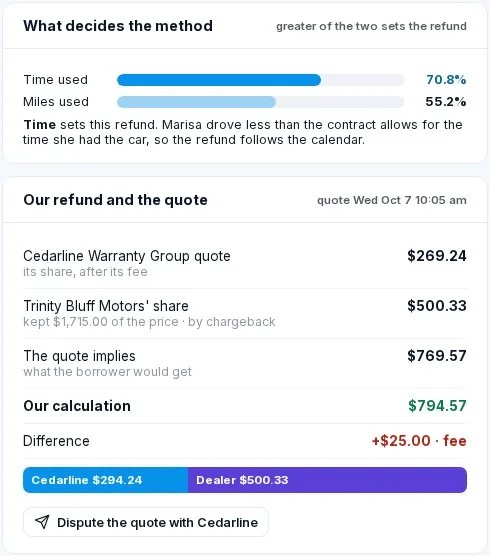
The administrator canceller compared three quotes: Halberd's $122.90 matched its share, Ridgeway's $25.86 matched, and Cedarline's $269.24 had taken the $75 fee from its national form. The dispute is drafted. The dealer chargeback tracker worked out that Trinity Bluff Motors kept $2,599 of the $4,339 it charged and owes $816.60, netted from its next funding.
Harrowgate pays Marisa the whole $1,259.60 now. Recovering $443.00 from administrators and $816.60 from the dealer is Harrowgate's problem afterwards.
Who owes what. The borrower paid first; each administrator's share and the dealer's chargeback, product by product, with the unearned share of what the dealer kept.
5
Two approvals, and a refund ten days after payoff
Tessa approves with her user name and password and the meaning "Calculated and checked — pay as shown". Because Harrowgate is paying $1,259.60 before recovering it, above its $1,000 advance limit, Priya Nandakumar approves the advance. The direct deposit goes to the checking account Marisa's last 12 payments came from, sent Monday, October 12, and in her account Tuesday, October 13, the next business day.
Her file says she prefers Spanish for written notices, so the letter goes in Spanish with an English copy, every calculation shown. The receipt reprints with the PAID stamp: day 10 of 30.
Approved and paid. Both approvals with their times, the deadline still 20 days away, and the deposit landing on Tuesday, October 13.
The solution's design targets are 100% of refunds paid inside the deadline and 10 days from payoff to refund against a 30-day policy. They are targets, to be measured on your own book. October 12, 2026 was Columbus Day, a Federal Reserve holiday, which is why the deposit settles on the 13th.
13 · Every screen
A fee caught in the margin, a Rule of 78s credit life refund, a repossession, a total loss and the exam report
In shortOne payoff is the story. These screens show the rest: the margin note behind any receipt line, a payoff that printed itself while the specialist watched, a credit life refund by the Rule of 78s, a repossession credited to the deficiency, a total loss reported to the GAP administrator, the queue, the letter, what administrators and dealers owe across the book, the state table, the timeliness report and the settings.
The margin note. Click any line to see where it came from. The quoted clause is the sample contract's Texas addendum; Texas law also caps a service contract cancellation fee at "a reasonable cancellation fee not to exceed $50".23
A payoff that printed its own receipt. Arash Rahmani's payoff posted at 7:12 am; by 7:19 his receipt was printed by the Texas rule, $924.25 due, without anyone opening the case.
Credit life by the Rule of 78s. The certificate names the Rule of 78s and the lender's table accepts it, so the receipt uses it: $33.84, with the pro rata figure, $185.75, printed beside it for review.
A repossession. The service contract refund, $609.21, reduces the deficiency from $3,528.40 to $2,919.19; the receipt flags that the credit posted on September 29 but the borrower's notice was never sent.
A total loss. GAP pays its benefit and earns no refund; the service contract and key replacement refunds are reported to the GAP administrator before the claim settles.
Refund cases. Every open case ranked by days left: 214 open, 38 due within five days, 41 administrator quotes that did not match this month.
The quote check. Time beats miles, and Cedarline's quote implies $769.57 for the borrower against the $794.57 owed: the $25 fee difference, with a dispute drafted.
The approval. A named person signs with a stated meaning; above the advance limit it goes to the team lead too. The approval and every calculation step go to the audit trail.
Refund and letter. Every amount from the calculator, the two approvers, the payment to the account the payments came from, and the draft letter that shows each calculation.
Recoveries. What administrators and dealers owe across the book, aged, with 37 open fee disputes against one administrator and a funding hold suggested for a dealer more than 90 days behind.
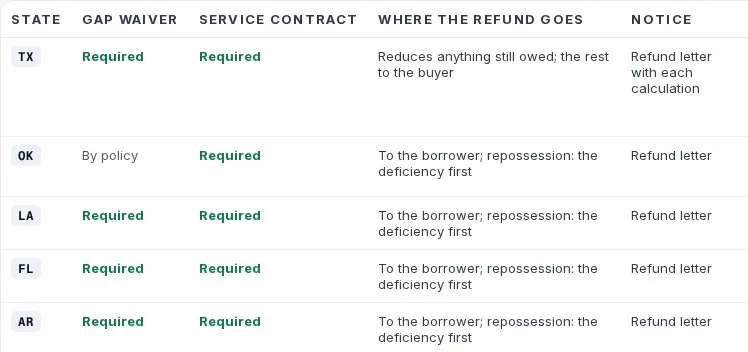
The state rule table. The lender's own versioned table, approved by compliance and cited on every case; it refunds every product even where a state does not require it. A real table needs current law: California, for example, has required GAP refunds since 2023.26
Refund timeliness. On-time refunds by month, by event and by administrator, ready to export for the exam file. The figures are the sample book's.
Your refund policy. The deadline, quote tolerance, odometer source, where each event's refund goes, letter language and approvals, versioned and on the audit trail.
Paid. The receipt reprints with the PAID stamp on October 12, day 10 of 30, and the recoveries still open on Harrowgate's side.
Select a screen to open it larger. The lender, borrowers, dealers, administrators, people and figures are fictional; the state table and rule references are sample data, to be confirmed by your counsel.
14 · Agents, and who approves
The refund specialist approves every add-on refund; the team lead approves advances above $1,000 and every override
In shortEach agent has one job and limits it does not cross. None of them sends money or a letter, accepts a quote that differs from the calculation, or holds a borrower's refund while a dealer pays. The refund specialist approves every refund; the team lead approves any advance above $1,000 and any override; compliance owns the state table.
Event watcher to letter drafter: six agents on every early termination
Event watcher
Watches servicing for payoffs, repossession sales and total-loss settlements, opens a refund case and starts the clock from the posted event date.
Never closes a case, and never takes the event date from anything but the posted transaction.
Contract reader
Reads the retail installment contract's itemization and every product form: price, term, administrator, refund method, fee and state addendum, and reports any product missing from servicing.
Never adds a product that is not on the contract; cites the line and clause for every value.
Refund calculator
Applies each contract's method and the state rule step by step, with the source of every input. If the contract names no method, it stops and asks compliance.
Never uses a method the contract or the rule table does not name; takes miles only from a signed statement.
Administrator canceller
Sends cancellation requests with the event date and odometer, reads each quote, compares it with the calculation and drafts a dispute for any difference above the tolerance.
Never accepts a quote that differs without raising it, and never delays the borrower's refund for a quote.
Dealer chargeback tracker
Works out each dealer's retained share of each product, raises the chargeback and nets it from the dealer's next funding.
Never holds the borrower's refund waiting on a dealer; a funding hold needs a person's approval.
Letter and payment drafter
Drafts the borrower letter with each calculation, in the borrower's preferred language with an English copy, and the refund payment.
Never sends money or a letter; uses the same numbers as the calculator.
Who approves a refund, who approves an advance, who owns the rule table
Approves every refundRefund specialistReviews the receipt and its exceptions, decides each one, and approves with a stated meaning.
Second approvalPayoffs and refunds team leadApproves when the lender pays more than $1,000 before recovering it, and any override of a calculated amount.
Owns the rulesCompliance reviewerApproves each version of the state rule table and re-checks 5% of approved refunds every week.
Every approval records the name, the meaning, the amount and the time. Agent steps and human decisions are kept apart on the audit trail, settings changes are versioned, and no money or letter leaves before approval.
Tessa Morales and the payoffs and refunds team
Fictional, from the sample data
TM
Tessa Morales · refund specialist
Works about 60 refund cases a day across GAP, service contracts, tire and wheel and credit life.
"Every refund is three companies' math and a deadline that's mine."
PN
Priya Nandakumar · payoffs and refunds team lead
Approves refunds paid before the money is recovered.
"We pay the borrower first. The dealer's chargeback is our problem."
OC
Owen Castellanos · compliance reviewer
Keeps the state rule table and samples refunds each week.
"Show me the method, the fee and the rule on the case."
JR
Jamal Reed · customer service
Takes the "where is my refund?" calls.
"I want to tell her the amount, the date and why on the first call."
GW
Graham Whitlock · VP servicing operations
Owns the refund timeliness number and the exam response.
"A refund finding is a lookback on every payoff for years."
15 · What goes in and out
What refund software reads from contracts, product forms and payoff events, and the cited refunds and dealer chargebacks it leaves
In shortIt reads what the lender already holds: the events servicing posts, the contract images, the product forms and their state addendums, administrators' quotes and the odometer statement. It leaves a refund per product with every step shown, cancellation requests and disputes, dealer chargebacks, the borrower's letter and a timeliness report for the exam file. Servicing stays the system of record.
From servicing and the deal jacket
Payoffs, repossession sales and total-loss settlements as they post
The retail installment contract and its itemization
GAP, service contract, tire and wheel, key and credit life forms with state addendums
The odometer statement from the trade-in or auction
From the lender
The state rule table, owned by compliance
Refund deadline, quote tolerance and advance limit
Where each event's refund goes
Approvers and letter languages
Agents find, calculate, check and draftEvery product on every contract, by its own method and the state's rule
A specialist approves each refund
Every amount cites its clause
Outputs
A refund per product with every step of the method shown
Cancellation requests, quote checks and drafted disputes
Dealer chargebacks netted from funding
The borrower letter in the preferred language, with an English copy
Recoveries aged by administrator and dealer
A refund timeliness report for the exam file
What changes for the team
Receipts to review, with the issues already flagged
Quotes checked before money moves
Borrowers paid first, recoveries tracked after
Servicing, contract images, administrator portals and payments it links
Administrator portals and emailCancellations out, quotes back
Dealer fundingChargebacks netted from the next funding
PaymentsACH to the paying account, else check
CorrespondenceLetters in the borrower's language
General ledgerReceivables from administrators and dealers
Identity and accessApproval limits, separation of duties
For each, check whether it has an API, a file feed, or only screens, and who owns it.
Your servicing system, administrators and dealers keep their roles
Your servicing system
Stays the system of record. Events come in as they post; credits and payments go back through your normal process after approval.
Your contract images
Read as they are, scans included. The itemization is checked against the products in servicing on every case.
Your administrators
Receive requests in the channel each already uses, and get disputes that cite the clause and the fee.
Your dealers
See each chargeback with the product, the price, what they kept and the unearned share.
Your compliance team
Owns a versioned rule table cited on every case, and a weekly sample of approved refunds.
Your examiners
Get a timeliness report and a file per refund: event date, every input with its source, the approval and the paid date.
Cited lines, the borrower paid first, a person approving
1
Every line cites its source
The clause, the product form, the odometer statement or the rule-table row, one click away.
2
The borrower is paid first
Administrators and dealers are recovered afterwards; nobody waits on a chargeback.
3
Agents draft; people approve
No money or letter moves until a named specialist approves, and the team lead above the limit.
Part C · Are you ready to automate?
Weighing automated GAP and service contract refunds for your payoff desk
You run auto loan servicing, or the payoff and refund desk, or you answer to examiners for it. This part is written for you: what late and short refunds cost, what automating them could return, whether your team is ready, and what to ask any vendor of refund software or refund-recovery services, including us.
16 · What late refunds cost
What a missed, short or late add-on refund costs you: the lookback, the redress and the hours
In shortThe refund itself is the borrower's money, so the real costs are everything around it: a lookback across years of payoffs when a defect is found, interest and penalties on top, wrong credit reports, the hours your team spends by hand, and the receivables you never collect from dealers. Start from your own numbers; nobody publishes an industry figure for any of them.
664 days
the longest refund delay examiners reported in one supervisory matter; delays there ran from 150 days.1
CFPB Supervisory Highlights 35, October 2024
90,000 accounts
one bank's Texas GAP refunds not made on time, 2017 to 2020: "remediation of more than $25 million".9
CFPB consent order, December 2022
$48M
of redress in one captive lender's order, $27.1 million of it for unrefunded GAP, plus a $12 million penalty.5
CFPB consent order, November 2023
Refunds leak at every hand-off: an illustrative book of 1,000 early terminations
How many refunds survive each step when the work depends on people noticing
Early terminations on contracts with an add-on1,000
A case opened without the borrower asking900
Every product on the contract found840
The amount right: date, miles, fee790
Paid inside your deadline700
Illustrative · replace with your own numbers · Illustrative numbers. Sample 50 of last year's payoffs, repossessions and total losses and measure your own drop at each step.
Show the numbers
Step
Refunds
Early terminations on contracts with an add-on
1,000
A case opened without the borrower asking
900
Every product on the contract found
840
The amount right: date, miles, fee
790
Paid inside your deadline
700
Your business case runs on your own numbers. Minutes per refund, refunds per specialist, wrong quotes, missing products and days to refund have no published industry figure (section 10), so the table below shows where to find each one in your files within a week.1
Unpaid, short and late refunds: sizing your own exposure
Cost
Where it hides
How to find your number in a week
Refunds never paid
Payoffs where nobody asked; products never entered in servicing
Pull 50 early terminations with add-ons; match each contract's itemization to what was refunded
Short refunds
Quotes from national forms, wrong dates, miles from the wrong document
Recalculate 30 recent refunds from the contract; compare with what was paid
Late refunds
Waiting on quotes and dealers before paying
Days from event to payment for the same 50 cases, against each state's clock and your policy
Time ten refunds from start to finish, stage by stage
Unrecovered receivables
Dealer chargebacks and administrator shares that age out
Age what dealers and administrators owe you; count items over 90 days
Exposure in a lookback
Years of payoffs processed the same way
Multiply the short and missing rate by your early terminations since the process last changed
Lookbacks, credit report errors and an attorney general's letter
The lookbackA defect found in one process reaches every payoff it touched, back to when it began.
Credit reportsDeficiencies reported too high because a refund never posted; one order paid $150 per wrong marker.5
The state attorney generalSettlements are counted per borrower, and they arrive with a press release.
Dealer relationshipsChargebacks raised months late are harder to collect and harder to explain.
The phone call"Where is my refund?" answered with no amount, no date and no reason.
17 · Your return
Clerk minutes per early termination and short refunds caught: working out your add-on refund return
In shortPut in your own numbers. The calculator starts from a published wage for loan clerks and asks you for the rest: how many early terminations carry an add-on, the minutes a refund takes now and with automation, how often refunds are short, and what the tool costs a year. Every default marked illustrative is an assumption to replace.
Six ways same-week GAP and service contract refunds pay
Specialist time
Receipts to review
Products found, methods applied and quotes checked before a person opens the case.
refunds × minutes saved ÷ 60 × loaded hourly cost
Accuracy
Short refunds caught
Missing products, wrong fees and wrong dates found before the money moves.
refunds × short rate × average shortfall
Timeliness
Paid inside the clock
Cases open when the event posts, and borrowers are paid before recovery.
share paid inside the deadline, before and after
Recovery
Receivables that do not age
Chargebacks raised on approval and netted from the next funding.
receivables over 90 days, before and after
Exams
A file per refund
Event date, inputs with sources, approval and paid date, exported for the examiner.
hours spent assembling exam samples
Exposure
No lookback to run
A process that gets it right going forward shortens any remediation window.
years of payoffs at risk × short and missing rate
Specialist time and short refunds on your early terminations
Only the hourly cost is built from a published figure: O*NET's 2025 median wage for loan interviewers and clerks, $24.05 an hour, divided by 0.70 for benefits and overhead (our assumption).38 Every input marked illustrative is an assumption.
Your volumeMinutes per refundAccuracyYour cost
Illustrative yearly value
Refund work today, valued$0
Specialist time released, valued$0
After your yearly cost$0
Borrowers' money found short or missing a year$0
Specialist hours released a year0
Refunds a year to cover your cost0
Formulas, per year: Refund work today = refunds × minutes today ÷ 60 × hourly cost Time released = refunds × (minutes today − minutes with automation) ÷ 60 × hourly cost After your cost = time released − yearly cost Short or missing = refunds × short rate × average shortfall Break-even refunds = yearly cost ÷ (minutes saved ÷ 60 × hourly cost)
The short or missing line is money your borrowers are owed, so it is a liability found, kept apart from the savings. In the fictional example one refund was $164.34 short before the contract was read. Not counted: exam preparation, credit-report corrections, dealer receivables and the cost of a lookback.
Minutes saved per refund decide how many refunds pay for the tool
Refunds a year needed to cover $120,000 of yearly cost, at $34 a specialist hour
Saves 35 minutes a refund6,050 refunds
Saves 20 minutes a refund10,588 refunds
Saves 10 minutes a refund21,176 refunds
Illustrative · replace with your own numbers
Show the numbers
Minutes saved
Refunds a year
Saves 35 minutes a refund
6,050 refunds
Saves 20 minutes a refund
10,588 refunds
Saves 10 minutes a refund
21,176 refunds
A lender with 10,000 early terminations a year on contracts carrying add-ons clears the first line and roughly matches the second. A credit union with 800 a year is far below all three and should weigh accuracy and exam exposure, which the calculator leaves out, more heavily than hours.
Start here18 · Readiness check
Scoring your add-on refund process: volume, dealer share, the state rule table, contract images and governance
In shortPick the answer closest to your team today. Eight questions score 0 to 2; the last is for reflection. The meter adds up your score as you go, and each question says why it matters and what a strong answer sounds like.
1
Volume
How many loans with an add-on end early each year: payoffs, repossessions and total losses together?
Why it mattersVolume turns minutes per refund into headcount, and repossessions and total losses take the longest.
A strong answer"About 9,000 a year: 7,800 payoffs, 900 repossessions, 300 total losses."
2
Indirect share
How much of your book comes through dealers who sell add-ons from several administrators?
Why it mattersDealer-sold products mean many forms, many fees and dealer chargebacks. A direct book with one in-house GAP product gains less.
A strong answer"Most of it, through 400 dealers and a dozen administrators."
3
Your baseline
Do you know your days from event to refund, your share paid inside each state's clock, and how often refunds are short?
Why it mattersNo public benchmark exists, so your own sample is the only way to prove an improvement or size a lookback.
A strong answer"Median 26 days, 71% inside our 30-day policy, and 4 of 50 sampled refunds were short."
4
Rule table
Is there one written, versioned table of each state's refund rules for GAP and service contracts, owned by compliance?
Why it mattersSoftware applies a table; it cannot settle which rule applies. Examiners also ask whether your process considers "state law requirements for refunds".20
A strong answer"One table, version 14, approved by compliance, and we refund every product whether the state requires it or not."
5
Findings
Have examiners, an attorney general, internal audit or complaints raised add-on refunds in the last three years?
Why it mattersFindings bring deadlines and budgets, and the supervisory record shows the same issues found year after year.1,6,3
A strong answer"Audit found we refunded only on request in states without a statute; we fixed it and ran a lookback."
6
Contracts and data
Are contract images and product forms stored electronically and linked to each account?
Why it mattersFinding products missing from servicing means reading the itemization. Paper jackets in a warehouse slow every case.
A strong answer"Every contract since 2019 is imaged in our document system, linked by account number, with an API."
7
Owner and budget
Is there a named owner of add-on refunds with a budget to change how they are done?
Why it mattersThe work crosses servicing, compliance, dealer relations, accounting and IT. Without one owner it stalls between them.
A strong answer"Our VP of servicing operations owns the timeliness number and has budget this year."
8
Governance
Do you have a way to approve software that reads contracts and drafts payments: vendor due diligence, human approval, an audit trail?
Why it mattersThird parties do not move the responsibility: examiners judge the lender's result, and the 2026 model risk guidance leaves generative and agentic AI outside its scope, to your own governance.1,39
A strong answer"Vendor management has a path for AI tools, and every refund needs a named approver."
9
Vision · for reflection
If an examiner picked 25 of last quarter's payoffs tomorrow, what would have to be true for you to show each refund's method, fee, rule, approval and paid date within a minute?
Why it mattersYour answer lists the gaps. Each gap is a candidate job for software: noticing, reading, calculating, checking or recording.
A strong answerA short, specific list, for example: "every product found from the itemization, every input sourced, quotes checked, borrower paid before recovery."
Sample 50 terminations, pilot a quarter or plan the full desk
0–6
Explore
Sample 50 early terminations, recalculate them from the contracts, write down one rule table, and name an owner. Start narrow, for example by checking every administrator quote against the contract before paying.
7–11
Ready to pilot
Run a measured pilot on last quarter's early terminations, with your own recalculations as the answer key. Compare products found, short refunds caught, false alarms and days to refund, and keep your specialists approving every refund.
12–16
Ready to implement
Plan the full desk: the rule table and settings, approval limits, servicing and document links, administrator channels, dealer chargebacks, letters and the exam report.
19 · Questions for any vendor
Seventeen questions for any refund software or refund-recovery service
In shortAsk every vendor the same questions, us included. The answers show whether it finds every product, follows each contract's method and fee, keeps the borrower's refund independent of the dealer, leaves you evidence, and lets you measure it on your own files.
Ask
A good answer
A warning sign
Finding the work
What starts a case: the posted event, or a borrower's request?
The posted payoff, sale or settlement, on the day it posts
"The borrower submits a request"
Does it read the contract's itemization, or only the products in servicing?
The itemization on every case, with missing products flagged
A product list from your servicing file
Which date does it use after a repossession?
The repossession date, from the posted event
The deficiency notice or sale date
The calculation
Where does the method come from?
The product contract and your rule table, cited on the case
One method for every product
How does it handle the greater of time or miles?
Both measures shown, miles from a signed odometer statement
Time only, or miles from a service record
Where does the fee come from, and what about state addendums?
The contract and its addendum, checked against your table
The administrator's standard fee
What happens when the contract names no method?
It stops and asks compliance
It picks a default
Money and counterparties
Does the borrower wait for the administrator or the dealer?
No: you can pay first and recover after, within your limits
Refund released when the dealer pays
How are administrator quotes checked?
Against the calculation, with a tolerance and a drafted dispute
Quotes passed through as the refund
How are dealer chargebacks raised and tracked?
Per product, netted from funding or a reserve, aged
A monthly spreadsheet to dealer relations
Evidence and control
Can every amount be traced to its clause, form or rule row?
Yes, on the case, for the specialist and the examiner
A confidence score
Who approves, and what is recorded?
A named person with a stated meaning; a second above your limit
Refunds released automatically
Who owns the state table, and is it versioned?
Your compliance team; every case cites the version
The vendor's table, updated when it updates
Your data and proof
Which AI models read the contracts, where do they run, and does our data train them?
Named models, your region, no training on your data, in writing
"Proprietary AI", no more detail
Can we test it on our own past cases before we sign?
Yes, against your own recalculations as the answer key
Demo contracts only
What will you report from the test?
Products found, short refunds caught, false alarms, minutes, days
One accuracy percentage
What does the examiner get?
A file per refund and a timeliness report by event and administrator
A screenshot of a dashboard
We found no published independent test of any refund vendor's accuracy, as of October 2026. Your own recalculated sample is the fairest comparison, and the same sample measures your current process.
20 · How to start
Recalculate last quarter's payoffs and repossessions first: a ten-week add-on refund pilot
In shortRecalculate a sample of your own refunds first, settle the rule table, then run a tool on the same files and on live cases side by side, and decide with four numbers. None of these steps commits you to a vendor.
Pull 100 early terminations from last quarter with add-ons on the contract: payoffs, repossessions and total losses in your main states.
Recalculate them by hand from the contracts: every product, method, fee and date. That is your answer key and your baseline.
Write down the rule table for those states, per product, approved by compliance.
Run the tool on the same 100, then in parallel on live cases for four weeks, with your specialists approving every refund.
Decide with four numbers: products found, short refunds caught, false alarms, and days from event to refund.
A ten-week pilot ends with a decision on four numbers
Your teamVendor
Pull 100 cases; recalculate by hand
Write and approve the rule table
Load settings, rule table, document access
Run the 100 cases blind
Parallel run on live cases
Score the four numbers
Decide
Week 0246810
Illustrative · replace with your own numbers
Show the numbers
Activity
From
To
Pull 100 cases; recalculate by hand
0
3
Write and approve the rule table
1
3
Load settings, rule table, document access
2
4
Run the 100 cases blind
4
5
Parallel run on live cases
5
9
Score the four numbers
8
9.5
Decide
9.5
10
Products found, short refunds caught, false alarms and days to refund
Measure
How
Why
Products found
Products the tool found ÷ products on the itemizations, per case
A missing product is a refund never paid
Short refunds caught
Your answer key's short cases the tool flagged ÷ all short cases
This is the exposure a lookback would find
False alarms
Exceptions on cases your answer key found correct, in reviewer minutes
A tool that flags everything catches everything
Days to refund
Event date to payment date, by event type and state
The examiner's number, and the borrower's
Specialist minutes
Stopwatch from opening a case to approving it
The cost case rests on it
The full working-session questions: 21 questions in seven groups
Bring servicing, compliance, dealer relations, accounting, vendor management and IT into one room. Each question says why it matters, what a strong answer looks like, and the warning sign.
A
Early terminations by event, state, product and administrator
A1
How many early terminations with add-ons do we have a year, by event, state and product?
Why it mattersRepossessions and total losses take longest; some states carry most of the book.
Strong answer · warning sign
Counts by event, state and product.
"About a few thousand payoffs."
A2
Which products do we see most, and from how many administrators?
Why it mattersEach administrator's forms and fees become rules.
Strong answer · warning sign
A list with volumes.
Nobody knows how many administrators.
A3
Do we refund in every state, or only where the law requires it?
Why it mattersExaminers pushed servicers to refund "in all states".1
Strong answer · warning sign
Every state, every product, by policy.
"Only where mandated."
B
The state rule table, Rule of 78s use and the odometer source
B1
Who owns the state rule table, and when was it last checked against the statutes?
Why it mattersTexas changed its GAP clock in 2023 and Colorado's GAP statute took effect in 2024.22,8
Strong answer · warning sign
Compliance, this year.
A 2020 survey.
B2
Where do we use the Rule of 78s, and on whose authority?
Why it mattersIt must be the contract's method and allowed by the state.
Strong answer · warning sign
Only where the certificate names it.
"The system default."
B3
Which odometer source do we use for miles-based contracts?
Why it mattersA wrong reading flips which measure governs.
Exam findings, ten refunds recalculated and products missing from servicing
C1
What did examiners, auditors or attorneys general say about our refunds in the last three years?
Why it mattersFindings show where the process breaks.
Strong answer · warning sign
A list with remediation status.
Nobody tracks them.
C2
Recalculate ten recent refunds from the contracts: do they match what we paid?
Why it mattersThe cheapest way to size the problem.
Strong answer · warning sign
Done, differences explained.
"Our administrators handle that."
C3
How many products on our contracts are missing from servicing?
Why it mattersA product missing from servicing is never refunded.
Strong answer · warning sign
Sampled and counted.
"None, surely."
D
Paying borrowers first, netting chargebacks and what is owed to you
D1
Do we pay borrowers before administrators and dealers pay us?
Why it mattersOtherwise the slowest party sets the borrower's date.
Strong answer · warning sign
Yes, within an advance limit.
"When the dealer pays."
D2
Can we net chargebacks from dealer funding or reserves?
Why it mattersSupervisors saw servicers debit dealer reserves after repossessions.6
Strong answer · warning sign
In the dealer agreement.
Invoices that age.
D3
What do administrators and dealers owe us today, and how old is it?
Why it mattersAging receivables are a cost and a signal.
Strong answer · warning sign
An aged report.
Nobody owns it.
E
Same-day payoff events, contract images and administrator contacts
E1
Can software see payoffs, sales and settlements the day they post?
Why it mattersThe clock starts at the event.
Strong answer · warning sign
An event feed or API.
A weekly report.
E2
Where are the contract images and product forms?
Why it mattersThe itemization is the source of truth.
Strong answer · warning sign
Imaged and linked by account.
Boxes at the dealer.
E3
How do we reach each administrator?
Why it mattersPortal, email or form sets the integration work.
Strong answer · warning sign
A list by administrator.
Each specialist's own contacts.
F
Refund approvals, vendor review and the April 2026 model guidance
F1
Who approves a refund, and who approves an advance or an override?
Why it mattersApproval limits become settings.
Strong answer · warning sign
Written limits by role.
"Whoever is on shift."
F2
What does vendor management need before a pilot sees real contracts?
Why it mattersContracts carry borrowers' personal data.
Strong answer · warning sign
A known path and timeline.
First time anyone asked.
F3
Has our model risk policy moved from SR 11-7 to the April 2026 guidance?
Why it mattersSR 26-2 replaced SR 11-7 on April 17, 2026.39
Strong answer · warning sign
Updated, with a view on AI tools.
Still cites SR 11-7.
G
Every refund calculated the day its event posts
G1
What if every refund were calculated the day the event posted?
Why it mattersTests the appetite for a same-week standard.
Strong answer · warning sign
"Our specialists would work exceptions."
"The quotes are the bottleneck anyway."
G2
What if every amount opened at its clause?
Why it mattersLinks refunds to exams and complaints.
Strong answer · warning sign
Exam samples in an afternoon.
Nobody would look.
G3
Which steps would we never let software do without a person?
Why it mattersTells you where the approvals belong.
Strong answer · warning sign
Paying, overriding, holding a dealer's funding.
"All of it": then start with quote checks.
21 · Frequently asked questions
GAP and warranty refunds after payoff, repossession or total loss: what borrowers and servicers ask
In shortThe questions borrowers, servicing teams and buyers search for most, each answered on its own.
Do you get a GAP refund when you pay off your car loan early?
Usually yes. A GAP waiver protects the loan, so it has no value once the loan is paid off, and the unused part of its price is refundable under most contracts and many state laws. The CFPB has treated a servicer's failure to ensure those refunds as an unfair practice, and the servicers in those exams changed their processes to refund in every state. Ask your lender or the GAP administrator for the refund and how it was calculated.
How do you calculate a GAP refund?
Use the method the GAP contract names, usually pro rata: price × days left ÷ days in the term, less any fee the contract and state allow. For example, a $795 waiver with 898 of 2,192 days left refunds $795 × 898 ÷ 2,192 = $325.69. Some contracts use the Rule of 78s, which refunds much less in the middle of the term.
Who is responsible for refunding GAP and other add-ons?
The administrator refunds its share and the dealer its markup, but federal examiners expect the lender or servicer to make sure the borrower is refunded, "either by ensuring that dealers or administrators provided refunds or by providing the refunds themselves." Many lenders pay the borrower first and recover from the administrator and the dealer afterwards. Texas law sets a 60-day refund duty on the holder, or 30 days to instruct the administrator and dealer.
Can I get a refund on an extended warranty after trading in my car?
Usually yes, if the service contract allows cancellation, which most do. After the free-look period (the first weeks, when cancelling brings a full refund), refunds are typically pro rata by time or miles, less a cancellation fee the state may cap: $50 in Texas, $25 in Washington. If the contract was financed, the refund may go to the lender first.
What is the difference between pro rata and the Rule of 78s?
Pro rata refunds the unused share of the term evenly: halfway through, half the price comes back. The Rule of 78s treats more of the price as earned early, so halfway through a 72-month product it refunds about a quarter. Federal law bans the Rule of 78s for interest on precomputed loans over 61 months; for add-on prices, the contract and state law decide.
What happens to GAP and a service contract when a car is repossessed?
Both end, and their unearned premiums should be credited first to the deficiency balance (what is still owed after the car is sold), with any remainder paid to the borrower. Examiners have found servicers using the deficiency notice date instead of the repossession date, which shrinks the refund, and applying refunds an average of 84 days after the sale. Ask for the calculation if the deficiency looks high.
What happens to an extended warranty when a car is totaled?
The service contract ends with the car and its unearned premium is refundable under most contracts. GAP pays its benefit instead of a refund, and refunds from other cancelled products often reduce the balance GAP covers, so they should reach the GAP administrator before the claim settles. Payments made after the loss that GAP covers should be returned.
How long does a GAP refund take?
It depends on the contract and the state. Texas requires the holder to refund within 60 days of an early termination or instruct the administrator within 30 days, California gives the holder 60 business days, and Colorado gives the original creditor 30 days after an assignee's notice. Examiners have found refunds taking from 150 to 664 days in one supervisory matter.
Is there a federal law requiring GAP refunds?
No federal statute sets a GAP refund method or deadline. The CFPB has applied the federal ban on unfair practices to missing, wrong and late add-on refunds, and a 1992 federal law (15 U.S.C. §1615) requires prompt refunds of unearned interest. State laws and the product contracts set the method, the fee and the clock.
What happened to the FTC CARS Rule?
The FTC's Combating Auto Retail Scams Rule, published in January 2024, never took effect. The Fifth Circuit vacated it on January 27, 2025 because the FTC skipped the advance notice of proposed rulemaking, and the FTC formally withdrew it on February 12, 2026. California's own CARS Act took effect on October 1, 2026.
What did the CFPB find about add-on refunds?
In its October 2024 auto finance report the CFPB listed nine add-on findings, including failing to ensure refunds in all states, miscalculating them, applying them late and collecting payments after a total loss that GAP would cover. Earlier reports in 2022 and 2023 found the same problems and more than $20 million of remediation. Those findings remain the clearest public statement of what examiners look for.
How much does a dealer keep from a GAP or service contract sale?
It varies widely. In a dataset studied by the National Consumer Law Center, dealers in 2012 marked GAP up 151% over cost on average and service contracts 83%, keeping about 60% and 45% of the price. That retained share is what a lender recovers by chargeback after a cancellation.
Can a lender automate GAP and service contract refunds?
Yes, if the software starts from the posted event, reads the contract's itemization and product forms, applies each contract's method and the state rule with every input sourced, and checks administrators' quotes. A named person should still approve each refund, and the lender should measure the tool on its own recalculated cases before relying on it.
22 · One-page summary
The add-on refund guide at a glance: methods, state rules, readiness and terms
Print this page
In shortThe whole guide on one screen: the method, the rules as of October 2026, the readiness questions and the terms.
The method
Open a case when the payoff, repossession sale or total-loss settlement posts.
Read the itemization; find every product, in servicing or not.
Apply each contract's method and the state rule: dates from the event, miles from a signed statement, the fee from the addendum.
Check every administrator quote against your figure.
Pay or credit the borrower first; on a repossession, the deficiency first.
Recover each administrator's share; charge back the dealer's share; keep the file.
Readiness: score 0–2 on eight questions: 0–6 explore · 7–11 pilot · 12–16 implement.
As of October 2026: CFPB findings 2022–2024 stand; Wells Fargo and Toyota orders ended in 2025 · CARS Rule vacated January 27, 2025, withdrawn February 12, 2026 · Texas GAP 60/30-day clock since September 1, 2023 · Colorado GAP statute since January 1, 2024 · California GAP refunds since 2023, CARS Act since October 1, 2026.
14 terms
Add-on
A product financed with the car: GAP, service contract, tire and wheel, key, credit life.
GAP waiver
A contract term cancelling the debt the insurance does not cover after a total loss or theft.
Debt cancellation agreement
The legal name for a GAP waiver in Texas and some other states.
Vehicle service contract
A promise to pay for repairs; often called an extended warranty.
Unearned premium
The share of an add-on's price for time or miles never used.
Administrator
The company that runs a product and processes its cancellations.
Itemization
The contract page listing every amount financed and its payee.
The first weeks after purchase, when cancellation brings a full refund.
Cancellation fee
A deduction the contract allows, often capped by state law.
Chargeback
Recovering the dealer's retained share from its funding or reserve.
Deficiency
What a borrower still owes after a repossessed car is sold.
Total loss
A car the insurer will not repair; it pays the actual cash value.
23 · Sources
Sources
Accessed October 2026. Regulatory status statements are as of October 2026.
CFPB, Supervisory Highlights: Special Edition Auto Finance, Issue 35 (Fall 2024), October 2024. files.consumerfinance.gov
National Consumer Law Center, Auto Add-Ons Add Up, October 2017. filearchive.nclc.org
CFPB, Supervisory Highlights Junk Fees Update Special Edition, Issue 31, Fall 2023, 88 FR 71534, October 17, 2023. govinfo.gov
15 U.S.C. §1615, Prohibition on use of "Rule of 78's" (Pub. L. 102-550, October 28, 1992). law.cornell.edu
CFPB, Consent Order, In re Toyota Motor Credit Corporation, 2023-CFPB-0015, November 20, 2023. files.consumerfinance.gov
CFPB, Supervisory Highlights, Issue 28, Fall 2022, 87 FR 72449, November 25, 2022. govinfo.gov
Texas OCCC, Advisory Bulletin B16-2, Review of Debt Cancellation Agreements, revised September 5, 2017. occc.texas.gov
Colorado Revised Statutes §5-9.3-106, Cancellation of GAP agreement (effective January 1, 2024). colorado.public.law
CFPB, Consent Order, In re Wells Fargo Bank, N.A., 2022-CFPB-0011, December 20, 2022. files.consumerfinance.gov
FTC, Combating Auto Retail Scams Trade Regulation Rule, 89 FR 590, January 4, 2024. federalregister.gov
CFPB, enforcement action page, USASF Servicing, LLC (complaint August 2, 2023; judgment November 26, 2024). consumerfinance.gov
U.S. Court of Appeals for the Fifth Circuit, National Automobile Dealers Ass'n v. FTC, No. 24-60013, January 27, 2025. ca5.uscourts.gov
Banking Dive, "Wells Fargo's 2022 CFPB consent order terminated", January 28, 2025. bankingdive.com
Auto Remarketing, "CFPB withdraws from lawsuit against Credit Acceptance", April 24, 2025. autoremarketing.com
CFPB, enforcement action page, Toyota Motor Credit Corporation (order November 20, 2023; terminated May 12, 2025). consumerfinance.gov
Congressional Research Service, Introduction to Financial Services: The Consumer Financial Protection Bureau, IF10031, updated August 28, 2026. everycrsreport.com
FTC, "Revision of the Negative Option Rule, Withdrawal of the CARS Rule, Removal of the Non-Compete Rule", 91 FR 6507, February 12, 2026. federalregister.gov
New York Attorney General, "Attorney General James Secures $700 Million from Abusive Subprime Auto Lender Credit Acceptance Corporation", September 17, 2026. ag.ny.gov
California DMV, OLIN 2026-10, Implementation of CARS Act (SB 766), September 22, 2026. dmv.ca.gov
Orrick InfoBytes, "California amends GAP disclosure legislation" (AB 2311), September 21, 2022. infobytes.orrick.com
California Civil Code §2982.12, Termination of guaranteed asset protection waiver (added by AB 2311, signed September 13, 2022; FindLaw text current as of January 1, 2026). codes.findlaw.com
Cox Automotive / Dealertrack F&I Express, Express Recoveries GAP/VSC information sheet (information as of October 2020). coxautoinc.com
Ballard Spahr, Consumer Finance Monitor, "Credit unions settle GAP fee refund cases with Colorado attorney general", January 11, 2023. consumerfinancemonitor.com
Federal Reserve Bank of New York, Household Debt and Credit Report, Q2 2026 press release, August 11, 2026. newyorkfed.org
CFPB, Auto lending to servicemembers (auto finance data pilot), January 2025. files.consumerfinance.gov
Experian, "New Experian Automotive report shows nearly one-third of automotive loan terms are longer than six years" (Q1 2026), May 28, 2026. experianplc.com
Allied Solutions, "The GAP trap: blind spots that could cost lenders big", February 26, 2025. alliedsolutions.net
ONET OnLine, 43-4131.00 Loan Interviewers and Clerks (wages 2025). onetonline.org
Board of Governors of the Federal Reserve System, SR 26-2, "Revised Guidance on Model Risk Management", April 17, 2026 (issued jointly as OCC Bulletin 2026-13 and FDIC FIL-15-2026; supersedes SR 11-7). federalreserve.gov
Next step
See it on your own payoffs and repossessions.
Explore the solution, or bring a sample of last quarter's payoffs, repossessions and total losses with their contracts, and we will work the refunds with you, every line tied to its clause.
We use essential cookies to make this site work, and cookieless, anonymised analytics to understand how it's used. "Accept all" also turns on Google Analytics, which sets cookies. Privacy policy