A GAP refund policy is the document that says what your lender does when an auto loan ends early and an add-on product still has unused term on it. Written well it is short, and almost all of it is decisions rather than principles: the event that starts the clock, the number of days on it, the source of the method, the inputs that may be used, the tolerance on an administrator's quote, where the money goes, who approves and how much is sampled. In GAP and Service Contract Refunds those eight decisions are settings, versioned and on the audit trail, so the policy and the behaviour cannot drift apart.
The reason to write it as settings rather than prose is that a policy nobody can test is not a control. "Refunds will be issued promptly" cannot come back false. "No refund passed thirty days from the event without a named owner" can, and will, and that is the point of it.
The four numbers a refund policy is argued over
8
decisions the policy actually has to make — the rest of it is explanation
30days
the tightest deadline a published order sets, for a vehicle service agreement refund
10%
penalty one state adds to a service contract refund not paid within 30 days of the contract being returned
5%
of approved refunds re-checked each week by compliance in this design
What should a GAP refund policy say?
It should answer eight questions and point at a ninth document. It should not restate the law — the law changes and a restatement goes stale in a drawer — and it should not promise behaviour that nothing measures.
Start where the examination starts. The first question in the examination manual's optional-products module is not about refunds at all: examiners "determine whether the servicer offers or finances optional products or services (such as biweekly payment plans, payment protection, credit protection, or extended warranties) and, if so, which products and/or services the servicer offers or finances" (Automobile Finance Examination Procedures). A policy that cannot list the product families on its own book, by administrator, has not begun.
Decision 1: when the clock starts
The first decision is the one that decides whether the programme is honest. The clock starts either at the event — the payoff posting, the repossession sale clearing, the total-loss settlement landing — or at a request from the borrower. Choosing the request is choosing to pay only the borrowers who know to ask.
Supervision closed that route. Examiners found servicers acting unfairly by failing to ensure refunds "upon early termination of their auto loans in all states, either by ensuring that dealers or administrators provided refunds or by providing the refunds themselves" (Supervisory Highlights, Issue 35). Two consent orders, both since terminated, said the same in operative language, and the Wells Fargo order added the point most policies get backwards: the refund was owed "regardless of state law", and nothing stopped the lender recovering it from somebody else afterwards (Wells Fargo consent order, 2022).
So: the event starts the clock, in every state, and recovery is a separate workstream with its own timetable. Write both halves down, because the second half is what makes the first affordable.
Decision 2: a reasonable GAP refund deadline, and why 30 days
No federal statute sets a universal number, so the working standard comes from consent orders and state law. The published deadlines on the record are 45 days from notice of cancellation for a GAP product administered by the lender's own affiliate, 60 days where a third party administers it, and 30 days for a vehicle service agreement refund (Toyota Motor Credit consent order, 2023).
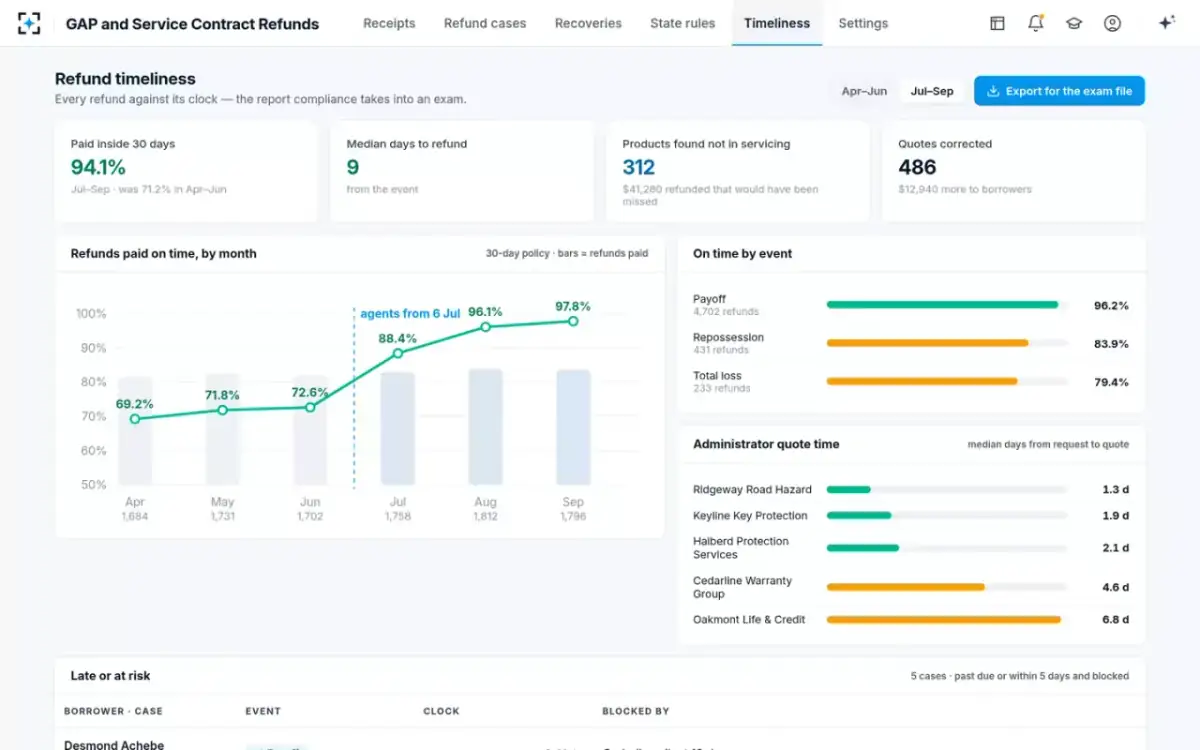
Thirty days from the event is the defensible choice for three reasons. It is the tightest number on the published record, so it cannot be argued down. It is measured from something the lender controls and timestamps, rather than from a notice that may never arrive. And it leaves room: the arithmetic takes minutes, so the days are spent on approvals and payment runs, not on waiting for an administrator — which is a choice, not a constraint. Where the days actually go takes that apart stage by stage.
Set it in steps of five days so the number can be tightened without rewriting the policy, and measure against it from day one, including on cases you expect to miss.
Decision 3: where the method comes from
Three candidate sources exist and only one of them is safe. The administrator's quote is the easiest and the worst: it is the counterparty's arithmetic, and examiners found servicers relying on "calculations performed by third parties that were not consistent with the terms of the add-on product contract". House custom is worse still, because nobody can say where it came from. The method has to come from the product contract's own clause, with the state's rule applied on top of it — and where the contract names no method, the case stops and compliance decides.
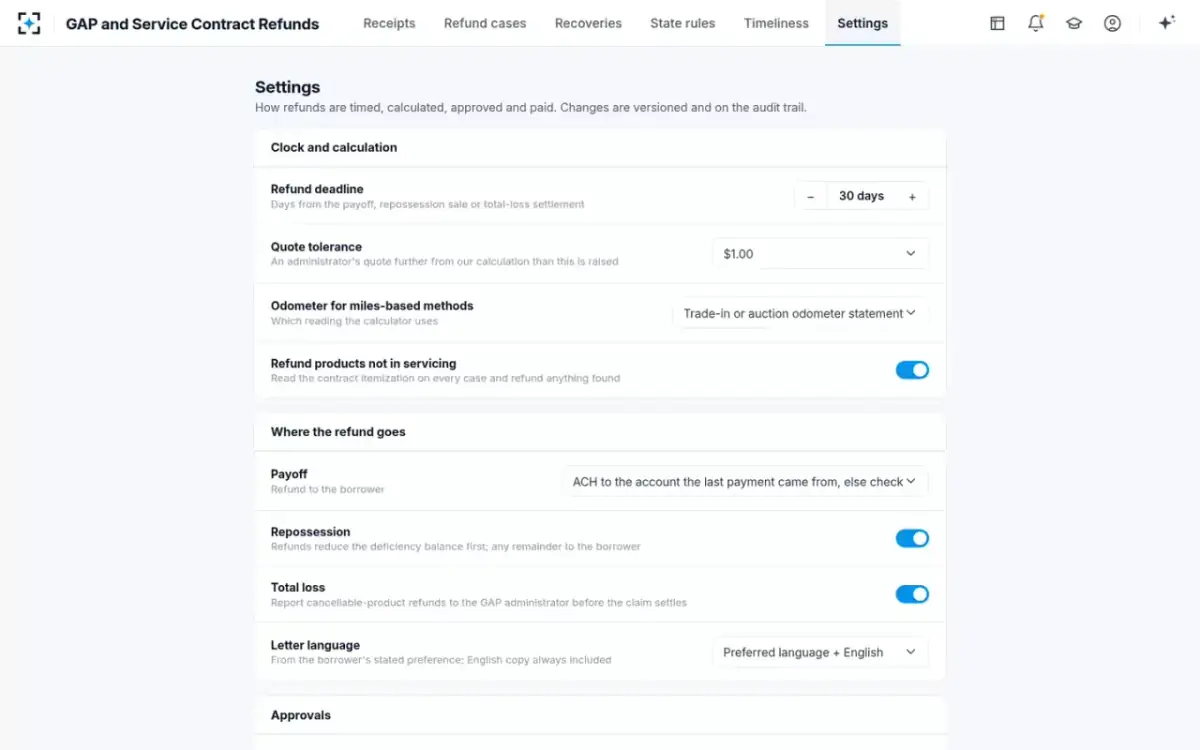
The corollary is a setting people skip: read the contract's itemization on every case, and refund the products it lists that servicing does not hold. Leave it off and the policy silently becomes "we refund the products our system knows about". Why the TILA itemization is the only complete list sets out what that costs.
Decisions 4 to 6: the inputs, the tolerance and the payment
These three are quick to decide and expensive to leave vague.
The odometer source. Any method measured by miles needs a reading, and the reading has to be from a document rather than a conversation: a signed trade-in or auction odometer statement, not the last service record and not the borrower's estimate. Name one source, allow the others only as a recorded exception, and the figure stops being arguable.
The quote tolerance. Every administrator quote is compared with the calculation, and the policy sets how far apart they may be before it is raised. A dollar is a good default: tight enough that a fee taken from a national form instead of a state addendum shows up, loose enough that rounding does not generate noise. The rule that matters more than the number is the second one — the borrower's refund is never held while a difference is argued.
Where the money goes. By direct deposit to the account the borrower's payments came from, falling back to a cheque. A refund posted to a closed account is a refund nobody received, and a cheque to an address three years old is the same thing more slowly. The letter goes in the borrower's preferred language with an English copy, and shows every calculation — which is cheaper than answering the call that follows a bare amount.
The eight decisions, the default GAP and Service Contract Refunds takes, and what goes wrong without it
| The decision | The default | Why | Without it |
|---|---|---|---|
| When the clock starts | The posted event: payoff, repossession sale or total-loss settlement | It is the only trigger the lender controls and timestamps. | Only borrowers who ask are paid — the finding examiners actually wrote down. |
| The deadline | 30 days from the event, in steps of 5 days | The tightest number on the published record, measured from an event rather than a notice. | No clock to be late against, so nothing to report and nothing to improve. |
| Where the method comes from | The product contract’s own clause, plus the versioned state rule row | It is the only source a reviewer can check against a document. | The administrator’s quote becomes the answer, which is the counterparty marking its own work. |
| Which inputs are allowed | Event date from the posted transaction; odometer from a signed statement | Both are documents with dates, so a wrong figure shows as a wrong input. | Refunds measured from the deficiency notice instead of the repossession, quietly shorter. |
| The quote tolerance | $1.00, and the borrower is never held for a difference | Catches a fee taken from a national form against a state addendum. | Quotes are accepted because disputing them is slower than paying them. |
| Where the refund goes | Direct deposit to the account the payments came from, else a cheque | The account is current by definition; the address on file may not be. | Credits sitting on closed accounts, and cheques to addresses nobody lives at. |
| Who approves | A named person per refund; a team lead above the $1,000 advance limit | Paying before recovering is a credit decision as well as a service one. | An approval that is a timestamp, which answers nothing at an examination. |
| How much is re-checked | 5% of approved refunds each week, by compliance | A control nobody samples is an intention. | The programme drifts, and the drift is discovered by somebody else. |
Decisions 7 and 8: who should approve a refund, and how much is re-checked
Approval is the point where the policy becomes a person. One named approver per refund, approving the whole case rather than each product, with the meaning of the approval recorded beside the amount and the time — "calculated and checked, pay as shown" is a sentence an examiner can read; a tick is not. A second approval applies above the advance limit, because paying the borrower in full before recovering from the dealer and the administrators means the lender is carrying the money in the meantime.
Sampling is the other half of the same control, and it belongs to compliance rather than to the team that works the queue. Five per cent of approved refunds re-checked each week is enough to find a method drifting, a rule-table version applied after it should have been retired, or an exception being closed too readily. The number matters less than the independence and the regularity.
The eight decisions as settings in GAP and Service Contract Refunds
The state rule table the policy points at
The ninth document is not part of the policy and should never be pasted into it. State rules change, and a fifty-state table inside a signed policy is a guarantee that the policy will be out of date and that nobody will notice. Point at it instead: a versioned table, owned by compliance, approved as a version, cited by every case under the version it was worked under.
Two properties make such a table defensible. GAP waivers and service contracts get separate rows, because in many states they are governed by different statutes with different methods, fee caps and clocks. And every row carries a note saying what it is based on, so a reviewer can go to the text rather than to the person who typed it. What the statutes actually say reads three of them closely and shows why the separation is not pedantry.
One thing the table is not for: deciding whether to refund. That decision was made in Decision 1, for every state. The table decides the method, the fee cap, where the refund goes and what notice is required — the how, never the whether.
Ninety days to a refund programme you can show an examiner
The plan below is ours, not a benchmark, and the durations are a proposal rather than a measurement. What makes it work is not the speed; it is that each phase ends in something that can come back false.
Ninety days, with something testable at the end of each phase
- Settle the decisions15 d
- Rule table and product forms25 d
- Live, back book in parallel30 d
- Sampling and reporting20 d
The one sequencing decision worth defending is in phase three: go live on new events before the back book is finished, not after. A programme that waits for history to be clean keeps producing the same defect on today's payoffs while it works, and arrives at an examination with a long remediation and a current failure. What examiners found, and what a file has to hold sets out how the two populations are worked with one method.
Pass marks: five sentences that have to be true before go-live, and every week after
- Every case cites the clause its method came from
Count the approved refunds whose method line has no clause behind it. The number has to be nought, and somebody has to look at it weekly.
- Every quote difference outside tolerance was raised
Compare the administrator quotes received against the calculations, and count the differences that closed with no dispute drafted.
- No refund passed its deadline without an owner
Late is a fact; unexplained is the failure. Each case past its date carries a reason and a name, and the count of those without one is reportable.
- The back book was worked by the same process as today
One method, not two. Show a historic case and a current case side by side and ask a reviewer to tell them apart.
- Products on the contract but not in servicing are refunded, not logged
Count them. If the number is nought on every case for a month, the check is not running.
The report GAP and Service Contract Refunds produces against the deadline
Finally, write down who owns the policy and when it is reconsidered. Not a review date on the page — those age badly and tell a reader nothing — but a named owner and a trigger: a new consent order in the market, a state rule change, a sampling result outside tolerance, or a product family arriving on the book that has no row in the table. What software can and cannot take on here is worth reading before the settings are signed, because two of the eight decisions are easier to hold when the work is instrumented.
Questions people ask
What should a GAP refund policy say?
Eight decisions and a pointer. The event that starts the clock, the deadline, where the method comes from, which inputs are allowed, how far an administrator's quote may differ, how the money reaches the borrower, who approves, and how much is re-checked — plus a pointer to a versioned state rule table owned by compliance. It should not restate the law, and it should not promise anything nothing measures.
What is a reasonable GAP refund deadline?
Thirty days from the event is defensible: it is the tightest number on the published record — the vehicle service agreement deadline in the 2023 Toyota Motor Credit consent order, since terminated, against 45 and 60 days for GAP depending on who administers it — and it is measured from something the lender timestamps rather than from a request that may never come.
What is a GAP refund policy after 30 days?
Two different things are often meant. One is the deadline for paying a refund, which some states enforce with a penalty — Washington adds 10 per cent to a service contract refund not paid within 30 days of the contract being returned. The other is a free-look window in which a cancellation returns the full price; that is a separate provision, and its length and fee cap vary by state and by contract.
Who should approve a refund?
One named person per case, approving the whole refund with the meaning of the approval recorded beside the amount and the time — not a tick. A second approval above an advance limit, because paying the borrower before recovering from the dealer and administrators is a credit decision. Neither approver should be the person who could change the calculation afterwards.
How much of a refund queue should be sampled?
Five per cent of approved refunds a week, re-checked by compliance rather than by the team that worked them, is a workable default: enough to catch a method drifting or an exception being closed too easily. The rate matters less than doing it independently, regularly and against the same sources the original calculation cited.
What is a state refund rule table?
A versioned list of what each state requires on a cancellation — separate rows for GAP waivers and service contracts, the method, any fee cap, where the refund goes and what notice is required, with a note on what each row rests on. It lives beside the policy rather than inside it, is owned and approved by compliance, and is cited by version on every case so an old refund can be rebuilt against the rule that applied then.