An AI agent on a loan servicing refund is a piece of software given one job, one set of documents to read and one rule about what it may never do. In GAP and Service Contract Refunds there are six of them, and between them they open the case when the loan ends, read every product off the retail installment contract, apply the method that contract names, ask each administrator to cancel, work out what the dealer owes back and draft the borrower's letter and payment. What none of them do is send anything. A named person approves every refund before any money moves, and the agents' entire output is arranged so that person can check it in under a minute.
This is a buying page, so the useful content is the limits rather than the capabilities. Anyone can list six agents. The questions that decide whether a refund programme survives an examination are narrower: what does each one read, what evidence does it leave, what happens when the document it needs does not exist, and who is on the hook for the answer.
What can an AI agent do on a loan servicing refund?
It can do the parts of the work whose answer is already written down somewhere and whose correctness can be demonstrated by pointing at the place it is written. That covers more of a refund than most people expect, because a refund is unusually document-bound: the product list is on the contract, the method is in the product form, the fee is in the state addendum, the event date is on the posted transaction and the odometer reading is on a signed statement.
It cannot do the parts where something has to be decided rather than found. Those are few, and they are the expensive ones.
The four tests a refund task passes before software may do it, and the three that fail
- The answer exists in a document
A price, a term, a method, a fee, a date. Reading is checkable: point at the line.
- The method is named, not chosen
The contract or the state rule says pro rata by days, or by the greater of time or miles. Applying a named method is arithmetic.
- The output can be compared with a source
Every figure sits beside the clause, statement or rule row it came from, so a reviewer rebuilds it without asking anyone.
- Being wrong is visible before it is expensive
A difference against an administrator’s quote, a missing clause, a date that disagrees with the posted transaction — each surfaces as an exception, not as a silent number.
- Choosing which method to use when the contract names none
That is a policy decision with legal consequences in fifty jurisdictions. It goes to compliance, and the case waits.
- Deciding to send money
Irreversible, and the thing an examiner asks who authorised. A named person approves, with the meaning of the approval recorded.
- Deciding that nothing is owed
The most dangerous answer in the work, because it closes a case quietly. It is a person’s call, with the reason written on the file.
The six agents, one at a time
Each one is narrow on purpose. A single agent that "handles refunds" cannot be told what it may never do, because everything is inside its job; six agents with one job each can each be given a line, and the lines are what a reviewer reads.
Each agent in GAP and Service Contract Refunds: what it reads, what it leaves, what it may never do
| Agent | What it reads | What it leaves behind | The line it does not cross |
|---|---|---|---|
| Event watcher | The servicing feed: payoffs, repossession sales, total-loss settlements as they post. | A case, opened on the event date, with the clock running against the policy deadline. | Never closes a case. The event date comes from the posted transaction, not from a note. |
| Contract reader | The retail installment contract’s itemization and every product form: price, term, administrator, method, fee, state addendum. | A product list with a line and clause cited for every value, and any product servicing does not hold named as such. | Never adds a product that is not on the contract. |
| Refund calculator | Each contract’s method clause and the versioned state rule row that applies to it. | Each step of the arithmetic with the source of every input, and the figure the other method would have given. | Never uses a method the contract or the rule table does not name; takes the odometer only from a signed statement. |
| Administrator canceller | The cancellation terms, and the quote that comes back. | The request sent with its date, the quote received, and the difference against the calculation. | Never accepts a quote that differs without raising it, and never delays the borrower’s refund waiting for one. |
| Dealer chargeback tracker | What the dealer charged and what it paid the administrator — the retained share. | A chargeback raised against the dealer’s next funding, with the product and amount behind it. | Never holds the borrower’s refund waiting on a dealer; a funding hold needs a person’s approval. |
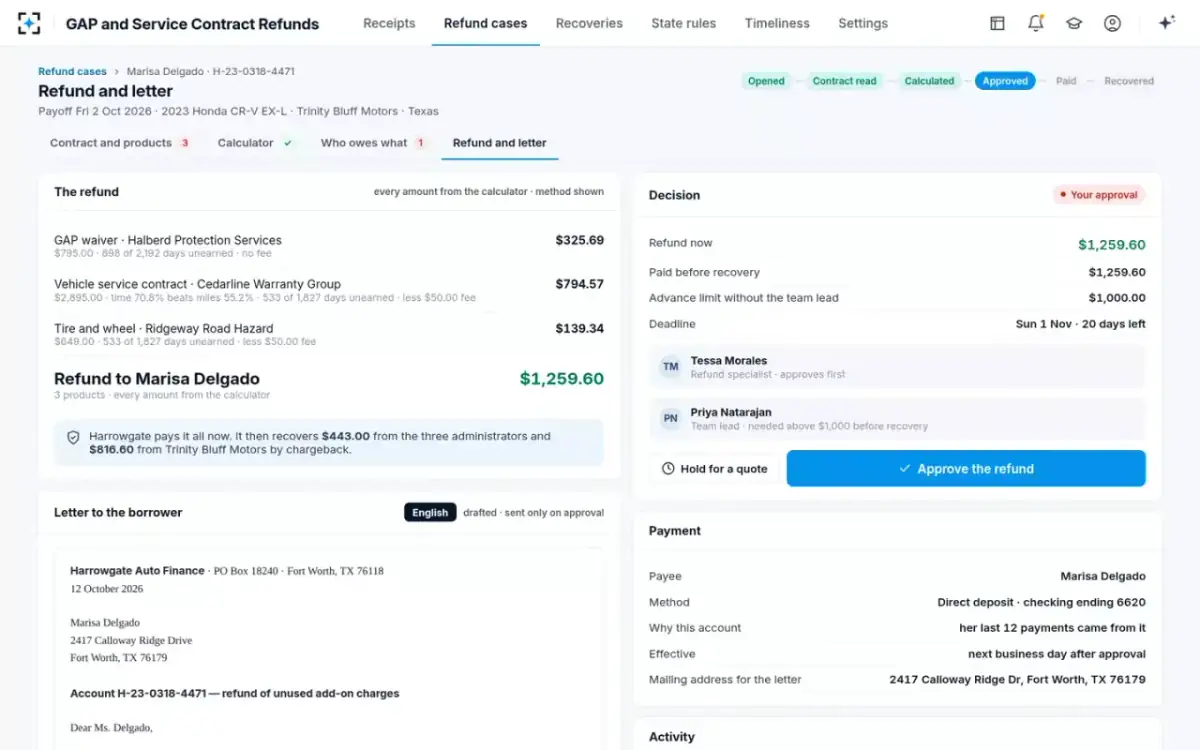
| Letter and payment drafter | The approved calculation and the borrower’s language preference and payment details. | A draft letter showing every calculation, and a draft payment — both unsent. | Never sends money or a letter, and never shows a number the calculator did not produce. |
Two things in that table do more work than they look. The contract reader's refusal to add a product that is not on the contract is what stops a plausible-looking refund for something nobody bought. And the drafter's rule that it may never show a number the calculator did not produce is what stops a letter that is beautifully written and arithmetically different from the case behind it.
What an AI agent should never be allowed to do
Three things, and all three are the same thing seen from different angles: an irreversible act, or a decision whose error nobody would notice.
Sending money is irreversible. So, in practice, is sending a letter that states an amount — a borrower told $412.60 will hold the lender to it. And deciding that nothing is owed is the quiet one: a closed case with no refund looks exactly like a correct case with no refund, and the difference only appears years later when somebody samples the population. That is precisely the failure examiners described when they found servicers who had never opened cases at all in states with no statute.
Consumers could not reasonably avoid the injury because the servicers retain substantial control over their refund processes and the calculation of payoff and deficiency balances.
CFPB, Supervisory Highlights: Auto Finance Special Edition, Issue 35
That sentence is the reason the limits are drawn where they are. The borrower cannot check this work: they do not have the method, the rule table or the dealer's cost. The whole of the control sits on the lender's side, so the lender has to supply its own adversary — a calculation that shows its working, a quote that is compared rather than accepted, and a person who signs.
Why the calculator stops rather than guesses
Some product contracts simply do not name a refund method. A general-purpose model asked for a refund on one of those will produce a number anyway, because producing numbers is what it does, and the number will be reasonable — most likely pro rata by days, which is the commonest method and often the right one. Reasonable is the problem. A figure that is right four times in five and unmarked the fifth time is worse than no figure, because nothing downstream can tell the cases apart.
So the calculator stops. The case goes to compliance with the gap named — this contract, this product, no method clause — and compliance either finds the clause, applies a rule-table default it has approved, or decides. The case waits, visibly, on its clock. A programme with no stopping condition has no exceptions, and a refund programme with no exceptions is not clean; it is unexamined.
The same logic governs inputs. A miles-based method needs an odometer reading, and the reading has to come from a signed trade-in or auction statement rather than from the last service record or the borrower's recollection. Where the signed statement is missing, that is an exception too. How each method is worked shows what a wrong reading does to the figure.
How an agent's answer is checked
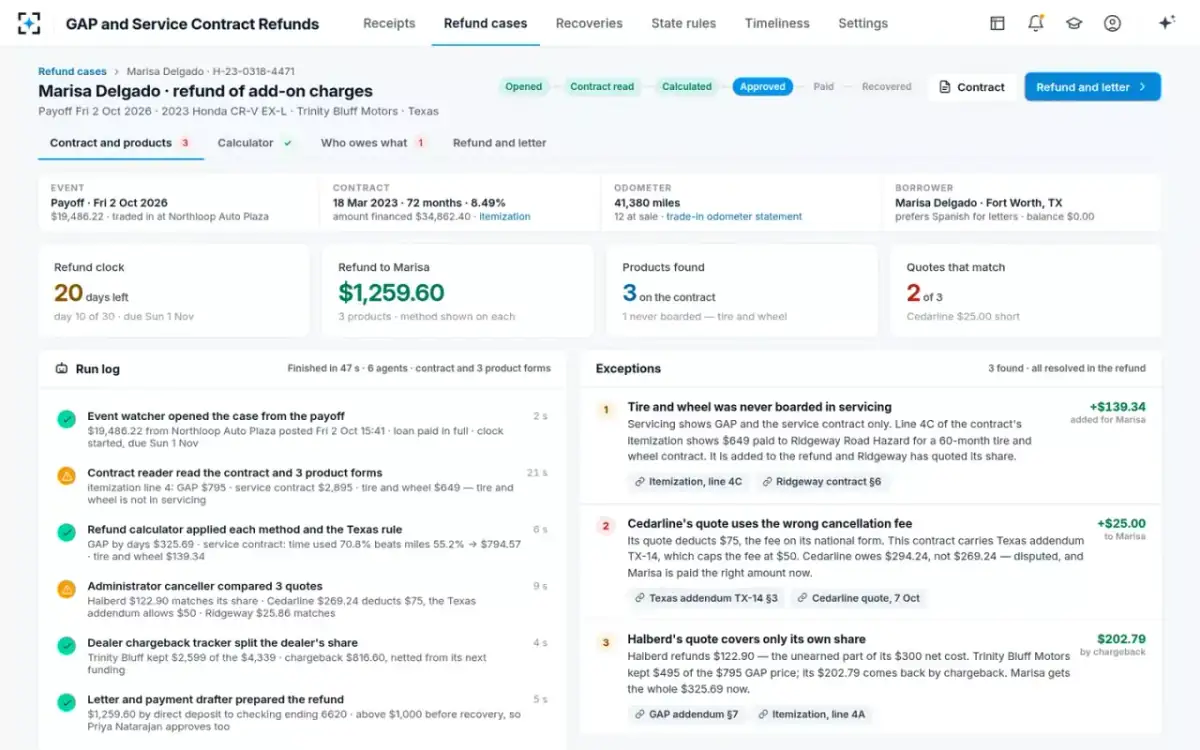
Three checks run on every case, and none of them is a confidence score. The first is the citation: every value on the receipt carries the clause, form, statement or rule-table row it came from, so a reviewer can rebuild the figure without asking anyone. The second is the second method: the receipt shows what the other permitted method would have produced, which turns a silent method error into a visible difference. The third is the quote comparison: the administrator's own figure is set against the calculation, and anything outside the tolerance is raised with a drafted dispute rather than quietly accepted.
Supervision has been explicit that the third check cannot be skipped by deference. Examiners found servicers relying "upon calculations performed by third parties that were not consistent with the terms of the add-on product contract". An administrator's quote is evidence, not an answer, and an agent that accepts it has not done the work — it has moved the error.
What GAP and Service Contract Refunds leaves on a case for a reviewer
Agents are not a chatbot on the servicing system
The distinction matters commercially, because the two are often sold with the same words. An assistant answers questions about work somebody else is doing. Agents do the work and hand over a result for approval. The difference shows up in what exists at the end: a conversation, or a case file.
An assistant over the servicing system, and agents working the refund
An assistant answering questions: Somebody asks. Quiet accounts stay quiet.
Agents doing the work: The event posts. The case opens whether or not anyone is watching.
An assistant answering questions: Whatever the servicing system holds.
Agents doing the work: The contract’s itemization, compared against servicing in both directions.
An assistant answering questions: An answer in a conversation, which disappears.
Agents doing the work: A case with a calculation, its sources, its exceptions and its clock.
An assistant answering questions: It does not. The answer looked fine.
Agents doing the work: As an exception against a named source, before the money moves.
An assistant answering questions: Nothing, unless somebody saved the chat.
Agents doing the work: The event, the method, every input, the approval and the date paid.
An assistant answering questions: Unclear, which is the point of the question.
Agents doing the work: The person who approved, by name, with the meaning they attached to it.
What the buyer should ask to see
Demonstrations of this kind of software are easy to make persuasive, because the happy path is genuinely impressive and takes under a minute. The useful questions are all about the unhappy paths, and they are worth asking in a room with your own contracts on the table.
Eight things to ask an agentic software vendor, with your own contracts in the room
- Show me a contract whose product form names no refund method.
Watch whether a number appears. If it does, ask where the method came from and who approved it.
- Show me a product on the contract that is not in the servicing file.
This is the case that finds money, and it is the one a demonstration built on clean data will not have.
- Show me an administrator quote that differs from your figure.
Ask what happens next, how the tolerance is set, and whether the borrower waits while it is argued.
- Click any number on the receipt and show me where it came from.
Not a log line saying which agent wrote it — the clause, the statement or the rule row itself.
- Change the state rule and show me what the case says afterwards.
A case should cite the version it was calculated under, so a refund worked last year can still be rebuilt against last year’s rule.
- Show me the approval, and what the approver was told they were approving.
A timestamp is not an approval. Ask what meaning is recorded, and whether it can be edited afterwards.
- Show me the report of refunds paid late, by month and by administrator.
The timeliness trend is the figure an examiner asks for, and the one a per-case tool cannot produce.
- Tell me what this does not fix.
A good answer names the dealer that never reported the product, the administrator that will not answer, and the contract that names no method.
It is also worth being plain about where agents do not help at all. They cannot make a product appear that the dealer never put on the contract. They cannot compel an administrator to answer a cancellation request, though they can make the silence visible and dated. And they cannot decide a policy question — which is why the eighth question above is the one that separates a usable answer from a sales one. The eight decisions a refund policy has to make sets out the questions that remain yours either way.
Where a person still decides
Four places, and all four are in the published record for a reason. A named person approves every refund, with the meaning of the approval recorded alongside the amount and the time. A team lead approves any advance above the limit, because paying the borrower before recovering from the dealer is a credit decision as well as a service one. Compliance owns the state rule table, approves its versions and samples approved refunds each week. And when the calculator stops, a person decides what happens next.
None of that is a limitation of the software. It is the shape the work has to have for anyone to be able to answer the examination manual's question about how a servicer "monitors optional products attached to loans or leases, including cancelling the products and providing refunds in a timely manner" (Automobile Finance Examination Procedures). Monitoring implies somebody who is monitoring. The agents make that person's job possible at volume; they do not replace them.
Nor is the point headcount. Loan interviewers and clerks are a large occupation — and one projected to decline slightly, by 1% or lower, over 2025–2035 (O*NET, 43-4131.00). The case for agents here is not that the people go away. It is that the evidence arrives: one consent order ran to tens of millions of dollars for refunds that had been calculated by a process nobody could reproduce (Toyota Motor Credit consent order, 2023), and reproducibility is a property of how the work is recorded, not of how many people do it.
Agents draft; people send, in GAP and Service Contract Refunds
Questions people ask
What can an AI agent do in loan servicing?
On refunds, it can watch for the events that end a loan, read the contract and each product form, apply the method those documents name, send cancellation requests, compare the quotes that come back, work out what the dealer owes and draft the borrower's letter and payment. All of those have an answer written in a document, which is what makes them checkable.
Can AI calculate a refund on its own?
It can produce the figure, and it should not be the last word. A refund calculated without its sources beside it is a number nobody can defend two years later. The useful design is a calculation that cites the clause, the dates and each input, is compared with the administrator's own quote, and is approved by a person before any money moves.
How is an AI agent different from a servicing chatbot?
A chatbot answers questions about work somebody else is doing; an agent does a defined piece of the work and leaves a case behind. The practical difference is what exists afterwards. A conversation leaves nothing an examiner can read. A case leaves the event, the method, the inputs, the exceptions, the approval and the date the money moved.
What should an AI agent never be allowed to do?
Send money, send a letter stating an amount, choose a method the contract and the rule table do not name, or close a case as owing nothing. The first two are irreversible; the second two are errors nobody would see. Everything else on a refund can be checked against a document, and checkable work is safe to automate.
How do you check an agent's calculation?
Three ways, run on every case rather than on a sample. Each value cites the clause or statement it came from. The result is shown beside what the other permitted method would have given, so a method error appears as a difference. And the administrator's quote is compared with the figure, with anything outside tolerance raised rather than accepted.
Where does a person still decide in an agentic workflow?
At the approval of every refund, at the approval of an advance above the limit, at the ownership and versioning of the state rule table, and wherever the calculation stops because a document does not say what it needs to say. Those are the four points where being wrong is either irreversible or invisible, which is exactly the test for keeping a person in them.