The GAP refund time frame a lender can defend is about thirty days from the event that ended the loan — the payoff posting, the repossession sale, the total-loss settlement — and on a well-run desk it takes ten. What it actually takes, on the published supervisory record, is often very much longer: in one examined matter refunds were applied "an average of 84 days after the post-repossession sale of the vehicle sale, with at least one up to 423 days afterwards", and in another "the refund delays ranged from 150 days to 664 days". Botminds' GAP and Service Contract Refunds exists because almost none of that delay is arithmetic. It is waiting, and most of the waiting is for a case that nobody has opened.
This guide takes the clock apart: the two different clocks a refund runs on, where each day goes between the loan ending and the money moving, who is waiting on whom at each point, and what a service representative can actually tell a borrower who calls to ask.
The same payoff refund, worked two ways
- Before a case opens4 d
- The products3 d
- Calculating4 d
- Waiting on quotes9 d
- Approvals and payment6 d
- Worked2 d
- Approvals and payment7 d
Read the second lane carefully, because its shape is the argument of this whole page. The agents do not make the approvals or the payment much faster — seven of the nine remaining days are still queue, letter, approval and bank time, and that is right, because a person has to read and approve a refund before money leaves. What disappears is the nine days of waiting on administrator quotes and the seven days spent noticing the event and assembling the paperwork. The work that can be compressed is the work nobody was doing on purpose.
How long should a GAP refund take?
No federal statute sets a universal figure, so the benchmarks come from three places, and they agree more than they differ.
From consent orders: 45 days from notice of cancellation for a GAP product the lender's own affiliate administers, 60 days where a third party administers it, and — for a vehicle service agreement — "no later than 30 days following cancellation" (Toyota Motor Credit consent order, 2023). From state law: Washington adds "a 10 percent penalty… to any refund that is not paid within 30 days of return of the contract to the provider" (RCW 48.110.075(4)(c)). From supervision generally: the published finding is not that refunds were a few days late but that they were months late, which tells you the bar is not being missed by a margin.
Thirty days from the event is therefore the number to design to. It is inside every deadline on the record, it is one number rather than four, and — importantly for an examiner — it does not require the lender to work out which clock applies before it knows how long it has.
When the refund clock starts, and the clock that actually counts
There are two clocks, and a refund programme usually measures the wrong one.
The first clock starts when the loan ends: a payoff posts, a repossessed car sells, a total-loss settlement clears. The lender can see all three the day they happen, because all three are transactions on its own system. This is the clock the borrower is living on — their money stopped being the product's and started being theirs on that date — and it is the clock Texas writes into statute, where a refund "must be based on the earliest date" of prepayment in full, an acceleration, a cancellation request or a denied claim.
The second clock starts when somebody opens a case: a borrower calls, a dealer forwards a cancellation form, a monthly report flags an account. This clock is the one most service-level agreements are written against, and measured on it a desk can look fast while borrowers wait months. A refund paid five days after a case was opened, where the case was opened ninety days after the payoff, is a five-day refund in the report and a ninety-five-day refund in the borrower's bank account.
The gap between the two clocks is the whole of the published problem. Examiners did not find servicers taking 664 days to do arithmetic. They found servicers who had not started.
Why do GAP refunds take so long?
Six waits sit between a loan ending and money arriving, and only one of them is work.
Who is waiting on whom, and what ends each wait
The borrower
OnNobody — and that is the problem
WhyMost borrowers do not know a refund is owed, so nothing starts when the loan ends.
What ends itStart the case from the posted event, not from a call.
The refund specialist
OnThe contract images
WhyThe retail installment contract and three or four product forms have to be found before anything can be worked out.
What ends itRead the contract on every case, the day the case opens.
The specialist again
OnThe administrator’s quote
WhyA cancellation request goes out and the answer comes back in days or weeks, often by email.
What ends itCalculate independently, pay the borrower, then reconcile the quote.
The approver
OnThe queue
WhyRefunds are approved in batches, so a case finished on Tuesday may be approved the following week.
What ends itRank the queue by days left on the clock, not by date opened.
The dealer recovery team
OnThe next funding
WhyA chargeback is netted when the dealer next funds a deal, which may be weeks away.
What ends itRecover after payment, never before it.
The service representative
OnAll of the above
WhyA borrower asking where their money is gets "it is being processed", because no date exists to give them.
What ends itPut the amount, the stage and the due date on the case, visible to the person answering the phone.
Why waiting for the administrator's quote is a choice
The administrator wait is the one worth arguing about, because it is usually defended as prudence. The reasoning goes: we cannot pay the borrower until we know what the administrator will send us, because otherwise we might pay the wrong amount or be out of pocket. Both halves are wrong. The amount the borrower is owed is set by the contract and the state's rule, not by what the administrator agrees to send, so the quote is not the authority on the figure. And being out of pocket for a few weeks is a funding question for a lender, not a reason for a person to go without money that is theirs.
It is also the largest removable wait on most desks: nine of the twenty-six days in the estimate above, more than a third of the whole elapsed time, spent on an answer that does not change what is owed. Removing it does not mean ignoring the quote. It means reversing the order — calculate from the contract, pay the borrower, then compare the quote with the calculation and raise anything outside tolerance with the clause that explains it.
The published position is the same. A refund programme that holds payment pending recovery has made the borrower the financier of its own dispute — and both consent orders on the point, since terminated, separated the two explicitly, requiring the refund while leaving the lender free to seek "reimbursement for refunds from any other party". Who is responsible for refunding GAP insurance follows the recovery side.
The repossession tail: 84 days on average, 423 at the worst
Repossession refunds run later than payoff refunds, consistently, and the reason is structural. A payoff is a single clean event. A repossession has four candidate dates — the recovery, the sale, the deficiency calculation, the deficiency notice — and a refund programme that has not chosen one will drift to the latest, because the latest is the one that lands in somebody's queue.
How late refunds actually were, where examiners measured them
The cost of the delay is not only the borrower's. After a repossession the refund reduces the deficiency balance, so every week it is late is a week the lender is reporting, collecting on and sometimes selling a balance that is too high. Of 905,000 repossession disposals in the CFPB's auto finance data pilot, "94 percent ended with a deficiency balance", averaging $11,340 by December 2022 (Repossession in Auto Finance). A refund applied 84 days after the sale is 84 days of collection activity on a figure the lender already knew was wrong — and examiners recorded exactly that: the practice "results in inflated payoff and deficiency balances".
There is one date error worth naming because it is invisible and mechanical. Examiners found servicers who "used the date of a deficiency notice for making a pro rata calculation instead of the date of the repossession". That does not just delay the refund; it shrinks it, silently, on every file, by however many days separate the two.
Three events, and why only one of them has a clean date
The three ways a loan ends early do not present the same timing problem, and treating them as one queue is how a desk ends up with a tail.
An early payoff or trade-in is the clean case: one transaction, one date, posted on the lender's own system, with no further event to wait for. There is no good reason for a payoff refund to be late, and a programme whose payoff refunds are late has a case-opening problem rather than a processing one.
A repossession has several dates and an unavoidable gap, because the deficiency is not known until the car is sold. The discipline is to fix the measuring date in policy — the repossession or the sale, written down, applied to every file — and to apply the refund to the deficiency before collection begins rather than after.
A total loss is the slowest, because a third party sets the pace: the physical damage carrier has to settle before the balance is known. The refundable vehicle products, though, do not have to wait for any of that. Their cancellation can start the day the car is declared a total loss, and it should, because those refunds change the number the GAP waiver is asked to cover.
What the clock does to the people who work it
Refund work sits with a small, specialised group. In the United States about 169,100 people work as loan interviewers and clerks (O*NET, 43-4131.00, 2025); refunds are a slice of that, and on a mid-sized auto book it is a handful of desks carrying thousands of cases. In the solution's sample lender a refund specialist works about sixty cases a day, each one carrying three companies' arithmetic and a deadline that is hers.
The five people a refund passes, and what the clock does to each
Today
About sixty cases a day, three companies’ arithmetic on every one, and a deadline she owns but cannot see.
With agents
Starts from a printed figure with every line cited and the issues already flagged, and approves one refund.
Still theirs: The approval, and the judgement about anything flagged.
Today
Borrowers wait while the dealer’s share of the refund waits on a chargeback.
With agents
Approves advances above the limit and sees what is owed back by each administrator and dealer.
Still theirs: Whether to advance before recovery.
Today
Asks which method and which fee applied, and finds the answer in somebody’s memory.
With agents
Owns a versioned state rule table cited on every case, and samples approved refunds each week.
Still theirs: The rule table, and the sample.
Today
Takes "where is my refund?" calls with no amount, no date and no reason to give.
With agents
Sees the case, the amount and the due date, and answers on the first call.
Still theirs: The conversation.
Today
Knows that one refund finding means a lookback across every payoff since 2021.
With agents
Reads timeliness by month, by event and by administrator, and can show it.
Still theirs: The policy, and the answer to the examiner.
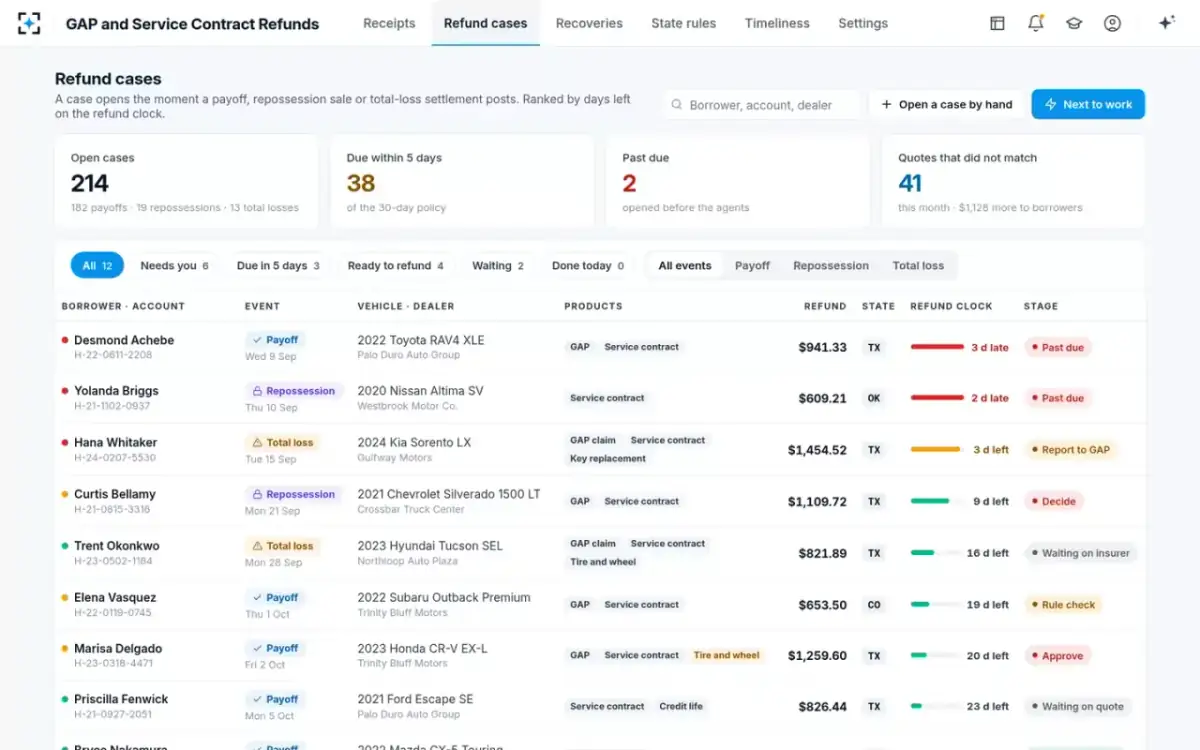
What changes for all five is the same thing: the deadline becomes visible. A queue ranked by date opened tells a specialist what arrived first. A queue ranked by days left on the clock tells her what will breach, which is the only ordering that protects the slowest cases — and the slowest cases are where the 664-day findings live.
A queue ranked by the clock, not by the date it arrived
What to tell a borrower who asks where their refund is
The question a service representative dreads is "where is my money?", and the reason it is dreaded is that the answer is usually "I cannot see". Four facts turn that call around, and all four are properties of the case rather than of the representative: the amount, the products it covers, the stage it has reached, and the date it is due. A borrower told "$1,259.60 for three products, calculated, approved on Tuesday, in your account by the 13th" does not call again. A borrower told "it is being processed" calls three more times, and then complains.
The same four facts are what an examiner asks for, from a different direction. The published examination module asks the servicer to "determine how the servicer monitors optional products attached to loans or leases, including cancelling the products and providing refunds in a timely manner" (Automobile Finance Examination Procedures). Monitoring, in that sentence, means being able to say where every open refund stands — which is the same capability as answering the phone well.
Five measurements that tell you whether your refund clock is real
- Median days from event to payment, not from case to payment
The second number flatters every programme. Only the first is the number the borrower experienced.
- The ninety-fifth percentile, not the median
Medians hide tails, and the tails are what examiners quote. One 423-day case moves no median at all.
- Share of cases opened by an event rather than by a contact
If it is not close to all of them, the quiet borrowers are the ones not being paid.
- Days spent waiting on administrator quotes, measured separately
It is the largest single wait on most desks, and the only one that can be removed outright.
- Refunds paid inside the policy, by month, by event and by administrator
Three cuts, because the failure is never uniform — repossession refunds and one slow administrator will own the tail.
Two further pages follow this one. Ancillary product refunds covers which products are in scope and who has to act, and how to calculate a GAP refund is the arithmetic the clock is waiting on.
Questions people ask
How long does a GAP refund take?
Designed well, about ten days from the payoff; a thirty-day policy measured from the event is inside every published deadline. Found by examiners, often far longer — an average of 84 days after a repossession sale in one matter, and a range of 150 to 664 days in another. The variation is almost entirely in how quickly a case is opened, not in how long the calculation takes.
Why do GAP refunds take so long?
Usually because nothing started. Many refund processes begin when a borrower or a dealer contacts the lender, so a loan that ended in March may not become a case until June. After that, the commonest remaining wait is the lender holding payment until the administrator sends its quote — which the lender does not need in order to know what the borrower is owed.
When does the refund clock start?
It should start at the event that ended the product: the payoff posting, the repossession sale or the total-loss settlement. Texas writes this into statute for GAP waivers, requiring the refund to be measured from the earliest of prepayment in full, a demand or acceleration, a cancellation request or a denied claim. Three of those four are events the lender sees without being told.
How long does an administrator take to send a quote?
Days to weeks, and it varies by administrator rather than by case, which is why it is worth measuring per administrator. The practical answer is not to speed the quote up but to stop depending on it: calculate the refund from the contract, pay the borrower, and reconcile the quote afterwards as a recovery question.
How long after a repossession is a refund applied?
It should be measured from the repossession or the sale, and applied to the deficiency balance before that balance is collected on. Examiners found refunds applied an average of 84 days after the post-repossession sale in one matter, with one case at 423 days — during which the lender was pursuing a deficiency balance it knew to be overstated.
What should a servicer tell a borrower who asks where their refund is?
The amount, the products it covers, the stage the case has reached and the date the money will arrive. If any of those four cannot be answered from the case, the gap is in the system rather than in the conversation, and the borrower will call again until it is closed.