A lender's GAP refund calculation takes the price the borrower paid for the waiver, work out the share of its term that was never used, apply the method the contract itself names, and deduct only the cancellation fee that contract and that state allow. Everything hard about it lives in those last two clauses. The method is not a house convention; it is a term of the agreement, and Texas requires an agreement to say which one it uses. The fee is not the administrator's standard figure; it is whatever the contract — and any state addendum attached to it — permits. Botminds' GAP and Service Contract Refunds works each product with the method its own contract names, shows the source of every input beside the step that uses it, and will not print a figure when the contract names no method at all.
The worked examples below use the solution's sample data: a fictional borrower, Marisa Delgado, with a fictional lender, Harrowgate Auto Finance, a service contract from a fictional administrator, Cedarline. The statutes and the federal rules quoted are real and linked where they appear.
A refund is four inputs, one method and one fee
The price
From the contract
What the borrower was charged for this product, as itemized on the retail installment contract — not what the administrator was paid for it.
Retail installment contract
The term used
Event date − start date
Measured from the date of the event that ended the product: the payoff, the repossession, the total loss. Not the date the paperwork caught up.
Servicing, from the posted transaction
The miles used
Odometer − starting miles
Only where the method needs it. The reading has to come from a signed odometer statement, not an estimate.
Signed odometer statement
The fee
Contract, as amended by the state addendum
A fixed cancellation fee the contract allows and the state permits. The commonest error in the whole calculation.
Contract and state addendum
How do you calculate a GAP refund?
Almost every GAP waiver and almost every vehicle service contract refunds pro rata: the unearned share of the price equals the unearned share of the term. A $795 GAP waiver on a 60-month contract, cancelled at the end of month 20, has 40 of its 60 months left, so two-thirds of its price — $530.00 — is unearned. Deduct the fee, if the contract allows one, and that is the refund.
Texas requires the agreement to be explicit about it. Its regulator's guidance on debt cancellation agreements, the Texas name for a GAP waiver, says that under Finance Code § 354.004(10) "the agreement must state the method for calculating refunds. The two most commonly used methods are: (1) the pro rata method, and (2) the pro rata method minus a fixed cancellation fee." It then forbids the obvious abuse: "The agreement may not state that the fee for the agreement is fully earned (i.e., nonrefundable) from the inception of the retail installment contract" (OCCC Advisory Bulletin B16-2).
Washington writes the method into the statute for service contracts. A provider "shall refund the purchase price pro rata based upon either elapsed time or mileage computed from the date the contract was purchased and the mileage on that date, less a cancellation fee not exceeding $25" (RCW 48.110.075(4)(b)). Florida takes a different route again: after the free-look window, a cancellation by the holder or the lender returns "not less than 90 percent of the unearned pro rata premium, less any claims paid on the agreement" (Fla. Stat. § 634.121(3)(b)). Same product, three arithmetics. GAP refund law by state reads the three texts side by side.
The four inputs, and where each one must come from
The inputs decide the answer, and three of the four have a documentary source that a reviewer can check. Get the source wrong and the method cannot save you.
The price is what the borrower was charged, which is not always what the product cost. A service contract that cost the dealer $1,032 and was sold for $1,891 refunds against $1,891, because that is what the borrower financed and paid interest on. The figure belongs on the itemization of the amount financed, which is why that document — and not the servicing file — is the starting point.
The term used runs from the contract's start date to the date of the event, and the event date is a fact, not a choice. The CFPB found servicers getting this wrong in a specific, costly way: a miscalculation happened "when, for example, the servicers used the date of a deficiency notice for making a pro rata calculation instead of the date of the repossession". Weeks of refund disappear in that substitution, invisibly, on every file.
The miles used only matter where the method asks for them, and then only from a document. Federal law already puts a signed mileage statement into the chain on any transfer of ownership: in connection with a transfer, "the transferor shall disclose the mileage to the transferee… This disclosure must be signed by the transferor and must contain the transferor's printed name", together with "the odometer reading at the time of transfer (not to include tenths of miles)" and the date (49 CFR § 580.5). A trade-in or an auction sale therefore produces exactly the evidence a mileage-based refund needs. A service advisor's note does not.
The fee is covered below, because it deserves its own section.
Pro rata by days, worked
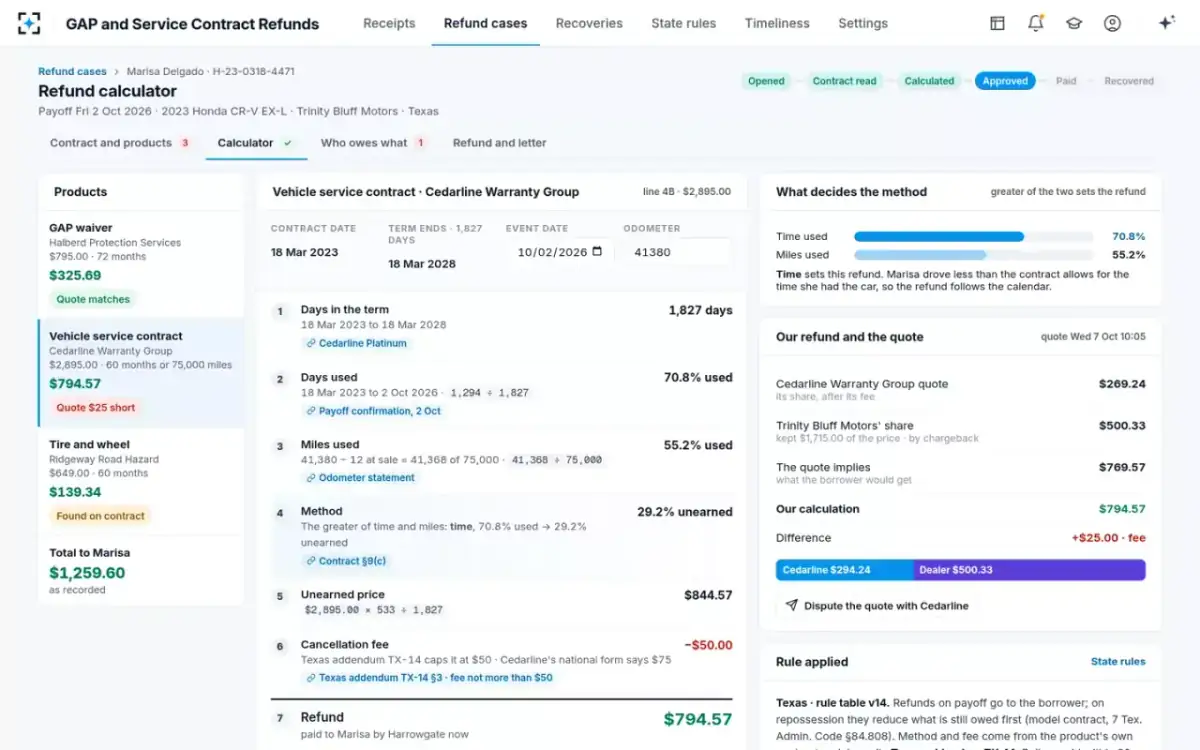
Take the sample case. Marisa Delgado's service contract from Cedarline ran 1,827 days — five years — at a price of $2,895. Her loan was paid off on day 1,294, leaving 533 days unused. The pure time calculation is one line.
A pro rata service contract refund, step by step
| Step | Calculation | Result |
|---|---|---|
| 1. The price the borrower paid | From the contract itemization | $2,895.00 |
| 2. The term, in days | 5 years | 1,827 days |
| 3. Days used at the payoff | Contract start to the posted payoff date | 1,294 days |
| 4. Days unused | 1,827 − 1,294 | 533 days |
| 5. Unearned share of the term | 533 ÷ 1,827 | 29.17% |
| 6. Unearned price, before the fee | $2,895 × 533 ÷ 1,827 | $844.57 |
| 7. The cancellation fee the contract allows | Capped by the state addendum attached to this contract | −$50.00 |
| 8. The refund | $844.57 − $50.00 | $794.57 |
Note what step 3 does not do. It does not round to whole months, and it does not use the month the paperwork cleared. Days are the honest unit when the contract is written in days, and a programme that converts to months quietly gives the borrower less about half the time and more the other half — which is worse, not better, because the errors do not cancel in a sample.
The greater of time or miles, worked
Many vehicle service contracts measure consumption two ways and keep the larger. Marisa's did. By time she had used 1,294 of 1,827 days, 70.8%. By mileage she had driven 41,368 of the contract's 75,000, 55.2%. The contract refunds on whichever use is greater, so time governs, and the mileage figure never reaches the answer.
The same contract, measured two ways
Measured by time (the one that governs): 1,294 of 1,827 days — 70.8%
Measured by mileage: 41,368 of 75,000 miles — 55.2%
Measured by time (the one that governs): 29.17%
Measured by mileage: 44.84%
Measured by time (the one that governs): $844.57
Measured by mileage: $1,298.19
Measured by time (the one that governs): $794.57
Measured by mileage: $1,248.19
Measured by time (the one that governs): The contract refunds on the greater of time used or miles used. Time is greater, so time sets the refund.
Measured by mileage: A light driver loses the mileage argument. The method is not unfair, but it has to be read before the number is quoted.
Two practical consequences follow. The first is that a mileage reading is load-bearing: a contract measured on the greater of two uses needs the odometer from a signed statement, because a reading taken a thousand miles out can flip which measure governs. The second is that borrowers are routinely quoted the wrong figure by whoever answers the phone first, because the wrong measure is the easy one to compute. The solution shows both measures on the calculation and marks the one the contract made decisive.
Every step of the method, with the clause it came from
What is the Rule of 78, and is it allowed?
The Rule of 78 — the sum-of-the-digits method — front-loads earnings. Instead of earning its price evenly, a 60-month product earns 60 parts in month one, 59 in month two and so on, out of 1,830 parts in total. Cancel at the end of month 20 and the unearned part is the sum of the remaining 40 digits, 820, divided by 1,830: 44.8% rather than the 66.7% pro rata gives.
Pro rata or the Rule of 78: the same cancellation, two answers
Is it allowed? The answer has two halves, and conflating them is how a refund policy goes wrong.
On interest, federal law settled it. The Truth in Lending Act requires that "if a consumer prepays in full the financed amount under any consumer credit transaction, the creditor shall promptly refund any unearned portion of the interest charge to the consumer", and for "any precomputed consumer credit transaction of a term exceeding 61 months… the creditor shall compute the refund based on a method which is at least as favorable to the consumer as the actuarial method" (15 U.S.C. § 1615). The Rule of 78 is less favourable than the actuarial method, so on long precomputed credit it is out.
On an add-on product's price, § 1615 does not reach: it governs the interest charge, not the premium for a service contract or the fee for a GAP waiver. What governs there is the contract and the state. Washington writes pro rata into the statute; Florida writes pro rata into the statute; Texas requires the agreement to name its method and forbids a fully-earned-at-inception clause. A programme that tells its examiner "the Rule of 78 is illegal" has cited the wrong authority for the right instinct, and a programme that tells itself "§ 1615 only covers interest, so we are free" has stopped reading two sentences early.
In the sample data the practical gap is visible on individual cases: the solution prints a method check beside every receipt, and on Marisa's refund the Rule of 78 would have left her $887.77 short of the $1,259.60 the contract and the state actually required.
The cancellation fee is the quietest error
Nothing on a refund goes wrong as often, or as invisibly, as the fee. It is a small number on a large one, it comes from a different document from the rest of the calculation, and the party that applies it is usually not the party that holds the document.
The mechanics are ordinary. An administrator operates nationally and quotes from its national form, which names one fee. The contract the borrower actually signed carries a state addendum, which names another. Nobody is lying; the quote is simply computed from the wrong page. In the sample case the administrator deducted $75 from its own form, while the Texas addendum on that contract capped the fee at $50 — so the administrator owed $294.24 rather than the $269.24 it had quoted, and the borrower was $25 short until somebody noticed.
Where $2,895 of service contract price went, and what came back
The price at signing
- Earned over 1,294 days used · 70.8%
- Unearned at the payoff · 29.2%
The unearned $844.57
- Refunded to the borrower: $794.57 · 94.1%
- Fee: $50 · 5.9%
If the fee had been the administrator’s $75
- Refunded: $769.57 · 91.1%
- Fee: $75 · 8.9%
Checking the administrator's quote against your own figure
A refund programme that forwards whatever the administrator returns has outsourced its arithmetic and kept the liability. Examiners have said so: in some cases "servicers rely upon calculations performed by third parties that were not consistent with the terms of the add-on product contract", and that was recorded as an unfair practice, not as a supplier problem (Supervisory Highlights, Issue 35).
The check is simple to describe and tedious to do by hand, which is why it usually is not done. Calculate independently from the contract. Compare with the quote. Where the two differ by more than a tolerance you have set — a dollar is a reasonable one — raise it with the clause that explains the difference, and pay the borrower the amount the contract requires while the dispute runs. The discipline matters because small differences are the ones that survive. Toyota Motor Credit's own consent order records "flawed system logic" that mis-calculated free-look refunds, affecting "at least 116 consumer accounts, causing $52,022 or more in monetary losses" — an average of about $450 each, far too small for any one borrower to litigate and far too consistent to be an accident (consent order, 2023).
What a defensible calculation shows
A refund figure is only as good as a reviewer's ability to rebuild it a year later without talking to the person who produced it. That means every line carries four things: the amount, the method, the input it used and the document that input came from. The sample receipt does exactly this — click a line and the margin note gives the clause, the product form, the odometer statement or the rule-table row behind it, and the agent that wrote it.
It also means the calculator refuses rather than guesses. If a contract names no refund method, the right behaviour is to stop and ask the people who own the rule table, not to apply the house default and move the case along. A default silently applied is the single hardest error to find later, because nothing on the file says a decision was made. Where the days go shows what an unwritten default does to a queue, and who owes the money explains why a right figure still has three parties to settle with.
Questions people ask
How is a pro rata refund calculated?
Divide the unused part of the term by the whole term, multiply by the price the borrower paid, and deduct any cancellation fee the contract and the state allow. On a 1,827-day service contract cancelled with 533 days left, that is 533 ÷ 1,827 = 29.17% of the price. Use the date of the event that ended the product, not the date the file was worked.
Is the Rule of 78 allowed for refunds?
For refunds of interest on precomputed consumer credit with a term longer than 61 months, no: federal law requires a method at least as favourable to the consumer as the actuarial method. For the refund of an add-on product's price, federal law is silent and the contract and the state decide — and several states require pro rata outright. Check the contract's stated method and the state's statute before assuming either way.
What cancellation fee can be taken from a refund?
Only one the contract allows, and only up to any cap the state sets. Washington caps a service contract cancellation fee at $25. Florida caps the administrative fee on a free-look cancellation at 5% of the gross premium. An administrator's national form is not authority for the fee on a contract carrying a state addendum.
What odometer reading is used for a refund?
The one on a signed odometer statement, taken at the event. Federal law already requires a signed mileage disclosure on a transfer of ownership, which means a trade-in or an auction sale produces a document with a date, a reading and a signature on it. An unverified figure from a service record should not decide a refund that turns on mileage.
Why is a refund often less than the borrower expected?
Three reasons account for most of it. The contract may measure consumption by the greater of time used or miles used, so a light driver is still charged for the time. A cancellation fee may have been deducted. Or the refund may have been calculated to a later date than the event — a deficiency notice rather than the repossession, say — which quietly removes days of unearned term.
How do you check an administrator's refund quote?
Recalculate it from the contract before accepting it: the price from the itemization, the dates from the posted event, the method and fee from the contract as amended by any state addendum. Compare the two figures, raise anything outside a small tolerance with the clause that explains it, and do not hold the borrower's money while the difference is argued out.