A vehicle service contract refund after a total loss is the unearned part of the contract's price, measured from the date of loss, owed because a contract that pays for repairs has nothing left to repair. The CFPB groups service contracts with the products that are "of no value" once a vehicle is "declared a total loss" and treats a servicer's failure to ensure the refund as unfair (CFPB Supervisory Highlights, Issue 35). For a lender the refund is the easy part. The hard part is that two settlements run on the same balance at the same time: the GAP waiver, which covers what insurance does not, and the refunds on vehicle products, which reduce the balance the waiver is calculated against. Worked in the wrong order, the same dollars are counted twice or not at all, and the borrower keeps paying for a car that no longer exists. Botminds' GAP and Service Contract Refunds opens a case when the total-loss settlement posts, cancels each vehicle product from the date of loss, and reports the refunds to the GAP administrator before the claim settles.
Figures marked as sample data come from the solution's fictional people and contracts; the illustrative total loss below is our own arithmetic. Supervisory findings are real and linked where they appear.
These products were of no value once borrowers' loans were terminated due to early payoffs, repossession, or total loss (or in the case of some products, such as service contracts, only once the vehicles were repossessed or declared a total loss).
CFPB Supervisory Highlights, Issue 35 (Fall 2024)
Does a vehicle service contract refund after a total loss?
Yes: the unused part of its term is refundable from the date of loss, less any cancellation fee the contract and state allow. A service contract promises repairs for a term in months and miles; once the vehicle is declared a total loss, the rest of the term cannot be used. The same is true of tire and wheel, key replacement, appearance and prepaid maintenance products, which are attached to the vehicle rather than to the loan.
The refund does not start itself. Almost every service contract requires a cancellation request with the date and the odometer reading, sent to the administrator named on the product form, not to the dealer that sold it. In a total loss the borrower is dealing with an insurer, a rental and a replacement car, and is the person least likely to send it. That is why supervisors look to the servicer: examiners found servicers "failing to ensure consumers received refunds of unearned premiums for add-on products" after early termination, "either by ensuring that dealers or administrators provided refunds or by providing the refunds themselves". Toyota Motor Credit's 2023 consent order included unfair practices in "failing to provide refunds owed to consumers who canceled their vehicle service agreements" (CFPB consent order, 2023).
Credit products and vehicle products end differently
The distinction that governs a total loss is what each product was attached to. The CFPB's examples: GAP products "are credit products that are offered to help pay off the loan if the car is totaled or stolen", while vehicle products "relate to the vehicle itself", as when "consumers may purchase a vehicle service contract to pay for the cost of certain repairs".
The same total loss, seen by the GAP waiver and by the service contract
The GAP waiver: The loan balance.
The vehicle service contract: The car, for a term of months and miles.
The GAP waiver: Triggers it: this is the event it was sold for.
The vehicle service contract: Ends it early, with the term unfinished.
The GAP waiver: No. It performs by waiving part of the balance.
The vehicle service contract: Yes: the unused share of the term, less any allowed fee.
The GAP waiver: The lender files the claim; the administrator calculates the waiver.
The vehicle service contract: Someone must cancel it with the date of loss and the odometer.
The GAP waiver: Pays what is left after everything else is applied.
The vehicle service contract: Its refund reduces the balance the waiver calculates against.
Does a service contract refund reduce the GAP waiver?
Where the waiver's terms deduct refunds of cancellable products, yes, and the deduction is why the order matters. The CFPB describes what a waiver generally covers: "The GAP waiver generally waives the amount owed under the retail installment contract or loan as of the date of the total loss, less any unpaid loan payments or similar charges, and less the actual cash value of the collateral as of the date of a total loss." A waiver written to deduct cancellable-product refunds needs the service contract refund as an input before it can be finalised.
Where the waiver does not deduct them, the refund is the borrower's money on top of the settlement. Either way the refund is owed; what changes is who holds it at the end and how many parties have to chase it. The illustrative case below shows the difference when the waiver does deduct.
One total loss, two orders of work, and the money each leaves behind
| Line | Refunds reported before the claim settles | Claim settles first, refunds later |
|---|---|---|
| Balance owed at the date of loss | $24,180.00 | $24,180.00 |
| Insurer's actual cash value settlement | −$19,650.00 | −$19,650.00 |
| Service contract and tire and wheel refunds, from the date of loss | −$2,358.00 | Not yet known |
| Amount the GAP waiver is asked to cover | $2,172.00 | $4,530.00 |
| What arrives afterwards | Nothing outstanding | $2,358.00 against an account already settled |
| Who is chasing whom | Nobody: one calculation, one settlement | The GAP administrator wants $2,358.00 back; the borrower is owed a refund nobody has sent |
What order should a lender work a total loss in?
Stop billing, settle the insurance, cancel the vehicle products from the date of loss, report their refunds to the GAP administrator, then let the waiver settle and refund whatever is left. Every other order produces a reconciliation, and the step most often dropped is the fourth, because reporting a refund to the waiver administrator makes the claim smaller rather than faster and helps nobody holding the file at that moment.
A total loss in the order that produces one clean settlement
A person decides
Stop the monthly billingOnce the lender knows a GAP waiver will cover the balance, it stops collecting payments on a vehicle that no longer exists.
Agent
Post the insurance settlementThe actual cash value payment reduces the balance as of the date of loss.
Agent
Cancel every vehicle productService contract, tire and wheel, key and others, each from the date of loss with the odometer from the total-loss valuation.
Never: Uses the date the claim closed.
Agent
Report the refunds to the GAP administratorSo the waiver is calculated on the balance after the refunds, where its terms require it.
A person decides
Settle the waiver and refund the restA refund specialist approves; anything left after the balance clears goes to the borrower as money.
The third step carries a quiet error with a cost on every case. A refund measured from the date the claim closed, rather than the date of loss, hands the administrator the weeks in between. On the sample service contract, $2,895 over 1,827 days, each day is worth about $1.58, so a month of drift is about $48 per contract by our arithmetic: too small for anyone to query, repeated on every total loss in the book. Examiners recorded the same kind of error after repossessions, where servicers used "the date of a deficiency notice for making a pro rata calculation instead of the date of the repossession".
Why payments after the loss became a supervisory finding
Because a borrower whose car was destroyed was paying for it and its replacement, and could not safely stop. Examiners found servicers "collecting monthly payments even after they knew the GAP waiver would cover the outstanding balance, and then failing to accurately reimburse consumers who made these payments". They "continued to collect monthly payments from consumers for months after a total loss event", and when the refunds came after the waiver was finalised, they "miscalculated the amount owed to consumers, resulting in underpayments".
The report spells out the harm in a lender's terms: consumers "may be forced to make multiple car payments, one for their totaled vehicle and another for a new vehicle", and "if consumers ceased making these payments servicers would furnish negative credit reporting information". The finding and the service contract refund are the same question in two forms: does the lender act on the date of loss, or on the date its own paperwork caught up? The CFPB's examination procedures ask how refunds are processed after a loan "is terminated (e.g., after repossession or total loss)" and whether the process considers state law (CFPB Auto Finance Examination Procedures).
Where does the refund go when a balance remains?
Follow the balance, not the product. If the insurance settlement and the waiver together have not cleared the balance, a vehicle product refund reduces what remains; the borrower should not receive cash while still carrying a debt the refund could have retired. If the balance is clear, the refund belongs to the borrower outright and should reach them as money.
Two failures live in the second case. A refund posted to a closed account sits as a credit balance nobody watches. A refund netted against a deficiency the waiver was supposed to have covered quietly reduces someone else's liability with the borrower's money. Both are visible when a case carries the balance and the refunds on one page, and invisible when they live in different systems. How long the borrower should wait for the money is the subject of the GAP refund time frame.
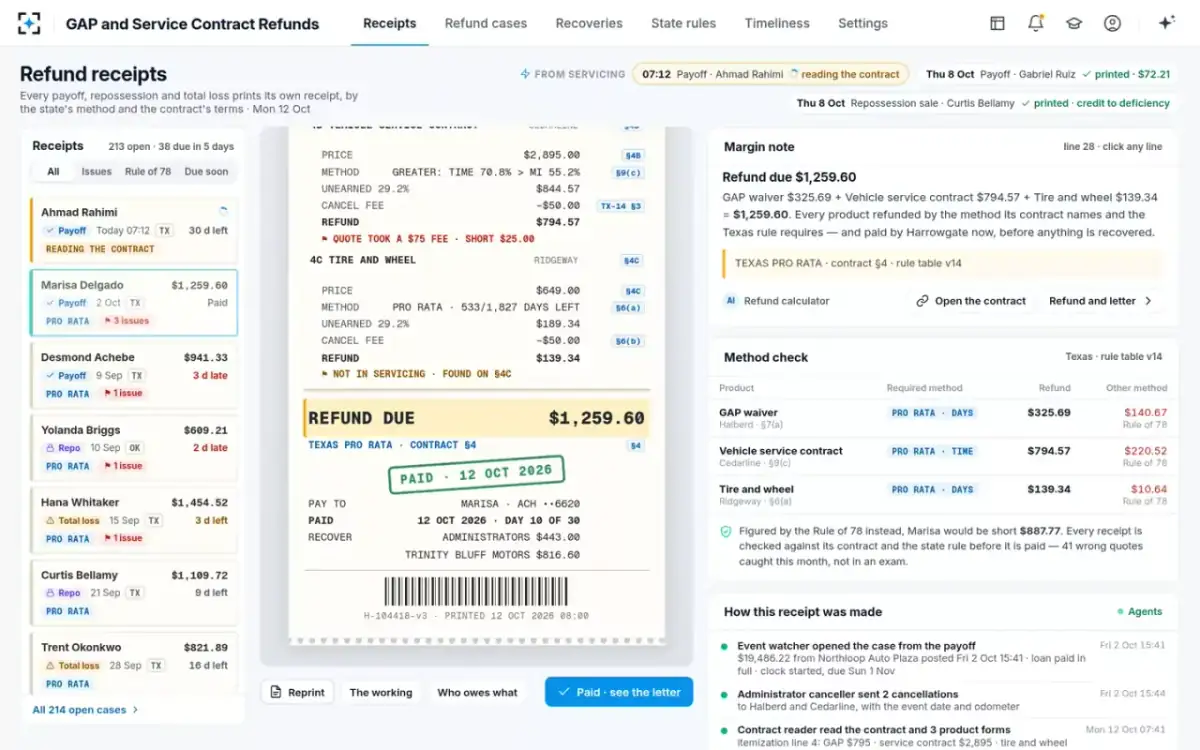
A refund settled and paid in GAP and Service Contract Refunds, with recovery still open behind it
Who owns a total loss inside the lender?
Usually several desks, and the refund falls between them. The collections or loss team learns of the loss, the insurance team posts the settlement, a GAP team files the claim, and a payoffs and refunds team handles cancellations, each on its own queue. The service contract refund belongs to whichever desk is last, which is why it so often waits for the GAP claim to close.
The sample lender gives one case to one owner from the moment the settlement posts. A refund specialist works the case and approves each refund with the meaning of the approval recorded; the payoffs and refunds team lead approves any refund the lender advances before recovery above $1,000; a compliance reviewer owns the versioned state rule table each refund is calculated against and samples 5% of approved refunds each week; and the customer service representative can see the case, the amount, the date and the reason, so a borrower who calls is answered on the first call. The GAP claim stays with the team that files it, but it receives the refund report from the case rather than discovering the refunds afterwards.
The point of the design is that the borrower's clock and the lender's recovery run separately. The borrower is refunded on the lender's deadline; what the administrator and the selling dealer owe back is pursued behind it, on the lender's side, as who is responsible for refunding GAP insurance sets out.
The total-loss inputs a lender must get right
Every vehicle product refund after a total loss rests on four inputs, and each has a better and a worse source. The date of loss comes from the insurer's settlement, not the lender's posting date. The odometer comes from the total-loss valuation or the auction statement, which the sample lender's settings prefer over the last service record. The method and fee come from the product form and any state addendum. And the product list comes from the contract's itemization, not the servicing file, as the TILA itemization of amount financed explains.
Six controls for vehicle service contract refunds after a total loss
- A case opens when the total-loss settlement posts
With a refund clock, so the cancellation does not wait for the borrower or the GAP claim.
- Billing stops when GAP coverage is known
The finding examiners made was payments collected for months after the loss.
- Every vehicle product is cancelled from the date of loss
Read from the contract's itemization, with the odometer from the valuation.
- Refunds are reported to the GAP administrator before the claim settles
Where the waiver deducts them, so one settlement replaces two reconciliations.
- Refunds follow the balance
Applied to what remains, or paid to the borrower as money when the balance is clear, never left on a closed account.
- Payments made after the loss are refunded accurately
Recalculated once the waiver is final; examiners found underpayments here.
How GAP and Service Contract Refunds runs a total loss
The solution's agents watch for the total-loss settlement, open the case with the date of loss, read the contract's itemization and each product form, cancel and calculate every vehicle product refund from the date of loss under the lender's versioned state rule table, and prepare the refund report for the GAP administrator. A refund specialist approves each refund, and where the lender pays before recovering above its advance limit, the team lead approves the advance. Refund deadlines, odometer sources and where each refund goes are settings the lender's servicing and compliance leaders own.
It does not value the vehicle, adjust the insurance claim or decide the GAP waiver; those belong to the insurer and the waiver administrator. What it changes is the order: the refunds are known before the waiver settles, so the borrower's account closes once. The obligation across every product and event is in ancillary product refunds; to see a total loss worked on your own book, start from GAP and Service Contract Refunds.
Questions people ask
Is a GAP waiver refunded after a total loss?
No. The total loss is the event the waiver was sold for, so it performs rather than refunds. The vehicle products sold beside it, such as the service contract and tire and wheel, are the ones with unearned value.
From what date is the service contract refund calculated?
From the date of loss, with the odometer from the total-loss valuation. Using the date the claim closed hands the administrator the days in between; on the sample $2,895 contract that is about $48 a month.
Should the lender keep collecting payments until the GAP claim settles?
Examiners treated collecting payments for months after a loss, when the servicer knew GAP would cover the balance, as unfair, and found the later refunds of those payments miscalculated. Stopping billing once coverage is known avoids both.
Who cancels the service contract after a total loss?
The contract usually requires a cancellation request to its administrator with the date and odometer. Supervisors expect the servicer to ensure the refund reaches the borrower, by making sure the administrator or dealer pays or by paying itself.
What if the vehicle product refund exceeds the remaining balance?
The excess belongs to the borrower and should be paid as money, not left as a credit on a closed account. Where a balance remains after insurance and GAP, the refund reduces it first.
Do state laws change the total-loss refund?
States can set refund methods, cancellation fees and deadlines for service contracts and GAP separately. The CFPB's examination procedures ask whether a servicer's refund process considers state law requirements after repossession or total loss.