A LOEUF score is a constraint metric: the upper bound of the ratio between the loss-of-function variants a gene actually carries in a sequenced population and the number expected by chance, so a low score means the gene has been strongly depleted of those variants and a high one means it has not — or that the gene is too small to tell. It is one input into the safety question, which is in turn one of the six questions a drug target assessment grades, alongside genetics, expression, biology, tractability and competition. The score is quick to look up and easy to over-read: it describes selection across a population, not the phenotype one carrier would show, and the exposure it reflects — complete loss from conception, in every tissue — is not the exposure a medicine produces. Botminds' Drug Target Assessment grades the safety question from carriers, constraint, animal evidence and class effects together, flags any human loss-of-function phenotype first, never lowers a liability without a cited source, and routes a weak grade to a translational safety scientist for a second signature.
The targets, variants, carrier counts and people in the worked examples below are fictional sample data from the solution's portfolio. The published studies are linked where they are used.
What does a LOEUF score measure?
It measures depletion, not danger. The model predicts how many loss-of-function variants a gene should carry in a cohort of a given size, given its length and sequence; the observed count is compared with that expectation, and LOEUF is the upper bound of the confidence interval around the ratio. The authors of the largest such survey describe it as a continuous measure: it "allows us to place each gene along a continuous spectrum of tolerance to inactivation", with the median gene carrying about 48% of the loss-of-function variation expected of it (Karczewski et al., Nature, 2020).
That continuity is the first thing a target assessment has to respect. The older metric most teams still quote, pLI, was built to be used as a dichotomous score — a gene is or is not likely to be haploinsufficient — and the newer work found the underlying distribution is not dichotomous at all. A gene in the most constrained tenth of the genome carries roughly 6% of its expected loss-of-function variation; a gene two deciles along is a different proposition, and a sentence that calls both "constrained" has discarded the measurement.
What the score is not is a statement about the target's safety. That question is the subject of its own series of guides — which risks a target carries, on-target and off-target works through the distinction between harm that comes from the mechanism and harm that comes from the molecule, and what a healthy heterozygous carrier proves takes the carrier evidence on its own terms. This page is about the narrower thing a target assessment does with constraint: read it as one line of evidence, and grade it with the others.
The four questions a safety grade answers — and the one it must not pretend to
What happens to people who have carried less of this protein since conception — heterozygous carriers at scale, and homozygous or compound heterozygous cases where any exist.
Whether the gene tolerates loss-of-function variation in the general population at all, and what the absence of carriers does and does not imply.
Knockout and conditional-knockout phenotypes, the tissues where the protein is essential, and what the model organism gets wrong about human biology.
What has already been seen with medicines acting on the same pathway, including effects that appear only at clinical doses or after long exposure.
The safety pharmacology core battery, repeat-dose toxicology, genotoxicity and the rest belong to a later stage, are governed by their own guidance, and ask about a substance at a dose rather than about a protein over a lifetime. A target assessment that implies those questions are answered is the most dangerous thing it can do.
Keeping the boundary visible changes how the grade is read. A target graded B on safety has a tolerable-looking human and animal picture for the mechanism; it has not been shown to be safe, and the people who will run the toxicology studies should be able to see exactly which of their questions remain open.
What happens when the target is taken away, in people
Human genetics gives drug discovery something no animal model can: people who have lived a complete life with altered activity of a specific protein, phenotyped for everything the cohort happened to measure. The scale of what is now catalogued is substantial. An aggregation of 141,456 human exomes and genomes catalogued 443,769 high-confidence predicted loss-of-function variants, after filtering out the artefacts that sequencing and annotation errors produce (Karczewski et al., Nature, 2020).
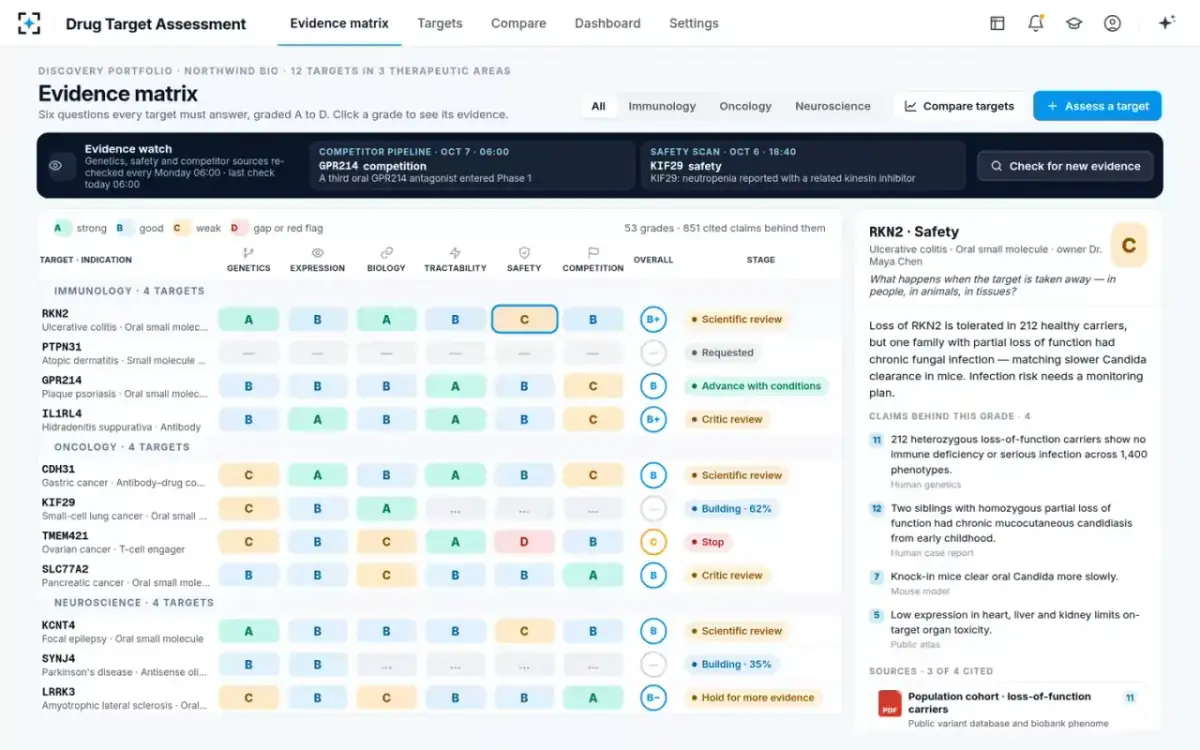
What that evidence looks like per target is the part that catches teams out. The sample portfolio's immunology target is a good illustration of the usual shape. Across 1,400 phenotypes, 212 heterozygous loss-of-function carriers show no immune deficiency and no excess of serious infection — reassuring, and the kind of finding that gets written up as "no safety signal". Two siblings with homozygous partial loss of function, however, had chronic mucocutaneous candidiasis from early childhood, and knock-in mice clear oral Candida more slowly. Both facts are true. A review that reports only the first is wrong, and a review that reports only the second is also wrong.
The evidence tiers behind a safety grade, strongest first
The ranking has one consequence worth stating out loud: animal evidence cannot outrank human evidence, in either direction. A clean mouse knockout does not neutralise a human phenotype, and a lethal mouse knockout does not disqualify a target whose human carriers are healthy. In the solution, animal-only evidence is labelled as such wherever it appears, for exactly this reason.
Can you drug a gene with a low LOEUF score?
Yes, and the assumption that a constrained gene is off limits is one of the most consequential errors in early safety reasoning. The most direct statement of it comes from the study that evaluated drug targets systematically against human loss-of-function variation.
First, even essential genes, in which loss-of-function variants are not tolerated, can be highly successful as targets of inhibitory drugs.
Minikel et al., Nature 581, 459–464, 2020
The reason is a mismatch between what genetics measures and what a medicine does. A germline loss-of-function variant removes the protein from conception, in every tissue, permanently. A drug reduces its activity partially, in an adult, for a period, and usually with a dosing regimen that can be stopped. Those are different exposures, and a gene can be intolerant of the first while being an excellent target for the second.
The practical rule is to treat constraint as a prompt rather than a verdict. A gene in the most constrained deciles is a reason to ask what the partial, adult, reversible version of the phenotype would look like, which tissues would be affected, and whether a margin between the therapeutic effect and the phenotype plausibly exists. It is not a reason to grade the target as disqualified.
What does a high LOEUF score miss?
A high score — little or no depletion — reads as permission, and it is the half of the metric that carries least information. Its authors are explicit that the upper bound makes the measure conservative in one direction only: a low score means the gene is confidently depleted, while a high score is a mixture of genes that genuinely tolerate loss and genes too small to estimate at all (Karczewski et al., 2020). About 30% of coding genes remain insufficiently powered even at the scale of that survey, and short genes are the ones most often affected, which has nothing to do with how important they are.
Three limits decide how much weight a constraint score can carry in a grade. It is a statement about selection across a population, not about the phenotype an individual carrier would show — a gene can be constrained because of a severe early-onset effect, or because of a modest effect on fertility, and the score does not distinguish. It is powered by gene length and population size, so short genes and under-represented ancestries give uninformative values. And it measures the consequence of lifelong complete loss, which is the exposure a drug does not produce.
So a constraint score belongs in a safety section as context, never as the claim. The useful sentence is "this gene is strongly depleted of loss-of-function variation, and no human carriers of complete loss have been described, so the human evidence is absent rather than reassuring" — which is a C with a named gap, not a D.
Finding human knockouts, and why most genes do not have any yet
The obvious experiment — find people with no working copies of the gene and examine them — is unavailable for most targets, and the reason is arithmetic rather than effort. The same analysis that corrected the essential-gene assumption put the scale of the problem plainly: "in most genes, loss-of-function variants are sufficiently rare that genotype-based ascertainment of homozygous or compound heterozygous 'knockout' humans will await sample sizes that are approximately 1,000 times those presently available, unless recruitment focuses on consanguineous individuals" (Minikel et al., 2020).
That last clause is where the evidence that does exist comes from. In a cohort with a high rate of consanguinity, among 10,503 participants, "these pLoF mutations are predicted to knock out 1,317 genes in at least one participant" (Saleheen et al., Nature, 2017) — and the long tail is thin even there: most of those genes were knocked out in only a single person.
What the human catalogues actually contain
443,769
high-confidence predicted loss-of-function variants across 141,456 sequenced humans
1,317
genes predicted knocked out in at least one participant of a consanguineous cohort of 10,503 people
~1,000×
the sample size that would be needed for most genes, without focusing recruitment on consanguineous individuals
2.0×
more likely that a side effect occurs where the drug target has human genetic evidence for a similar trait
What follows for grading is uncomfortable and useful. For most targets, "no human knockouts described" is the expected finding, not a red flag — and a review that treats absence of evidence as evidence of safety has inverted the one thing it was meant to establish. The honest grade is the one that says which carriers exist, how many, and what was screened.
Does a genetic association predict a drug side effect?
It predicts some of them, measurably, and the measurement comes from the same literature that established the efficacy advantage. Comparing approved drugs' labelled side effects against the genetic associations of their targets, the authors found that side effects "were 2.0 times more likely to occur for drugs whose target possessed human genetic evidence for a trait similar to the SE" (Minikel and Nelson, PLOS Genetics, 2025).
Two readings of that are worth separating. The useful one is methodological: the phenotype breadth around a target — every trait associated with the gene, not only the indication you care about — is a legitimate source of safety hypotheses, and reading it is cheap. The unhelpful one treats the figure as a forecast for a particular programme, which it cannot be: it is an enrichment across a population of approved drugs, it misses effects driven by chemistry rather than the target, and it has nothing to say about effects that depend on dose or short-term exposure.
It also means the genetics and safety sections of a review have to read each other. The variant that supports your mechanism is often the same variant that carries the side-effect hypothesis, which is one of the arguments for grading both from one shared set of cited claims rather than writing them independently — what the genetics proves, and how far works through the efficacy side of the same evidence.
Class effects: when the pathway already has a warning on it
Where medicines already act on the same pathway, their labelled effects are the most clinically relevant evidence available, because they describe what happens at a therapeutic dose in adults — the exposure genetics cannot model. A class effect also carries something genetics rarely does: an established way of managing it. Monitoring schedules, screening before treatment and contraindications exist because someone worked out how to use the medicine anyway.
That is the argument that moves a grade in the sample portfolio. A sceptical reviewer notes that the fungal infection seen in the homozygous siblings is a known, monitorable effect of medicines acting on the same pathway, and that the 212 heterozygous carriers are healthy, so the risk reads as dose-dependent rather than disqualifying — and proposes raising safety from C to B with a fungal-infection monitoring condition attached.
Two readings of the same finding, and the grade each one produces
Read as a disqualifying risk: Two siblings with chronic infection from early childhood: the protein is required for host defence.
Read as a dose-dependent, monitorable one: Two siblings with complete, lifelong, near-total loss — an exposure no inhibitor produces.
Read as a disqualifying risk: Heterozygotes retain half the function, so they say little about full inhibition.
Read as a dose-dependent, monitorable one: 212 carriers, 1,400 phenotypes, no immune deficiency: partial reduction is tolerated in people.
Read as a disqualifying risk: Knock-in mice clear the infection more slowly: the phenotype reproduces across species.
Read as a dose-dependent, monitorable one: The same, and it reproduces as a graded defect rather than an absolute one.
Read as a disqualifying risk: A known infection risk on this pathway is a reason to avoid it.
Read as a dose-dependent, monitorable one: A known risk on this pathway comes with an established monitoring and screening practice.
Read as a disqualifying risk: C, and the programme carries a liability it cannot size.
Read as a dose-dependent, monitorable one: B, conditional on a monitoring plan and a defined patient exclusion.
Read as a disqualifying risk: A human loss-of-function phenotype exists and is flagged first, whatever the grade.
Read as a dose-dependent, monitorable one: The same, and the grade needs the safety scientist’s signature as well as the lead’s.
A constraint score is not a safety study
The target-stage reading and the regulatory studies are regularly conflated, and the boundary is defined precisely enough to quote. Safety pharmacology studies, in the words of the guideline that governs them, are "those studies that investigate the potential undesirable pharmacodynamic effects of a substance on physiological functions in relation to exposure in the therapeutic range and above" (ICH S7A, 2000). They are about a substance, at a dose, and the core battery they begin with covers three organ systems chosen for how dangerous their acute failure is — which may or may not include the organ a constraint score has made you worry about.
The on-target question sits earlier and asks about the protein, not the substance. The same guideline gives the earlier, target-facing work its own name: "Studies on the mode of action and/or effects of a substance in relation to its desired therapeutic target are primary pharmacodynamic studies", and it states plainly that "Primary pharmacodynamic studies do not need to be conducted in compliance with GLP" (ICH S7A, note 2 and section 2.11). A target review reads even further upstream than that, from evidence that other people gathered for other reasons.
Why insist on the distinction in a document nobody files? Because the two produce different kinds of claim. The later studies are standardised, conducted to a formal quality standard and designed to support a regulatory decision. A target assessment is a judgement about evidence that was gathered by other people for other reasons. Grading it, citing it and having a named person sign it is the closest equivalent to the rigour the later work gets from its protocols.
Grading a liability: monitorable, dose-dependent, or disqualifying
A safety grade is useful only if the letters mean something operationally different. Three bands cover most real findings. A liability is monitorable when the effect is detectable before it is harmful and an established practice exists to detect it — the question then moves to the development plan rather than the target. It is dose-dependent when the human evidence shows a graded relationship between activity and effect, which is a reason to care about the therapeutic margin and about selectivity, and often a reason to prefer one modality over another. It is disqualifying when the effect is severe, undetectable before it occurs, and inseparable from the mechanism you intend to use.
What a safety claim must carry before it can move a grade in Drug Target Assessment
- The variant class, and what it does to the protein
Complete loss, partial loss, gain of function or unknown. A partial loss-of-function phenotype and a complete knockout phenotype are different claims about different exposures.
- Zygosity and the number of carriers
Heterozygous, homozygous or compound heterozygous, with counts. Two homozygous cases and two hundred heterozygous carriers tell different stories and are often reported as one.
- What was screened, not what was reported
The breadth of phenotyping behind a negative finding. "No immune deficiency across 1,400 phenotypes" is evidence; "no reported phenotype" usually is not.
- Human, animal or in vitro, labelled
Stated on the claim itself, so that an animal-only liability cannot be read as a human one and vice versa.
- The source passage, not the paper
The table or figure the number came from, reachable in a click, because a safety claim is the one a reviewer is most likely to want to check.
- Whether the finding raises or lowers the liability
And, if it lowers one, a cited source saying so. A liability is never reduced by an argument alone.
Behind a safety grade: the question, the claims, the passages
Why a weak safety grade needs a second signature
A safety C is not a footnote; it is a monitoring plan, an exclusion criterion, or a reason to prefer a different modality — and it is the grade most likely to be quietly absorbed into an overall score. That is the argument for routing it to someone whose job is the liability rather than the programme. In the solution a safety grade of C or D goes to the translational safety scientist, who co-signs after the therapeutic-area lead, and the setting that enforces it is visible rather than conventional.
The second signature does two things that a single reviewer cannot. It puts the conditions in writing at the moment of the decision, so a monitoring commitment made in October is still attached to the programme in March. And it separates two judgements that are easy to blur: whether the evidence supports the grade, and whether the programme is worth running given the grade. The first is a scientific question; the second is a portfolio one, and it is covered in who decides a target, and on what.
A sceptical reader argues the other side, and proposes — never decides

The grade, the conditions it carries, and the two signatures
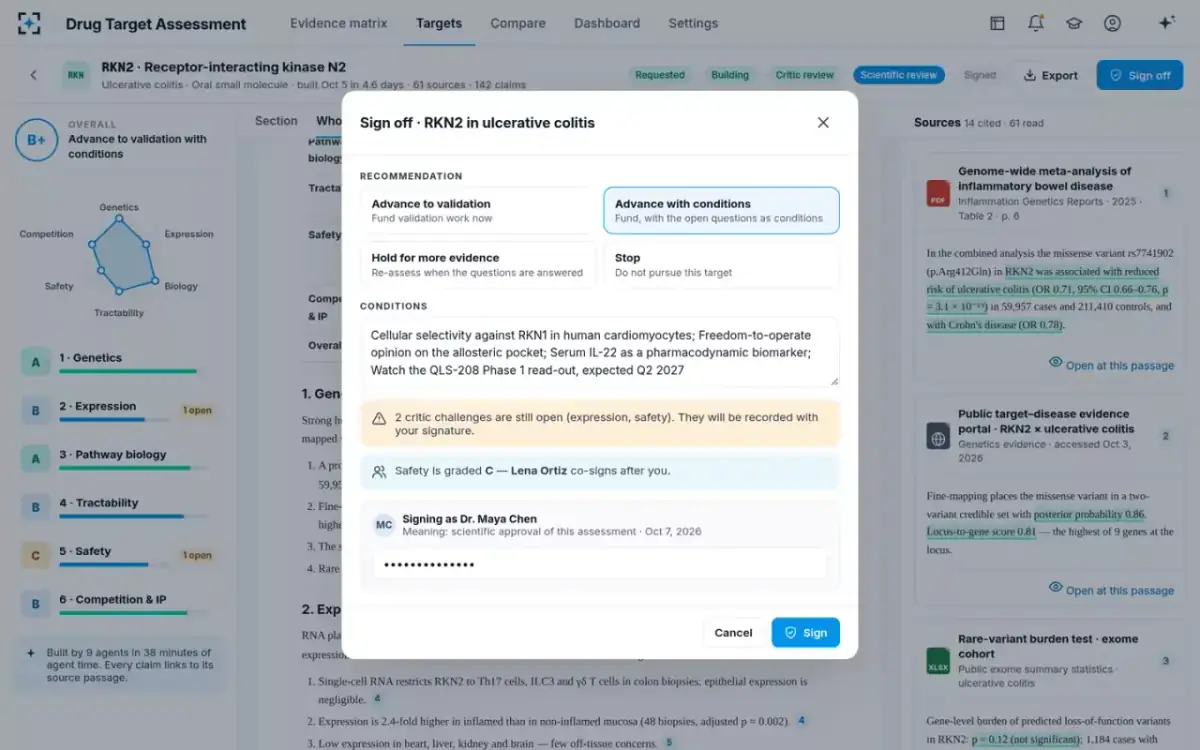
The last piece is what happens to the gaps. Open questions become conditions on the signature with named owners rather than paragraphs in a discussion, and open challenges can be carried as recorded conditions instead of being forced to a resolution the evidence does not support. Where safety sits among the other five questions is set out in the six questions, graded; what a liability found late costs is in why most programmes fail, by cause. To see a safety section with its carriers, phenotypes and passages on your own targets, start from Drug Target Assessment.
Questions people ask
What does a loss-of-function variant tell you about a drug target?
It tells you what a lifelong reduction in that protein's activity did to the people who carry it, across whatever phenotypes the cohort measured. That is the closest natural analogue to an inhibitor, and the most valuable safety evidence available at the target stage. Its limits are specific: the exposure is complete, lifelong and from conception, carriers are usually few, and a finding in heterozygotes and a finding in homozygotes describe different degrees of loss and must not be merged.
Is a low LOEUF score a reason to drop a target?
No. A low score says the gene is depleted of loss-of-function variation in the population, which reflects selection against lifelong complete loss — an exposure no medicine produces. Genes intolerant of loss of function have been successfully targeted by inhibitory drugs. Treat a low score as a prompt to ask what partial, adult, reversible reduction would look like and whether a therapeutic margin plausibly exists, and grade the human phenotype evidence rather than the score.
When does an on-target safety finding stop a programme?
When the effect is severe, cannot be detected before it harms someone, and cannot be separated from the mechanism you intend to use — for example because it is caused by the same activity in a tissue you cannot spare, with no selectivity or delivery route that avoids it. Short of all three, the finding usually changes the programme instead of ending it: a monitoring plan, an excluded population, a different modality, or a therapeutic margin that has to be demonstrated early.
Who signs off on target safety?
In most organisations the therapeutic-area lead signs the scientific conclusion of a target review, and a translational safety scientist signs the safety judgement separately when it is weak. The separation matters because the two are answering different questions, and because the person who owns the programme is not well placed to be the last reader of its main liability. In the solution a safety grade of C or D routes to the safety scientist, who co-signs after the lead.
What is a class effect, and how far does it transfer?
It is an effect seen with multiple medicines acting on the same target or pathway, which makes it more likely to arise from the mechanism than from any one molecule. It transfers best when the new programme shares the mechanism, the tissue and the degree of modulation, and worst when it is really a chemotype effect being attributed to the pathway. The transferable part usually comes with the useful part: an established way of monitoring for it.
Does reading on-target risk replace nonclinical safety studies?
No, and treating it as though it does is the biggest failure mode of the target-stage safety review. The later nonclinical work asks about a specific substance at specific exposures, under its own guidance and to a formal quality standard, and the safety pharmacology core battery examines the cardiovascular, respiratory and central nervous systems in that light. A target assessment asks what the protein does over a lifetime in people and animals. It should make those later studies better designed, and it never anticipates their result.