Target validation in drug discovery is the work of showing that a chosen protein really drives the disease you mean to treat, and that changing its activity with the modality you mean to use would help a patient you can identify. It is not one experiment and it is not a verdict reached once. It is six separate questions — human genetics, expression, pathway biology, tractability, safety, competition — each answered at a stated level of evidence. It is hard because the six draw on different literatures and different internal datasets, because the bar for "enough" is almost never written down, and because a scientist answering them by hand reads for weeks per target. Botminds' Drug Target Assessment puts the six on one rubric, gives each to a specialist agent that researches it and grades it against a bar you set, and keeps every grade one click from the passage behind it.
Every person, company, target and study in the examples on this page is fictional sample data from the solution's own portfolio. The research figures are published and linked where they appear.
What is target validation in drug discovery?
The phrase has no single agreed definition, and that is the first thing a practitioner should know. The GOT-IT recommendations, written by a working group funded by Germany's Federal Ministry of Education and Research to help academic scientists carry targets toward the clinic, and published in Nature Reviews Drug Discovery, put it carefully: target validation "can be understood in numerous ways depending on the context", but "usually describes the technical evaluation of whether a target has a key role in a disease process and whether pharmacological modulation of the target could be effective in a defined patient population" (GOT-IT, 2021).
Read that definition slowly and it contains three claims, not one: a role in the disease, an effect of modulating the target, and a patient population you can name. A review that proves the first and assumes the other two is common, and it is the review that fails in phase 2. The same recommendations are explicit that no framework settles the matter for you.
However, it must be recognized that there is no single best or correct approach, as too many project-specific elements exist that cannot be covered by general target assessment guidelines.
GOT-IT recommendations, Nature Reviews Drug Discovery, 2021
That sentence is usually read as a licence for informality. It is the opposite. If no general framework can decide when the evidence is enough, then the people on the programme must decide, in advance, and in writing — which is exactly what a grading rubric is.
Identification, validation, assessment: three words for three different jobs
The three words get used interchangeably and mean different things. Identification produces a candidate: a gene comes out of a screen, an association study, a pathway argument or a patient cohort. Validation tests the causal claim: does changing this protein change the disease. Assessment is the wider judgement a company actually needs before it spends money — validation plus the questions a scientific paper rarely asks, such as whether the planned modality can reach the protein, what the protein does elsewhere in the body, and who else is already working on it.
GOT-IT's own structure makes the distinction concrete. It groups the work into five assessment blocks: "AB1: target-disease linkage (that is, the causal relationship between target and disease) AB2: safety aspects (on-target or target-related) AB3: microbial targets (aspects related to non-human targets) AB4: strategic issues (for example, clinical needs and commercial potential) AB5: technical feasibility (including druggability, assayability and biomarker availability)". Only the first is validation in the narrow sense. The rest is what a portfolio committee spends its hour on.
The six questions a target has to answer
Six questions cover the same ground for a human target, in the order a discovery team usually reaches them. They are deliberately phrased so that each has a possible answer of "we do not know", which a verdict of "validated" hides.
The six questions Drug Target Assessment grades, and what earns an A on each
| The question | What it asks | Evidence that earns an A | Evidence that earns a C | Who owns the answer |
|---|---|---|---|---|
| 1. Genetics | Does human genetics link the target to the disease, and in which direction? | Two independent human sources: a replicated genome-wide or rare-variant association with the causal gene resolved, and the direction of effect stated. | One unreplicated association, or an association whose causal gene is unresolved. | Computational biology, with the therapeutic-area lead |
| 2. Expression | Is the target present in the cells that drive the disease? | Protein and RNA evidence in the disease tissue and the driving cell type, against healthy tissue, from more than one dataset. | RNA only, or bulk tissue only, or a single internal dataset. | Omics and translational biology |
| 3. Pathway biology | Is there functional proof that changing the target changes the disease? | Human cell or tissue perturbation plus an animal model, with effect sizes and the number of donors, lines or animals. | Animal-only evidence, or a single laboratory, or overexpression without loss of function. | Disease biology |
| 4. Tractability | Can the planned modality reach it? | A structure with a defined site plus a selective chemical or biological starting point with cellular activity. | A predicted pocket, a family analogy, or potency without selectivity data. | Chemistry or biologics, against the stated modality |
| 5. Safety | What happens when the target is taken away? | Human loss-of-function carriers at scale with phenotypes screened, read alongside animal knockouts and class effects. | Animal knockout only, or constraint scores with no human phenotype data. | Translational safety, who co-signs any weak grade |
| 6. Competition | Who else is already on it, and with what? | Current competitor programmes by target, modality and phase, with the patent landscape described. | A list more than a quarter old, or modality unresolved. | Competitive intelligence; freedom to operate goes to counsel |
Three properties of this table matter more than its contents. Each question is answerable separately, so one weak answer does not sink the others or hide behind them. Each has an owner, so a grade has someone to argue with. And each has a C defined as carefully as its A, which is the part most rubrics skip — a bar that only describes excellence turns every imperfect answer into a negotiation.
What makes a good drug target, question by question
"What makes a good drug target" is the question behind the search, and the honest answer is that no property is sufficient and only a few are nearly necessary. Human genetic support is the closest thing to a general predictor, and it is worth stating its size precisely rather than as a slogan: in the study that established the pattern, "the proportion of drug mechanisms with direct genetic support increases significantly across the drug development pipeline, from 2.0% at the preclinical stage to 8.2% among mechanisms for approved drugs, and varies dramatically among disease areas" (Nelson et al., Nature Genetics, 2015). What that measures is a shift in composition along the pipeline, not a promise about your protein. The arithmetic behind it, and what a genetic claim must state to count at all, is set out in what the genetics actually proves.
Expression is the question most often answered too easily. A transcript in a disease biopsy is weak evidence that the protein is in the cell type that drives the pathology; the useful answer names the cell type, the method, and the healthy comparison. Pathway biology is where single-laboratory findings accumulate, which is why a grade should say how many independent groups have seen the effect. Tractability is not a property of the protein at all but of the protein and a chosen modality together, so the same target can be a D for a small molecule and an A for a degrader or an antibody — how to assess tractability for the modality you have chosen works through the evidence each one needs. Safety asks the one question no later study asks: what happens to a person who has had less of this protein their whole life.
Twelve targets, six questions, every cell a grade
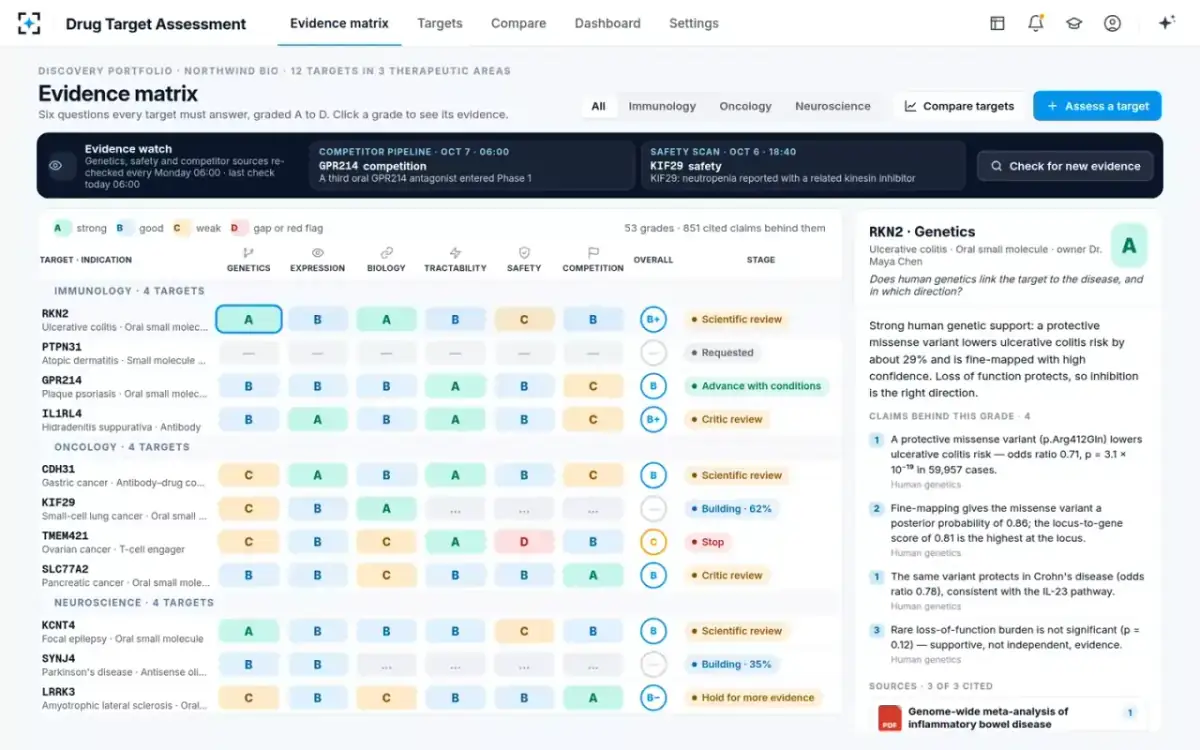
Reading the matrix down a column is the part that surprises teams. A portfolio with eight B grades on genetics and five C grades on tractability is not a portfolio with a tractability problem on one programme; it is a portfolio whose chemistry capacity is about to be the binding constraint, and that is a planning conversation, not a scientific one.
Writing the bar down first: what earns an A, a B, a C and a D
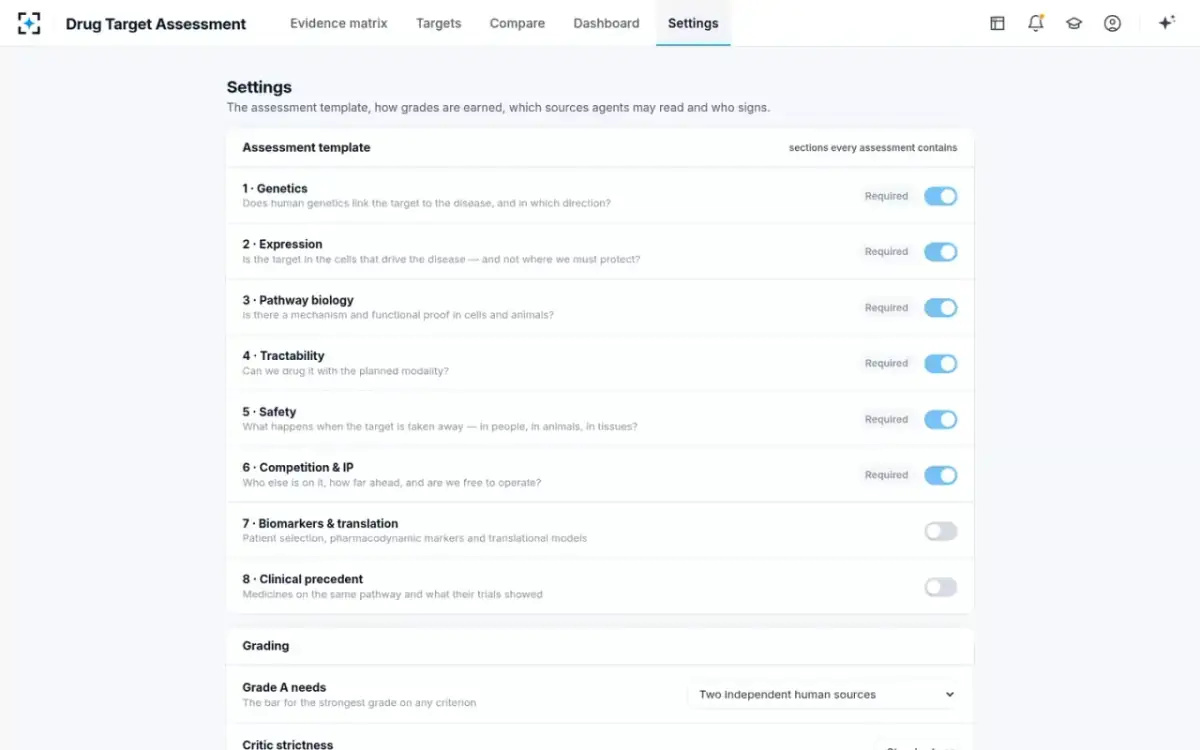
A grade is only worth anything if the bar existed before the evidence did. The scale itself can be simple — A strong, B good, C weak, D a gap or a red flag — provided each letter is defined per question, as in the table above, and the definition is agreed before anyone reads a paper. Two mechanisms keep it honest. The first is that the rule for an A is a setting the team owns and can argue about openly: two independent human sources, or one human source plus one functional study, or any three sources. The second is that the person who sets the bar is not the person who awards the grade.
The bar for an A, written as a rule a reviewer can apply without you in the room
- Two independent human sources, and "independent" is defined
Two papers from the same cohort are one source. Two analyses of the same biobank are one source. The rule has to say so, or it will be read the generous way.
- The direction of effect is stated for every genetic claim
Whether loss of function protects or harms decides whether you inhibit or activate. A claim that omits it cannot support an A, however small its p-value.
- Protein evidence, not only RNA, for the disease cell type
RNA and protein evidence are labelled separately, and an expression A needs the protein in the cell type that drives the pathology.
- The modality is named before tractability is graded
A tractability grade without a stated modality is not a grade. Biochemical and cellular potency are reported separately.
- Human loss-of-function evidence, or the grade says it is missing
Animal knockouts and constraint scores support a B at best on their own. A human phenotype — present or absent at scale — is what an A needs.
- Competitor evidence refreshed inside thirty days
A competitive picture a quarter old is a C, because the thing it is meant to tell you is exactly what changed since.
- Every number cites the table or figure it came from
Not the paper: the table. A reviewer who cannot reach the number in two clicks will re-derive it, and that is the four weeks all over again.
The bar is a setting, not a convention
Why most published target validation answers only one of the six
If you have ever read a paper titled as a target validation study and found it silent on everything that worries a committee, you were not unlucky. The GOT-IT authors surveyed 428 articles from academic research groups on target validation and assessment, and counted what they cover. The answer is one question out of six, overwhelmingly.
What published target validation actually covers
85.5%
discussed the link between target and disease, and identified future patient populations
9.1%
included potential safety issues, on-target or target-related
8.6%
included three-dimensional structure discovery
6.1%
included the application of biomarkers
2.1%
addressed the intellectual property or patent situation
1.9%
addressed target assayability
This is not a criticism of the literature. A paper is written to make one argument, and the target–disease link is the argument worth publishing. It is a criticism of using that literature as a target review. If 9.1% of the papers touch safety and 1.9% touch whether the target can be assayed, then a review assembled from papers will be silent on safety and assayability unless someone deliberately goes looking — and the committee will discover the silence in the meeting.
It also explains why the six questions are so uneven in effort. Genetics and expression have rich public evidence and a dense literature. Safety and tractability have thin published evidence per target and heavy internal evidence. A rubric that demands all six forces the thin questions to be answered explicitly, even when the honest answer is a D with a named gap.
Can a target ever be fully validated?
No, and the word "fully" is where programmes get into trouble. A target is validated for a claim, at a level of evidence, on a date. The claim can be strong ("loss of function in people with this variant protects against this disease, replicated in two cohorts, with the causal gene resolved by fine-mapping") and still not be the claim your programme needs ("an inhibitor given to adults with established disease will reduce symptoms"). The gap between those two sentences is what clinical development is for.
There is also no state in which the evidence stops moving. New association studies land, new loss-of-function carriers are described, a competitor reads out, a class effect appears on a medicine that works on the same pathway. In the sample portfolio one target was signed as a hold because its genetics rested on a single small association study, and two weeks later a larger meta-analysis replicated the locus; the genetics grade moved from C to B with a tag showing what it had been, and the owner was asked to confirm before the figure was used anywhere. The grade changed; the target did not become "validated".
The practical consequence is that a target review needs a date, an owner and a refresh cadence, and that a signed version has to stay as it was signed while the live view moves. Both things are true at once: the committee decided on the evidence of the day, and the evidence of the day is already out of date.
The grade and the claim behind it: one rule that changes the argument
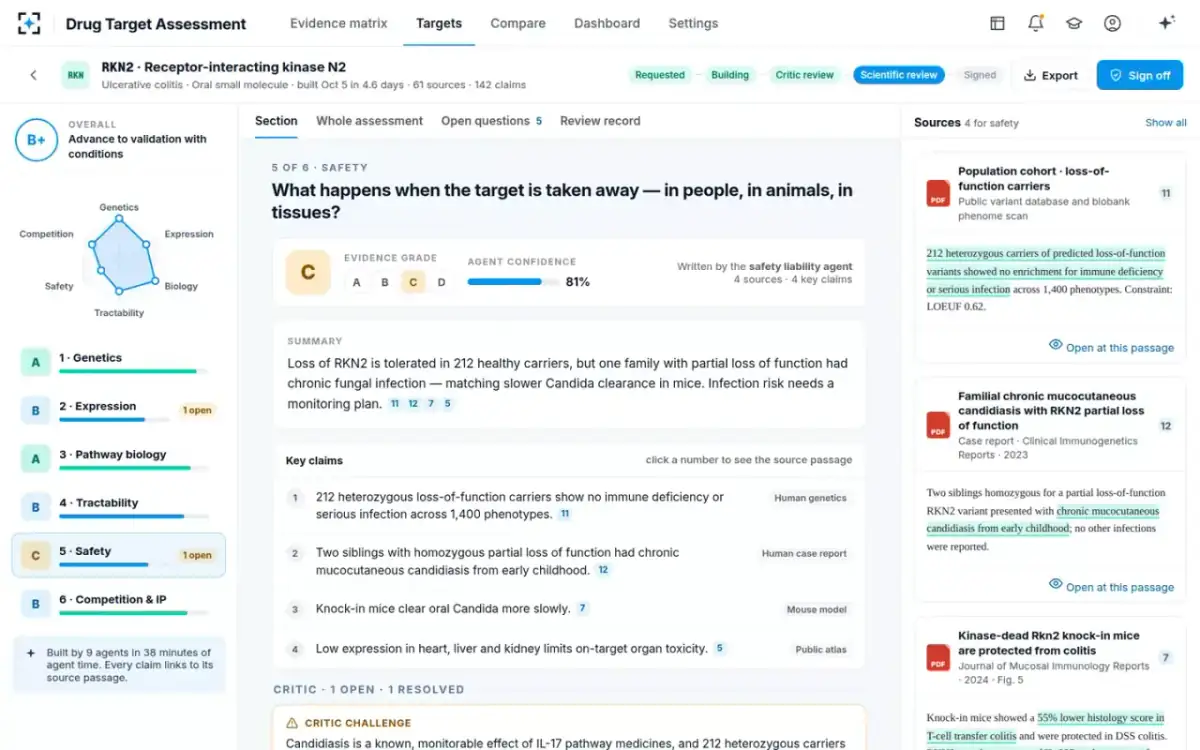
The single rule that changes how a target review is read is this: no claim appears without the passage it came from, and no grade appears without its claims. It sounds procedural. In practice it moves the argument from authority to evidence, because a committee member who disagrees with a B can open the four claims behind it and disagree with one of them specifically.
One question's path through Drug Target Assessment, in four steps
Agent
The research questionsA planner splits the request into the template sections and 35 to 45 research questions, assigns each to a specialist agent, and sets what evidence would earn an A, a B, a C or a D on each.
Never: grades a section itself, or plans without the modality stated
Agent
The sources readThe specialist agent reads the literature, public genetics resources, internal omics, screening and chemistry reports and the competitor extract that the team has switched on, and keeps the passage behind each number.
Never: uses a source the team has not enabled
Agent
The claims, with their numbersEach finding becomes a claim carrying its effect size, cohort or sample size, evidence type and a numbered citation that opens the highlighted passage. Uncited claims are dropped.
Never: writes a claim with no source passage
A person decides
The grade, and the decisionA critic argues the other side of every section and proposes changes; the therapeutic-area lead accepts, keeps the grade, or sends the agent back, then signs with a recommendation and conditions.
Never: needs the agent’s permission, or signs a safety C or D without the safety scientist
One section: the question, the grade, the claims, the passages
What a target review owes the committee that reads it
A committee is not asking to be convinced. It is asking what is known, how well, and what it would take to change the answer. Those three things are hard to extract from a narrative review and trivial to extract from six graded answers, which is most of the case for the format.
The same target, written up two ways
A narrative target review: An argument, built over several pages, whose conclusion is in the summary.
Six graded answers: Six grades and an overall grade, each one a link to the claims behind it.
A narrative target review: Read the whole thing, or trust the author to have flagged it.
Six graded answers: Look for the C and the D. They are defined, so they cannot be written around.
A narrative target review: A disagreement about the conclusion, which is hard to settle in the meeting.
Six graded answers: A disagreement about one claim, which can be settled by opening the passage.
A narrative target review: Two documents written to different standards, often by different scientists.
Six graded answers: One rubric, side by side, criterion by criterion.
A narrative target review: Usually invisible: a section nobody wrote reads like a section nobody needed.
Six graded answers: A required question with no evidence is a D with a named gap.
A narrative target review: A static document whose evidence has moved and whose reader cannot tell.
Six graded answers: A signed version that stays as signed, next to a live view that shows what changed and asks the owner to confirm.
There is a size argument too. The literature a committee would have to hold in its head is enormous and unevenly explored: approved drugs act through 893 curated human and pathogen-derived biomolecules, of which 667 are human-genome-derived proteins (Santos et al., Nature Reviews Drug Discovery, 2017), while the systematic effort to track how much is known about each human protein "indicates a substantial knowledge deficit for approximately one out of three proteins in the human proteome" (Oprea et al., 2018). A third of the proteome cannot be graded from public evidence at all. A format that can say so plainly is worth more than one that cannot.
Where the evidence runs out, and what you do then
A D is a result. The useful move when a question has no evidence is to convert the gap into the cheapest experiment that would change the grade, and to attach it to the decision as a condition rather than leaving it in the discussion. In the sample portfolio that is what happened to a selectivity question: the closest family member of the target is expressed in heart, the published selectivity was forty-fold, and rather than argue the point the review carried a cellular selectivity check in human cardiomyocytes as a named condition on the signature, owned by a named person.
Three gaps come up often enough to plan for. Human genetics may not exist for the indication, in which case the honest grade is a C and the next step is usually a biobank analysis rather than more reading. Human loss-of-function data may not exist at the scale needed, which is the normal case rather than the exception and is covered in reading a gene constraint score. And tractability may be unresolvable without a structure or a screen, which turns the target review into a request for a hit-finding campaign with a defined stopping rule — the decision shape set out in who decides a target, and on what.
What none of this does is improve the odds of a particular programme, and a target review that claims to is overselling. What it changes is the quality of the decision and the speed at which it can be revisited — the reason most programmes fail, by cause, is worth reading next to the rubric. To see the six questions, the grades and the evidence behind them on real targets, start from Drug Target Assessment.
Questions people ask
What is the difference between target identification and target validation?
Identification produces a candidate — from a screen, an association study, a pathway argument or a patient cohort. Validation tests the causal claim that changing the protein changes the disease. The wider judgement a company needs before funding a programme is broader than both: GOT-IT splits it into target–disease linkage, safety, strategic issues and technical feasibility, and only the first of those is validation in the narrow sense.
What evidence is needed to validate a drug target?
There is no universal list, which is why the bar has to be local and written down. A defensible default is two independent human sources for the causal link with the direction of effect stated, protein-level expression in the cell type that drives the disease, functional evidence in a human system as well as an animal one, a structure and a selective starting point for the chosen modality, and human loss-of-function evidence on safety. Anything weaker is a grade, not a failure.
How long does target validation take?
By hand, a thorough six-question review on one target is usually estimated in weeks of a scientist's reading rather than days; the estimate behind the solution's own figures is about four weeks per target, split across scoping, genetics and expression, biology and tractability, safety and competition, and writing and review. The design goal with agents doing the reading is a median of about five days from request to a signed assessment, most of which is people reviewing and deciding rather than searching.
Who does target validation in a pharma company?
Usually a target discovery scientist or computational biologist assembles the evidence, with specialists contributing per question — omics for expression, chemistry or biologics for tractability, translational safety for liabilities, competitive intelligence for the landscape. The therapeutic-area lead signs the scientific conclusion, and a portfolio committee takes the funding decision. A weak safety grade should carry a second signature from translational safety, because it is a monitoring plan rather than a footnote.
What are the criteria for a good drug target?
No single property qualifies a target, and only human genetic support behaves like a general predictor across many programmes. The criteria worth grading are the six questions: a causal human genetic link with a known direction, presence in the driving cell type, functional proof in a human system, reachability by the chosen modality, a tolerable consequence of removing the protein, and a competitive position you can live with. A target that is excellent on five and a D on one is a specific conversation, not a rejection.
Can a target be validated for one disease and not another?
Yes, and this is the most common misreading of a target review. Every one of the six questions is asked about a target in an indication, with a modality in mind: the genetics is disease-specific, the expression question names the disease tissue, and safety depends on the patients you intend to treat and for how long. A target graded B in one indication starts from scratch in the next, though the safety and tractability work usually carries across.