A target tractability assessment asks whether the therapeutic approach you intend to use can actually reach and change the protein you have chosen — not whether the protein is "druggable" in the abstract. The distinction is the whole of the discipline. A shallow active site that defeats an inhibitor is irrelevant to a knockdown; a protein that no antibody can reach may be ideal for a degrader; a beautiful crystal structure says nothing about whether your molecule will ever be selective enough to dose. The work is hard because the evidence lives in four different places — structures, chemistry reports, screening data and the delivery literature — and because the question is usually answered against a modality nobody wrote down. Botminds' Drug Target Assessment grades tractability against a stated modality and no other, and shows the structure, the ligand and the selectivity data each grade rests on.
The targets, compounds, potencies and people in the worked examples here are fictional sample data from the solution's portfolio; the published work is linked where it is used.
What is target tractability assessment?
It is the judgement of whether a candidate target can be modulated by a defined therapeutic approach, with the evidence stated. The term sits inside the wider discipline that the druggable-genome literature describes as the pair of steps before a programme starts: "target identification (determining the correct drug targets for a disease) and target validation (demonstrating an effect of target perturbation on disease biomarkers and disease end-points) are important steps in drug development" (Finan et al., Science Translational Medicine, 2017). Tractability is the feasibility half of that pair, and it is routinely the question with the least evidence and the most opinion behind it.
Three things turn an opinion into an assessment. The modality has to be named before anything is graded. The evidence types have to be ranked in advance, so that a predicted pocket and a co-crystal structure cannot be presented as equivalent. And the grade has to say what is missing, because a tractability C is almost always a statement about an absent experiment rather than about the protein.
Why the same target is a D for one modality and an A for another
Every modality asks a different question of the same protein, and the answers are often uncorrelated. A small molecule asks whether there is a pocket it can occupy with enough affinity and selectivity to matter inside a cell. An antibody barely cares about pockets and asks instead whether the protein is on the cell surface, whether the epitope is accessible, and whether expression is specific enough to spare the tissues you need to spare. A degrader asks whether there is any ligandable site at all — not necessarily a functional one — plus a usable ligase in the right cell type. An oligonucleotide ignores the protein entirely and asks whether the transcript can be reached in the tissue that matters.
One protein, four questions: what each modality needs before Drug Target Assessment will grade it
| Modality | What must be true of the target | The evidence that settles it | The usual blocker |
|---|---|---|---|
| Small molecule | A pocket with enough shape and chemistry to bind a drug-like molecule, reachable inside a cell. | An experimental structure with a defined site, a selective chemical starting point, and cellular as well as biochemical potency. | A shallow or flat site, or potency that does not survive the move into cells. |
| Antibody or protein therapeutic | An extracellular or surface-exposed epitope, expressed where you need it and not where you do not. | Surface localisation confirmed at protein level, epitope accessibility, and expression specificity against the tissues at risk. | An intracellular target, or expression in a tissue that cannot tolerate the effect. |
| Degrader | Any ligandable site — functional or not — and a ligase expressed in the disease cell type. | A binder with a usable exit vector, evidence of ternary complex formation, and degradation selectivity across the family. | No ligandable site at all, or a ligase that is absent from the cells that matter. |
| Oligonucleotide or nucleic-acid approach | A transcript that can be reached in the tissue that drives the disease. | Expression in the deliverable tissue, a knockdown that reproduces the desired biology, and a delivery route with precedent in that tissue. | Delivery. The biology is often settled long before the tissue is reachable. |
The practical consequence is that "is this target druggable?" is an unanswerable question and "can we reach this target with an oral small molecule?" is a gradeable one. The second question also carries its own fallback: a D against one modality is a prompt to grade a second, not a verdict on the target.
Small molecules remain the default for anything inside the cell, for a reason worth stating plainly: "for intracellular targets, small molecules continue to be the drug modality of choice due to their ability to cross cell membranes" (Hartung et al., Journal of Medicinal Chemistry, 2023). That is why so many tractability assessments collapse into a pocket question — and why the ones that do not are often the more interesting programmes.
What makes a target undruggable, and why that verdict expires
A target earns the label when the modality of the day cannot reach it: no pocket of the right shape, no surface exposure, a protein–protein interface too flat and too large to block, or a binding site so conserved across a family that selectivity looks impossible. Each of those is a statement about the available toolkit, and the toolkit keeps changing. Covalent chemistry opened sites that reversible binders could not hold. Degradation made non-functional ligandable sites useful. Nucleic-acid approaches removed the requirement for a pocket entirely, in the tissues they can reach.
Which is why an undruggable verdict needs an expiry condition attached to it. A tractability D that says "no ligandable site identified; the assessment assumed an oral small molecule; a covalent or degrader approach has not been assessed" is useful two years later. A D that says "undruggable" is a dead end someone will have to re-derive.
The public resources have moved the same way, adding modality-specific annotation rather than a single verdict. The Open Targets authors describe the shift directly: "prioritising likely causal targets in a drug discovery program requires a comprehensive understanding of the target biology that could inform risks and strategies for modulating the target", and note that recent work aims "to expand the Platform's ability to inform about the target tractability for different modalities" (Ochoa et al., Nucleic Acids Research, 2023). What those resources give you is the starting bucket; what they cannot give you is the grade for your programme, which is the subject of what the public platform answers and what it leaves you.
The evidence that settles tractability for a small molecule
Rank the evidence types once, in advance, and most tractability arguments stop being arguments. The ranking below is ordinary medicinal-chemistry practice written down, and its purpose is to make it impossible to present a prediction as though it were a measurement.
Tractability evidence, strongest first, and the grade each one can carry
| Evidence | What it demonstrates | Highest grade it supports alone | What it cannot do |
|---|---|---|---|
| A co-crystal structure with a drug-like ligand | The site exists, is reachable, and holds a molecule of the right class. | A, with cellular activity and selectivity data alongside it. | Tell you the series can be optimised, or that selectivity is achievable. |
| A validated chemical series with cellular activity | Binding survives the move into cells, with structure–activity relationships to work from. | A, with a structure or a defined site. | Substitute for selectivity data against the close family members. |
| A confirmed screening hit | Something binds, at some potency, in some assay. | B, if confirmed in orthogonal assays and not a frequent hitter. | Prove the site is the one you want, or that the hit is tractable chemistry. |
| An experimental structure with no ligand | The fold and the candidate sites, including transient ones if captured. | B for the site question, C for the modality question. | Say whether anything drug-like will bind the site it shows. |
| A predicted structure or predicted pocket | A hypothesis about the fold and where a site may be. | C, stated as a prediction. | Support a potency, a pose or a selectivity claim. |
| A family analogy | That proteins resembling this one have been drugged. | C at best, and D where the family is known for selectivity problems. | Carry a grade on its own for a specific target. |
Two habits do most of the damage. The first is quoting a biochemical potency as if it were a cellular one; the second is treating a single screening hit as a chemical starting point. A hit becomes a starting point when it has been confirmed in an orthogonal assay, is not a known promiscuous chemotype, and has at least some structure–activity signal around it. Before that it is a well to re-pick.
Surface, internalisation, delivery: tractability for the other modalities
For an antibody or an antibody–drug conjugate the pocket question disappears and three others take its place. Is the epitope genuinely extracellular, confirmed at protein level rather than inferred from topology prediction? Is expression specific enough that the tissues you must protect are spared — which makes the expression question and the tractability question partly the same question? And for a conjugate, does the target internalise, at a rate that delivers payload rather than merely binding? In the sample portfolio the strongest tractability grade belongs to a target of exactly this kind: a conjugate programme in gastric cancer where staining in 74% of tumours carries both the expression and the tractability case.
For a degrader the decisive question is ligandability rather than function, which is why a protein with no inhibitable active site can still be an excellent degradation target. The evidence a grade needs is a binder with a usable attachment point, evidence that a ternary complex forms, a ligase that is actually expressed in the disease cell type, and degradation selectivity measured across the close relatives. For nucleic-acid approaches the biology is usually the easy part and delivery is the grade: the useful question is whether the transcript can be reached in the tissue that drives the disease, with a route that has precedent there.
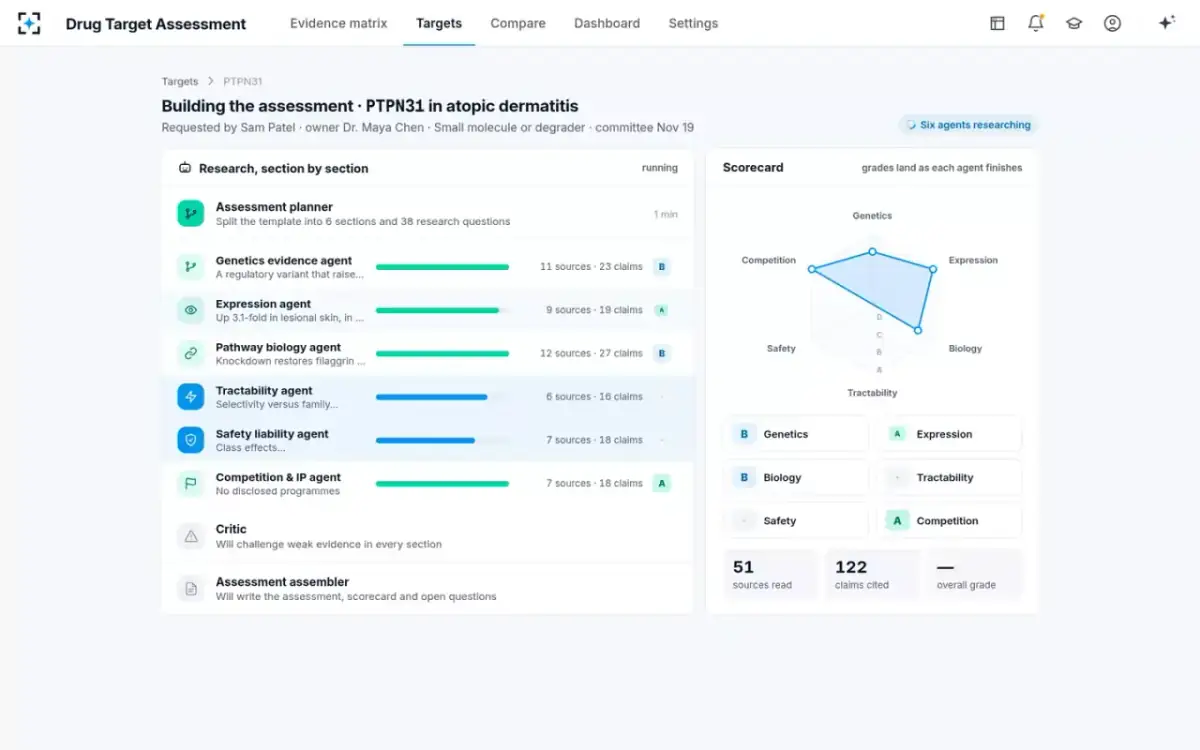
Six agents at work, with tractability graded against the stated modality
Can AlphaFold tell you whether a target is druggable?
Partly, and the limits are specific enough to be worth stating precisely. Structure prediction genuinely solved a hard problem: its authors described "the first computational method that can regularly predict protein structures with atomic accuracy even in cases in which no similar structure is known" (Jumper et al., Nature, 2021). For a tractability assessment that means a fold and a plausible set of sites for a protein that has never been crystallised, which is a real advance over having nothing.
What it does not do is tell you how a ligand will sit in that site, and the measured gap is larger than most teams assume.
Strikingly, however, the accuracy of ligand-binding poses predicted by computational docking to AF2 models is not significantly higher than when docking to traditional homology models and is much lower than when docking to structures determined experimentally without these ligands bound.
Karelina, Noh and Dror, eLife 12:e89386, 2023
A predicted structure and an experimental one, for the work a tractability grade needs
Predicted structure: Often accurate enough to reason about, including for proteins with no close structural relative.
Experimental structure: Measured, with the resolution and the conditions stated.
Predicted structure: Useful: binding pockets are captured substantially better than by older homology models.
Experimental structure: Direct, and shows the site in a state the protein actually adopts.
Predicted structure: Docking into a predicted model is not significantly more accurate than docking into a homology model.
Experimental structure: Much more accurate, even when the structure was solved without the ligand bound.
Predicted structure: A single predicted conformation, which may not be the one a ligand needs.
Experimental structure: Capturable, with the right experiment, and the reason a structural campaign is sometimes the answer.
Predicted structure: A C, stated as a prediction, and a well-defined next experiment.
Experimental structure: An A for the site question, with chemistry and selectivity alongside.
Note what the solution does not do with any of this. It reads, cites and grades the structural, chemical and screening evidence that exists for a target; it does not predict structures, dock ligands or run any computation of its own. A tractability grade is a reading of the evidence, and the grade points at the passage it came from.
Selectivity against the closest family member is part of the grade
A tractability case that stops at potency is half a case. The question that decides whether a molecule can be dosed is usually selectivity against the proteins that most resemble the target, because those are the ones whose inhibition will produce the effects you did not plan for. Selectivity is therefore part of the tractability grade and not a later concern.
The sample portfolio shows the shape of the argument. An oral small-molecule programme has a close family member expressed in heart, which a sceptical reviewer immediately raises as an off-target risk. The published selectivity is forty-fold, which is enough to keep the grade and not enough to close the question, so the review carries a cellular selectivity check in human cardiomyocytes as a named condition on the signature rather than as a sentence in the discussion. That is the right outcome: the grade reflects what is known, and the gap becomes an experiment with an owner.
Selectivity evidence also has a quality bar of its own. A panel of fifty kinases is not a selectivity claim for a target whose closest relative is not in the panel; a cell-free selectivity ratio is not a cellular one; and an inactive control compound matters as much as the active one. The published criteria for high-quality chemical tools are the closest thing to an agreed standard here, and they are worth reading alongside a tractability grade — what makes a chemical probe trustworthy covers that ground.
Screening hits, chemical starting points, and what counts as one
More tractability grades turn on this distinction than on any structural question, because a screening campaign produces numbers that look like evidence long before it produces a starting point. A hit is a compound that showed activity in one assay. A chemical starting point is a compound a chemistry team would be willing to build a programme on, which is a much higher bar and a much rarer thing.
Before a hit counts toward a tractability grade in Drug Target Assessment
- Confirmed in an orthogonal assay
A second read-out with a different detection chemistry. Single-assay activity is the main source of hits that evaporate on re-testing.
- Not a known promiscuous chemotype
Compounds that aggregate, react indiscriminately or interfere with the detection method hit everything. A hit that belongs to one of those classes is a negative result wearing a potency.
- Active in cells, reported separately
Biochemical and cellular potency are recorded as two numbers, never averaged into one. A large gap between them is itself a finding about permeability or the cellular state of the target.
- Some structure–activity signal
Close analogues that are more and less active. A singleton with no neighbours is a starting point only in the sense that it is somewhere to start looking.
- Binding to the site you want
Competition, mutagenesis, a structure, or a biophysical measurement. A hit at an unintended site can be perfectly real and useless.
- Selectivity against the closest relatives
Measured against the proteins most likely to be hit, not against a convenient panel that omits them.
Two consequences for grading. Fragment hits and high-throughput hits are not interchangeable: a weak fragment with a structure and a clear growth vector often says more about tractability than a micromolar screening hit with no site information. And an existing tool compound is not the same as a starting point either — a well-characterised chemical tool answers whether the target is ligandable, while a programme needs chemistry that can be optimised toward a medicine.
The drugged proteome, and the third of it nobody can grade
It helps to know the size of the field you are grading against. Approved drugs act through a small and heavily reused set of proteins, and the long tail of the proteome is not so much undruggable as unstudied.
The scale behind every tractability grade
667
human-genome-derived proteins targeted by drugs for human disease, in a curated map of approved drug targets
893
human and pathogen-derived biomolecules through which 1,578 approved drugs act
~1 in 3
proteins in the human proteome carry a substantial knowledge deficit, on evidence-based tracking of how much is known about each
Two readings follow, and a target review should be explicit about which it is making. The first is that privileged families — the folds and classes that have been drugged many times — carry real prior evidence, and a target inside one starts from a better place. The second is that the prior is not the grade: a well-studied family contains plenty of individual proteins nobody has made a selective molecule for. For a target in the unstudied tail, the honest grade is often a C or a D with the gap named, because the evidence that would support anything higher has not been generated by anyone.
What a tractability C should trigger, not conclude
A weak tractability grade is the most actionable grade on the matrix, because the missing evidence is nearly always something a company can go and generate. In the sample portfolio a phosphatase target came back with tractability at C for a specific and useful reason: the active site is shallow, and the allosteric pocket that might be better has no ligand reported. That sentence contains two experiments — a screening campaign against the allosteric site, and a structural effort to characterise it — and a stopping rule for each.
The useful form of a tractability C is therefore a short list: what is missing, what experiment would supply it, roughly what it costs, and what grade it would support if it worked. That turns the portfolio conversation from "is this target tractable" into "do we want to spend a hit-finding campaign on this question", which is a question a committee can actually answer — the decision shape set out in who decides a target, and on what.
Three targets, three modalities, one rubric
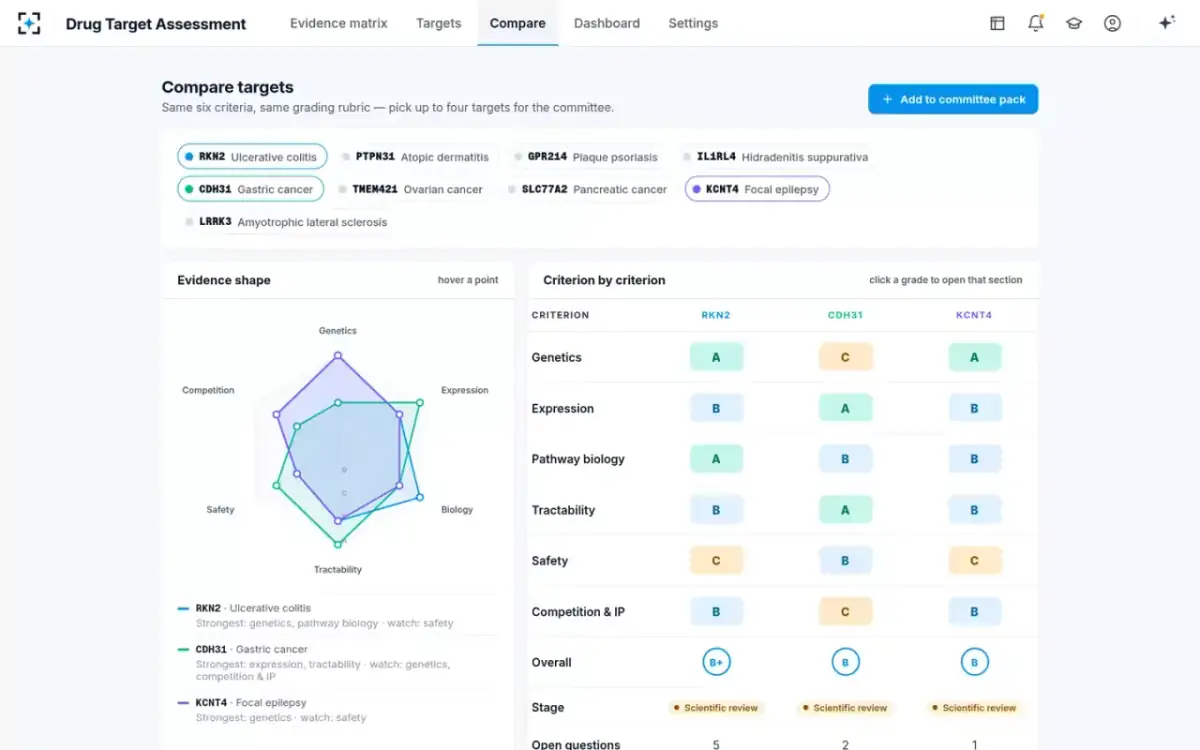
One last caution about the neighbouring question. A patent landscape frequently shapes which modality is worth pursuing, and it is read and summarised alongside the chemistry — but it is a description of the landscape and never a legal opinion, and freedom to operate goes to counsel. Where tractability sits among the other five questions is set out in the six questions, graded. To see a tractability section with its structures, ligands and selectivity data on your own targets, start from Drug Target Assessment.
Questions people ask
What does tractability mean in drug discovery?
It means that a specific therapeutic approach can reach and modulate a specific target. It is narrower than "druggability", which is usually used about a protein in general, and it is always relative to a modality: the same protein can be tractable for a degrader and intractable for an inhibitor. A tractability statement without a named modality cannot be checked, and should not carry a grade.
What are tractability buckets?
They are the tiered classifications public resources use to summarise what is known about reaching a target with a given modality — from targets of approved drugs at the top, through targets with clinical or preclinical compounds, to those with only predictive evidence such as structural or family-based signals. Modern versions are kept separately per modality, including assessments of whether a protein is a plausible degradation target. They are a useful starting point and not a grade: the bucket describes a class, while the grade has to describe your target with the evidence cited.
What is a cryptic pocket?
A binding site that is not visible in the protein's usual resting structure and opens only in a particular conformation, often when a ligand is present. Cryptic pockets matter because they are how some targets long written off as flat or featureless turned out to be reachable. They also complicate the evidence ranking: a site seen only in simulation is a prediction, and the grade it supports is the grade a prediction supports until an experiment shows the state exists.
How do you assess tractability for a degrader?
Ask four questions rather than one. Is there any ligandable site, whether or not it is functional? Does the binder have an exit vector that can carry a linker without losing affinity? Does a ternary complex with a ligase actually form? And is that ligase expressed in the cell type that drives the disease? Degradation selectivity across the closest family members belongs in the grade as well, because a degrader that removes a relative is a different medicine from the one you designed.
How many human proteins are drugged?
In a curated map of the targets of approved medicines, 1,578 approved drugs act through 893 human and pathogen-derived biomolecules, of which 667 are human-genome-derived proteins. Against a proteome of roughly twenty thousand proteins, that is a small and heavily reused fraction — and systematic tracking of how much is known about each protein indicates a substantial knowledge deficit for about one in three of them.
How do you choose a modality for a target?
Work backwards from the biology you need and the tissue you have to reach, then test each candidate modality against the evidence it would require. Does the target need to be blocked, removed, or reduced? Is it inside the cell or on its surface? Which tissue must the medicine reach, and does a delivery route exist there? Grade two modalities rather than one where the choice is genuinely open: a C for an inhibitor and a B for a degrader is a far more useful result than a single averaged verdict.