AI for drug target identification works where the job is reading at scale — finding the studies, pulling the effect size out of a table, placing each claim beside the passage that supports it, and doing it for six questions across a portfolio rather than one target at a time. It fails where buyers most often assume it succeeds: judging whether the evidence is enough. The failure is not vague, it is measured and published, and it is specifically a failure of citation. Botminds' Drug Target Assessment is designed around that split — nine agents with narrow jobs and written limits, every claim carrying the passage it came from, an adversarial pass that argues against every grade, and a named scientist who signs. This guide is about where that line should sit, whoever builds the system.
The evidence here is unusually good for a question about AI: two medicines regulators have published what they expect, and the specific failure mode has been measured in peer-reviewed journals. The portfolio and people in the worked examples are fictional sample data from the solution's own sample portfolio.
Can AI identify drug targets?
Not in the sense the phrase implies. What a language model can do is assemble the case for or against a target from what has been published and from your own data, far faster than a person and with the sources attached. What identifies a target is a human genetic association, a screen, a clinical observation — evidence that exists in the world whether or not anyone reads it. The useful question is not whether a machine can find a new target but whether it can build the argument about an existing one honestly enough that a committee can decide on it.
That reframing matters commercially, because it changes what you should ask a vendor to prove. "Can it find novel targets" is unanswerable in a four-week evaluation. "Does every claim it writes resolve to a passage that says what the claim says" is answerable in an afternoon, and it is the property everything else rests on.
What agents are good at: reading at scale, with the passage attached
The work a target assessment actually consists of is mostly retrieval and transcription under a rubric. Find the genome-wide studies for this gene and this disease; report the effect size, the p-value and the cohort size from the table they are in; say whether loss of function protects or harms. Place the target in tissues, disease against healthy, keeping RNA and protein evidence apart. Gather knockdown, knockout and animal-model evidence with the number of donors, lines or animals. Judge pockets, structures, ligands and selectivity against the closest family members — for the modality that is actually planned, not in general. Ask what happens when the target is taken away. Map who else is working on it, by modality and phase.
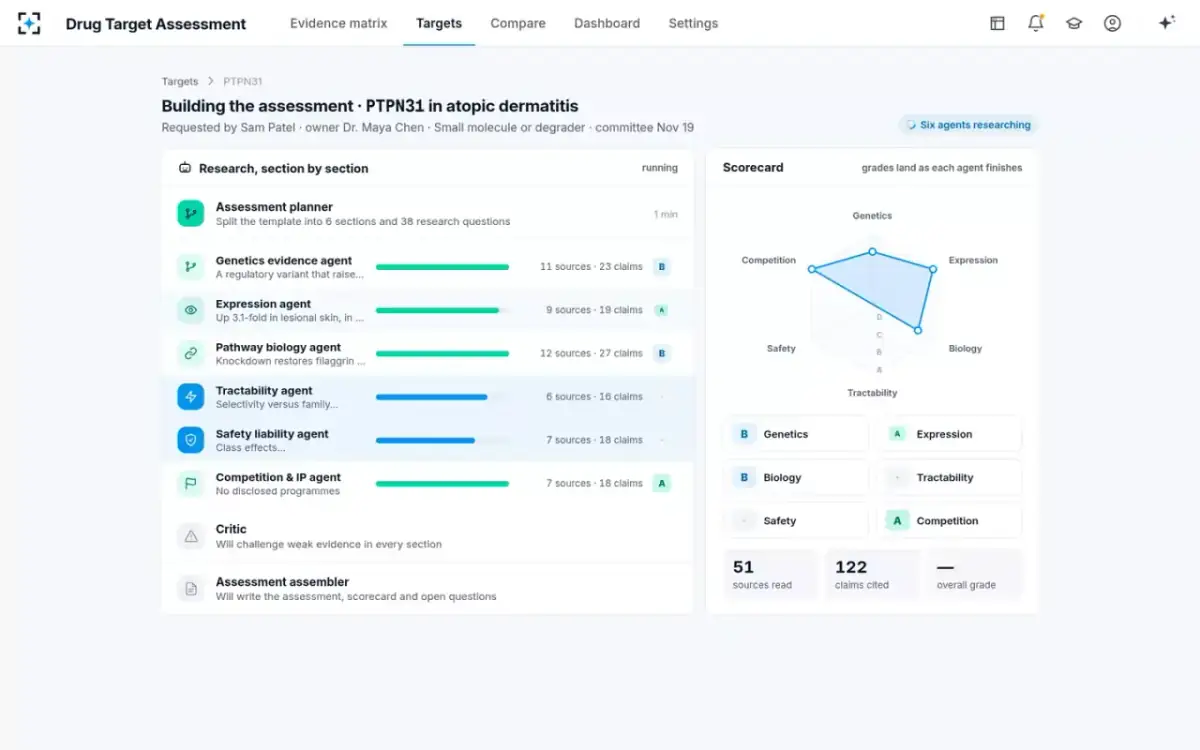
None of that is judgement. All of it is reading, and it is the part that takes a scientist about four weeks per target. In the sample portfolio those six questions are researched in parallel, and the measured agent time for the sample assessment was 38 minutes across nine agents — against 4.6 days from request to a finished assessment, because the rest is people reviewing, answering the challenges and signing.
Six questions researched at once, each lane showing its sources and claims
Does AI make up references?
Yes, and the rate has been measured. Two peer-reviewed studies put numbers on it for general chatbots asked to produce literature-review text, which is the task closest to the one being sold here.
Fabricated and inaccurate citations, measured in two peer-reviewed studies
55%
of GPT-3.5 citations fabricated, against 18% of GPT-4 citations, in 636 references from 84 generated reviews
47%
of references fabricated in 115 references from 30 generated short medical papers
7%
of that second set were both authentic and accurate
Read the mechanism rather than the percentages. A model asked to produce a reference from its own weights is generating a plausible string, and a plausible string is exactly what a citation looks like. The remedy is not a better model; it is an architecture in which no claim can exist without the passage it was read from, so that a fabricated citation has nothing to attach to. Checking every reference in a year of target assessments by hand is the work those two studies had to do to produce their percentages, and no reviewer will repeat it. If a tool cannot show you the passage, it is asking you to.
There is a second, subtler failure in multi-step systems. An error in the first step of a chain is rarely corrected by later steps; more often it is elaborated by them, because each step treats the previous one's output as settled. That is an argument for short chains with checkable outputs at each hand-off, and against long autonomous runs that report only at the end.
What regulators actually say about AI in drug discovery
Both of the regulators that matter most have now published, and both say something buyers rarely hear from a vendor: this part of the work is outside what they examine.
The two published positions, side by side
| U.S. Food and Drug Administration | European Medicines Agency | |
|---|---|---|
| The document | Draft guidance on the use of AI to support regulatory decision-making for drug and biological products, announced in the Federal Register on 7 January 2025. | Reflection paper on the use of artificial intelligence in the medicinal product lifecycle, adopted by the CHMP and CVMP and published in September 2024. |
| Does it cover drug discovery? | No. Its scope statement leaves out AI used in drug discovery, and AI used for operational efficiencies that do not affect patient safety, drug quality or the reliability of nonclinical or clinical study results. | Only conditionally: drug discovery "can be low regulatory impact if non-optimal performance only affects the developer" — but if results feed the evidence presented for review, non-clinical principles apply. |
| Its central idea | Credibility for a stated context of use: trust in how a model performs for one defined use, earned by collecting evidence about that performance. | Responsibility sits with the sponsor, applicant or manufacturer for every algorithm, model, dataset and pipeline used. |
| What it means for a target assessment | Nobody will inspect it — unless what it concludes later turns up in a submission, at which point the standard applies retrospectively to work already done. | The same, stated as a boundary rather than an exclusion: the moment the output contributes to the body of evidence, the lighter treatment ends. |
The FDA's framing is the more useful of the two for a buyer, because it is portable. Fix the context of use first — what exactly is this model doing, inside which decision — and then scale the evidence you collect about its credibility to the consequences of that decision being wrong. A target assessment that routes a screening budget needs less credibility evidence than one whose conclusions will be quoted in a filing three years later. Both need more than a demonstration.
Why nobody will inspect your target assessment
Because discovery sits before the regulated boundary, and both authorities have said so. That is not a licence; it is a transfer of the burden onto you, and the EMA states where it lands.
The EMA states it as a key principle of its reflection paper: the clinical trial sponsor, the marketing authorisation applicant or holder, or the manufacturer is responsible for making sure that every algorithm, model, dataset and data-processing pipeline it uses is fit for purpose and meets legal, ethical, technical, scientific and regulatory standards, good practice rules included (EMA reflection paper, section 2.2).
Two practical consequences follow. First, no vendor can hand you a certificate that discharges this: there is nothing to certify against for discovery work, and anyone implying otherwise is describing a different regulatory world. Second, because the EMA explicitly ends the lighter treatment once results contribute to the body of evidence presented for review, the honest planning assumption is that some of today's target work will be read later in a regulatory context. Build it to be readable then — dated, cited, signed — rather than reconstructing it under time pressure.
The three things no agent should be allowed to decide
A limit is only real if it is a property of the system rather than a promise in a slide. Three decisions should be outside what any agent can take, and each of them has a person attached.
Three decisions that stay with a named person, and who holds each
Six grades and a recommendation are inputs to a commitment of money, people and calendar. The judgement that the remaining uncertainty is acceptable belongs to the person whose name goes on it, and the published target-assessment framework says the same: the framework identifies the decision points, scientists decide when the bar is met.
Who decidesThe therapeutic-area lead who signs.
A human loss-of-function phenotype is a fact; whether it is monitorable, dose-dependent or disqualifying is a clinical judgement about a future medicine. The agent that reads safety is barred from lowering a liability without a cited source, and a weak safety grade is routed to a second, named reader.
Who decidesThe translational safety scientist who co-signs.
A patent landscape can be mapped and chemical similarity to your own series can be measured. The step from a map to "we can work here" is a legal opinion, and no agent in the solution gives one.
Who decidesCounsel, on a question the assessment hands over.
There is a fourth that is easy to miss because it looks procedural: whether a claim counts at all. In the sample portfolio an uncited claim never reaches the assessment, which means the assembler cannot write a sentence it cannot source, however true the sentence may be. That is an uncomfortable rule — real knowledge gets dropped — and it is the rule that makes the rest of the document trustworthy.
One agent, or nine with one job each?
One general agent asked to assess a target will produce something readable and will give you no way to find out where it went wrong. Nine agents with one job and written limits each produce something auditable, because every limit is a place a reviewer can point at. The division also makes the limits enforceable rather than aspirational: an agent that only ever reads genetics can be required to state direction of effect for every claim, which a general agent cannot sensibly be.
Nine jobs, and the limit written into each
| The agent | What it may do | What it may not do | Whose decision it touches |
|---|---|---|---|
| Assessment planner | Splits a request into the template’s sections and 35–45 research questions and sets the evidence that would earn an A, B, C or D. | Grade any section; plan before the modality has been stated. | The team that sets the rubric. |
| Genetics evidence agent | Finds genome-wide and rare-variant evidence, fine-mapping and colocalisation, with effect size, p-value and cohort size. | State a genetic claim without its direction of effect, or a number without the table or figure it came from. | The owner reading whether inhibition is the right direction. |
| Expression agent | Places the target in tissues and cell types, disease against healthy, from internal omics and the public atlas. | Let RNA stand in for protein; omit off-tissue expression in heart, liver, kidney and brain. | The safety scientist reading off-target tissue risk. |
| Pathway biology agent | Gathers mechanism, knockdown, knockout and animal-model evidence with the model and the number of donors, lines or animals. | Present animal-only evidence unlabelled, or a single-laboratory finding unflagged. | The owner weighing functional proof. |
| Tractability agent | Judges pockets, structures, ligands, screening hits, delivery and selectivity for the planned modality. | Grade against a modality nobody chose; merge biochemical and cellular potency. | The chemistry lead deciding what to screen. |
| Safety liability agent | Reads loss-of-function carriers, constraint, knockout phenotypes, essential tissues and class effects of medicines on the same pathway. | Lower a liability without a cited source, or leave a human loss-of-function phenotype unflagged. | The safety scientist who co-signs a C or D. |
| Competition & IP agent | Maps competitor programmes by target, modality and phase, checks registries and summarises the patent landscape. | Give a legal opinion; present competitor data more than 30 days old without refreshing it. | Counsel, and the portfolio committee. |
| Critic | Argues the other side of every section and proposes grade changes and open questions, citing the claim it questions. | Change a grade. | The owner who accepts, keeps or asks for another look. |
| Assessment assembler | Writes the assessment, scorecard, open questions and references in plain words, and routes it to the right reviewer. | Include a claim that carries no citation. | Everyone who reads the finished document. |
The path one assessment takes, and where it stops being a machine’s work
Agent
PlanThe template becomes sections and 35–45 research questions, each assigned to a specialist, with the bar for each grade set in advance.
Never: grades anything
Agent
Research, six questions in parallelEach specialist reads its own sources and writes claims, every one carrying the passage behind it and its evidence type.
Never: writes a claim it cannot cite
Agent
ChallengeEvery section is read against itself: single-source claims, animal-only evidence, transcripts standing in for protein, stale data, the wrong direction of effect.
Never: changes a grade
Agent
AssembleThe cited claims become a document with a scorecard, open questions and numbered references, routed to the reviewer who owns the target.
Never: includes an uncited claim
A person decides
Decide and signThe therapeutic-area lead settles each challenge, turns open questions into conditions and signs; a weak safety grade is co-signed by the safety scientist.
Challenge before sign-off: an adversarial pass on your own evidence
The most valuable thing an agent does in this process is argue against the document it just wrote. A reviewer reading a well-written assessment is at a disadvantage: the case has been assembled by something with no stake in the outcome but also no scepticism, and fluency reads as confidence. A pass that explicitly looks for the weak joins restores the balance before the meeting rather than during it.
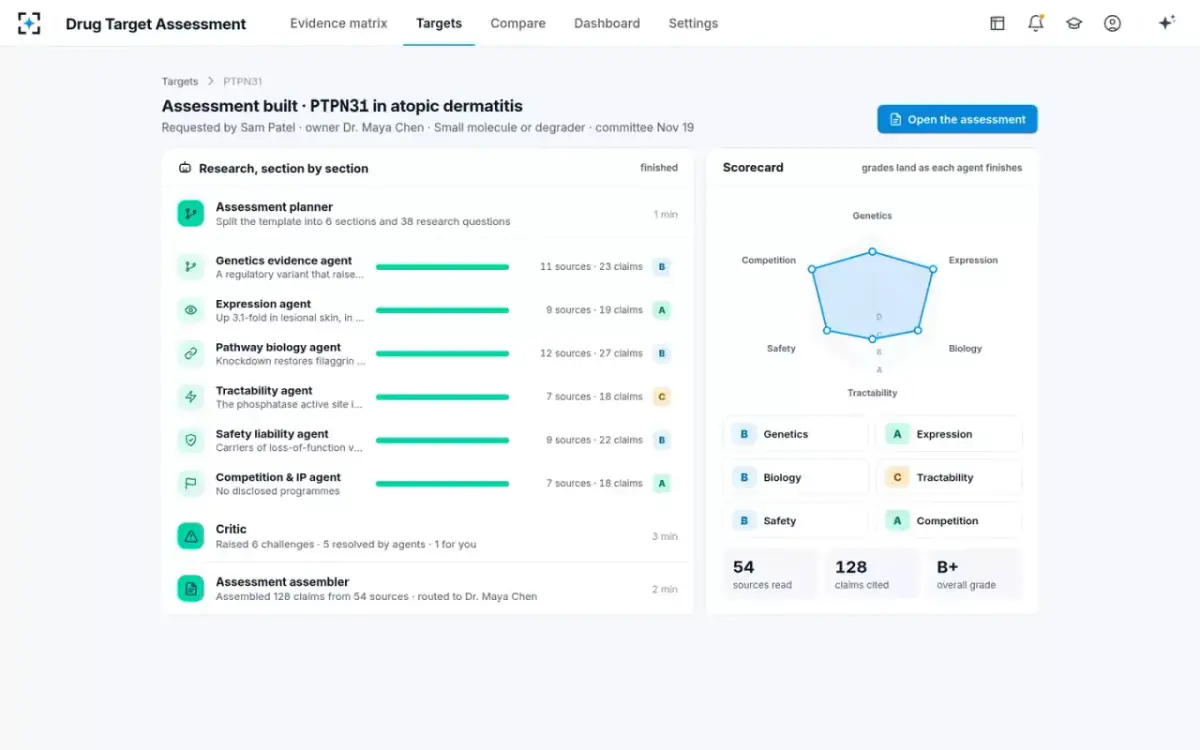
What it looks for is specific and worth copying whatever system you use: claims resting on one source, evidence that exists only in animals, transcript measurements standing in for protein, competitor or genetic data old enough to have been superseded, and effects whose direction contradicts the thesis. In the sample portfolio's atopic dermatitis build the challenge pass raised six, resolved five against the agents' own sources and left one for the owner to decide. The setting that governs how hard it pushes — standard, or strict enough to challenge every single-source claim — is a team's to choose.
Challenged, assembled and routed: the end of the machine's part
What to demand of any claim an agent writes
Five questions, asked of a sample of claims rather than of the system as a whole, will tell you more than any demonstration. They work on any product, including ours, and the answers should be visible in the interface rather than available on request.
Five questions to put to a sample of agent-written claims
- Which source, exactly?
A title and a year is not a citation you can check. You want the identifier and a link that opens the document itself.
- Which passage?
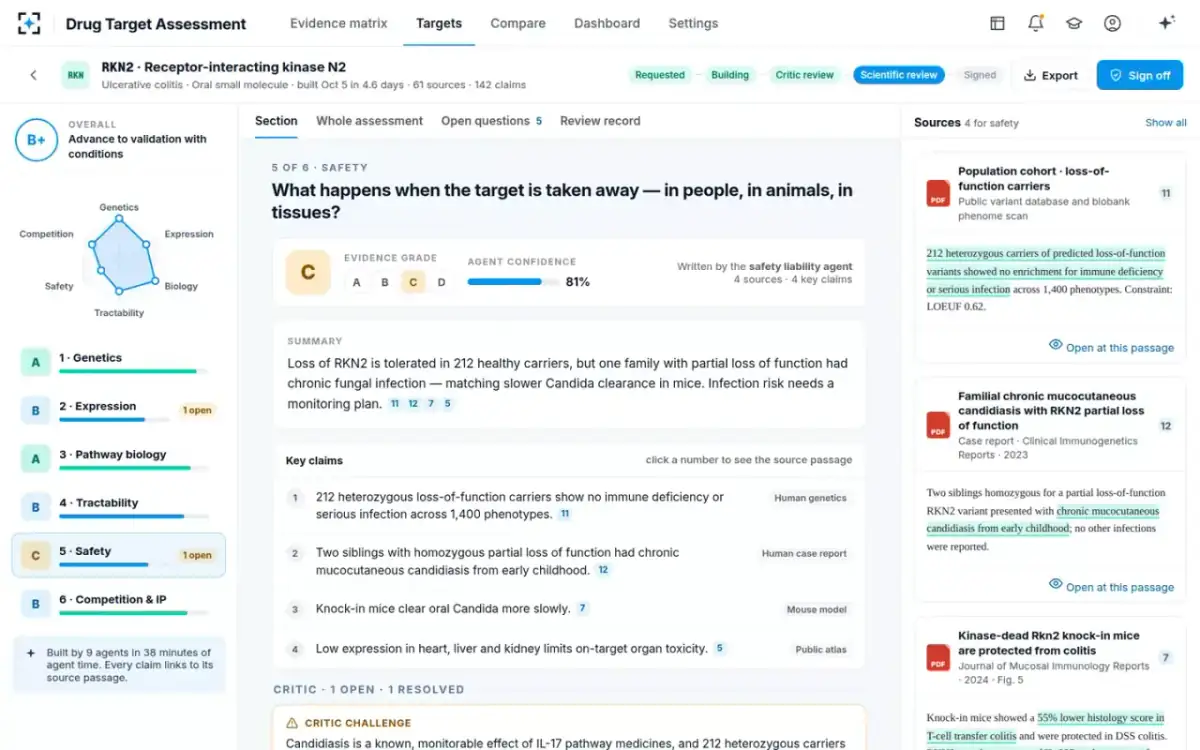
The sentences, table or figure the claim was read from, highlighted. This is the property that turns a fabricated citation from a hidden error into one a reviewer catches in seconds.
- Which number, from where in the paper?
An effect size quoted from an abstract is not the same as one read out of the table; the table has the confidence interval and the cohort.
- Which evidence type?
Human carrier, animal model, cell line, transcript, protein. A grade that does not distinguish these is a grade you cannot argue with.
- Who confirmed it, and when?
Which person accepted the grade, on what date, and what the evidence looked like on that date — because it will not look the same in six months.
One section, with the passage behind each claim
Where this breaks: licensed text, internal data and the questions nobody has studied
Three limits are worth stating plainly, because they are the ones that surface in month two rather than in week one.
Licensing is the first. Full text is readable only where you are licensed to read it, and what the agents may read is a setting rather than an assumption; licensed source material stays inside the assessment instead of being exported in full. A target whose key evidence sits behind a licence you do not hold will be graded on what is actually available, and the grade should say so.
Internal data is the second, and it is where a general tool stops being comparable to a specialist one. The expression question cannot be answered from public atlases alone when your own single-cell data says something different about the disease tissue; reading both and labelling which is which is the job. The same applies to your screening and chemistry reports, which no public source can substitute for.
The third is the honest one: some questions have no literature. A target nobody has studied in the disease you care about produces a thin assessment, and a system that returns a confident grade on thin evidence is worse than one that returns a D and says why. This is where the grade bar earns its place — and where what the public platforms already answer, and what they leave you is the right next question. If you are planning an evaluation rather than reading for background, how to test this kind of software on your own targets sets out a four-week protocol. To see the claims, the challenges and the signature on a sample portfolio, start from Drug Target Assessment.
Questions people ask
Can AI decide whether to progress a target?
No, and it should not be configured to. The published target-assessment framework for this decision is explicit that scientists remain responsible for deciding when the quality of evidence is sufficient. A sensible system produces grades with their evidence, argues against them, and hands the decision to a named person with the options written down; what it must not do is convert a score into a commitment.
How accurate is AI at reading scientific literature?
Accurate enough at extraction to be useful, and unreliable enough at citation to need an architecture around it. In the two peer-reviewed studies above, general chatbots asked to write literature reviews fabricated between 18% and 55% of their references depending on the model, and many of the real ones carried errors. The design answer is to make every claim resolve to a retrieved passage, so there is no step at which a reference is generated rather than read.
Is AI in drug discovery regulated?
Not at the discovery stage, in either major jurisdiction. The FDA's draft guidance on AI for regulatory decision-making states that it does not address the use of AI models in drug discovery, and the EMA's reflection paper treats drug discovery as low regulatory impact while poor performance affects only the developer. Both change once the output contributes to evidence submitted for review, and the EMA puts the responsibility for fitness for purpose on the sponsor or applicant throughout.
What is an AI agent in drug discovery?
A model given a narrow job, a set of sources it may read and a limit on what it may conclude — for example, read the genetics for this gene and this disease, report effect size, p-value and cohort size from the table, and state the direction of effect for every claim. The useful distinction from a chatbot is not autonomy but constraint: agents are worth having because their limits can be written down and tested.
How do you check an AI-generated claim?
Open the passage. If the interface cannot show you the sentences the claim was read from, inside the document it came from, the claim is unverified no matter how plausible the citation looks. Beyond that, check that the number matches the table rather than the abstract, that the evidence type is stated, and that a person has confirmed the grade the claim supports.
What are the limits of AI in target validation?
It cannot run the experiment that would settle the question, it cannot read what you are not licensed to read, it cannot tell you anything about a target nobody has studied, and it cannot accept risk on your behalf. A fifth limit is structural: in multi-step pipelines an early error tends to be elaborated rather than corrected by later steps, which is an argument for short chains whose outputs a person can check at each hand-off.