Drug target Mendelian randomization uses naturally occurring variants that change a specific protein's activity as a lifelong, randomly allocated experiment, and asks what happened to the disease in the people who carry them. For a discovery team the point is not the causal estimate an epidemiologist would report. It is the three things the estimate lets you write down about a candidate target: which gene, in which direction, and how confidently. That is harder than it sounds — most association signals sit in non-coding sequence near several genes, and the direction is often assumed rather than measured. Botminds' Drug Target Assessment treats genetics as one graded question of six, where a grade is only as strong as the weakest of those three answers, and every number on the page opens the table or figure it came from.
The targets, studies, cohort sizes and people in the worked examples below are fictional sample data from the solution's own portfolio; the published figures are linked to their sources.
What is drug target Mendelian randomization?
The method is older than its application here. "Mendelian randomization (MR) is a method that utilizes genetic variants that are robustly associated with such modifiable exposures to generate more reliable evidence regarding which interventions should produce health benefits," wrote Davey Smith and Hemani in the review that set out the logic (Human Molecular Genetics, 2014). Alleles are allocated at conception and are not moved by the disease, so a variant that alters an exposure gives an unconfounded, lifelong natural trial of altering it.
Point the same logic at a protein rather than a lifestyle exposure and the exposure becomes the target itself: carriers of a variant that lowers the protein's activity are living a lifelong, low-dose version of the inhibitor you want to make. If they get less of the disease, the hypothesis that inhibiting the target helps has human support before a single molecule exists. If they get more, you have learned that you should be activating it — and if you had guessed, you would have guessed wrong half the time.
Two differences from the epidemiological use matter in a target review. The exposure is a protein, so the instrument should sit in or near the gene that encodes it rather than anywhere in the genome. And the output you need is not a number with a confidence interval but a claim with a grade: a lifelong partial reduction is not a therapeutic dose given to an adult with established disease, so the honest reading is directional and supportive, never quantitative about efficacy.
From locus to gene: fine-mapping, colocalisation and what each one settles
The first thing a genome-wide association study gives you is a locus — a block of correlated variants, often spanning several genes, none of which need be the one that matters. Turning that into a target requires two separate pieces of work that are frequently confused.
Fine-mapping narrows the signal within the locus: it asks which variants could plausibly be the causal one, given the correlation structure, and returns a credible set rather than a single answer. Colocalisation asks a different question — whether the disease signal and a molecular signal, typically expression of a nearby gene in a relevant tissue, are driven by the same underlying variant. The statistical test for this was set out by Giambartolomei and colleagues, who described "a novel statistical methodology to assess whether two association signals are consistent with a shared causal variant" (PLOS Genetics, 2014). Two signals that sit on top of each other but arise from different variants look identical on a regional plot and mean entirely different things.
Four kinds of genetic evidence, and what each one licenses you to claim
What you have: Rare coding variants in one gene segregating with a severe phenotype across families, with the mechanism of the variant known.
What you may write down: The gene is causal and the direction is usually unambiguous. The strongest evidence available, and the hardest to extrapolate to common disease.
What you have: A common or low-frequency variant that changes the protein, associated with the disease at genome-wide significance and replicated.
What you may write down: The gene is named by the variant itself, so no fine-mapping is needed. Direction follows from whether the variant raises or lowers function.
What you have: A non-coding association that colocalises with expression or protein levels of one gene in a relevant tissue.
What you may write down: The gene is probable, not certain, and the direction is inferred from the molecular signal. Strong support; not the same as a coding variant.
What you have: A genome-wide significant association in a region containing several genes, no fine-mapping, no molecular signal.
What you may write down: That the region matters. Nothing about which gene, and nothing about direction. A target claim built on this is a hypothesis wearing a p-value.
The order matters more than the methods. A target review that cites a p-value before it has named the gene has skipped the step that decides whether there is a target at all — which is why the same locus can appear in three companies' reviews attached to three different genes.
What is genome-wide significance, and why p = 4 × 10⁻⁵ is not evidence
Genome-wide significance is the threshold that corrects for the number of independent tests a genome-wide scan performs. Its conventional value, 5 × 10⁻⁸, comes from treating the common-variant genome as about a million independent tests at a 5% family-wise error rate. That denominator was measured: Pe'er and colleagues "report an estimated testing burden of a million independent tests genomewide in Europeans, and twice that number in Africans" (Genetic Epidemiology, 2008) — which is also why the same threshold is conservative in some populations and permissive in others.
A p-value of 4 × 10⁻⁵ is therefore not a weak result. It is an expected result: in a scan of a million independent tests, forty associations that strong will appear by chance alone. The practical rule follows directly. A sub-threshold association in a candidate-gene analysis, declared after the gene was chosen, is worth almost nothing; the same value in a pre-registered replication of a specific prior hypothesis is worth a great deal. The number alone cannot tell the two apart, so a claim has to say which it is.
It is worth knowing what the public catalogue of these results holds and does not hold. The GWAS Catalog's "scope covers the most significant variant-trait associations, as well as structured metadata about the publication, study design, samples and traits, for all published human GWAS" (Sollis et al., Nucleic Acids Research, 2023). It is an index of associations, not of causal genes. The step from one to the other is the work.
Direction of effect: the question that decides whether you inhibit or activate
Nothing else on this page changes a programme as completely as the direction. "Determining the correct direction of effect (DOE), whether to increase or decrease the activity of a drug target, is essential for therapeutic success," as a 2025 analysis in npj Drug Discovery puts it (on PubMed Central). A target with excellent genetics and an inverted direction is not a weak programme; it is an expensive one aimed the wrong way.
Direction is read differently depending on the evidence type. A coding variant that destroys function and is associated with lower disease risk says that loss of function protects, so inhibition is indicated. A regulatory variant that raises expression and raises risk says the same thing by a different route. A rare gain-of-function variant causing disease says it a third way. The trap is the common case, where the association is non-coding, the molecular direction is unknown, and the direction in the review is inherited from a mechanistic story rather than from data. That is why the rule in the solution's genetics section is blunt: direction of effect is stated for every genetic claim, or the claim cannot support a top grade.
How Drug Target Assessment reads a genetic claim before it grades one
The gene
locus → credible set → colocalised gene
Which gene, by what method — fine-mapping, a coding variant or a colocalised molecular signal. A region is not a gene.
Resolved, probable or unresolved
The direction
loss of function → protects or harms
Whether less of the protein means less disease. Read from the variant class or the molecular signal, never from the mechanism you expect.
Stated, or the claim is incomplete
The estimate and the cohort
OR or beta, 95% CI, cases / controls
The effect with its interval and the sample it came from, cited to the table or figure that reports it rather than to the paper.
Cited to a table or figure
Replication
independent cohort, same direction
An independent sample, not a second analysis of the same biobank. Without it the claim is provisional, whatever its p-value.
Replicated, or provisional
How much does genetic evidence improve the odds of approval?
This is the number everyone quotes and almost nobody quotes correctly. The current estimate, from an analysis of drug programmes matched to genetic associations, is stated by its authors as a relative success rate rather than a promise.
We estimate the probability of success for drug mechanisms with genetic support is 2.6 times greater than those without.
Minikel, Painter, Dong and Nelson, Nature 629, 2024
Three qualifications travel with that sentence and are usually stripped off. It is measured across mechanisms that had already entered clinical development, so it compares programmes that exist, not genes that might become programmes — the authors note that the metric "does not address the probability that a gene associated with a disease, if targeted, will yield a successful drug". It varies by therapy area and by phase. And it is a property of a population of programmes, which means it cannot be applied to yours as a forecast.
The published advantage, and what it does and does not depend on
2.6×
estimated probability of success for drug mechanisms with genetic support, against those without
3.7RS
relative success for Mendelian evidence from OMIM, the highest of any source examined
>2RS
for every source of human genetic evidence the analysis examined
None
significant effect of genetic effect size, minor allele frequency or year of discovery on the advantage
The earlier estimate agrees on the part that matters for grading. "When causal genes are clear (Mendelian traits and GWAS associations linked to coding variants), we find the use of human genetic evidence increases approval by greater than two-fold, and, for Mendelian associations, the positive association holds prospectively" (King, Davis and Degner, PLOS Genetics, 2019). Both analyses point at the same lever: clarity about the causal gene, not the strength of the signal.
Effect size is not the signal everyone thinks it is
Programmes argue about effect sizes constantly — an odds ratio of 1.08 is dismissed, a 1.6 is celebrated — and the evidence does not support the argument. The 2024 analysis tested the advantage against the quartile of effect size for both quantitative and case-control traits and found it largely unaffected, along with allele frequency and the year the association was discovered.
This makes sense once the mechanism is clear. A common variant with a small lifetime effect on a protein's activity may be a faithful, low-dose read-out of a pathway that a drug can perturb far harder. The genetic effect size measures the size of the natural nudge, not the size of the available therapeutic effect. What the genetics is being asked to establish is causality and direction; magnitude is a question for pharmacology.
The practical consequence is a rubric that rewards the right work. An extra two years of meta-analysis to move a p-value is usually worth less than a fine-mapping study or a protein colocalisation that moves the causal gene from probable to resolved. A grading bar built around "two independent human sources with the causal gene resolved and the direction stated" puts the effort where the published evidence says the return is.
Replication, and what a grade should do while you wait for it
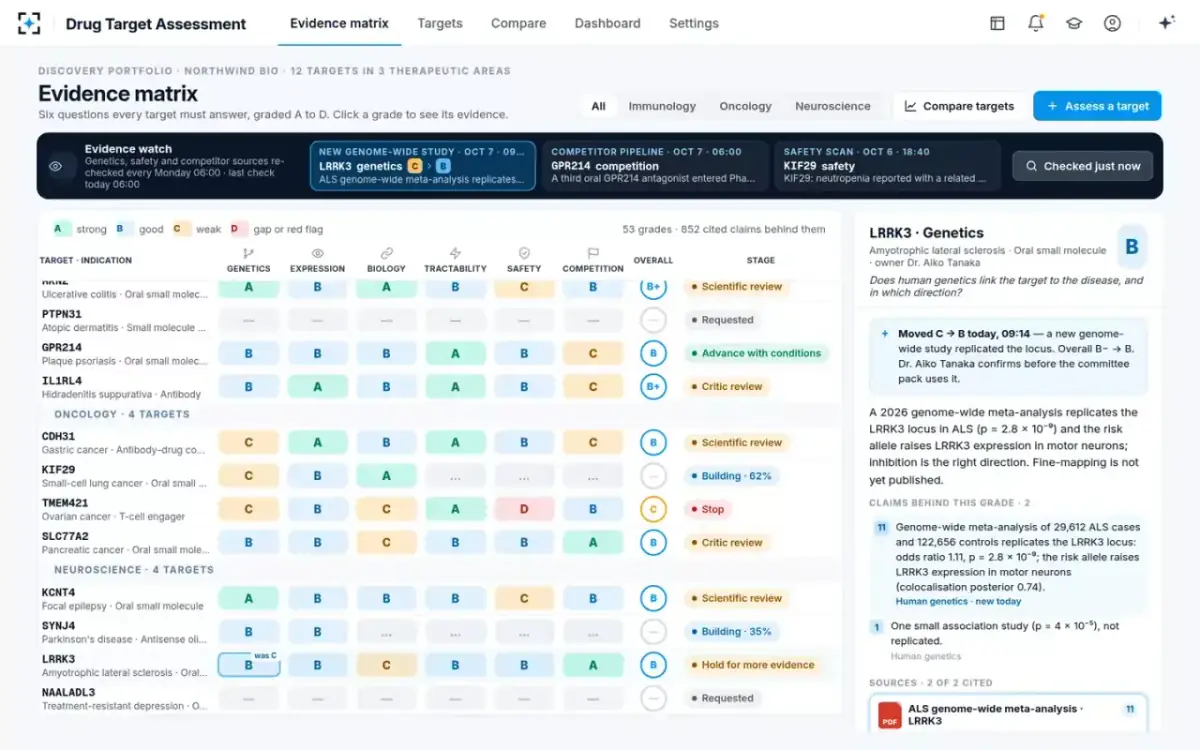
An unreplicated association is a reasonable hypothesis and a poor foundation. The useful question is not whether to believe it but what grade it earns and what the grade commits you to. In the sample portfolio a neuroscience target was signed as a hold on exactly this basis: its genetics rested on one small association study at p = 4 × 10⁻⁵, with no replication, which earned a C and an overall grade below the threshold for advancing.
A hold on thin genetics is the right call and the most perishable one on the matrix, because the evidence that would overturn it is being generated by other people on their own schedule. Two years can pass before anyone on the programme reads the study that changes the answer.
One target's genetics, and the two years nobody was watching
- One association, p = 4 × 10⁻⁵, unreplicated · graded CC
- No new reading on this target24 months
- Someone reads the meta-analysisC → B
- One association, p = 4 × 10⁻⁵, unreplicated · graded CC
- Weekly re-check of genetics, safety and competitorswatched
- Meta-analysis replicates the locus · owner confirmsC → B
Note what the grade does not do when the new study lands. It moves to B and stops there, because the causal gene is still probable rather than resolved, and it is tagged with what it was so a reader can see the change. The owner of the target is asked to confirm before the new figure is used in a committee discussion. A grade that moved silently would be worse than a stale one.
The same method, pointed at safety instead of efficacy
The argument that makes genetic evidence attractive for efficacy makes it uncomfortable for safety, and the two cannot be separated. Lifelong carriers of a function-altering variant show you the consequences of altering the protein across every system, not only the one you are interested in — and an analysis of approved drugs found that a labelled side effect was about twice as likely when the drug's target carried human genetic evidence for a similar trait (Minikel and Nelson, PLOS Genetics, 2025). That is a population-level enrichment across many drugs, not a prediction for one target, but it settles the principle: the same search that supports your mechanism will also tell you what your label may say.
In practice this means a genetics section and a safety section that read the same variants for different purposes, and a rule that neither may quietly ignore what the other found. The full version of that question — human loss-of-function carriers, constraint, knockout phenotypes and class effects — is what a constraint score says, and what the carriers add.
A grade moves on new evidence, in view, with the owner asked to confirm
What a genetic claim must state to be gradeable at all
Most disagreements about a genetics grade turn out to be disagreements about what was claimed. The fix is mechanical: fix the shape of a claim, and a reviewer can tell in seconds whether it supports the grade attached to it.
What every genetic claim in a target review has to carry
- The trait, as studied
The phenotype the study actually measured, which is often narrower than the indication you intend — a subtype, a biomarker, or a self-reported diagnosis.
- The gene, and how it was named
Coding variant, fine-mapped credible set, or colocalisation with a molecular signal in a stated tissue. "Nearest gene" is a method, and a weak one; say so if it is what you have.
- The direction of effect
Whether lower activity means less disease or more. Without it the claim cannot tell a programme whether to inhibit or activate, which is the decision it exists to inform.
- The effect estimate with its interval
An odds ratio or beta with its 95% confidence interval, not a p-value standing in for both. A tight null is a result; a wide positive is not.
- The sample, with ancestry
Cases and controls or sample size, and the ancestries represented. The testing burden and the correlation structure both differ by population.
- Replication status
An independent cohort with the same direction, or an explicit "not replicated". A second analysis of the same biobank is not replication.
- The table or figure the number came from
The citation points at the passage, not the paper, so the next reader can check it without re-deriving it.
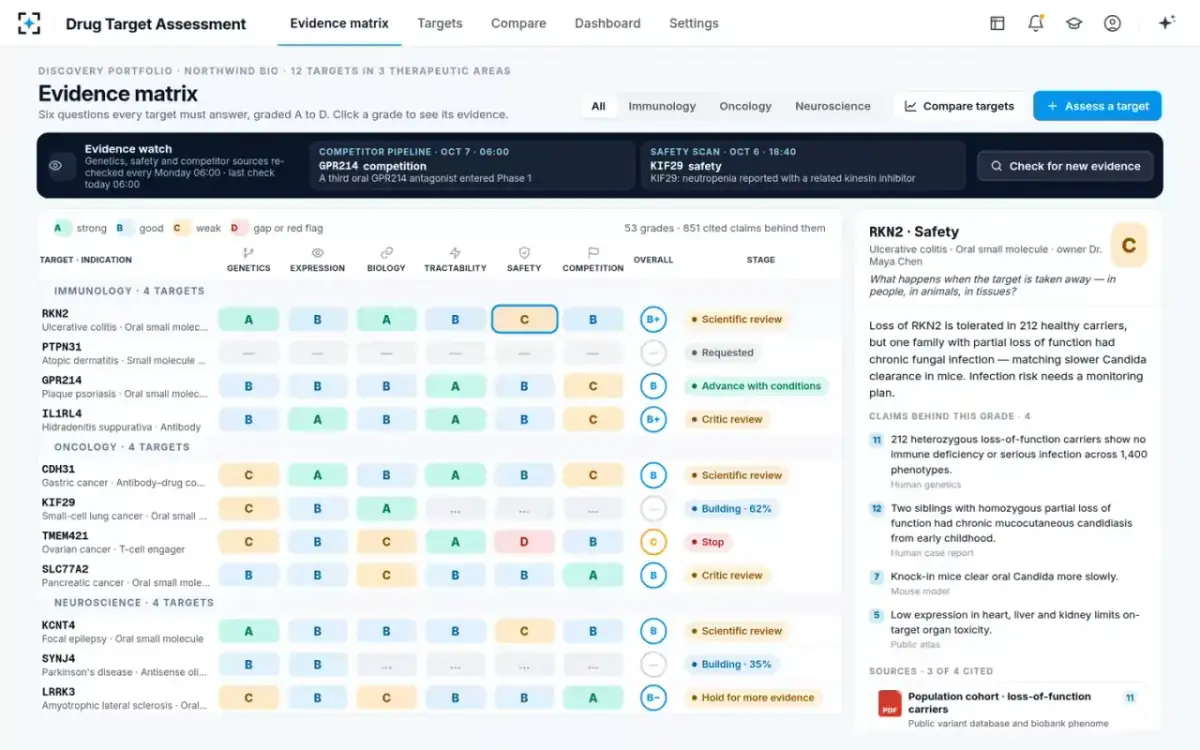
Behind one grade: four claims, their evidence types and their sources
When the genetics changes after you have signed
A target review is a decision taken on a date, and the genetics underneath it does not hold still. Two things have to be true at once for that to be manageable: the signed version stays exactly as it was signed, so the committee's decision can be read against the evidence it actually had, and a live view shows what has changed since.
The machinery for this is small. Signed assessments are re-checked on a cadence the team sets. A grade that moves shows the move and its new citation rather than replacing the old value silently. The owner of the target confirms before the new grade counts for a committee discussion, and a grade changed by a person carries a written reason. None of that is about genetics specifically; it is what makes a graded review safe to keep rather than safe to file.
It also changes which targets get a second look. A hold placed on thin genetics is the most likely grade in the portfolio to be wrong a year later, and the least likely to be revisited — the pattern behind why most programmes fail, counted by cause. Where the six questions sit together, and what each one has to answer, is set out in the six questions, graded. To see a genetics section with its claims and passages on your own targets, start from Drug Target Assessment.
Questions people ask
What is the difference between a GWAS hit and a causal gene?
A hit is a position in the genome where variation tracks with the disease; a causal gene is the gene through which that variation acts. Most hits are non-coding and sit near several genes, so the two are only the same when a coding variant names the gene directly. Fine-mapping narrows the candidate variants and colocalisation tests whether the disease signal and a molecular signal share a causal variant. Until one of those is done, the nearest gene is a guess.
What is colocalisation in GWAS?
It is a statistical test of whether two association signals in the same region — typically a disease signal and an expression or protein-level signal — are driven by the same underlying variant. The widely used Bayesian version weighs how probable it is that both signals come from one shared causal variant rather than two. It matters because two signals that overlap on a plot may reflect different variants in correlation, which would mean the gene you inferred is not the gene the disease acts through.
What is a protective variant?
A variant whose carriers have less of the disease than non-carriers — an odds ratio below one. When the variant reduces the target's function, it is the most useful observation in target discovery, because it is a natural experiment in exactly the direction a drug would push. The sample portfolio's strongest genetics grade rests on one: a protective variant with an odds ratio of 0.71, which says both that the target is causal and that inhibition is the right direction.
Can Mendelian randomization predict drug side effects?
It can anticipate some of them, and the effect is measurable across many drugs: side effects were about twice as likely for drugs whose target had human genetic evidence for a trait resembling the side effect. That is an enrichment across a population of approved drugs, not a forecast for one programme, and it misses effects that depend on dose, on chemistry rather than the target, or on short-term exposure. Treat it as a reason to read the phenotype breadth carefully, not as a safety package.
Is a drug target Mendelian randomization study enough on its own?
No. It speaks to one of the six questions a target has to answer, and only partly: it supports causality and direction in people who have lived with altered activity since conception. It says nothing about whether the protein is present in the cells that drive the disease, whether your modality can reach it, what else happens when it is suppressed, or who else is already working on it. A review that treats a strong genetic result as a validated target has answered a sixth of the question.
How is Mendelian randomization used in drug discovery?
Mostly in three places. Before a programme starts, to test whether altering a candidate target plausibly changes the disease and in which direction. During indication selection, to scan the phenotypes associated with the same gene for other diseases the mechanism might serve. And in safety, to look for the traits that carriers also show. In each case the output that a discovery team can act on is a claim with a named gene, a stated direction and a replication status — not a causal estimate.