A go/no-go decision in drug development is the point at which a team stops gathering evidence about a target and commits — or refuses to commit — the money, people and calendar that the next block of work would take. It is almost never the moment the evidence becomes sufficient, because it never does; it is the moment a named person accepts the uncertainty that is left, writes it down as conditions somebody owns, and signs. Botminds' Drug Target Assessment is built around that fact rather than around the hope of removing it: nine agents research six questions, grade each against a bar the team sets, argue the other side of every grade, and hand the therapeutic-area lead a document in which each claim opens the passage it came from. The decision stays with the scientist.
The research cited below comes from the published target-assessment literature and from peer-reviewed analyses of clinical success; the portfolio, people and targets in the worked examples are fictional sample data from the solution's own sample portfolio.
Although the GOT-IT recommendations support the identification of value inflexion points for each project, scientists are ultimately responsible for deciding when a 'quality of evidence' level is reached to enable go/no-go decisions and to move on to the next activity or assessment block.
Emmerich et al., the GOT-IT recommendations, Nature Reviews Drug Discovery 20, 2021
That sentence is worth reading twice, because it is the most honest thing published about this decision. The framework, built by a publicly funded working group with industry mentors for exactly this problem, can tell you where the decision points are and what questions to have answered at each. It will not tell you when enough is enough. A person does that, and the design of the decision therefore matters more than the quantity of evidence in front of it.
What is a go/no-go decision in drug development?
It is a planned stopping point where a project either earns its next block of work or does not. In discovery the commonest one sits between target assessment and lead generation: the target has been graded on human genetics, expression, pathway biology, tractability for the planned modality, safety and the competitive field, and a committee decides whether to start screening. Later ones sit before candidate selection and before the first study in humans, where the money at stake is an order of magnitude larger and the evidence is correspondingly firmer.
The reason to plan them in advance rather than decide when someone asks is operational, and the recommendations say so directly: "Entering drug discovery projects with a strategic plan that clearly outlines goals and expectations, milestones and go/no-go decision points helps to reduce operational risks and facilitates resource management". A decision point nobody scheduled becomes a decision nobody takes, and a programme that nobody decided to continue is the most expensive kind.
What makes the target-stage decision unusually hard is the shape of the evidence. It is almost all other people's — published studies, public portals, an internal screen or two — and it is being read by someone whose incentive is to find it convincing. That asymmetry is why the published literature on targets looks the way it does.
What published target-validation papers actually cover
85.5%
discussed the link between target and disease and identified future patient populations
9.1%
included potential safety issues
1.9%
included target assayability
Five of the six questions a decision needs are largely absent from the papers that argue for targets. They have to be assembled from somewhere else, by someone, before the meeting — and whoever assembles them shapes the decision more than the committee does.
Who decides which drug targets go forward?
In most organisations the signature belongs to the therapeutic-area head, and the committee is where the portfolio is balanced rather than where the science is settled. But a target decision is never one person's work, and naming the seats is the first thing that makes it reviewable. Five roles recur, and each of them decides something different.
Five seats around one target, and what each of them decides
Today
Signs target reviews built from weeks of reading, and answers the committee’s questions by going back to the papers.
With agents
Opens any grade, sees the claims and passages behind it, decides each challenge and signs with conditions.
Still theirs: the decision, and what the signature means
Today
A target held for weak genetics stays held until somebody happens to read the next study.
With agents
Is asked to confirm when new evidence moves a grade on her targets, with the new citation in front of her.
Still theirs: whether the move counts for the committee
Today
Has to find each safety finding in a long document before she can judge it.
With agents
Sees human loss-of-function phenotypes flagged first, and co-signs any safety grade of C or D.
Still theirs: the second signature on a weak safety grade
Today
Spends three weeks reading for one target.
With agents
Requests an assessment, watches the questions researched in parallel, and takes the open questions that need his data.
Still theirs: the answers only internal data can give
Today
Assembles the meeting from documents written to different standards.
With agents
Builds it from signed assessments on one rubric, compared side by side.
Still theirs: making three targets comparable
The seat most often left empty is the second one. Someone has to own each target between meetings, because evidence arrives between meetings; a portfolio where only the committee can move a grade is a portfolio that moves four times a year.
The four options, and what each one actually commits
Most decision processes offer two outcomes and then invent a third in the room. Four named options is better, because the two in the middle are where most targets honestly belong and because each one commits something different.
Four decisions on one target, and what each commits
| The decision | What it commits | What it costs if it is wrong | Who is on the hook |
|---|---|---|---|
| Advance | A screening campaign, chemistry effort and a place in next year’s budget. | The largest visible cost, and the one everybody counts: a programme that runs for two years on a target that was never there. | The signing lead, at the next review. |
| Advance with conditions | The same work, plus named experiments and opinions that must land by a date. | Nothing, if the conditions are owned. Everything, if they are decoration: the programme runs and the conditions quietly lapse. | A named owner per condition, by a date. |
| Hold for more evidence | Nothing today — and, usually, nobody tomorrow. | Invisible. A target that was right stays held because no one is watching for the study that would move it. | Nobody, unless the hold has an owner and a trigger. |
| Stop | The team is released and the work is written down. | A target that later proves out elsewhere. Recoverable if the reasoning survives; irrecoverable if it does not. | The signing lead, and the written reason. |
Note the second row. Conditions are the honest answer to a target that is good but not finished, and they are also the easiest thing in the process to render meaningless. A condition without an owner and a date is a sentence in a document; a condition with both is a decision that has been taken and scheduled.
One rubric, or the comparison is an argument about style
Three targets assessed by three scientists are not comparable, however good each assessment is. One will grade genetics against replicated genome-wide evidence, another against a single association study, and the committee will spend its meeting discovering that rather than deciding. The fix is dull and effective: one rubric, written down, applied to every target, with the bar for each grade stated — in the sample portfolio an A needs two independent human sources, and a team can set that to one human source plus a functional study, or to any three sources, and the choice travels with every assessment made under it.
A rubric also keeps borrowed statistics out of the room. Published success rates differ sharply by disease, phase, sponsor and whether a biomarker is used: one large study of clinical success, built on more than 400,000 trial records, reports that it computes "disaggregated estimates across several trial features including disease type, clinical phase, industry or academic sponsor, biomarker presence, lead indication status, and time", and that in several cases its results differ significantly from widely cited figures. A single portfolio-wide probability of success, applied to a specific target in a specific indication, is therefore an argument dressed as a number. The rubric's job is to make the evidence comparable; it is not to predict the outcome.
Three targets on one rubric, criterion by criterion
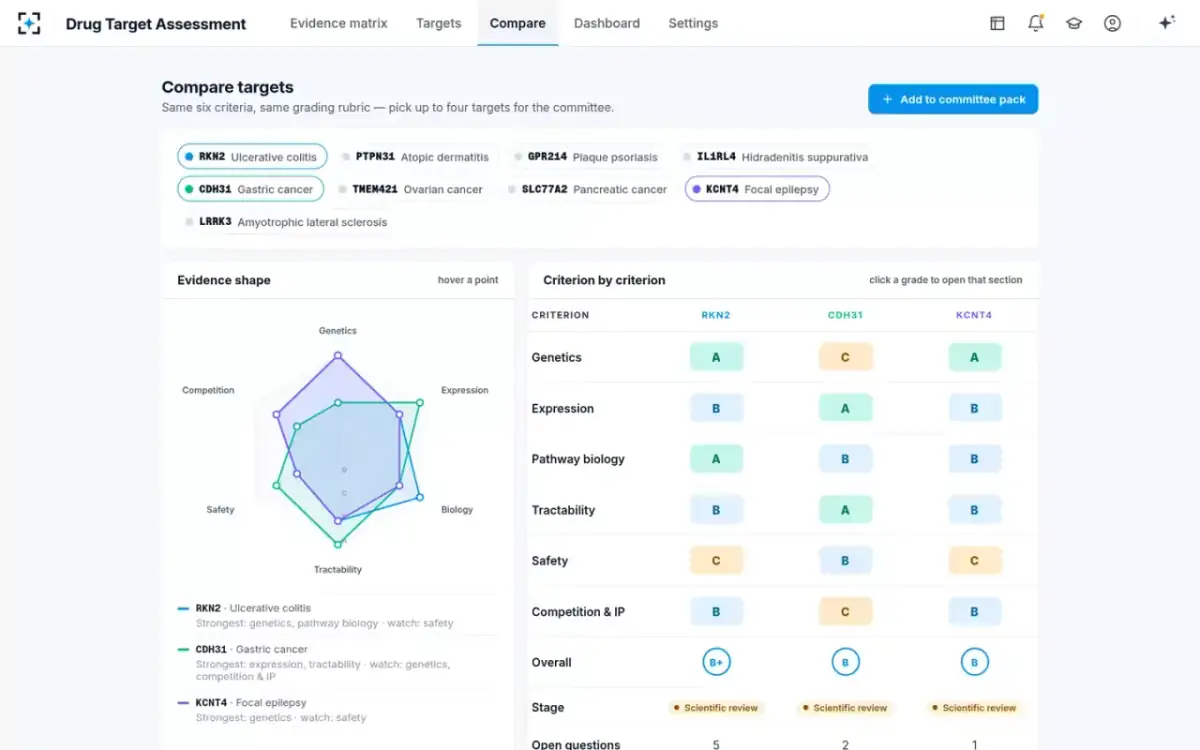
Killer experiments: designing the test that could end it
A killer experiment is one designed so that a particular result would invalidate the target, rather than one designed to show that the target works. It is the cheapest insurance in discovery and the hardest thing to commission, because everyone in the room has an interest in the target surviving.
The published recommendations build it into the method. Projects work through sets of experimental approach questions at each assessment block, and those questions "also help to design high-quality 'killer experiments' with the potential to invalidate a target". The mechanism matters: the questions are chosen before the answers are known, which is what stops the experiment from being designed around the result that is wanted.
In practice the killer experiment usually falls out of the weakest grade rather than the strongest. If tractability for the planned modality is a C because the pocket is shallow and no ligand exists, the experiment that could end the programme is a fragment screen, not another disease-biology paper. If safety is a C because of a human loss-of-function phenotype, it is a selectivity measurement in the tissue that phenotype points at. Reading the weakest grade as the experimental plan is a habit worth building, and it is the practical use of grading all six questions rather than arguing the strongest one.
Conditions are a decision too, if somebody owns them
The route from an unresolved argument to a condition is the part of the process most organisations leave informal, and it is where decisions leak. An assessment that has been argued properly leaves two kinds of loose end: questions nobody has answered yet, and challenges the owner declined to accept. Both should survive the meeting in writing, attached to the signature rather than to the minutes.
From a graded assessment to a signed decision, in five steps
Agent
Grades with their evidenceEach of the six questions is graded against the written bar, and every claim behind a grade carries the passage it came from.
Never: an uncited claim reaches the assessment
Agent
The challenge passEach section is read as a sceptic would read it — single-source claims, animal-only evidence, transcripts standing in for protein, stale competitor data, the wrong direction of effect — and a grade change is proposed with the claim it questions.
Never: changes a grade itself
A person decides
The owner’s callsThe therapeutic-area lead accepts each challenge, keeps the grade, or asks for another look. A grade she changes herself carries a written reason.
A person decides
Open questions become conditionsWhat could not be settled from the literature is written as a named condition with an owner and a date — an experiment, an opinion, a read-out to watch.
A person decides
The signature, with its meaningThe lead signs for scientific approval of the assessment, choosing one of the four options; a weak safety grade routes to the safety scientist to co-sign after her.
In the sample portfolio's RKN2 decision the lead chose Advance with conditions, and the four open questions became the four conditions: cellular selectivity against the closest family member in human cardiomyocytes, a freedom-to-operate opinion on the allosteric pocket, a serum marker to use as a pharmacodynamic read-out, and a competitor's Phase 1 result to watch. Two challenges she declined to accept were recorded with her signature rather than dropped. A year later that is the difference between a decision and a recollection.
Why a hold is the most expensive decision in the set
Stop is a decision; hold is a deferral that behaves like one. It feels cautious, it costs nothing this quarter, and it is the only option in the set with no owner by default. The target leaves the meeting, the evidence that would change it is published somewhere nine months later, and nobody reads it because nobody was assigned to.
The quantity of evidence still arriving makes this worse every year rather than better. The most recent large analysis of genetic support for clinical success closes by saying that "These results indicate we are far from reaching peak genetic insights to aid the discovery of targets for more effective drugs." Translated into portfolio terms: a target held for weak genetics in 2024 is being held against a body of evidence that is still growing quickly, and the hold decays in accuracy from the day it is taken.
The workable fix is to give a hold the two things it lacks — an owner and a trigger — and then to automate the watching rather than the deciding. Signed assessments in the sample portfolio are re-checked weekly for new genetics, safety and competitor evidence; when a new study moves a cell the move is shown with the new citation and a "was C" tag, and the owner is asked to confirm it before any committee comparison uses it. In the sample portfolio that is how a neuroscience target held for an unreplicated association returned to the table: a genome-wide meta-analysis replicated the locus, the genetics grade moved, and the area lead confirmed it.
The second signature: who co-signs a weak safety grade
One signature on a weak safety grade is a known failure mode, because the person who has spent four weeks building the case for a target is not the right person to be the only reader of its worst section. A second signature from someone whose job is safety costs little and changes who is accountable.
There is a published reason to put the safety reading early rather than at candidate selection. An analysis of side effects of approved drugs against human genetic evidence concludes that the pattern it finds "supports the integration of human genetic evidence early in the drug discovery process to identify potential SE risks to be monitored or mitigated in the course of drug development". The signal that predicts a side effect is often visible in the same human genetics already being read for efficacy — which means the target-stage assessment is where it is cheapest to see, and the safety scientist should be reading at that stage, not three years later.
Signing: the recommendation, the conditions and the second signature
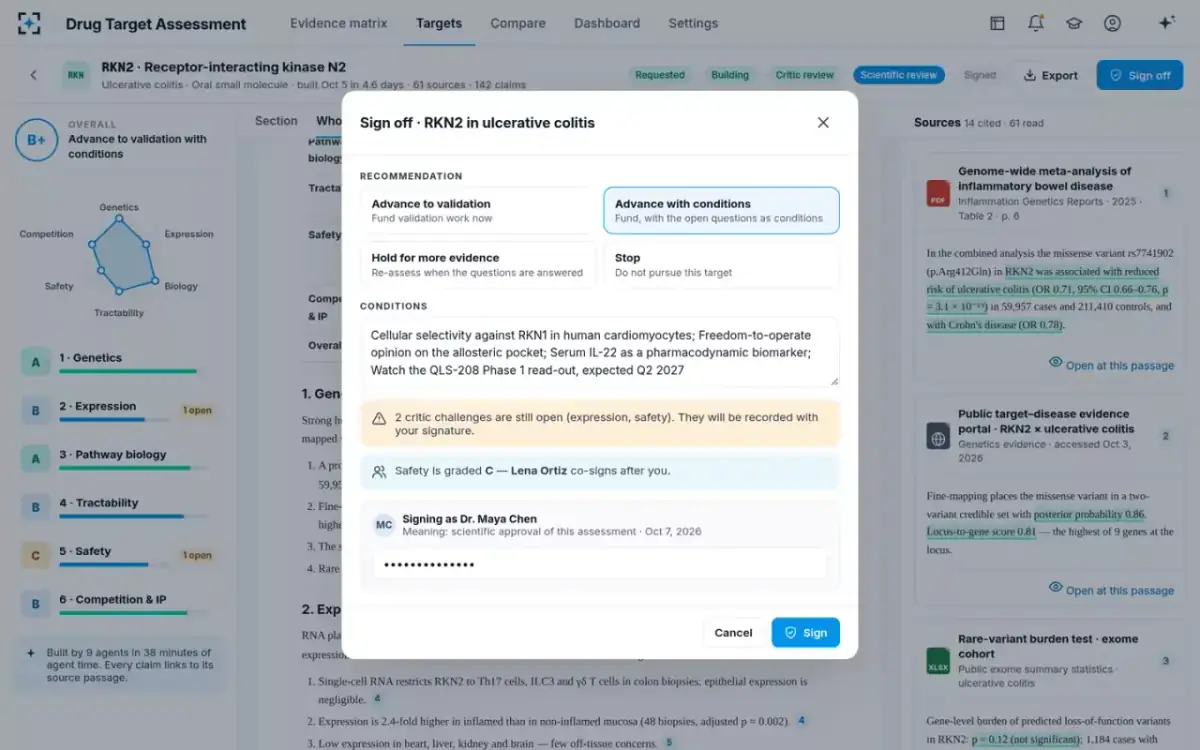
Whether every challenge must be resolved before sign-off is the setting that most changes the character of the meeting. Set on, nothing is signed with an argument outstanding; set off, open challenges are carried as conditions with the signature. Neither is right for every therapeutic area, and the useful discipline is to choose deliberately rather than by default. The same logic applies to what a constraint score can and cannot claim.
What the committee pack has to contain to be decidable
A committee pack is decidable when a member who has not read the underlying papers can reach a defensible position in twenty minutes. That is a high bar and a short list.
What each target needs in the pack before the meeting is worth holding
- One rubric, stated
The bar each grade had to clear, identical across every target in the comparison, printed where the grades are.
- Every grade one click from its evidence
The claims behind the grade, each with the passage it came from and its evidence type — human, animal, cell, transcript, protein.
- The challenges, including the ones left open
What a sceptical reader raised against each section, and whether the owner accepted it, kept the grade or asked for another look.
- Open questions with named owners and dates
The ones that will become conditions if the answer is advance — written before the meeting, not improvised in it.
- The date the evidence was last checked
Competitor and genetics evidence more than a few weeks old is a different claim from the one the grade was written against.
- The recommendation, and what the signature will mean
Scientific approval of an assessment is not the same as a commitment of budget; say which one is being asked for.
How a decision is defended a year later
The test of a target decision is not whether it was right. It is whether, a year on, a colleague who was not in the room can reconstruct why it was reasonable — what the evidence said, what was challenged, what was accepted and by whom. Most organisations fail that test not through carelessness but through drift: the document is updated, the grades change, and the version the committee actually decided on no longer exists anywhere.
That is why a signed assessment should be frozen. In the sample portfolio a signed version's grades change only through the weekly re-check or a new version, every action by people and agents is kept in the assessment's own history, and licensed source material stays inside the assessment rather than being exported in full. The practical effect is that the question "what did we know on 22 October" has an answer, and the question "who decided, and what did they say they were approving" has a name attached.
Two further questions sit next to this one. What a weak genetics grade is really asserting is the subject of what drug target Mendelian randomization proves; what an agent may and may not be allowed to do in this process is the subject of what AI can and cannot do in target identification. To see the grades, the challenges and the signature together, start from Drug Target Assessment.
Questions people ask
What criteria are used for a go/no-go decision on a target?
Six questions carry most of the weight: whether human genetics links the target to the disease and in which direction, whether it is present in the cells that drive the disease, whether there is functional proof, whether the planned modality can reach it, what happens in people and animals when it is absent, and who else is already working on it. The useful discipline is grading all six against one written bar, because the published literature arguing for targets covers the first far more often than the rest.
What does a portfolio committee do?
It balances a portfolio rather than settling science. Its proper work is comparing targets that have already been assessed to the same standard, deciding where limited screening and chemistry capacity goes, and holding the organisation to the conditions it attached to earlier decisions. A committee that spends its meeting arguing about whether one paper is convincing has been handed assessments that were not comparable.
How do you document a target decision?
Freeze the assessment the decision was taken on, and keep four things with the signature: the recommendation, the conditions with their owners and dates, the challenges that were left open, and what the signature means — scientific approval of the assessment is a narrower claim than a commitment of budget, and the difference matters a year later. A grade changed by a person should carry its written reason.
What happens when a target is put on hold?
Usually nothing, which is the problem. A hold has no owner by default, so the study that would change it is published and nobody reads it. Give every hold a named owner and a trigger — the specific evidence that would move it — and re-check for that evidence on a schedule rather than when someone remembers. The analysis of genetic support for clinical success published in 2024 concludes that the field is far from peak genetic insight, so holds taken on weak genetics decay quickly.
How do you compare two targets fairly?
Grade them on the same questions against the same written bar, and show the evidence behind each grade rather than the grade alone. Comparison without a shared rubric reduces to a comparison of how confident each author was. Published success rates do not help here either: a large trial-level analysis of clinical success computes separate estimates by disease, phase, sponsor and biomarker use, so a single portfolio-wide number applied to one target is an argument, not evidence.
Who signs off on a drug target?
In most organisations the therapeutic-area head, with the signature meaning scientific approval of the assessment rather than a budget commitment. A weak safety grade is worth a second signature from a translational safety scientist, because the person who built the case is not the right person to be its only reader. Both are configurable, and what matters is that the signature names a person and states what they are approving.