The Open Targets Platform is a free, open-source resource that aggregates and harmonises gene–disease evidence from many data sources, scores each target–disease association, and attaches annotations about a target's tractability, genetic constraint and safety. Its own 2023 paper describes it as "an open source resource to systematically assist drug target identification and prioritisation using publicly available data". If you are evaluating anything in this category, the honest first step is to go and read what it already answers for your target — because a great deal of a target assessment is there, and a buyer who has not asked why the free resource is insufficient has not done the evaluation. What the public portals do not do is the rest of the job, and that boundary is what this guide draws. Botminds' Drug Target Assessment sits on the far side of it.
Everything said here about the public resources comes from their own peer-reviewed papers, linked where it appears; nothing here ranks or scores them, and none of them is compared with any commercial product. The portfolio in the screens is the solution's fictional sample data.
What is the Open Targets Platform?
A public knowledge resource that takes the scattered evidence connecting genes to diseases — genome-wide association studies, rare-variant findings, somatic mutations in cancer, expression data, pathway and animal-model evidence, drug and text-mined evidence — and puts it behind one gene page with one score per target–disease pair. It is built by a public–private research consortium and released openly, with the data downloadable and the code open source.
The scale of that integration is the part hardest to reproduce in-house. Its 2021 update describes maintaining and improving "evidence for target-disease relationships from 20 different data sources" across ten releases in two years. Harmonising twenty sources so that a score means the same thing across diseases is years of curation work that no discovery team should be repeating.
What is in it: evidence, scores and annotations
Three layers, and they are worth separating because they age differently and fail differently. The evidence layer is the underlying records: this study, this variant, this association. The scoring layer combines them into a number per target–disease pair. The annotation layer describes the target itself regardless of disease — is it constrained in the population, is there a structure, can a small molecule or a degrader plausibly reach it.
For target and drug annotations, we have incorporated new features that help assess target safety and tractability, including genetic constraint, PROTACtability assessments, and AlphaFold structure predictions.
Ochoa et al., The next-generation Open Targets Platform, Nucleic Acids Research 51(D1), 2023
The annotation layer is the one most teams underuse. Constraint tells you how rarely a gene is knocked out in the general population, which is the first thing worth knowing before anyone argues about safety. Tractability assessments say what kind of molecule has a chance of reaching the protein. Both are inputs to a grade; neither is a grade, because neither knows what modality you are planning or what the programme would commit.
The 2021 update added the other half of the safety picture — "evaluation of post-marketing adverse drug reactions and new curated information on target tractability and safety" — which means a target with medicines already acting on its pathway carries public evidence about what happens when it is modulated in people. That is a stronger starting point than most target reviews acknowledge.
The scale of the public evidence, from the resources' own papers
45,000+
published genome-wide studies in one catalogue, across more than 5,000 human traits
40,000+
full summary-statistics datasets deposited in that same catalogue
443,769
high-confidence predicted loss-of-function variants identified across 141,456 sequenced people
The difference between Open Targets Platform and Open Targets Genetics
They answered two halves of one question, and today they are one site. The Platform's unit is the target–disease pair: everything known that connects this gene to this disease, scored. Open Targets Genetics was built around the locus: which variant in a region is doing the work, which gene it most likely acts through, and whether the same variant signal is shared with an expression or protein measurement in a relevant tissue. That locus-level work now sits inside the Platform — the old Genetics address forwards there, and the project describes the Platform's own locus-to-gene model as combining several sources of functional evidence to rank the genes near a disease-associated locus (Open Targets, 2026). Fine-mapping and colocalisation are what turn an association near a gene into an argument about that gene, wherever you read them.
For a target assessment the practical consequence is that a strong Platform score is not by itself a strong genetics grade. A score aggregates evidence of several kinds; a genetics grade is a claim about one gene, one direction of effect and one quality of causal inference. The question of what causal genetic evidence actually proves is the subject of what drug target Mendelian randomization shows, and the two are easy to conflate.
The other public resources, and what each one settles
No single portal answers the six questions a target decision needs, and treating one as if it did is the commonest mistake in a public-data-only assessment. Each of the resources below is authoritative for something specific.
Six public resources, and the question each one settles
Target–disease evidence, aggregated and harmonised from many data sources and scored, with tractability, genetic constraint and safety annotations attached to the target.
The published genome-wide association record itself: variant–trait associations with their supporting metadata, and full summary statistics where they have been deposited.
Population variation and tolerance to inactivation — how often a gene is knocked out in people who were not selected for disease, and how constrained it is.
Which human proteins are reachable in principle by a small molecule or an antibody, connected to the loci that genome-wide studies implicate.
Illuminating the Druggable Genome
The map of what is not known: which proteins in a druggable family nobody has studied, which is a different question from which ones are unpromising.
Expression atlases and dependency screens
Where a protein is, tissue by tissue and cell type by cell type, and which cancer cell lines depend on it — public reference panels, not your patients.
Two of these deserve a note. The druggable-genome work connected disease loci to the proteins that can actually be reached: its authors "connected complex disease- and biomarker-associated loci from genome-wide association studies (GWAS) to an updated set of genes encoding druggable human proteins, to agents with bioactivity against these targets and, where there were licensed drugs, to clinical indications". That mapping is the reason a genetic hit can be triaged for tractability in minutes rather than weeks, and it feeds the tractability question directly.
The second is the map of ignorance. The US National Institutes of Health launched a programme "to map the knowledge gaps around proteins encoded by the human genome and to promote the exploration of currently understudied, but potentially druggable, proteins". A target with no literature is not the same as a target with evidence against it, and a public resource that distinguishes the two is doing something a search engine cannot.
What the Open Targets Platform does not tell you
Five things, and they are the five that take the time in a real assessment.
It does not read the paper for you. A score points at evidence; it does not open the table, read the effect size with its confidence interval and cohort size, and place the number beside the sentence that reports it. A grade defended in a committee rests on that passage, not on the score that led you to it.
It does not know your modality. Tractability assessments are general; your programme is a small molecule, a degrader, an antibody–drug conjugate or an oligonucleotide, and the same protein can be a B for one and a D for another. A grade written against a modality nobody has chosen is not a grade.
It does not see your data. Your single-cell dataset from disease tissue, your CRISPR screens, your selectivity panels and your chemistry reports are not in any public resource, and on many targets they are the evidence that decides.
It does not argue the other side. A score has no view about whether the evidence behind it is thin, single-laboratory, animal-only or pointing the wrong way. Someone has to say that out loud before a committee meeting rather than during it.
And it does not produce a dated, signed document. A portal shows the current state of the world; a decision needs the state of the world on the day it was taken, with a name against it. These are not criticisms of the public resources — they are not trying to do any of this.
A public target–disease score beside a graded assessment of the same target
A public score: An aggregation of the public evidence connecting one gene to one disease, computed the same way for every pair.
A graded assessment: A judgement about one target for one programme, against a bar the team wrote down, with the evidence behind each grade.
A public score: Triage and discovery: which of ten thousand genes is worth a second look for this disease.
A graded assessment: A decision: whether to commit screening and chemistry effort to this target, with conditions.
A public score: That two targets with the same score can rest on completely different evidence, one replicated in people and one on a single mouse study.
A graded assessment: Nothing, if every claim opens its passage — and everything, if it does not.
A public score: General tractability annotations, not specific to the molecule you plan to make.
A graded assessment: Graded against the modality that was stated before the work started.
A public score: Not included, by design — it is a public resource.
A graded assessment: Internal omics, screens and chemistry read alongside the public evidence and labelled as internal.
A public score: A shortlist, and a reason to look.
A graded assessment: A decision, a year later, to a colleague who was not in the room.
Can you run a target assessment from public data alone?
For a first pass, yes, and you should. A competent scientist with the public resources can reach a defensible view on genetics, expression and competitive position for most targets in a day or two. For a decision that commits a programme, not usually — not because the public data is weak but because three of the six questions are partly or wholly about things no public resource holds.
The useful test is to ask, for each of the six questions, who is the only person who can answer it. The table below is that test.
Six questions, and where the answer actually comes from
| The question | Mostly public | Mostly yours | Who else can answer it for you |
|---|---|---|---|
| Does human genetics link the target to the disease, and in which direction? | Yes — catalogues, fine-mapping and colocalisation are public. | Rarely, unless you hold an unpublished cohort. | Anyone, which is why this is the cheapest grade to get right. |
| Is it in the cells that drive the disease? | Partly — public tissue and cell atlases cover healthy reference tissue. | Yes, for disease tissue: your own bulk and single-cell data. | Nobody, for the disease-against-healthy comparison that matters. |
| Is there functional proof? | Yes — published knockdown, knockout and animal-model work. | Partly — your own screens, often unpublished. | Anyone, for the published half. |
| Can the planned modality reach it? | Partly — structures, ligands and tractability annotations are public. | Yes — your screening hits, selectivity panels and chemistry. | Nobody, once the question is about your series. |
| What happens when it is taken away? | Yes — constraint, loss-of-function carriers and class effects are public. | Partly — your own tolerability data on the pathway. | Anyone, for the human genetics; nobody, for your chemistry. |
| Who else is already on it? | Partly — registries and congress abstracts are public but scattered. | Yes — your competitor extract and patent landscape. | Nobody, on the timetable a decision needs. |
Where your internal data changes the answer
Expression is where it changes most often. A public atlas tells you where a protein is in healthy reference tissue; the question that decides a programme is whether it is raised in the diseased tissue, in the cell type that drives the disease, in the patients you would enrol. That comparison lives in your own bulk and single-cell datasets, and reading it alongside the public atlas — with each labelled for what it is — is the job. In the sample portfolio the expression agent is required to keep RNA and protein evidence apart and to report off-tissue expression in heart, liver, kidney and brain whatever the headline says, because those are the organs that turn a selectivity question into a safety one.
Tractability is the second. Public annotations describe what a protein is like; your screening output describes what has actually bound to it. A shallow pocket with no public ligand and a fragment hit in your own file are different grades, and only one of them is visible from outside.
Competition is the third and the most time-sensitive. Public registries are incomplete and lag; a competitor extract refreshed weekly is a different instrument. In the sample portfolio competitor evidence older than thirty days is refreshed before a review, which is a rule about staleness rather than about sources.
A portfolio graded on six questions, public and internal evidence together
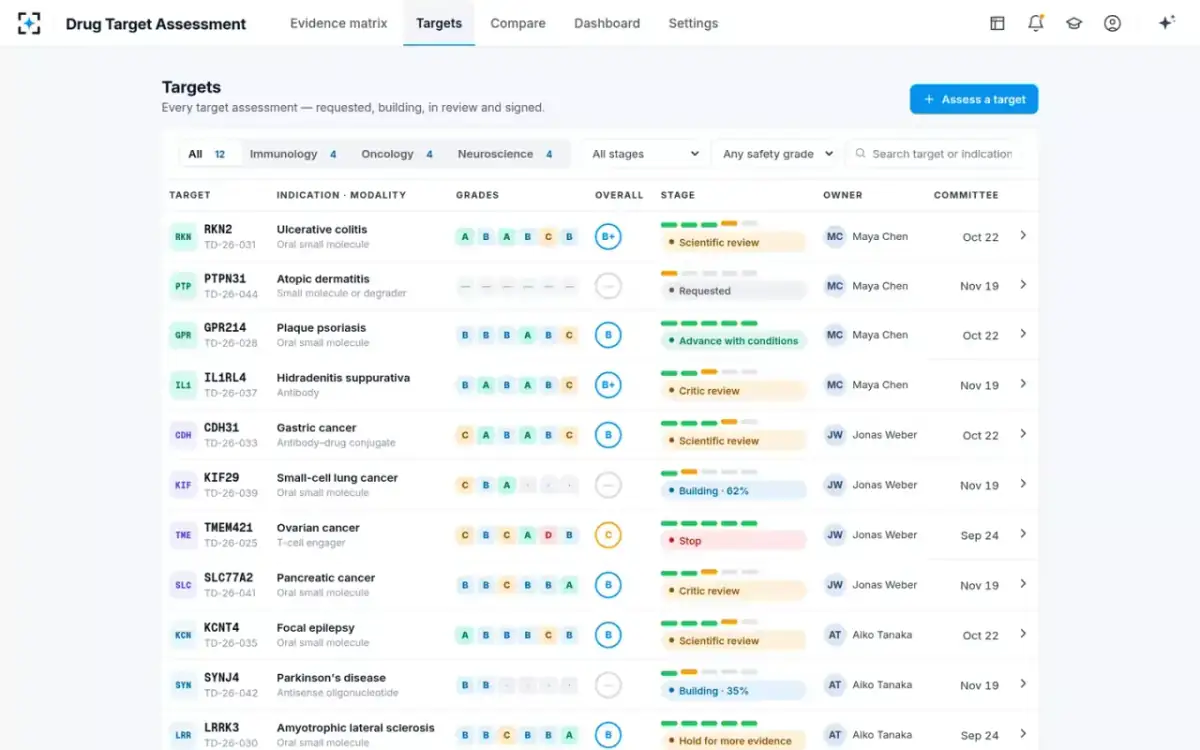
When the public score and your own grade disagree
They will, and the disagreement is informative rather than embarrassing. Three causes account for most of it.
The first is aggregation. A score combines evidence types; a grade does not. A target with a high score built from text-mined and animal evidence and no human genetics is correctly scored and correctly graded C on genetics, and both statements are true at once.
The second is modality. A public tractability annotation is modality-general. If your programme is an oral small molecule and the protein's only credible route is a degrader, your tractability grade should be worse than the annotation implies, and the reason should be written down.
The third is recency in both directions. A portal release is a snapshot taken on a date; so is your assessment. When they disagree, check which is older before concluding anything. The rule worth adopting is that the disagreement itself is recorded as a claim with both dates, rather than silently resolved in favour of whichever was read second.
One public fact's path into a graded claim
Agent
The portal rowA target–disease association in a public resource, with the data source it came from and the release it was read in.
Never: is quoted as the claim itself
Agent
The study it points toThe underlying publication is opened — not the summary of it, the paper.
Never: is cited from the portal’s description alone
Agent
The passage and the numberThe effect size, p-value and cohort size are read from the table or figure that reports them, with the direction of effect stated.
Never: takes a rounded number from an abstract
Agent
The graded claimThe claim is written with its citation, its evidence type and the date it was read, and graded against the written bar.
Never: appears without a citation
A person decides
The owner confirmsA scientist accepts the grade, keeps it, or sends it back — and confirms again when new evidence moves it.
What to keep using the free resources for
Almost everything at the front of the process. They were built for exactly this job and cost nothing, and a team that stops using them because it has bought software has made a mistake.
What to take from the public resources, and what to re-read before you grade it
- Take: the shortlist
Which genes are associated with this disease at all. Nothing replaces an aggregated, harmonised score for narrowing a genome to a page.
- Take: constraint and loss-of-function counts
How tolerant the gene is to inactivation in the population. This is the first safety number worth knowing, and it is free.
- Take: the tractability annotations, as a starting bucket
They tell you which routes are worth investigating. Re-grade against the modality you have actually chosen.
- Take: the map of what is understudied
A protein nobody has worked on is an opportunity or a trap; either way, knowing which is which changes the plan.
- Re-read: every number you intend to grade on
Open the study and read the effect size, confidence interval, cohort and direction of effect from the table. An index entry is not a citation.
- Re-read: anything about safety
A liability summarised in one line in a portal is the beginning of a safety section, not the end of one.
- Record: the release and the date
Which release of which resource, read on which day. Without it the assessment cannot be reproduced six months later.
Citing, versioning and the date your evidence was true
Two citation habits save a great deal of argument later. Cite the resource's own paper for what the resource is and does, and cite the underlying study for any fact you are grading on. A reference list in which a genetic effect size is attributed to a portal rather than to the study that measured it is a reference list that cannot be checked.
Then record the release. Public resources update on a schedule, and a score computed in one release is not the same number as the score computed in the next. An assessment that records which release it read, on which date, can be reproduced; one that does not cannot be defended against a colleague who looks the target up a year later and sees something different.
The same logic is why a signed assessment should be frozen while the world keeps moving. In the sample portfolio a signed version's grades change only through the re-check or a new version, each move shows the new citation and the grade it replaced, and the owner confirms before a committee comparison uses it. Licensed source material stays inside the assessment rather than being exported in full — a boundary that matters as soon as full-text licences are involved.
The whole assessment: claims, numbered citations, and the sources beside them
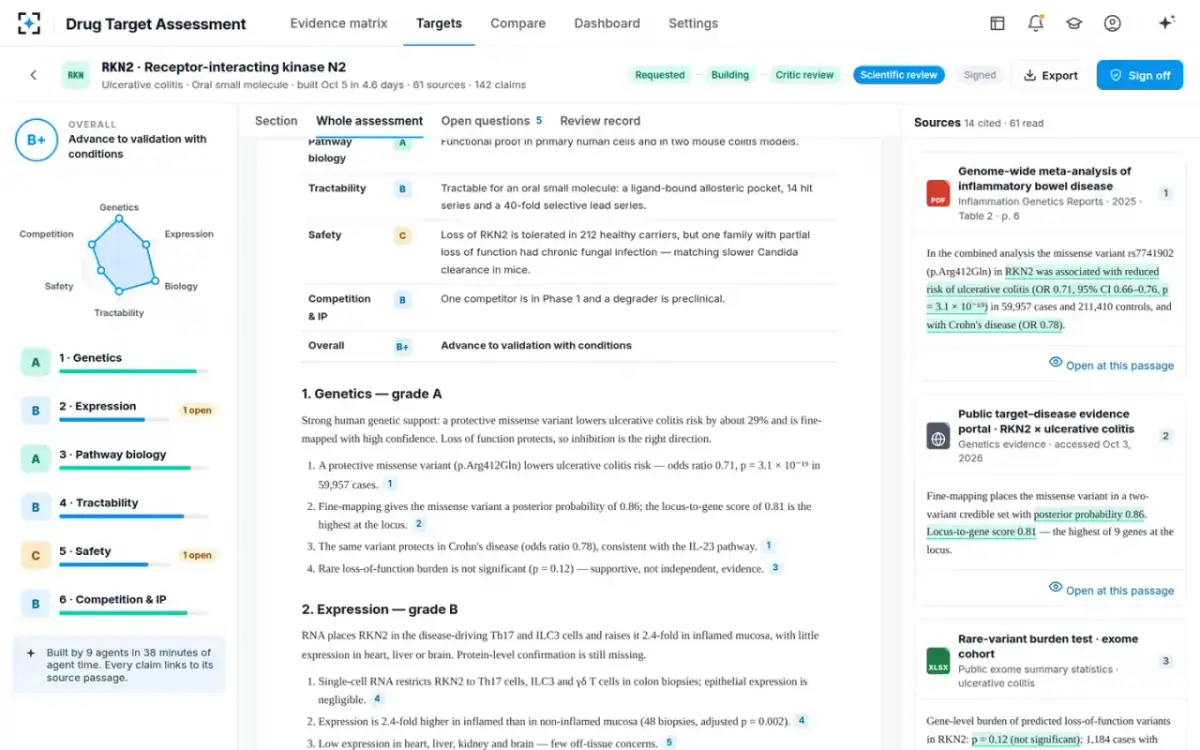
If you are planning an evaluation of anything in this category, start by writing down which of the six questions the public resources already answer well enough for your decisions — and then test the rest. How to test this kind of software on your own targets sets out a four-week protocol built on exactly that comparison, and what agents can and cannot do covers the limits worth insisting on. To see graded, cited assessments on a sample portfolio, start from Drug Target Assessment.
Questions people ask
Is Open Targets free?
Yes. It is an open-source public resource built by a research consortium, with the data available to download and the code open. Its own 2023 paper describes it as an open-source resource for systematically assisting drug target identification and prioritisation using publicly available data. Using it costs nothing but the time to read what it points at.
What data is in it?
Evidence connecting genes to diseases from many data sources — genome-wide and rare-variant findings, somatic mutations, expression, pathways, animal models, drugs and text-mined literature — aggregated into a score per target–disease pair, plus annotations about the target itself. Its 2021 update describes maintaining evidence for target–disease relationships from 20 different data sources; the 2023 update added genetic constraint, degrader tractability assessments and predicted structures.
How do you cite Open Targets?
Cite the resource's own paper for what the resource is, and record which release you read and when. For any individual fact you are grading on — an effect size, a cohort size, a direction of effect — cite the underlying study instead, because that is where the number was measured and where a reviewer will look to check it.
How often is it updated?
On a release schedule rather than continuously: the 2021 update describes ten releases over the preceding two years. For a target assessment the practical implication is that a score is a snapshot, so the release and the date you read it belong in the assessment alongside the number.
Do you still need your own target assessment?
For a shortlist, no. For a decision that commits a programme, yes — because three of the six questions a decision needs depend on data no public resource holds: disease-versus-healthy expression from your own samples, tractability for the modality you chose and against your own chemistry, and a current competitive picture. A public score is where the assessment starts, not what it produces.
What are the other public drug target databases?
Beyond the integrated target–disease resources, four kinds matter for an assessment: the published association record itself, in the NHGRI-EBI GWAS Catalog; population variation and tolerance to inactivation, in gnomAD; tissue and cell-type expression atlases; and cancer cell-line dependency screens. Alongside them sit the druggable-genome mapping, which connects disease loci to proteins a small molecule or antibody can reach, and the National Institutes of Health programme that maps which druggable proteins nobody has studied. They answer different questions and are normally used together.