Chemical probe criteria are the published tests a small molecule has to pass before a result obtained with it can be read as evidence about a target: measured potency in a biochemical assay and in cells, selectivity against the closest members of the target's own family, direct proof that it engages the target inside a cell, chemistry free of the groups that make a compound promiscuous or interfere with the assay, enough solubility and stability to survive the experiment, and a structurally similar but inactive analogue to run beside it. They matter because most target validation in the literature rests on a compound, and a compound that fails the criteria turns a finding back into a hypothesis. Botminds' Drug Target Assessment grades each of the six questions about a target against the evidence class behind it, which is what lets a reviewer disagree with a confident paper without arguing about it.
The criteria themselves are public, peer-reviewed and written by the chemical-biology community for its own use; they are quoted and linked where they appear below. The targets, compounds and studies in the worked examples are fictional sample data from the solution's sample portfolio, not a customer's result.
The curated probe space is small, and the bar is explicit
321probes
recommended with three or more stars by the expert-reviewed Chemical Probes Portal
281targets
protein targets those probes let a researcher study with confidence
30-fold
selectivity over other family members proposed for covalent and degrader probes
Put against the roughly twenty thousand protein-coding genes in the human genome, 281 targets is a narrow strip of well-covered ground. Most target arguments are therefore built on compounds nobody has reviewed, which is not in itself a reason to reject them — it is a reason to know what grade they can support.
What are the criteria for a chemical probe?
A chemical probe is a small molecule whose behaviour is characterised well enough that an experiment using it reports on one target rather than on chemistry in general. The criteria divide cleanly into what the compound does to the biology and what the chemical matter itself is like. The 2023 Journal of Medicinal Chemistry paper on expanding probe space states both sets in one sentence: the criteria comprise "a set of biology-focused criteria (biochemical and cellular potency, target selectivity, and proof of target engagement) and a set of chemical-matter-related criteria (absence of moieties causing overt promiscuity or assay interference, sufficient solubility and stability to be usable under typical assay conditions, and availability of a chemically similar but inactive negative control molecule)".
Read as a reviewer's test rather than a chemist's specification, that sentence is a list of things a paper either shows or does not. Each one has a failure that is specific and recognisable, which is what makes the list usable by someone who is not a medicinal chemist.
The probe criteria as a reviewer's test, and what each one rules out
- Biochemical potency, with the assay and the value
A number against the isolated target. Without it there is no way to know whether the concentration used in the experiment was reasonable or forty-fold above it.
- Cellular potency, measured separately
Cells are not an enzyme assay: uptake, efflux and protein binding all intervene. A compound quoted only on biochemical potency has not shown it works where the experiment was done.
- Selectivity against the close family
The relevant comparison is the target’s own paralogues and the kinases, phosphatases or bromodomains next to it, not a broad panel of unrelated proteins.
- Proof of engagement inside the cell
Target occupancy or a direct binding read-out in cells, not the phenotype itself. A phenotype is the thing being explained; it cannot also be the proof of what caused it.
- Chemical matter that behaves
No groups causing overt promiscuity or assay interference, and enough solubility and stability to survive the conditions the experiment actually used.
- A chemically similar but inactive analogue
The one criterion a reader can check from a figure legend in seconds, and the one most often missing.
Potency, selectivity, cell engagement and the inactive twin
Three of those checks interact, and the interaction is where published claims most often break. Potency sets the concentration a paper may legitimately use; selectivity sets the window above it; engagement proves the compound was on the target at that concentration. Lose any one and the other two stop meaning anything.
The usual failure is quiet. A compound with a 40 nM biochemical potency and two family members hit at 300 nM has a window of roughly seven-fold. Used in cells at 10 µM — a concentration that is common, because cellular potency is usually worse than biochemical potency — it is acting on all three proteins and on whatever else sits in that range. The figure still shows a phenotype. The phenotype is still real. What it is evidence of has changed, and nothing in the paper's text will say so.
For covalent and degrader probes the authors of the 2023 criteria put a number on the window rather than leaving it to judgement: "We propose a selectivity factor of 30-fold in favor of the intended target of the probe compared to that of other family members or identified off-targets under comparable assay conditions." Thirty-fold is a proposal for that class, not a universal law, and it is worth holding in mind as a scale when a paper reports seven.
Selectivity against the closest family member is also where a target assessment and a probe assessment ask the same question. Where the neighbouring protein is expressed in heart, liver or kidney, a narrow window is not only an interpretation problem in the paper — it is a liability line in the safety question in a target assessment and a programme risk in tractability for the planned modality.
What is the difference between a chemical probe and a tool compound?
A tool compound is any molecule a laboratory uses to perturb a target. A chemical probe is a tool compound that has been characterised against the criteria above and, in the strongest case, reviewed by people other than the ones who made it. The words are often used interchangeably in papers, which is exactly why a reviewer should insist on the distinction: it is the difference between a reagent and an argument.
The consequence of blurring it has been written down plainly by the community itself, in the paper describing the expert-review resource built to fix the problem.
However, the widespread use of small-molecule compounds that are claimed as chemical probes but are lacking sufficient quality, especially being inadequately selective for the desired target or even broadly promiscuous in behaviour, has resulted in many erroneous conclusions in the biomedical literature.
Antolin et al., The Chemical Probes Portal, Nucleic Acids Research 51(D1), 2023
That sentence is the reason this page exists. "Many erroneous conclusions in the biomedical literature" is a statement about the published record, made by the people who curate probes for a living, in a peer-reviewed journal. An earlier commentary in Nature Chemical Biology put the same point at the level of the reagent: "Chemical probes are powerful reagents with increasing impacts on biomedical research. However, probes of poor quality or that are used incorrectly generate misleading results." Note the second half — used incorrectly. A qualified probe at the wrong concentration fails as surely as an unqualified one.
Why a negative control changes what a result can mean
The inactive analogue is the cheapest of the criteria to check and the most decisive. Its logic is simple: if a close structural relative of the compound, inactive against the target, produces the same phenotype, the phenotype was never about the target. The Portal's paper states what the control is for: "These control compounds are known to be inactive, or much less potent, against the target of interest while retaining a similar chemical structure and therefore could help rule out confounding off-target effects."
The target-assessment recommendations published in Nature Reviews Drug Discovery go one step further and ask for both a control and a second, unrelated chemical series: "to control for any off-target activity of the tool compound, a structurally orthogonal chemical probe to enable cross-validation studies as well as an inactive close analogue as a negative control (for example, an inactive enantiomer) are highly recommended". An inactive enantiomer is the ideal case — same atoms, same physical properties, different handedness — and its absence from a figure is not a technicality. It is the difference between a claim about a target and a claim about a molecule.
Covalent inhibitors and degraders need their own criteria
The classical criteria were written for reversible small molecules binding one site, and two modalities now in wide use do not fit them. A covalent inhibitor's effect accumulates with exposure time, so a single potency number describes nothing without the incubation it was measured over, and its selectivity has to be read as a reactivity profile rather than an affinity ranking. A degrader works by recruiting the cell's own machinery, so its action depends on the ternary complex it forms, and a compound can hit a target hard and degrade nothing at all.
That is why the 2023 proposal exists as a separate paper with its own numbers: the same six-part logic, re-derived for compounds whose mechanism makes the original measurements ambiguous. For a reviewer the practical rule is short. Ask what the potency was measured over for a covalent compound, and ask for the degradation itself — not the binding — for a degrader, with the inactive analogue that binds but does not degrade.
The same published finding, read as the paper states it and as the criteria leave it
As the paper states it: Inhibiting the target blocks the inflammatory phenotype in primary cells, so the target drives the disease biology.
As the criteria leave it: A compound active against the target, and against two of its paralogues within seven-fold, blocks the phenotype at 10 µM.
As the paper states it: Named, with a biochemical potency of 40 nM and a reference to the original synthesis paper.
As the criteria leave it: No cellular potency, no engagement read-out in these cells, no selectivity panel in this paper — the panel is in the synthesis paper, against a different family.
As the paper states it: Vehicle only.
As the criteria leave it: No inactive close analogue, so the phenotype cannot be separated from the molecule.
As the paper states it: A knockdown in a different cell type, in the supplementary figures.
As the criteria leave it: Orthogonal in principle, but in a different cell type and without the matching read-out — supporting, not confirming.
As the paper states it: A validated target for this indication.
As the criteria leave it: A single-technology functional finding, flagged as single-laboratory: enough for a C on pathway biology, not enough for a B.
Orthogonal evidence: why two methods beat one good experiment
A perfect experiment repeated ten times is still one experiment. The target-assessment recommendations ask for internal rigour — blinding, randomisation, adequate power — and then go further: their data-quality questions "emphasize the need to establish external validity by multiple independent replicates as well as several orthogonal technologies, which provide greater confidence and converging evidence for the therapeutic relevance of a target".
Orthogonal means the methods could not fail in the same way. A compound and a knockdown are orthogonal: chemistry cannot produce an off-target RNA effect, and an RNA reagent cannot produce a promiscuous binding effect. A compound and a second compound from the same series are not orthogonal at all, however different their potencies. A knockdown and a knockout are partly orthogonal — they share the risk that the cell compensates when the protein is absent, which a compound given for two hours does not.
This is also why the direction of a human genetic finding sits in a class of its own rather than at the top of the same ladder. It is not a better experiment; it is a different kind of evidence, measured in people who were born with the perturbation. What drug target Mendelian randomization proves, and what it does not, is the companion question.
How do you know a published target result is reliable?
You cannot know, and the useful move is to stop trying. Reliability is not a property you can read off a paper's abstract; what you can read off a paper is which class of evidence it belongs to, and each class supports a bounded claim. Grade the class, state the claim it supports, and the argument about the paper's quality becomes an argument about a rubric — which two people can settle.
Evidence classes for one claim about one target, and the grade each supports
| Evidence class | What it establishes | What it cannot establish | Grade it supports |
|---|---|---|---|
| One compound, no inactive control | That the molecule produces the phenotype in that system. | That the target produces the phenotype. | D — a hypothesis to test |
| One qualified probe with its inactive analogue | That the target’s activity is required for the phenotype in that system. | That it matters in the disease, or in a person. | C — a functional finding |
| Knockdown or knockout, one laboratory | That the protein is required, over days rather than hours. | Whether compensation explains the result; whether it holds elsewhere. | C — flagged single-laboratory |
| Probe plus an orthogonal technology, agreeing | That the requirement is a property of the target, not of one method. | Direction or magnitude of effect in human disease. | B — converging evidence |
| An animal model of the disease | That removing the target changes disease biology in a whole organism. | That the human disease works the same way. | B — labelled animal-only |
| A human loss-of-function phenotype | What happens to people who have less of the target, lifelong. | What happens when it is inhibited partially, in adults. | B on its own; A with a second independent human source |
The practical gain from naming the class is that it ends a specific kind of meeting. A scientist who says "I do not believe this paper" invites a debate about the paper. A scientist who says "this is a single-technology functional finding and our bar for a B is two" invites a debate about the bar, which is written down and the same for every target in the portfolio.
Behind one grade: the claims, their evidence types and the sources they cite
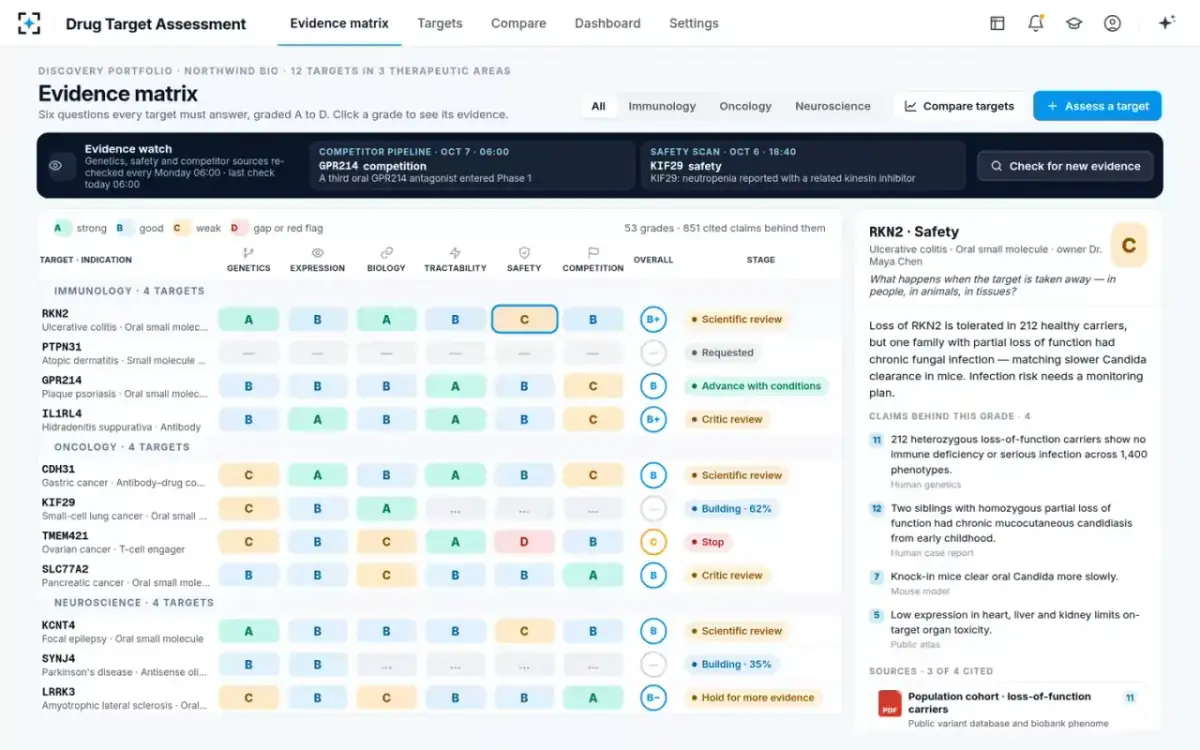
Do you let a preprint move a grade?
A preprint is a manuscript posted before peer review, and the server that hosts most biology preprints says what that means for a reader in its own words: "Readers should therefore be aware that articles on bioRxiv have not been finalized by authors, might contain errors, and report information that has not yet been accepted or endorsed in any way by the scientific or medical community."
That is a labelling instruction, not a prohibition, and treating it as a prohibition costs real information: a genome-wide study that will be published in nine months is true or false now, and competitors are reading it either way. The workable answer is to make it a setting with a default rather than a rule with exceptions. In Drug Target Assessment preprint servers are off by default; switched on, every claim drawn from one is labelled as not peer reviewed, and the label travels with the claim into the assessment and the committee comparison. A grade that rests on a labelled preprint is a grade a reviewer can argue with on the right grounds.
The grading bar as settings, including whether preprints count
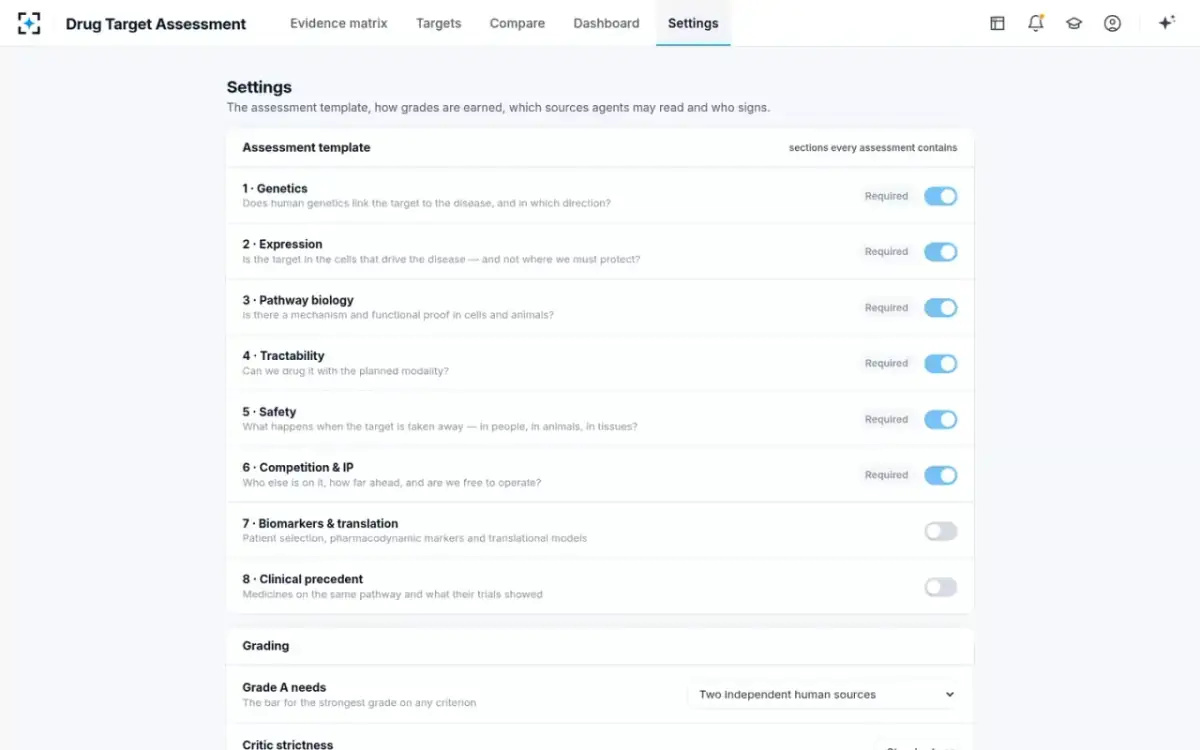
Grading the evidence class, not the confidence of the author
The design that follows from everything above is narrow. Every claim in an assessment carries the passage it came from — the table, figure or page — and uncited claims never reach the assessment at all. Every claim carries its evidence type, so a reader sees at a glance whether a grade rests on people, animals, cells or one compound. Animal-only evidence is labelled; single-laboratory findings are flagged; RNA and protein evidence are reported separately, because a transcript is not a protein and a reviewer should not have to infer which one a paper measured.
What the solution does not do is judge a compound in the way a laboratory would. It does not run a selectivity panel or measure engagement; it reads what was published, places the claim in its class and shows the passage. That is a narrower job than "validating the target", and saying so is the point: the narrow job is the one that can be done honestly at the speed a portfolio needs.
What a sceptical reader should challenge first
Four challenges catch most of what goes wrong, and each one asks the author of the claim for something specific rather than for reassurance. They are worth running in order, because the first two are answerable from a figure legend and the last two are not.
Four challenges, and what each one asks the claim to produce
- Which compound, and does it meet the criteria?
Ask forThe name, the biochemical and cellular potency, the selectivity panel and the concentration used in the figure you are relying on.
WhyA compound used ten-fold above its selectivity window is reporting on the family, not on the target.
- Where is the inactive analogue?
Ask forThe structurally similar inactive control, run in the same experiment, at the same concentration, shown in the same figure.
WhyWithout it, the phenotype belongs to the molecule. With it, the phenotype belongs to the target.
- What is the second, unrelated method?
Ask forA knockdown, a knockout, a degrader, a resistant mutant — anything whose failure mode is not chemical.
WhyTwo technologies that could not fail the same way agreeing is a finding; one technology repeated is a replicate.
- Is any of this in a human being?
Ask forA loss-of-function carrier phenotype, a human genetic association, a medicine already acting on the pathway.
WhyAnimal and cellular evidence sets the hypothesis. Human evidence is what changes the odds of a programme.
In the sample portfolio those four are what the critic runs automatically, as a sceptical committee member would: it challenges single-source claims, animal-only evidence, RNA without protein, stale data and the wrong direction of effect, cites the claim it is questioning, and proposes a grade change. It proposes only. On the sample PTPN31 assessment it raised six challenges, resolved five against the agents' own sources and left one for the owner to decide. Set to Strict it also challenges every single-source claim, which is the setting to use when a therapeutic area is building its first assessments on one rubric.
A challenge with the claim it questions, and the grade change it proposes

Where the challenges cannot be settled from the literature, they become conditions on the decision instead of silence in the document. That hand-off — open question to named condition to signature — is the subject of who decides a target, and what each decision commits. To see the grades, the challenges and the passages behind them together, start from Drug Target Assessment.
Questions people ask
What are the criteria for a chemical probe?
Measured biochemical and cellular potency, selectivity against the target's close family, direct proof that the compound engages the target inside a cell, chemical matter without groups that cause promiscuity or assay interference, enough solubility and stability for the assay conditions used, and a chemically similar but inactive analogue to run as a negative control. The 2023 Journal of Medicinal Chemistry criteria for covalent and degrader probes state all six in one sentence and add a proposed 30-fold selectivity window over other family members.
Why do you need a negative control compound?
Because without one the phenotype belongs to the molecule rather than to the target. A close structural analogue that is inactive against the target, run in the same experiment, separates the two: if it reproduces the phenotype, the result was off-target. An inactive enantiomer is the strongest version, because it differs from the active compound in handedness alone.
How selective does a chemical probe have to be?
There is no single number that covers every modality, and the comparison that matters is against the target's own paralogues rather than a broad panel. For covalent and degrader probes, the 2023 criteria propose a selectivity factor of 30-fold in favour of the intended target over other family members or identified off-targets under comparable assay conditions. The practical test is whether the concentration used in the experiment sits inside the window the selectivity data support.
What is target deconvolution?
Working backwards from a compound's effect to the protein responsible for it — the problem a phenotypic screen leaves behind. It is the mirror image of probe assessment: instead of asking whether a compound is clean enough to report on a known target, it asks which target a compound with an interesting phenotype is acting on. Both questions are answered with the same tools: selectivity profiling, resistant mutants, inactive analogues and an orthogonal genetic method.
Should you cite preprints in a target review?
Cite them labelled, or not at all — never silently. The server that hosts most biology preprints warns that its articles have not been finalised by the authors, might contain errors and have not been endorsed by the scientific community. In practice a preprint can inform a decision while being unable to carry a top grade on its own, which is why whether preprints are read at all is a setting, off by default, and every claim from one is labelled when it is on.
What evidence is stronger than a tool compound?
In rising order: a qualified probe with its inactive analogue; that probe plus an orthogonal genetic method agreeing; a knockout phenotype in an animal model of the disease; and a human loss-of-function phenotype, which is a different class rather than a better experiment. Published target-assessment recommendations ask for several orthogonal technologies precisely because converging evidence, not one strong experiment, is what establishes external validity.