Most drugs fail clinical trials because they do not work — not because they are unsafe, and not because the trial was run badly, although both happen. In the largest estimate from trial-level data, 13.8% of development programmes that reach phase 1 eventually lead to approval, and the heaviest single loss sits in the transition out of phase 2, where efficacy is first tested seriously. The work of choosing a target well is hard because the evidence that would have predicted the failure is scattered across genetics, expression, biology, safety and competitive data, and because nobody is rewarded for spending four weeks reading before a programme exists. Botminds' Drug Target Assessment makes that pre-work cheap and legible: six graded questions per target, every claim carrying the passage it came from, so a committee can see which of them is thin before the money is committed.
The published figures on this page come from peer-reviewed work and are linked where they appear. The portfolio in the worked examples is fictional sample data, and the solution's own estimates are labelled as estimates and never added to published numbers.
Why do most drugs fail clinical trials?
Three causes account for nearly all of it: the drug does not produce a clinically meaningful effect, it produces an unacceptable one, or the programme is stopped for commercial and strategic reasons even though the science held. Of those, lack of efficacy is the largest, and it is the one most directly traceable to a decision taken before any patient was dosed.
Over a quarter of drugs that enter clinical development fail because they are ineffective.
Nelson et al., Nature Genetics 47, 856–860, 2015
That sentence is worth reading twice, because it is a claim about a cause of failure within the whole set of clinical-stage drugs, not about the share of failures. Combine it with an overall approval rate in the low teens and the structure of the problem is clear: efficacy failure alone removes about twice as many programmes as are ever approved.
The review literature has reached for the point repeatedly. One widely read paper puts the challenge as a question rather than an answer: "ninety percent of clinical drug development fails despite implementation of many successful strategies, which raised the question whether certain aspects in target validation and drug optimization are overlooked?" (Sun et al., Acta Pharmaceutica Sinica B, 2022). The 90% figure in that sentence is the commonly quoted one; the next section explains why it and the 13.8% figure are both correct and not in conflict.
What percentage of drugs fail, by phase and by denominator
Almost every argument about attrition is really an argument about denominators. Three different quantities circulate as though they were one: the share of programmes entering phase 1 that reach approval, the share of clinical programmes overall that are eventually approved, and the share of individual trials that meet their endpoint. They are not the same, and quoting one with another's number is the most common error in this whole subject.
The denominators, each with its source
13.8%
of drug development programmes reaching phase 1 eventually lead to approval, across 406,038 trial entries covering 21,143 compounds
~10%
of clinical programmes eventually receive approval, in the analysis of genetic support across the pipeline
3.4%
overall probability of success in oncology — the lowest of any therapeutic group examined
33.4%
for vaccines in infectious disease, the highest, a tenfold spread across therapy areas
The by-phase picture is where the useful detail sits. Two-thirds of programmes get out of phase 1, a little under six in ten get out of phase 2, and a little under six in ten of those that reach phase 3 are approved. Most people guess the last of those correctly and the middle one badly.
Probability of success at each transition, all indications
Phase 2 is the expensive place to be wrong, and not only because the trial costs more than phase 1. It is the first point at which the hypothesis is tested in patients with a meaningful endpoint, which means it is the first point at which a target chosen on weak evidence has to answer for itself. Everything spent before that — the chemistry, the toxicology, the manufacturing — was spent on a question the programme had not yet asked.
The three causes, and which one dominates
Grouping failures by cause is more useful than grouping them by phase, because the causes map onto decisions somebody made. Efficacy failure says the biological hypothesis was wrong — either the target does not drive the disease, or modulating it to the degree achievable does not change the outcome. Safety failure says the molecule or the mechanism produced harm that outweighed the benefit. Commercial and strategic termination says the programme no longer fitted the portfolio, which frequently means a competitor arrived first or the clinical bar moved.
Four failure modes, and the question that would have raised the flag
| How it fails | What it looks like | The question that would have flagged it | What that question needs to be gradeable |
|---|---|---|---|
| No efficacy | The endpoint is missed in phase 2, often with the mechanism confirmed and the biomarker moved. | Genetics and pathway biology: is there human causal evidence, in the right direction, with functional proof? | A replicated human association with the causal gene resolved, plus human-system functional evidence. |
| Unacceptable safety | A toxicity emerges that the preclinical package did not predict, or a known mechanism-based effect proves unmanageable. | Safety: what happens when the target is taken away, in people and in animals? | Human loss-of-function carriers with phenotypes screened, animal knockouts, and the class effects of medicines on the same pathway. |
| The wrong patients | The drug works in a subgroup that the trial was not powered or selected to find. | Expression and translation: is the target in the cells that drive the disease, in these patients? | Protein-level evidence in the disease cell type, and a biomarker that can select the population. |
| Overtaken commercially | The programme is stopped while the science is intact, because the standard of care moved. | Competition: who else is on this target and this modality, and at what phase? | A current competitor picture by target and modality, refreshed rather than remembered. |
The fourth row deserves a note. A programme stopped for commercial reasons is often described as a non-scientific failure, which understates it: the competitive picture was knowable at the start, and a target review that recorded it as a stale list rather than a live one gave the committee a false read. Competitive data ages faster than any other input to a target decision.
Lack of efficacy is a target problem, not a molecule problem
This is the claim that matters most, and it follows from what an efficacy failure actually looks like. In the typical case the molecule did what it was designed to do: it reached the target, engaged it, and moved the pharmacodynamic marker. The disease did not move. That is not a chemistry failure; it is a failure of the hypothesis that this protein, modulated this much, in these patients, changes the outcome.
The economics of genetic support line up with the same conclusion, because the advantage attaches to the failure mode that dominates. An estimated probability of success 2.6 times greater for mechanisms with human genetic support is a large effect precisely because efficacy is the big loss, and genetics is the evidence type that speaks to causality in humans rather than in a model. That advantage improves with confidence in the causal gene and is largely unaffected by the size of the genetic effect — which is an instruction about where to spend the pre-work, as the genetics guide sets out in detail.
The GOT-IT authors make the connection to the pre-work explicit: "insufficient validation of drug targets at an early stage has been linked to costly clinical failures and low drug approval rates" (GOT-IT recommendations, 2021). It is worth being careful about what that sentence claims. It is a link, not a measured causal effect of doing better target work, and nobody has run the trial that would establish one.
Oncology, vaccines and the spread between therapy areas
The tenfold spread between the best and worst therapeutic groups is the strongest hint that attrition is about what is being attempted rather than how well it is executed. Oncology's 3.4% overall probability of success and vaccines' 33.4% describe two different scientific problems: one targets a heterogeneous, adaptive disease with an endpoint that takes years to read, the other a known pathogen with an immunological endpoint and strong mechanistic precedent.
Two implications matter for a target review. First, a programme's prior is set substantially by its therapeutic area, so a target graded B in oncology and a target graded B in infectious disease do not carry the same expected value and should not be compared as though they do. Second, areas with low baseline success have the most to gain from evidence that speaks to causality in humans, and the least patience for reviews that restate mechanistic plausibility.
What a late failure costs the next programme
Attrition is not only a loss on the programme that failed; it is the reason the next one is expensive. The capitalised cost of bringing a medicine to market carries the failures with it: after accounting for the costs of failed trials, the median capitalised research and development investment to bring a new drug to market was estimated at $985.3 million (Wouters, McKee and Luyten, JAMA, 2020). The number is contested in its details and is an estimate from a sample of approvals, but the structure of it is not in dispute: most of what a successful medicine costs is the price of the ones that failed.
The same wrong assumption, found at two moments
Found in the target review: Weeks of reading by a scientist and a reviewer, before any programme exists.
Found at the phase 2 read-out: Everything spent from target to read-out: chemistry, toxicology, manufacturing and the trial itself.
Found in the target review: That the human causal evidence is one unreplicated study, or that the direction was assumed.
Found at the phase 2 read-out: That the endpoint did not move, usually without learning which assumption was wrong.
Found in the target review: Commission the experiment that would settle it, grade a second modality, or stop cheaply.
Found at the phase 2 read-out: Run a post-hoc subgroup analysis, or stop expensively.
Found in the target review: The programme that was never started, which nobody counts.
Found at the phase 2 read-out: The next programme, through the capitalised cost of failure.
Found in the target review: Visible as a C or a D, with the gap named.
Found at the phase 2 read-out: Visible in hindsight, in a review nobody re-read after it was signed.
The asymmetry in that table is the whole argument for doing the pre-work properly, and it is also why the pre-work is skipped. The cost of the thorough review is visible, immediate and charged to a named team. The cost of the shallow one is invisible, deferred, and charged to the industry as a whole.
Do biomarkers and patient selection change the odds?
Measurably, yes. In the same trial-level analysis, "trials that use biomarkers in patient-selection have higher overall success probabilities than trials without biomarkers" (Wong, Siah and Lo, 2019). The mechanism is intuitive: a trial that can identify the patients whose disease is actually driven by the mechanism is testing the hypothesis the programme holds, rather than testing it diluted across a population.
For a target review, this converts a clinical observation into a target-stage requirement. If patient selection materially changes the odds, then the question "is there a biomarker that identifies the patients in whom this mechanism operates?" belongs in the review rather than in the clinical plan — which is why a biomarkers and translation section is worth adding to a template as an optional seventh question for programmes where selection is plausible.
It also sharpens the expression question. Evidence that the target is present in the cells that drive the disease, in the patients you intend to enrol, is the same evidence a selection strategy would be built on. A review that establishes it has done part of the clinical design work.
Which failures a target assessment can actually prevent
This is where the honest line has to be drawn, because the temptation to overclaim here is considerable. No target review improves the probability that a given programme is approved, and no such measurement exists. What a graded, cited review changes is the quality and the revisability of the decision — and those act on some failure modes and not others.
The six questions as a pre-mortem: what would have to be true for this programme to fail on each
- Genetics — it fails because the causal gene was never resolved
The association was real and belonged to the neighbouring gene, or the direction was inherited from a mechanistic story. Reachable before the programme starts.
- Expression — it fails because the target is not in the cells that drive the disease
The transcript was in the biopsy and the protein was in a different cell type. Reachable, and the same evidence supports patient selection.
- Pathway biology — it fails because the effect was animal-only or single-laboratory
The model reproduced the phenotype and the human system did not. Partly reachable: the gap can be named even when the experiment has not been done.
- Tractability — it fails because the molecule could never be selective enough to dose
The potency was there and the margin was not. Reachable as a graded risk, not as a certainty.
- Safety — it fails because a mechanism-based effect was unmanageable
Partly reachable: human carriers and class effects can be read in advance, and dose-dependent effects at clinical exposure cannot.
- Competition — it fails because the standard of care moved
Reachable only if the competitive picture is current rather than remembered, which means it has to be re-read rather than filed.
What a review cannot do is also worth listing plainly. It cannot predict a toxicity that depends on chemistry rather than mechanism. It cannot tell you whether the achievable degree of modulation is enough, which is a pharmacology question. It cannot anticipate a trial design failure, a recruitment failure or a manufacturing one. And it cannot make an unknowable question knowable: for a target in the unstudied tail of the proteome, the honest grade is a D with a gap, and the decision to proceed anyway is a legitimate one taken with open eyes.
What a target review can measure about itself
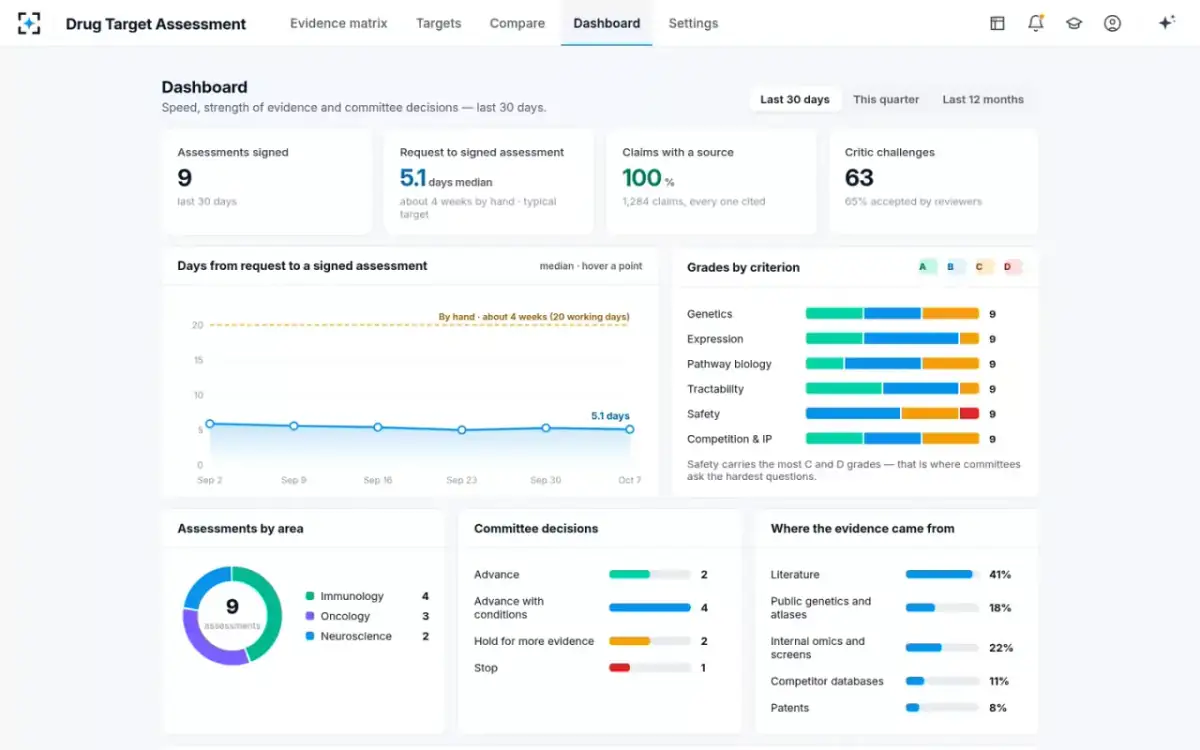
The evidence that was thin all along, read backwards
Read a failed programme's original target review and the thin spot is usually visible, which is the uncomfortable part. It is rarely hidden; it is simply not graded. A narrative review that spent eight pages on the mechanistic case and two paragraphs on the human genetics is not lying about the balance of evidence — it is reproducing the balance of the literature, where the target–disease link is the argument worth publishing and safety, assayability and competitive position rarely get written up at all.
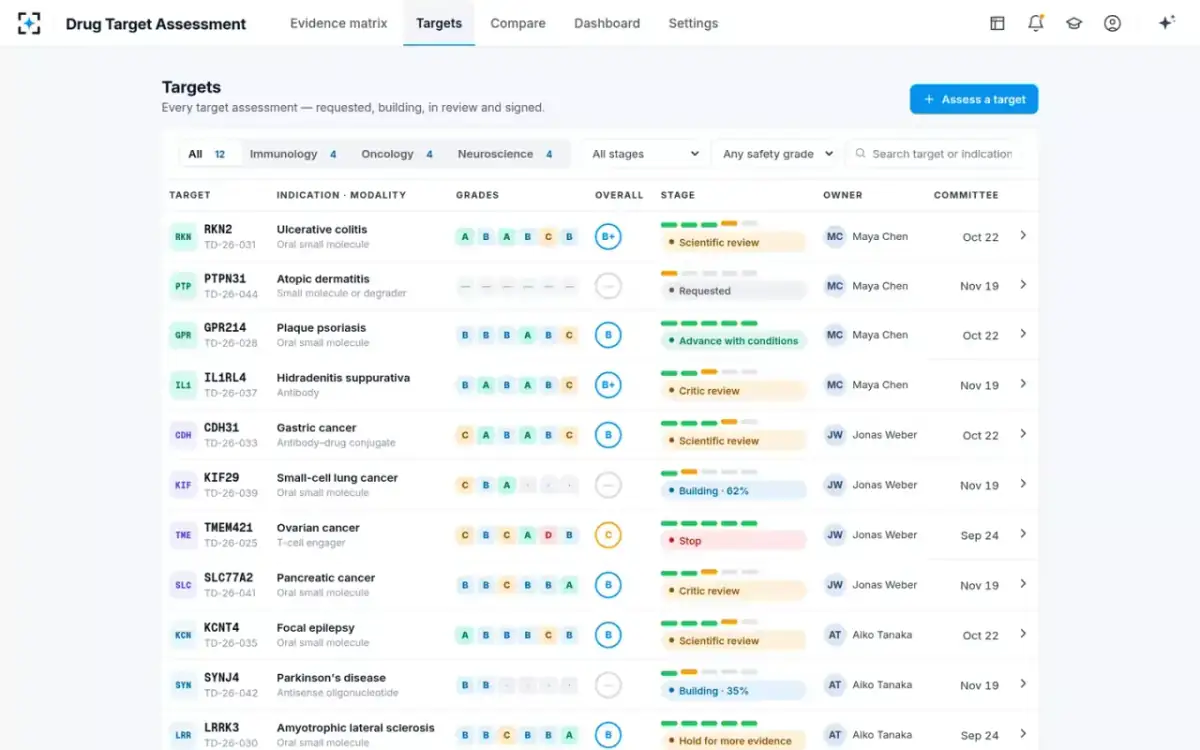
That is the practical reason for requiring every question to carry a grade rather than a section. A grade of D on genetics is a sentence the committee cannot read past. Two paragraphs of careful hedging on the same evidence can be read past by anyone, and usually are. In the sample portfolio the row that reads worst is not a weak target; it is one where a required question has no evidence at all, which is a different and more actionable state than a weak answer.
Every target, with its weakest answer visible
What to do with a target whose only genetics is one small study
This is the common case, and it has a right answer that is neither "proceed" nor "drop". In the sample portfolio a neuroscience target was signed as a hold for more evidence precisely because its genetics rested on one small association study at p = 4 × 10⁻⁵, which had not been replicated. That is a C, and a C on the question that carries the largest share of clinical failure is a reason not to start — but it is also a perishable judgement, because the study that would settle it may be published by someone else next year.
So the hold needs three things attached to it: the specific evidence that would change the grade, a named owner, and a mechanism that notices when it arrives. Without the third, a hold becomes permanent by default. In the sample portfolio that is exactly what the weekly re-check is for: when a genome-wide meta-analysis replicated the locus, the grade moved from C to B with a tag showing what it had been, and the owner was asked to confirm before the figure was used in a committee discussion.
The alternative — the one most organisations are living with — is that the decision stands until somebody happens to read the right paper. That is not a failure of diligence; it is what a static document does. Making the pre-work cheap and the review refreshable does not change the odds for any one programme, and it does change how long a wrong hold survives. How the six questions are graded in the first place is set out in the six questions, graded, and what to do when the evidence runs out on the hardest of them is in can your modality reach it. To see a portfolio graded this way on your own targets, start from Drug Target Assessment.
Questions people ask
How many drugs fail in phase 2?
A little over four in ten programmes that reach phase 2 do not progress to phase 3: the estimated probability of success for that transition is 58.3% across all indications, from trial-level data covering 2000 to 2015. It is an expensive place to fail, because it is the first serious test of efficacy and everything spent before it was spent on an untested hypothesis.
How many drug programmes reach approval?
Between roughly one in ten and one in seven, depending on the population counted. From trial-level data, 13.8% of programmes reaching phase 1 eventually lead to approval. The analysis of genetic support across the pipeline reports that about 10% of clinical programmes eventually receive approval, and the same trial-level study compares its figure with an earlier estimate of 10.4%. The figures differ because of what they count and over which years, so the useful habit is to quote the denominator with the number.
How much does it cost to develop a new drug?
The most-cited recent peer-reviewed estimate, after accounting for the costs of failed trials, is a median capitalised research and development investment of $985.3 million to bring a new drug to market. Estimates vary widely with method, sample and the cost of capital assumed, and the capitalised figure is not cash spent on one molecule. What is not disputed is the shape: most of the cost of a successful medicine is the cost of the failures around it.
Is the 90% failure figure right?
It is a reasonable shorthand and not a precise statistic. It corresponds to an approval rate of about 10% of clinical programmes, which is within the range the published estimates give; trial-level data for 2000 to 2015 puts the comparable figure at 13.8% from phase 1. Both numbers describe the same situation. Trouble starts when the 90% is attached to a different denominator — individual trials, or preclinical candidates — where it is simply wrong.
Which therapeutic area has the lowest success rate?
Oncology, by a clear margin: an overall probability of success of 3.4% from phase 1 to approval in the trial-level analysis, against 33.4% for vaccines in infectious disease at the other end. The spread is about tenfold. It means a target's therapeutic area is a large part of its prior, and that comparing grades across areas without that context overstates how comparable two programmes are.
Does better target selection actually lower attrition?
The honest answer is that the evidence is associative rather than experimental. Mechanisms with human genetic support have an estimated probability of success 2.6 times greater than those without, and insufficient early validation has been linked to costly clinical failures — but nobody has run a controlled comparison of two portfolios selected by different standards. The defensible claim is about the decision, not the outcome: a graded, cited review shows a committee where the evidence is thin before the money is committed.