A heterozygous loss of function variant is one broken copy of a gene in a person who still has the other — and for a drug target, the people who carry one are the nearest thing discovery has to a long-running natural experiment in partial inhibition. That makes carrier evidence the most valuable line a target safety assessment can hold, and the easiest to overstate. A healthy carrier cohort says that lifelong partial loss, in those people, screened for the phenotypes that study recorded, produced no detected signal. It does not say the organ is safe: the scan has a power limit, the phenotypes examined are the ones the study could test, and the absence of complete knockouts is not evidence that complete knockout would be tolerated. Botminds' Target Safety Assessment keeps the carrier count, the zygosity and what was screened with every human-genetics finding, and sets it against the knockout mouse organ by organ so that a silence is visible as a silence.
Figures that name a target, a person or a company come from the solution's sample data on fictional targets — SRK9 and NLRP15 — and are labelled where they appear. The population figures are from the published human-genetics literature, linked where they are used.
The scale of the human loss-of-function evidence
443,769
high-confidence predicted loss-of-function variants, after filtering, in 141,456 sequenced people
95
rare predicted protein-truncating variants carried by the average participant in a large biobank
337,205
biobank participants tested against 135 medical phenotypes in one phenome-wide scan
27
associations outside the major histocompatibility complex that scan found
What does heterozygous loss of function mean?
It means one of a person's two copies of a gene has been disrupted in a way predicted to abolish the protein it makes — a premature stop codon, a frameshift, a splice-site disruption or a whole-gene deletion — while the other copy is intact. In most genes the result is roughly half the normal amount of protein, and in most genes that is uneventful: the average participant in a large biobank carries close to a hundred rare ones and does not know it. Karczewski and colleagues found "443,769 high-confidence predicted loss-of-function variants in this cohort after filtering for artefacts caused by sequencing and annotation errors" across 141,456 people, and DeBoever and colleagues report that in the UK Biobank "each participant had 95 predicted PTVs with minor allele frequency (MAF) < 1% on average".
The words to keep are predicted and high-confidence. A variant annotated as loss-of-function may escape nonsense-mediated decay, fall in an exon that is not used in the relevant tissue, or be an annotation artefact — which is why every large survey filters hard and reports the filtering. For a target assessment, a carrier count that has not been filtered is not a carrier count; it is an upper bound.
Carriers as a natural trial of partial inhibition
The reason this evidence outranks almost everything else is the design of the experiment nature ran. The species is the right one. The exposure is lifelong, beginning before birth, which is longer and more complete than any clinical programme will ever achieve. The dose is the one a near-complete inhibitor approximates. And the comparison group — everyone else in the cohort — is enormous.
No designed study has those properties together, and that is why genetic evidence about a target has become a routine input to target selection rather than a curiosity. What the design does not give is control. The carriers were not randomised, they were not dosed, their variants are spread across different positions in the gene with different real consequences, and the outcomes measured are whatever the cohort happened to record.
What does a healthy carrier prove — and what it does not
It proves something narrow and genuinely useful: that in that cohort, at that sample size, for the phenotypes that were tested, carrying one broken copy did not produce a detectable excess of disease. Written that way, the claim survives review. Written as "carriers are healthy, so the target is safe", it does not, and the gap between the two sentences is where most of the damage is done.
Two readings of the same carrier scan, and what each one licenses
What gets written: Carriers are healthy, so the target looks safe.
What the data supports: No signal in 418 carriers screened for blood counts; liver and kidney not examined.
What gets written: The whole body, implicitly.
What the data supports: Exactly the phenotypes the cohort recorded and the scan could test.
What gets written: Unstated.
What the data supports: Stated: the smallest effect that number of carriers could have detected.
What gets written: Left out.
What the data supports: Heterozygous. Nothing is claimed about complete loss.
What gets written: Nothing specific, so the sentence is accepted or distrusted whole.
What the data supports: The count, the phenotype list, the power calculation, the filtering.
What gets written: Lowers the probability of every organ at once.
What the data supports: Lowers the probability of the organs that were screened, and marks the rest as not examined.
There is a second, subtler limit. A carrier is not a dose-matched model of a drug. Lifelong half-dosage allows compensation that an adult given an inhibitor for twelve weeks does not get, which can make carriers look safer than a drug will be. In the other direction, a drug that only achieves 60% occupancy for part of the day is a gentler intervention than lifelong 50% protein loss, which can make carriers look more alarming than the drug will be. Neither error is correctable by arithmetic; both are correctable by saying out loud which way the comparison is likely to be wrong.
How many carriers do you need before silence means something?
The answer is a function of two numbers a programme can state: the frequency of the phenotype in the comparison group, and the smallest excess that would matter clinically. A cohort of 400 carriers can usually rule out a doubling of a common laboratory abnormality, and usually cannot rule out a tripling of a rare one. The honest output of a carrier scan is therefore not "nothing found" but "nothing found, and here is what we could have found".
What a carrier finding has to state before it can lower a probability
Carriers
Filtered, high-confidence heterozygotes in the cohort
After the same filtering the source survey applied; an unfiltered count is an upper bound, not a cohort.
Computational biologist
Phenotypes screened
The outcomes the cohort recorded and the scan could test
Phenome scans need a minimum number of cases per phenotype; anything rarer was not tested at all.
Computational biologist
Detectable effect
The smallest excess that number of carriers could have found
The number that converts “no signal” into evidence. Without it, silence is uninterpretable.
Statistician or computational biologist
What is left unsaid
The organs the scan could not speak to
Recorded as not examined, not as clear. This is the term that is dropped under deadline.
Toxicologist who signs
The constraint on what a biobank can test is structural, not a matter of effort. In the UK Biobank scan cited above, association analyses were run against "135 medical phenotypes with at least 2000 case samples". A phenotype with fewer cases than that was not tested, however important it is to one programme — and a target whose feared liability is a rare organ event will find that the largest human dataset in the world is silent on precisely the question it was asked.
Constraint scores: what they measure, and where they run out of power
A constraint score answers a different question from a carrier scan. Instead of asking what carriers show, it asks whether the gene has fewer loss-of-function variants in the population than chance would predict — that is, whether selection has been removing them. A strongly constrained gene is one where losing a copy has usually had consequences, somewhere, at some point, even if no cohort has caught them.
The widely used metric is an upper bound on the observed-to-expected ratio, and its authors are explicit about the asymmetry that creates: "the use of the upper bound means that LOEUF is a conservative metric in one direction: genes with low LOEUF scores are confidently depleted for pLoF variation, whereas genes with high LOEUF scores are a mixture of genes without depletion, and genes that are too small to obtain a precise estimate". A low score is a finding. A high score is a finding or an absence of power, and the metric cannot tell you which.
At population scale, constraint still cannot be estimated for a third of genes
Constraint is also not a verdict on druggability, and reading it as one is the most expensive mistake available here. A companion analysis of the same population data pointed out that genes under near-complete selection against loss of function include HMGCR and PTGS2, the targets of statins and aspirin (Minikel et al., 2020) — a case taken up in the predictive validity of animal models when mouse and human differ. How the same score is read when a target assessment grades it alongside tractability and competition is set out in reading a gene constraint score in a target assessment. What constraint does well is tell a toxicologist how much weight a silence deserves: in a strongly constrained gene, the absence of healthy complete knockouts is expected and uninformative; in an unconstrained gene, that same absence is a little more surprising.
Homozygotes, compound heterozygotes, and the genes that have none
Complete human knockouts — people with both copies disrupted — are the strongest evidence of all, and for most genes they do not exist in any dataset. The DeBoever scan found that "778 genes were predicted to be homozygous or compound heterozygous for PTVs with MAF < 1% in at least one individual", a small fraction of the genome, and the counts per gene are usually in the single figures.
“For most genes, the lack of total knockout individuals identified so far does not yet provide statistical evidence that this genotype is not tolerated.”
Minikel EV et al., “Evaluating drug targets through human loss-of-function genetic variation”, Nature 581, 2020
That sentence cuts in the direction people rarely expect. It is usually quoted to warn against claiming safety from an absence — correctly. It also warns against claiming danger from one: a programme that reads "no human knockouts exist" as evidence that complete inhibition would be lethal is making the same unsupported inference with the sign reversed. In both directions the right entry is that the dataset is silent, with the carrier evidence doing whatever work it can do on its own.
One more inference deserves naming, because it is usually made silently. Genetic association analyses, as DeBoever and colleagues note, "typically assume that genetic effects are additive; that is, the log OR of a homozygote is expected to be twice the log OR of a heterozygote". That is an assumption, not an observation, and a target whose biology is threshold-like will violate it — which is exactly the case where extrapolating from a healthy carrier to a fully inhibited patient is least safe.
Does a loss-of-function variant predict a drug side effect, organ by organ?
Yes, measurably, and by a margin small enough to keep expectations in proportion. Nguyen and colleagues tested the link directly and found that "across 1819 drugs and 21 phenotype categories analyzed, drug side effects are more likely to occur in organ systems where there is genetic evidence of a link between the drug target and a phenotype involving that organ system, compared to when there is no such genetic evidence (30.0 vs 19.2%; OR = 1.80)".
Read that as a prior, which is what it is. Genetic evidence pointing at an organ raises the chance of a clinical side effect in that organ from roughly one in five to roughly three in ten. It does not make the side effect likely, and its absence does not make the organ clear — the base rate without genetic evidence is still 19.2%. The practical use is in ordering work: the organs where the genetics points are the organs to put a study against and a monitoring line into the first protocol, and the magnitude of the odds ratio is the reason that ordering is a judgement rather than an algorithm.
Writing the carrier finding so a toxicologist can score it
Everything above reduces to five fields and a sentence. If the five fields are present, a second reader can disagree with the right thing; if they are not, the finding can only be believed or not.
The five fields a carrier finding needs, and the sentence that ties them together
- The cohort, named, with its size
Which dataset, how many people sequenced or genotyped, and the ancestry composition if the variant frequency depends on it.
- The carrier count, after filtering
High-confidence predicted loss-of-function heterozygotes, not every annotated variant.
- The zygosity, stated explicitly
Heterozygous or homozygous. An assessment that does not say is unscorable, because the two support different claims.
- The phenotypes screened
What was actually tested, including the minimum case count the scan required. Everything else is “not examined”.
- The cited passage
The sentence the claim rests on, so the claim and the evidence can be compared without leaving the page.
- And the sentence: what the silence licenses
“No excess of X in N carriers screened for Y; organs Z not examined” — a claim with edges, which is the only kind that can be scored.
How Target Safety Assessment sets carriers against the knockout mouse
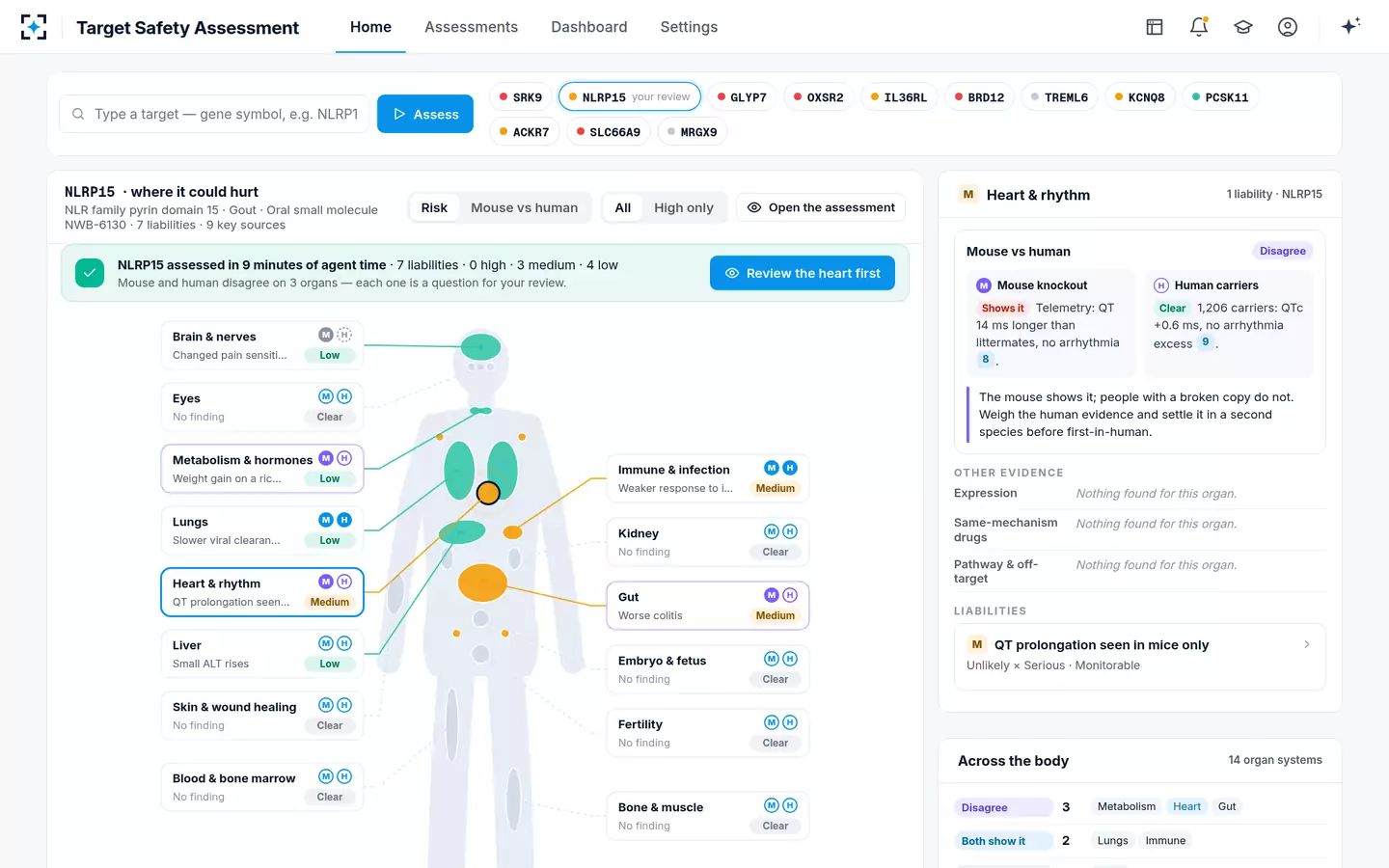
In Target Safety Assessment the human genetics agent reads loss-of-function counts and constraint, biobank carrier scans, Mendelian disease and case reports, and it has two limits that are the argument of this page rather than a feature list: it states whether evidence is homozygous or heterozygous, and it never infers a direction of effect without a source. Its findings land on the same body as the mouse evidence, organ by organ, with an H mark beside the mouse's M — filled where there is a finding, open where the organ was examined and was clear, dashed where there is nothing.
Target Safety Assessment: two species on one organ, with a verdict where they differ
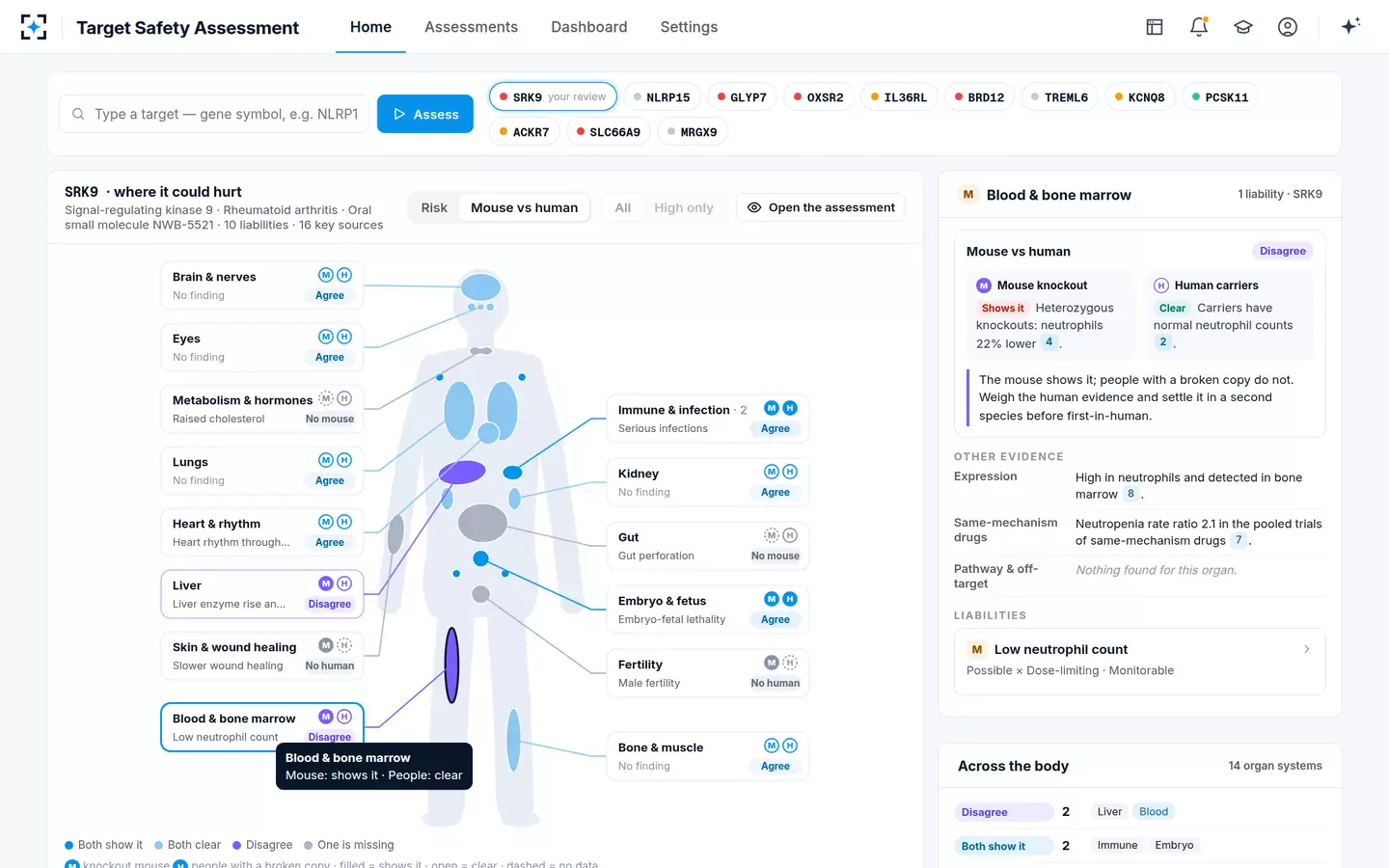
The sample data shows what that discipline buys. On SRK9, heterozygous knockout mice have 22% fewer neutrophils and 418 people carrying a broken copy have normal counts — a disagreement on blood and bone marrow, drawn as a disagreement rather than resolved by whichever species the writer trusts more. On the fictional target NLRP15, 1,206 carriers with a resting electrocardiogram show no excess of arrhythmia or syncope while the knockout mice have a longer QT interval; the carrier figures, the confidence interval beside them and the mouse telemetry are all sample data on a fictional target, not measurements from a published study.
A cardiac liability where the carriers argue against the mouse
The evidence ladder for a single liability is where the carrier finding has to hold its own against five other lines. It is shown as a line of its own, with the passage it came from beside it, and with the direction it argues in marked — supports the risk, or argues against it — because a carrier scan is most often the line arguing against, and a reader who cannot see that will assume the agents simply found less.
The human-genetics line, and the direction it argues in
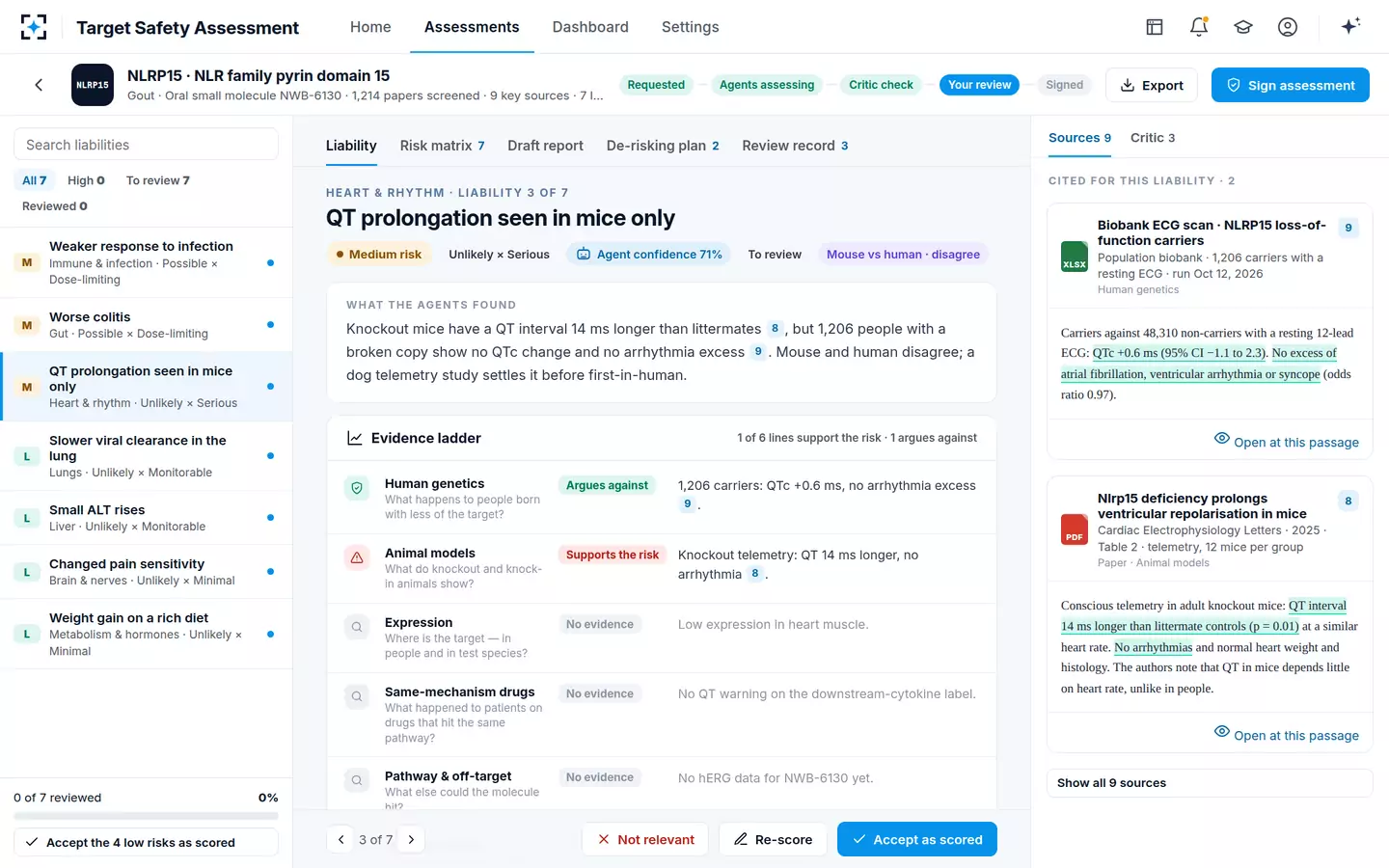
What happens next is the part that cannot be automated. The agents propose a score — probability against impact, with a judgement about whether the organ could be monitored in a patient — and a critic challenges single-source and species-weak findings in plain view. A discovery toxicologist then accepts, re-scores with a written reason or dismisses each liability, and signs. For how that disagreement is turned into one study that settles it, see the studies that settle a risk; for the evidence lines that sit beside the genetics, start from Target Safety Assessment.
Questions people ask
What is the difference between a heterozygous and a homozygous knockout in people?
A heterozygote has one disrupted copy and one working copy, so roughly half the normal protein; a homozygote, or a compound heterozygote carrying two different disrupting variants, has none. Heterozygotes are the better model of a drug, because almost no drug abolishes a target completely for a lifetime. Homozygotes are stronger evidence where they exist, and for most genes they do not: one large biobank scan identified 778 genes with any predicted homozygous or compound heterozygous carrier at all.
Where do biobank carrier scans come from?
From population cohorts that have both sequence data and linked health outcomes — hospital records, registries, questionnaires and laboratory values — so that carriers of a variant can be compared with everyone else. The important limitation is built into that design: the scan can only test the outcomes the cohort recorded, and phenome-wide analyses need a minimum number of cases per phenotype, so rare events are often untested rather than tested and negative.
Can you find human knockouts for any gene?
No. Complete knockouts are concentrated in genes where losing both copies is tolerated, and in cohorts where related parents make rare recessive genotypes more common. For most drug targets the honest entry is that no complete knockouts have been identified, and the published guidance on that point is explicit that the absence does not amount to statistical evidence that the genotype is not tolerated.
Is partial inhibition the same as half the gene?
Not exactly, and the differences run in both directions. A carrier has had half-dosage since conception, with a lifetime for compensation; a patient gets incomplete suppression for a limited period with no such adaptation. A drug may also inhibit more deeply than 50% at peak concentration while the target recovers between doses. Carriers are the best available analogue, and the comparison should be stated with its direction of likely error rather than assumed to be exact.
What is a constraint score, and what does it miss?
It compares how many loss-of-function variants a gene actually carries in a population with how many would be expected by chance, so a strongly constrained gene is one selection has been removing variants from. It misses two things. Short genes may never accumulate enough expected variation for an estimate — about 30% of coding genes remain insufficiently powered even in the largest surveys — and constraint says nothing about whether a gene makes a good drug target, since several heavily constrained genes are the targets of long-established medicines.
Does a healthy carrier cohort lower a liability's score?
It lowers the probability for the organs that were screened, by an amount that depends on how many carriers there were and how large an effect that number could have detected. It leaves the organs that were not screened where they were. The discipline worth keeping is to write both halves of that sentence into the finding, so that the next person to read it cannot mistake the first half for the whole.