The safety pharmacology core battery is the set of studies ICH S7A asks for on the cardiovascular, respiratory and central nervous systems before a substance is first given to people. It is fixed, modest and the same for every programme — which is exactly why it rarely answers the question a target safety assessment has raised. A liability in the gut, the immune system or the embryo falls instead to the supplemental studies the guideline reserves for a cause for concern, and that cause for concern is what a good assessment produces. Botminds' Target Safety Assessment writes the second half of that sentence down: each liability carries the study that would settle it, with its species, its weeks, its cost and its owner.
The worked plan on this page is sample data on a fictional target in the product; its study names, weeks and dollar figures belong to that example and are not a price list. Research and regulatory figures are linked where they appear.
What is the safety pharmacology core battery?
It is the minimum set of functional studies, run before people are dosed, on the organ systems whose acute failure is immediately dangerous. ICH S7A names them in one sentence: in this regard, the cardiovascular, respiratory and central nervous systems are usually considered the vital organ systems that should be studied in the core battery
(ICH S7A, 2000). The timing is just as explicit — the effects of a test substance on the functions listed in the safety pharmacology core battery should be investigated prior to first administration in humans
.
In practice that means three readouts: a cardiovascular study, usually telemetry in a conscious non-rodent with blood pressure, heart rate and the electrocardiogram; a respiratory study, usually plethysmography in a rodent; and a central nervous system observation battery covering motor activity, behaviour, coordination, reflexes and body temperature. They are run on the candidate molecule, late, and they are about the molecule's effects at a given exposure rather than about the biology of the target.
What the core battery does not cover
Everything else, deliberately. The guideline splits the remaining work into two kinds, and the distinction is the one a target assessment needs. Follow-up studies go deeper on the same vital functions: follow-up studies are meant to provide a greater depth of understanding than, or additional knowledge to, that provided by the core battery on vital functions
. Supplemental studies go elsewhere entirely, and only on a trigger.
Supplemental studies are meant to evaluate potential adverse pharmacodynamic effects on organ system functions not addressed by the core battery or repeated dose toxicity studies when there is a cause for concern.
ICH S7A, Safety Pharmacology Studies for Human Pharmaceuticals, 2000
The three tiers, and which one answers a target liability
Core battery
When it runsBefore the first dose in humans
What it coversCardiovascular, respiratory and central nervous system function — the three the guideline calls vital organ systems.
For a target liabilityRun for every substance, whatever the target does. It is a floor, not an answer to your question.
Follow-up studies
When it runsWhen the core battery leaves a vital function unexplained
What it coversGreater depth on the same vital functions the core battery covers.
For a target liabilityTriggered by what the core battery showed, so it arrives late in the programme by design.
Supplemental studies
When it runsWhen there is a cause for concern
What it coversAny organ system the core battery and the repeat-dose work do not address — the renal, gastrointestinal, immune and endocrine systems among them.
For a target liabilityThis is where an on-target liability is usually answered, and the cause for concern is what a target assessment writes down.
Read that way, the architecture is clear and a little uncomfortable. The studies that happen automatically are about three organ systems chosen for their acute danger, not for their relevance to your target. The studies that would answer an on-target question about the colon, the bone marrow or the fetus happen only if somebody writes down a reason. Nobody is better placed to write that reason than the person assessing the target, and nobody does it later or more expensively than the programme that waits.
Which studies settle an on-target liability?
The ones whose readout would change the score. That sounds circular, and it is the single most useful test to apply, because most proposed studies fail it. A study settles a liability when its result, whichever way it falls, moves the entry — closes it, confirms it, or converts it into something monitorable in the clinic. A study that cannot do that is background work.
Four kinds do most of the settling at target stage. An ex vivo or in vitro functional assay asks whether the degree of inhibition a drug will achieve still leaves the relevant human biology working — the right question when the liability comes from a knockout, which is complete loss. An added endpoint on a study already planned — histology of an organ, a biomarker in serum — buys an answer for the cost of the assay rather than the cost of a study. A readout in a second, better-chosen species answers a question the first species cannot, as a non-rodent cardiac readout does for a rodent QT finding. And a qualified alternative assay can confirm a developmental mechanism without an animal study, where the guideline allows it.
The published target safety assessment of plasmepsin IX/X makes the same move in one line, proposing an early in-life experiment rather than waiting for the regulatory package: an investigative rodent study conducted early in drug discovery would serve as an initial risk assessment of the potential hazards identified
(Barber et al., Toxicology Research, 2021). The hazards were identified by reading; the study was chosen to test them.
The mapping: liability, question, study, species, weeks, cost, owner
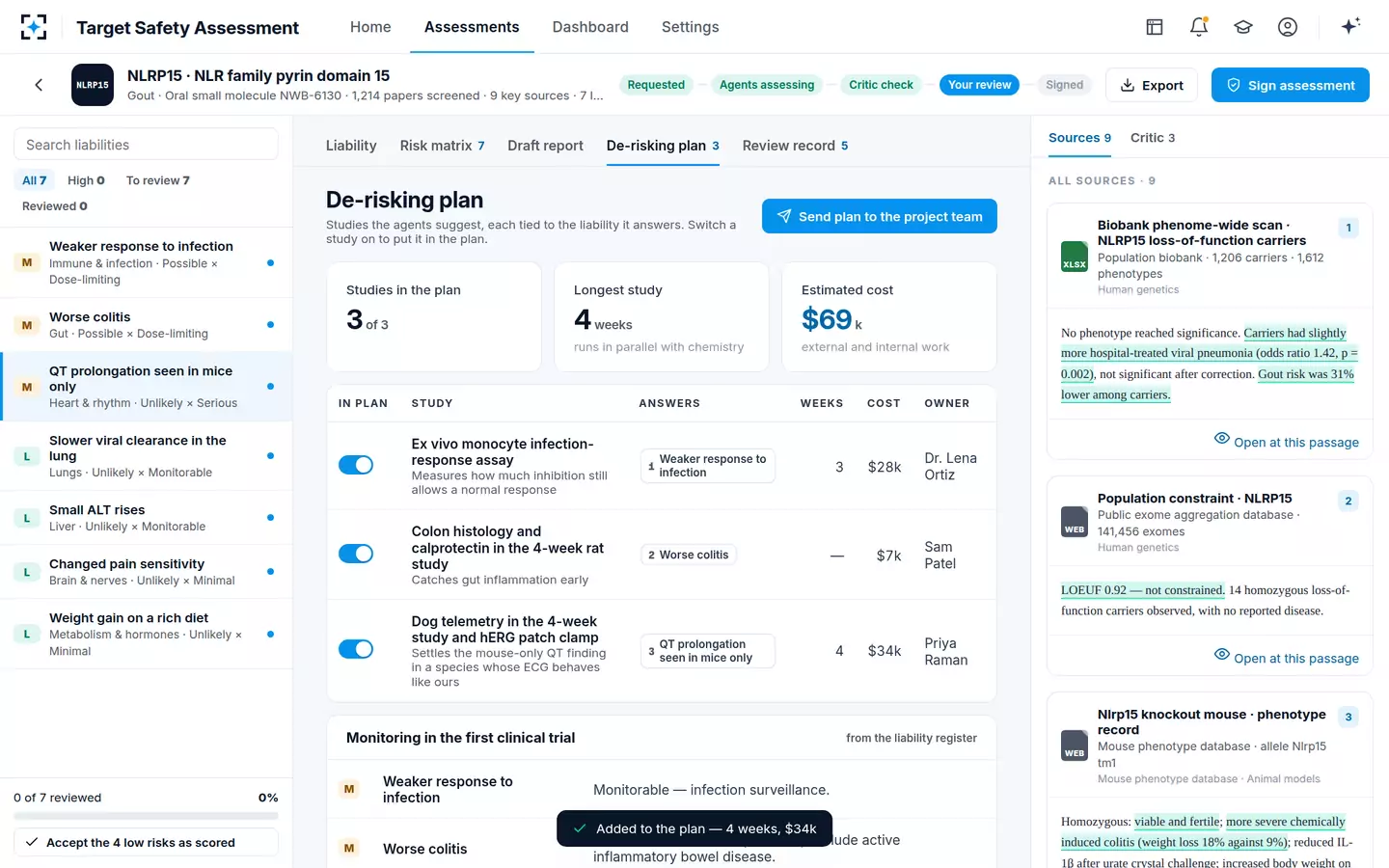
A de-risking plan is a table, and the discipline is in the columns. Each row starts from a liability that already exists in the register, states the question in a form a result could answer, and then names what it would take. The sample plan below belongs to the fictional target used throughout the product's example; it is short on purpose, because a plan with eleven studies in it is a plan nobody will fund.
One de-risking plan in Target Safety Assessment, from liability to answer
| Liability | The question a result would answer | The study, and why that species | Weeks · cost · owner |
|---|---|---|---|
| Weaker response to infection | Does the degree of inhibition a drug achieves still allow a normal response, or does only complete loss of the target impair it? | Ex vivo monocyte infection-response assay — human cells, so the question is asked in the species that matters. | 3 weeks · $28k · the discovery toxicologist |
| Worse colitis | Is there gut inflammation at the exposures the repeat-dose study already reaches? | Colon histology and faecal calprotectin added to the four-week rat study — no new animals, no new study. | No added weeks · $7k · the computational biologist |
| QT prolongation seen in mice only | Does the repolarization change survive in a species whose ECG behaves like ours? | Dog telemetry in the four-week study with a hERG patch clamp — the rodent is excluded from this question by guideline. | 4 weeks · $34k · the safety pharmacologist |
Three properties make such a plan honest. Every row begins with a liability rather than with a study, so nothing is in the plan because it is customary. Every row has an owner who is a person, because a study with no owner is a hope. And the species in the third column is justified in the same cell — chosen because it can answer the question, not because it is the species the next study was going to run in anyway.
What three studies cost in elapsed weeks
- Run and read out3 weeks
- Inside the four-week study already plannedadded endpoints
- Run and read out4 weeks
Cause for concern is what a target assessment produces
The phrase in ICH S7A is doing real work. Supplemental studies are not optional extras a cautious team adds; they are the response to a documented reason to be concerned about an organ system the routine package does not address. What counts as such a reason is not defined by the guideline, which is appropriate — it depends on the biology. A ranked list of on-target liabilities, each with the evidence behind it and the organ named, is as close to a written cause for concern as a programme is likely to produce.
This is the argument for doing the assessment at target stage rather than at candidate selection. ICH M3(R2) sets the goals of the non-clinical safety evaluation as characterising toxic effects in four respects — the target organs, how they depend on dose, how they relate to exposure and, where appropriate, whether they reverse (ICH M3(R2), 2009). Every one of those four is cheaper to characterise if the target organs were predicted before the molecule existed. The assessment does not replace the package; it tells the package where to look.
Developmental findings: the knockout, the guideline and the alternative assay
Embryonic lethality in a knockout is one of the most common and most misread findings in target work, so it is worth seeing what the reproductive toxicity guideline actually says. ICH S5(R3) treats an expected developmental effect as a starting position rather than a hypothesis to be tested in animals: for pharmaceuticals that are expected to adversely affect embryo-fetal development based on mechanism of action, pharmacologic class or target biology, it can be appropriate to confirm this activity in a qualified alternative assay(s)
(ICH S5(R3), 2020).
The next sentence is the one that saves animals and money: under this scenario, since the pharmaceutical is expected to adversely affect embryo-fetal development, there is no merit in using in vivo EFD studies to attempt to negate a positive alternative assay response
. In other words, where the biology says the effect is expected, the work to do is confirmation and management — labelling, contraception requirements, exclusion criteria — not two in vivo studies run in the hope of a different answer. A target assessment that records embryonic lethality with its allele and zygosity, and says plainly that the effect is expected from the mechanism, puts the programme on that path at the start.
The reverse error matters too. A germline knockout removes the gene from conception in every tissue, which is not what an inhibitor given to an adult does. The reading of such a finding, and what a conditional knockout adds, is worked through in the guide to reading knockout phenotypes.
Monitoring in the first trial, where a study cannot settle it
Some liabilities cannot be closed before people are dosed, either because no animal model reproduces the biology or because the effect is subjective. For those the honest output is not a study but a monitoring line: a measurement in the first clinical trial, a stopping rule, an exclusion criterion. Whether a risk is monitorable is itself part of its score — a serious effect that announces itself on a weekly blood count is a different risk from the same effect arriving silently.
Writing the monitoring line at target stage has one practical advantage over writing it later: it can be carried straight into the protocol and the investigator's brochure by the people who will run the trial, with the evidence that produced it attached. In the sample assessment the monitoring section sits beneath the de-risking plan and is drawn from the same register, so every monitored item traces back to a liability someone scored.
A liability with a named study, against one left to the clinic
Named study: The question, the study that answers it, the species and why, the weeks, the cost, the owner.
Monitor in the clinic: The measurement, its frequency, the stopping rule, and who is excluded.
Named study: An animal or in vitro readout exists that would move the score either way.
Monitor in the clinic: No model reproduces the biology, or the effect is detectable and reversible in people under observation.
Named study: The study cannot reach clinical exposures, or its result would not change anything.
Monitor in the clinic: It is chosen because the study was inconvenient — which converts a question into a risk carried by the first volunteers.
Named study: Weeks and money, spent before the committee decides.
Monitor in the clinic: Little at the time, and a protocol amendment later if the finding appears.
What a de-risking plan costs, and how to choose what to fund
Against the cost of development, a plan of this size is a rounding error. The median capitalised investment to bring a new drug to market has been estimated at $985.3 million, with a 95% confidence interval of $683.6 million to $1,228.9 million, after accounting for the cost of failed trials (Wouters, McKee and Luyten, JAMA, 2020). A plan whose three studies cost tens of thousands of dollars and whose longest runs four weeks in parallel with chemistry is not a budget decision; it is a sequencing decision.
The sequencing argument is supported by what animal studies actually catch and when. In the classic multi-company survey of concordance between animal and human toxicity, where animal models in one or more species identified a toxicity that was also seen in people, 94% were first observed in studies of 1 month or less in duration
(Olson et al., 2000). Most of the predictive value of animal work arrives early. A short, well-aimed study near the start is doing the same job as a long one later, sooner and for less.
Three numbers behind a de-risking plan's economics
3studies
in the sample plan, longest four weeks, running in parallel with chemistry
94%
of animal findings concordant with human toxicity were first seen in studies of one month or less
$985.3m
median capitalised investment estimated to bring one new drug to market, after the cost of failed trials
What to fund, then, follows three rules rather than a formula. Fund the studies that would change a decision the committee is about to take. Prefer an added endpoint on a study already planned to a new study, every time it will do. And where two studies would answer the same question, choose the one in the species that can answer it — a cheap study in the wrong animal is the most expensive line in any plan.
What every study in a de-risking plan has to state before it is funded
- The liability it answers, by name
Written as the register writes it, so the result closes a specific entry rather than producing general reassurance.
- The question, in a form a result can answer
Not "characterise the gut effect" but "is there histological inflammation at the exposures the four-week study reaches".
- The species, with the reason
Chosen because it can answer the question. Where a guideline excludes a species for an endpoint, say so in the cell.
- What each outcome would mean
What a negative result closes and what a positive result triggers — decided before the study runs, not after.
- Elapsed weeks, and whether it sits on the critical path
An added endpoint on a planned study often costs no weeks at all; that is the difference between a plan and a delay.
- Cost and a named owner
A person who will run it and report it. A study with a function rather than a person attached does not get done.
How Target Safety Assessment ties each study to its liability
The risk scorer proposes de-risking studies alongside the probability and impact it suggests for each liability, and its limit is stated rather than implied: it proposes, and a toxicologist accepts, re-scores or dismisses. Each proposed study arrives attached to the entry it answers, with weeks, cost and an owner, and switching one on puts it in the plan with that link intact. The plan's header counts what is in it and what the longest study costs in elapsed time, because that is the number a project leader actually needs.
The de-risking plan: three studies, each tied to the liability it answers
The report carries the same structure into the document. Monitoring and the de-risking plan is one of the sections every assessment contains, written from the register rather than retyped, and species relevance and study design is an optional section, switched on in the sample settings. What the report looks like, and who signs it, is set out in the guide to running the assessment by hand, outsourced or with agents.
The plan arrives in the report as a section, not as an attachment
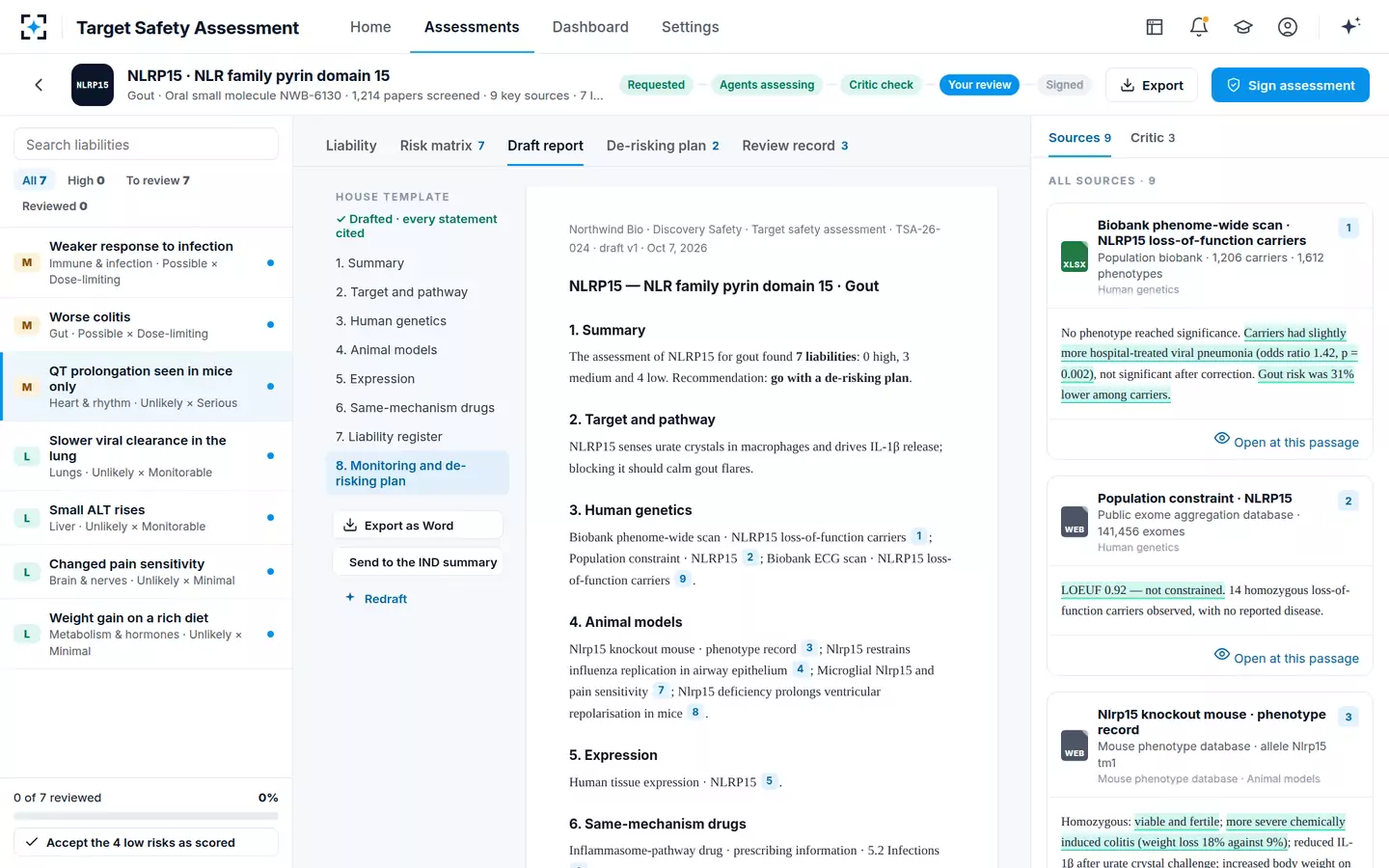
The test of a plan is whether a reviewer can read it backwards: from a study, to the question, to the liability, to the passage that produced it. To see the three studies against the register they came from, start from Target Safety Assessment.
Questions people ask
What is the safety pharmacology core battery?
It is the set of functional studies ICH S7A asks for on the cardiovascular, respiratory and central nervous systems — the organ systems it calls vital — investigated before a substance is first given to humans. It is run on the candidate molecule and is the same for every programme, so it is a floor rather than an answer to a target-specific question.
What is a supplemental safety pharmacology study?
It is a study of an organ system the core battery and the repeat-dose toxicity studies do not address — renal, gastrointestinal, immune, endocrine and others — run when there is a cause for concern. That trigger is why a documented on-target liability matters: it is the written reason that makes the study justifiable rather than discretionary.
Do you need an embryo-fetal study if the knockout is lethal?
Not necessarily in the way programmes assume. ICH S5(R3) says that where a pharmaceutical is expected to affect embryo-fetal development from its mechanism, class or target biology, confirming that activity in a qualified alternative assay can be appropriate — and that there is no merit in running in vivo studies to attempt to negate a positive alternative assay response. The work shifts from proving the effect to managing it.
When must the core battery be done?
Before the first administration in humans, as ICH S7A states directly. Follow-up studies are triggered by what the core battery shows and so come later; supplemental studies are triggered by a cause for concern and can be run much earlier, which is why a target-stage liability can buy an answer long before the regulatory package is assembled.
How much does a de-risking plan cost?
It depends entirely on what is in it, and the useful comparison is not with other studies but with the development programme: the median capitalised investment to bring a drug to market has been estimated at $985.3 million. In the sample plan used here three studies total $69,000 with the longest running four weeks in parallel with chemistry — figures that belong to that fictional example rather than to any price list.
Who owns each study in a de-risking plan?
A named person, not a function. In the sample plan the ex vivo infection assay sits with the discovery toxicologist, the added gut endpoints with the computational biologist and the cardiac work with the safety pharmacologist. The reason to insist on a name is practical: the plan is reviewed weeks later, and an unowned row is the one that has not moved.