A knockout mouse phenotype database holds what was observed when a gene was switched off in the mouse: the gene, the allele used, whether the animals carried one broken copy or two, the genetic background they were bred on, the tests that were run and the results that reached significance. For a target safety assessment it is the most systematic organ-by-organ evidence a target has, because one consortium phenotypes every line through the same battery. It is also the evidence most often quoted without its design, and that cuts both ways: a lethal homozygote says little about an adult taking an inhibitor, and "viable, no significant phenotype" usually means the test for the organ you care about was never run. Botminds' Target Safety Assessment reads the phenotype databases and the published literature together, keeps the allele and the zygosity with every finding, labels developmental findings separately from adult ones, and shows each organ system's mouse evidence beside what people with a broken copy show.
Figures naming a target, a person or a company on this page come from the solution's sample data on fictional targets — SRK9 and NLRP15 — and are labelled where they appear. Everything else is from the consortium's own publications and the population genetics literature, linked where it is used.
What systematic mouse phenotyping has produced so far
8,267genes
with systematic phenotype data in one consortium release
85.9M
individual data points behind them
97,294
phenotype calls that reached significance
1,321
human diseases the calls are aligned to
What a knockout mouse phenotype database actually holds
There are two kinds, and a safety claim should say which it rests on. The first is systematic: a consortium knocks genes out on a fixed allele design and a fixed background, runs every line through the same battery of tests at the same ages, and publishes the results whether or not anything was found. The International Mouse Phenotyping Consortium describes itself as "an international effort by 21 research institutions to identify the function of every protein-coding gene in the mouse genome", working through "roughly 20,000 genes" with standardised physiological tests across a range of biological systems.
The second is curated from the literature: decades of individual laboratories' knockouts, each made for a specific question, on whichever background that laboratory used, phenotyped for whatever the investigators cared about. It is far richer per gene where a gene has been studied, far more uneven between genes, and it carries publication bias in a direction that matters for safety — a laboratory that found nothing interesting often did not publish.
For a target assessment the two are complementary, and the combination is what the work needs: the systematic source tells you what a standard battery found and, just as importantly, what it looked for; the literature tells you what anyone has ever found, including the conditional and tissue-specific experiments the systematic pipeline does not run. The error to avoid is writing as though there were one database with one answer per gene.
One gene's mouse evidence as a target assessment has to store it
| Field | Why it is a separate field | A sample entry |
|---|---|---|
| Gene and allele | A null, a hypomorph, a point mutation and a conditional-ready allele support different claims about complete inhibition. | Srk9, targeted null allele |
| Zygosity | One broken copy is a model of partial loss; two is a model of complete loss. | Heterozygous |
| Background | The strain is part of the measurement, not a footnote; it is held constant precisely so lines can be compared. | Standard consortium background |
| Developmental or adult | An embryo-fetal finding belongs to reproductive toxicology, not to the organ it superficially resembles. | Adult, 16 weeks |
| Pipeline and parameter | Which test produced the number, so a reader can ask what the test can detect. | Haematology, neutrophil count |
| Finding and statistic | An effect size with its n and its threshold, not “reduced”. | 22% fewer neutrophils than littermates |
| Organ system | The unit a monitoring plan and a histopathology report are written in. | Blood and bone marrow |
| Cited passage | The sentence relied on, so a second reader can disagree with the right thing. | The paper’s own result sentence |
What is the difference between a conditional knockout and a knockout?
A conventional knockout removes the gene from conception in every cell of the animal. A conditional knockout removes it only where and when the experimenter chooses — in one tissue, using a cell-type-specific driver, or in the adult, using an inducible system. The difference matters for drug safety more than for almost any other use of these animals, because a patient taking an inhibitor is an adult whose tissues developed normally.
That is the single most common misreading in a target assessment. A germline null that dies in utero has answered a question about development. It has not answered the question the programme is asking, which is what happens when a fully formed adult has the protein's function suppressed, partially, for weeks or months. The two can agree, and often do. They are still different experiments, and an assessment that does not say which one a finding came from is not scorable.
The same gene, two experiments, two different claims about an inhibitor
Germline homozygous knockout: The protein, in every cell, from conception.
Adult conditional knockout: The protein, in the chosen tissue, from the day induction starts.
Germline homozygous knockout: The function is needed for an organ to form or an animal to survive.
Adult conditional knockout: The function is needed to keep that tissue working once it is formed.
Germline homozygous knockout: Little about chronic adult suppression; compensation during development can mask it.
Adult conditional knockout: Much more: the closest animal analogue of a drug given to an adult.
Germline homozygous knockout: Complete, in every cell.
Adult conditional knockout: Complete in the cells that excised; excision is rarely total and should be reported.
Germline homozygous knockout: Developmental compensation; secondary effects of a malformed organ.
Adult conditional knockout: Driver expression outside the intended tissue, and effects of the driver itself.
Germline homozygous knockout: The great majority of entries.
Adult conditional knockout: Rare, and usually found only in the primary literature for well-studied genes.
Allele, zygosity, background: the four things that change the answer
Four design choices sit underneath every phenotype call, and changing any one of them can change the result. The first is the allele. A true null, a hypomorph that leaves residual function, a point mutation that models a human variant and a tagged or trap allele that may be leaky are all called "knockout" in conversation and are not interchangeable in an assessment.
The second is zygosity, which decides what the animal is a model of. Two broken copies model complete loss; one models partial loss, which is what most drugs actually achieve. The third is the genetic background, which is part of the measurement rather than a detail of husbandry — a consortium holds it constant precisely so that lines can be compared with one another, and a literature finding on a different background is not automatically comparable with a consortium call.
The fourth is the battery: which tests were run, at what ages, in how many animals, and at what statistical threshold. It is the one most often left out of a quotation, and the one that decides whether a silence in the data means anything at all.
The allele deserves a second look, because the word "knockout" covers designs that differ in exactly the way a safety argument cares about. Many large-scale alleles are built to be converted — a cassette inserted into an intron disrupts the gene, and the same line can later be converted into a conditional allele by crossing it to a recombinase line. Some of those disrupting cassettes leak, leaving residual transcript. A programme whose whole argument is "complete loss of this protein is tolerated" is relying on the loss having been complete, and that is a property of the allele, not of the word.
Zygosity carries a symmetrical trap in the other direction. A heterozygote with no phenotype is sometimes quoted as evidence that partial inhibition is safe, when the experiment was never powered to detect the effect size a clinician would care about: a 10% change in a blood count is usually too small to detect in ten animals per group, so its absence is not reassurance. The number of animals belongs in the entry for the same reason the threshold does.
How many genes have knockout mouse data at all?
Systematic phenotype data exists for roughly eight thousand genes — 8,267 in the release described above — against about twenty thousand protein-coding genes in the mouse genome. Many more genes appear somewhere in the published literature, but unevenly, with no common battery and no guarantee that the organ a programme cares about was examined.
For target safety that produces a specific discipline. For a large share of targets, on most organ systems, the accurate statement is "no mouse data for this organ" — which is a completely different claim from "the mouse is clear on this organ", and the two are routinely collapsed into one sentence in a narrative report. An assessment that cannot distinguish them will systematically understate uncertainty, because every untested organ reads as a quiet pass.
The practical consequence is that the mouse cannot be the backbone of an assessment for most targets, and the lines that can fill the gap have to be named rather than assumed. Where there is no mouse, a programme falls back on what people carrying loss-of-function variants show, on the organs where the protein is actually present, on drugs already working through the same pathway, and on cell-level evidence of whether the gene is required for viability. None of those is a substitute for an organ-by-organ animal battery. Saying which of them is carrying the weight, for each organ, is what makes the resulting score defensible — and it is why an assessment is written as six lines of evidence rather than as a literature review.
Where the mouse has nothing to say, drawn as nothing
Lethal, subviable, viable — and why the line matters
Viability is the first call a systematic pipeline makes, and it is made against a stated rule rather than an impression.
“Lines are defined as lethal if zero homozygous animals are identified after 28+ animals have been genotyped.”
Dickinson ME et al., “High-throughput discovery of novel developmental phenotypes”, Nature 537, 2016 (International Mouse Phenotyping Consortium)
Written out like that, the call is clearly a statistical statement about a breeding programme, not a biological pronouncement. Subviable sits between: homozygotes appear, but below the expected Mendelian proportion. Both are useful to a target assessment, and both are frequently over-read.
What happens to a null allele, across the genome
Roughly a third of genes, then, cannot be deleted in both copies without consequence for survival — which means a lethal call is common enough that it cannot by itself be a reason to abandon a target. It is a strong signal about development and a weak one about adult inhibition, and the correct next question is whether an adult conditional knockout, or people carrying a broken copy, show anything at all. Where those sources contradict the mouse, the contradiction is the finding; what to do when mouse and human evidence disagree takes that case in full.
When "no significant phenotype" means "not tested"
A phenotype call is the output of a specific test, run in a specific number of animals, judged against a specific threshold. Three different silences hide behind the same summary sentence, and an assessment has to tell them apart.
The first is a test that was run and found nothing: genuine, if limited, evidence of absence, bounded by the power of that test at that n. The second is a test that was never run, because the organ or the function sits outside the battery, or because the line died before the age at which the test is done. The third is a test that was run and found an effect that did not reach the threshold — a direction of travel that a reader with a prior hypothesis about that organ should want to see.
Only the first supports the sentence "the mouse is clear on this organ". The second supports "not examined", and the third supports "a sub-threshold effect in the expected direction, n too small to settle it". Collapsing all three into "no significant phenotype" is how a programme arrives at first-in-human believing an organ was cleared.
Six questions to ask of any knockout claim before it is scored
- Which allele?
Null, hypomorph, point mutation, conditional-ready or trap. Residual function changes what a clean result means.
- Which zygosity?
Homozygous models complete loss; heterozygous models partial loss, which is what most inhibitors achieve.
- Which background, and was it the same as the comparison?
Strain is part of the measurement. A literature finding on another background is not automatically comparable with a standardised call.
- Was this organ actually tested, and at what age?
If the battery does not cover it, or the animals died first, the honest entry is “not examined”.
- At what threshold, in how many animals?
A sub-threshold effect in the direction of a known liability is worth more than a significant effect in an organ nobody suspected.
- Developmental or adult?
Ask it last, because it decides where the finding goes: the reproductive section, or the organ the programme will monitor.
Incomplete penetrance in a standardised line
The most useful thing systematic phenotyping has shown about its own data is that identical animals do not always give identical results. The consortium reported it plainly: "unexpectedly, we observed instances of phenotypes that display incomplete penetrance, including variable lethality (subviability), despite the standard allele structure and defined genetic background".
That sentence should change how a disagreement in the literature is read. When two papers report different phenotypes for the same knockout, the first explanations to reach for are different alleles, different backgrounds, different ages and different tests — and when none of those applies, incomplete penetrance in a controlled line is a documented possibility rather than an accusation that one laboratory was careless. For scoring, it argues for treating a single small-n phenotype as a weaker signal than its p-value suggests, and for saying so in the entry instead of in a conversation.
Heterozygotes: the closest mouse analogue of a partial inhibitor
Heterozygous animals are rarely the headline of a knockout paper and are frequently the most relevant line in it. A drug that occupies most of a target most of the time is a partial-loss experiment, and the animal that models partial loss is the one carrying a single broken copy.
Heterozygous effects are real and measurable at scale. In the largest survey of human loss-of-function variation, constraint against such variants was tested against the mouse: "in 389 genes with orthologues that are embryonically lethal after heterozygous deletion in mouse, we find a lower LOEUF score (mean = 0.488), compared with the remaining 18,808 genes (mean = 0.962)" — genes whose mice cannot tolerate losing one copy are also the genes under the strongest selection against losing one copy in people. The two species agree, at population scale, about which genes are dose-sensitive.
For a specific target that agreement is a prior, not an answer, and the mouse heterozygote and the human carrier should be set against each other explicitly. What a healthy carrier licenses a toxicologist to claim is the subject of what a healthy heterozygous carrier proves.
How Target Safety Assessment files the mouse evidence by organ
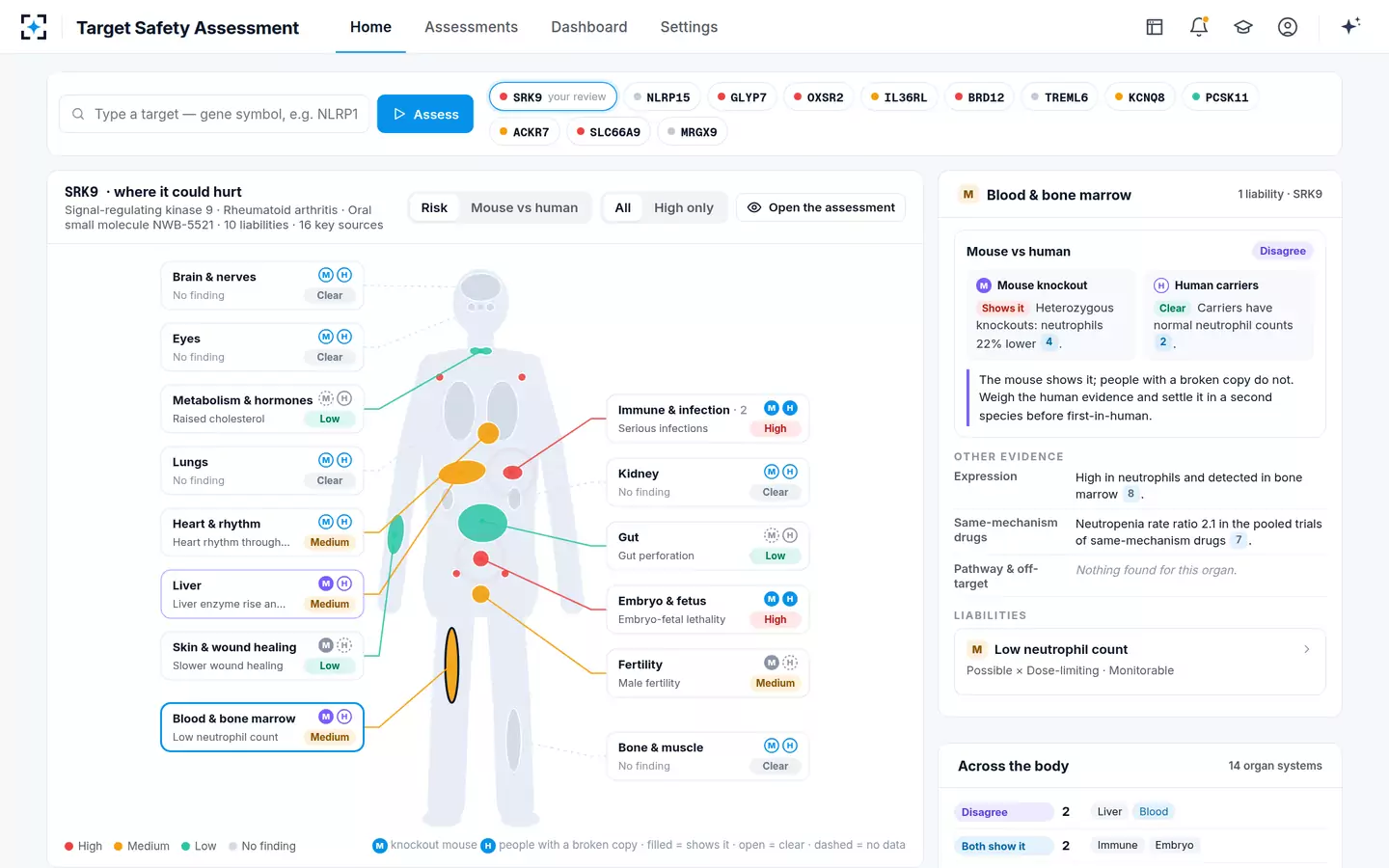
In Target Safety Assessment the mouse evidence is one of six lines read in parallel, and the agent that reads it has limits stated as rules of the work rather than as features. It collects knockout, knock-in and conditional phenotypes from the phenotype databases and the literature; it labels developmental findings separately from adult findings; and it keeps the allele and the zygosity with the finding, because a finding without them cannot be scored. Where there is nothing, the organ carries a dashed mark rather than an empty space.
Target Safety Assessment reading one target on six evidence lines at once
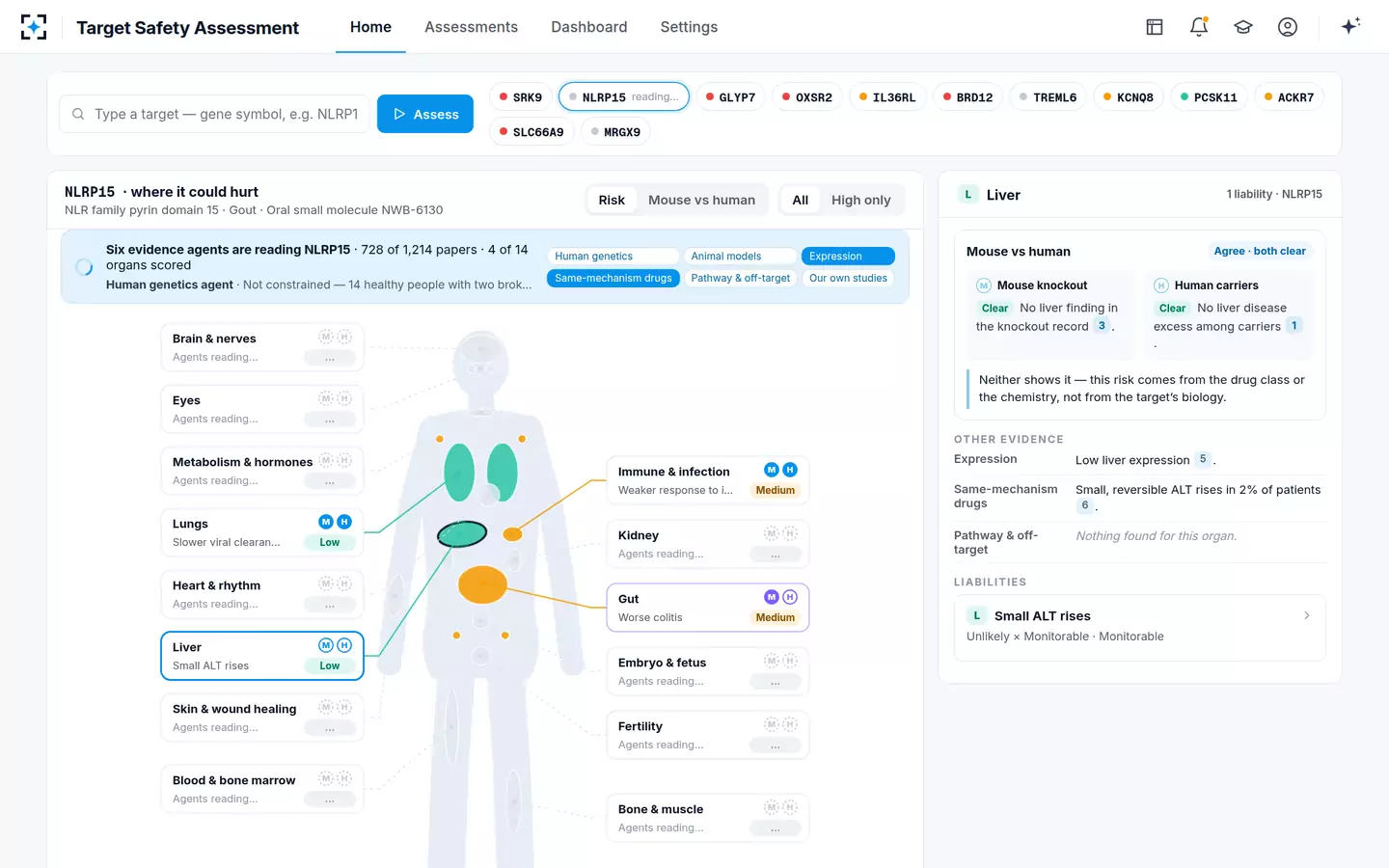
What the toxicologist sees per organ is both species' marks together: what the knockout mouse shows, what people with a broken copy show, and a verdict where they differ. On the solution's fictional target SRK9, heterozygous knockouts have 22% fewer neutrophils and develop fatty liver on a high-fat diet, while 418 people carrying a broken copy have normal counts and no liver disease — two organs where the species disagree, drawn as a disagreement rather than averaged into a sentence. On NLRP15, the knockouts are viable and fertile but develop worse chemically induced colitis, which is a finding about a challenge model and is filed as one.
The mouse finding and its cited passage, beside the other five lines
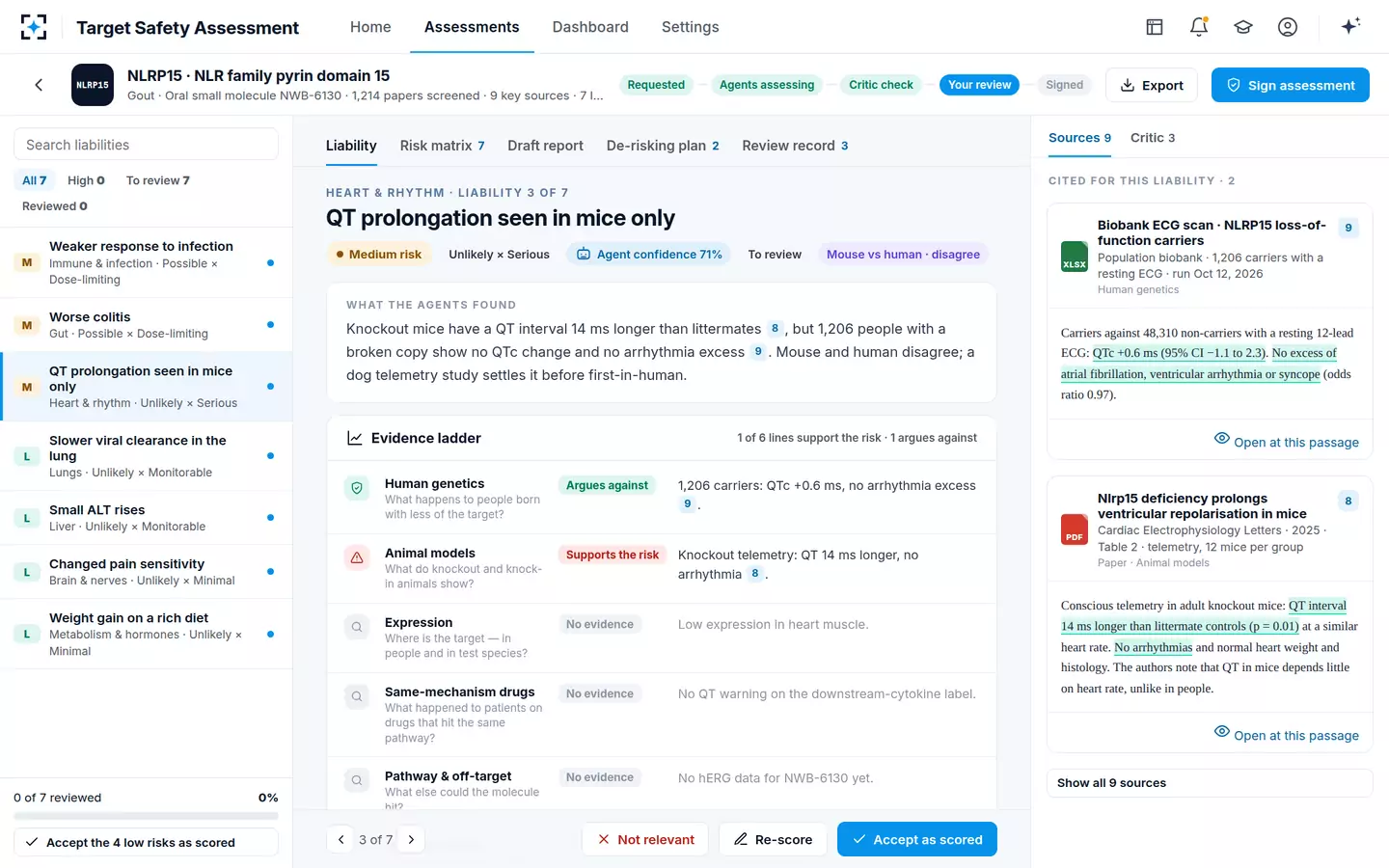
The design decision behind all of it is that an assessment is meant to be argued with. A mouse finding that arrives with its allele, its zygosity, its background, its organ and the sentence it came from can be challenged on any of those; a mouse finding that arrives as a claim can only be believed or doubted. For what a buyer should demand of any tool doing this work, see what a target safety assessment tool must show you, or start from Target Safety Assessment.
Questions people ask
Where can I find knockout mouse phenotypes for a gene?
Two places, and a complete answer uses both. Systematic consortium data gives a standardised battery run on a fixed allele and background, freely available, for the genes it has reached — 8,267 in the release cited above. Literature-curated resources give every published allele for a gene, including the conditional and tissue-specific experiments the systematic pipeline does not run. A gene missing from the first is not a gene with no mouse evidence; a gene present in the first has been examined only for what the battery covers.
What does it mean if a knockout mouse is embryonic lethal?
That deleting both copies from conception is incompatible with normal development. It is a strong statement about development and a weak one about an adult taking an inhibitor, and it is common: the consortium's genome-wide estimate is that about 24% of null mutations are lethal and a further 11% subviable. The useful follow-ups are whether an adult conditional knockout exists, what heterozygotes show, and whether people carrying a broken copy are healthy.
Does the mouse strain background change the phenotype?
Yes, which is why a systematic programme holds it constant and reports it. Background is part of the measurement: it modifies penetrance and severity, and it is one of the first explanations to examine when two laboratories report different results for the same gene. A finding quoted without its background cannot be compared with one that has a different background.
What is a subviable knockout?
A line in which homozygous animals are born but at fewer than the expected Mendelian proportion — some die and some survive. For safety it is a useful middle category, because it says the function is important for survival without being absolutely required, and the surviving animals can then be phenotyped as adults.
Why do two papers report different phenotypes for the same knockout?
Usually because they are not the same experiment: a different allele, a different background, different ages, a different test, or a different number of animals. When none of those explains it, incomplete penetrance is a documented phenomenon even in a standardised allele on a defined background, so genuinely variable results are possible without either laboratory being wrong.
Do knockout mouse phenotypes predict what a drug will do in people?
Partly, and the direction matters more than the headline. Mouse evidence is strongest as an organ-by-organ map of where to look, and weakest as a verdict: lethal knockouts exist for the targets of widely used, chronically taken medicines, and findings in the mouse can also fail to appear in people. The practical discipline is to score the mouse finding against the human evidence organ by organ and to name the study that would settle a disagreement, rather than to let either species win by default.