The predictive validity of animal models is usually argued as a yes-or-no question and is far more useful as a handful of measured numbers. In a multinational survey of compounds whose human toxicities were already known, animal studies identified the same target organ in 71% of cases when rodent and non-rodent species were taken together, 63% for non-rodents alone and 43% for rodents alone. In an industry database of 182 molecules, sensitivity was 48% while specificity was 84%, with a negative predictive value of 86% — so a clean animal study is much stronger evidence than a positive one. Those numbers describe a population of compounds. The question a programme actually faces is narrower and harder: one organ, where the knockout mouse says one thing and the people carrying a broken copy of the target say another, and a recommendation due on Thursday. Botminds' Target Safety Assessment is built around that case — it gives every organ system an explicit verdict, including disagree, and ties each disagreement to the one study that would settle it.
Figures naming a target, a person or a company come from the solution's sample data on fictional targets — SRK9 and NLRP15 — and are labelled where they appear. The research figures come from peer-reviewed surveys and systematic reviews, linked where they are used.
What the surveys measured, when they compared animals with people
71%
true-positive concordance for rodent and non-rodent species together
63%
for non-rodents alone
43%
for rodents alone
48%
sensitivity across 182 molecules in a later industry database
How predictive are animal models of human toxicity?
Moderately, asymmetrically, and much better in combination than alone. The Olson survey put it as a true-positive concordance rate: of the human toxicities that occurred, what share had been seen in an animal study first. "The results showed the true positive HT concordance rate of 71% for rodent and nonrodent species, with nonrodents alone being predictive for 63% of HTs and rodents alone for 43%". Two species together are better than either alone, and the rodent is the weaker of the two — which is worth remembering whenever a target assessment's animal evidence is entirely murine.
The Monticello database asked a different and in some ways more demanding question: taking every molecule in a set, including the ones that caused nothing, how well did animal findings predict what happened in phase 1? "Sensitivity was 48% with a 43% positive predictive value (PPV)", across 182 blinded molecules, with specificity of 84% and a negative predictive value of 86%. Fewer than half of the clinical findings had an animal precedent, and fewer than half of the animal findings produced a clinical one.
Neither result argues that animal studies are dispensable, and neither supports quoting an animal finding as a prediction. They support a specific habit: treat a positive animal finding as a hypothesis about an organ, and treat a clean one as reasonably strong evidence of absence.
The two numbers that matter: sensitivity and negative predictive value
Sensitivity and negative predictive value answer opposite questions and are routinely confused in a programme meeting. Sensitivity asks: of the things that went wrong in people, how many had been seen in animals? Negative predictive value asks: when the animals were clean, how often were people also clean? The first is a statement about catching trouble; the second is a statement about being reassured.
The same database, read in both directions
When an animal study found a target-organ toxicity, what happened in phase 1
- A clinical finding followed: 43% · 43%
- No corresponding clinical finding: 57% · 57%
When the animal studies showed no target-organ toxicity, what happened in phase 1
- The clinic was clean too: 86% · 86%
- A clinical finding appeared anyway: 14% · 14%
The asymmetry has a practical consequence that is almost the opposite of how animal data is usually discussed. A positive animal finding, taken alone, is right fewer than half the time about what will happen in a person — so it is a reason to look harder, not a reason to stop. A clean result in two species, by the same dataset, is right most of the time — so it is the stronger piece of evidence, and it is the one that tends to be reported in a single clause and forgotten.
Which species finds what: rodent, dog, non-human primate
The same database separated the species, and the separation is specific enough to inform a study plan. "The nonhuman primate had the strongest performance in predicting adverse effects, especially for gastrointestinal and nervous system categories", while "the beagle dog had the strongest performance in predicting an absence of clinical adverse effects". One species is the better finder; the other is the better clearer.
Read with the Olson result — highest overall concordance in haematological, gastrointestinal and cardiovascular toxicities, and lowest in cutaneous — a rough map emerges of where animal work is load-bearing. Blood, gut and heart translate comparatively well. Skin translates worst. Nervous system findings are best caught in the primate. None of this makes the choice of species for a particular programme, which depends on target expression and pharmacological relevance, but it does say what a given species' silence is worth.
The mouse misleads in both directions
The most consequential errors are not statistical, they are categorical: a lethal knockout read as a veto, or a clean mouse read as a clearance. The first is best illustrated by two of the most widely taken medicines in the world. Minikel and colleagues found that "genes with near-complete selection against pLoF variants also include HMGCR and PTGS2, the targets of highly successful, chronically used inhibitors—statins and aspirin", and noted in the same passage that "homozygous knockout of Hmgcr and Ptgs2 are lethal in mice".
Had either target been judged on its knockout alone, it would have failed at selection. The reason the inference breaks is the one set out in how to read a knockout mouse record: a germline homozygous null is a developmental experiment, and partial pharmacological inhibition in an adult is a different intervention.
Four cases where the animal evidence pointed the wrong way, and one where it held
What the animal evidence said: Homozygous knockout is lethal in mice.
What happened in people: Under near-complete selection against loss-of-function variants, and inhibited chronically by statins.
What the animal evidence said: Homozygous knockout is lethal in mice.
What happened in people: Also under near-complete selection, and inhibited chronically by aspirin.
What the animal evidence said: Benefit in animal models: pooled odds ratio 0.58 (95% CI 0.41 to 0.83) for adverse functional outcome.
What happened in people: No benefit in clinical trials of treatment for head injury.
What the animal evidence said: Infarct volume reduced by 29% (21% to 37%); neurobehavioural scores improved by 48% (29% to 67%).
What happened in people: Associated with a worse outcome in patients with ischaemic stroke.
What the animal evidence said: Respiratory distress reduced in animal models; the effect on mortality inconclusive.
What happened in people: Respiratory distress and mortality both reduced in neonates — the animal result did translate.
The error in the other direction is quieter and more common. A mouse that is viable with no significant phenotype is quoted as a clean result when the battery never examined the organ in question, or when the species cannot show the phenotype at all — the rodent heart being the standing example, since its repolarisation does not work the way a human heart's does. That case is taken on its own terms in settling a cardiac risk between hERG, ICH S7B and a mouse QT finding.
Four verdicts for one organ: agree, disagree, no human data, no mouse data
A target assessment that reports one sentence per organ loses the only distinction that matters here. Four states are possible on any organ, and each implies a different action. Collapsing them into a narrative — which is what a written report does by default — hides two of the four entirely.
The four verdicts, the evidence pattern behind each, and what each one asks for
| Verdict | The evidence pattern | What it implies |
|---|---|---|
| Both show it | An animal finding and a human finding in the same organ, pointing the same way. | Accept the liability. Score it, plan the monitoring, and spend the study budget elsewhere — this organ is no longer uncertain. |
| Both are clear | The organ was examined in both species and nothing was found. | The strongest clearance available before a compound exists, and worth recording as such — the published negative predictive value is the reason it is worth something. |
| They disagree | A finding in one species, an examined absence in the other. | Weight the human evidence, name the mechanistic reason for the difference if there is one, and choose the single study that would settle it. |
| One of them has no data | The organ was never examined in the mouse, or no human carrier evidence exists for it. | Record it as no data, not as clear. If the organ matters to the indication, this is where a new experiment is cheapest. |
What do you do when the mouse and the human evidence disagree?
Six steps, in order, and the first two are where most of the value is.
Name the disagreement as the finding. Not "mixed evidence" — a verdict on one organ, with both species' findings written out beside each other. A disagreement that is stated can be challenged; one that is averaged into a sentence cannot be found again by the next reader.
Check that it is a real disagreement. Many dissolve on inspection: the species were examined at different ages, the mouse finding is developmental and the human evidence is from adults, the zygosities differ, or the endpoints are not the same measurement. Only the residue is a biological contradiction.
Weight the human evidence, and say by how much. The human is the right species; that does not make it the stronger observation in every case, because a carrier scan has a power limit and a knockout experiment is controlled. The judgement is defensible when the weighting is written down — how many carriers, screened for what, against how many animals at what effect size.
Ask whether there is a mechanistic reason for the difference. Where there is one — a pathway the species does not share, a receptor with a different distribution, a physiology that does not transfer — the disagreement is explained and the human evidence wins outright. Where there is not, the disagreement stands and needs an experiment.
Choose the one study that would settle it, not three that would illuminate it. A second species with the relevant physiology, a conditional adult knockout, a targeted assay in human cells. The test of a good choice is that both possible results change what the programme does.
Write the residual uncertainty into the first trial. If the study cannot be done before the candidate is chosen, the disagreement becomes a monitoring line and a stopping rule in the protocol, and the person who signs the assessment is agreeing to that.
A disagreement, from the moment it appears to the signature that accepts it
Agent
Evidence agentsRead six lines in parallel and land each finding on an organ system with its allele, zygosity, cohort and cited passage.
Never: Never merge two species’ findings into one sentence.
Agent
Risk scorerSets a verdict for every organ — both show it, both clear, disagree, or no data — and proposes a probability and an impact.
Never: Never decides; proposes only.
Agent
CriticChallenges single-source liabilities and species relevance, such as a rodent cardiac finding, and shows the challenge beside the liability.
Never: Never applies a challenge silently.
A person decides
Discovery toxicologistWeighs the human evidence against the animal finding, accepts, re-scores with a written reason or dismisses, and chooses the one study that would settle it.
Never: Cannot change a score without a reason.
A person decides
The signatureSigned with a stated meaning and a recommendation, the report drafted around it with every statement tied to a numbered reference; the head of discovery safety co-signs when a high risk remains.
Never: No statement in the report without a citation.
Why a clean animal study is stronger evidence than a positive one
This follows directly from the 43% and the 86%, and it is worth stating as a rule because it runs against instinct. Toxicology is trained to treat findings as signals and absences as nothing. The data says the opposite for this specific inference: an absence of target-organ toxicity in animals predicted an absence in phase 1 most of the time, and more often still when both species were clean, while a finding in animals predicted a clinical finding fewer than half the time.
Two cautions keep that from being over-applied. The negative predictive value was measured against phase 1 observations — short exposures in small numbers of people — so it speaks to early clinical safety, not to what a two-year exposure will show. And an absence is only evidence if the test was run: the whole value of the result depends on the organ having been examined, which is why "no data" and "clear" must be different entries. For how the same distinction decides what a de-risking study is actually for, see the studies that settle a risk.
Discordance that is bias, and discordance that is biology
When animal and human results differ, there are two families of explanation, and separating them is the difference between redesigning an experiment and redesigning a programme.
“Discordance between animal and human studies may be due to bias or to the failure of animal models to mimic clinical disease adequately.”
Perel P et al., “Comparison of treatment effects between animal experiments and clinical trials: systematic review”, BMJ 334, 2007
Bias is the first thing to exclude, because it is the cheaper problem. Small group sizes, no randomisation, no allocation concealment, selective publication of positive results and endpoints chosen after the data was seen all inflate animal effects in a direction that makes the species look more informative than it is. A finding from a single small study with none of those safeguards is not a contradiction of the human evidence; it is a weak observation that happens to point the other way, and it should be scored as weak.
Failure of the model to mimic the disease is the second family, and it is the one that actually changes a decision. Where a species' physiology genuinely differs — repolarisation, immune repertoire, metabolic route, receptor distribution — the animal result is not a weak version of the human answer, it is an answer to a different question. The practical test is whether a mechanism can be named. If it can, the human evidence wins and the assessment records why. If it cannot, the disagreement is still open and the programme owes it a study.
What a disagreement entry must carry before it can be signed
- Both findings, written out side by side
Species, allele and zygosity on one side; cohort, carrier count and phenotypes screened on the other.
- The verdict, as a state rather than a sentence
Disagree — so that it can be counted, filtered and reviewed, not buried in a paragraph.
- The alternative explanations that were excluded
Developmental versus adult, different endpoints, different ages, different zygosity. Say which were checked.
- The mechanistic reason, or its absence
A named reason the species differ settles it. “No mechanistic explanation found” is a legitimate and informative entry.
- The weighting, and who did it
Which evidence was preferred and why, with the name of the person who made the call — not the agent that proposed it.
- The study that would settle it, with weeks, cost and owner
Or, if there is to be no study, the monitoring line and stopping rule that will carry the risk into the first trial instead.
How Target Safety Assessment makes a contradiction the first thing you see
In Target Safety Assessment every organ system carries two marks — what the knockout mouse showed and what people with a broken copy showed — and one switch recolours the whole body by verdict instead of by risk level. The practical effect is that a reader who opens a target they have never seen can answer "where do the species disagree?" in a second, which is the question a discovery toxicologist actually arrives with.
The default view: every organ coloured by its highest liability
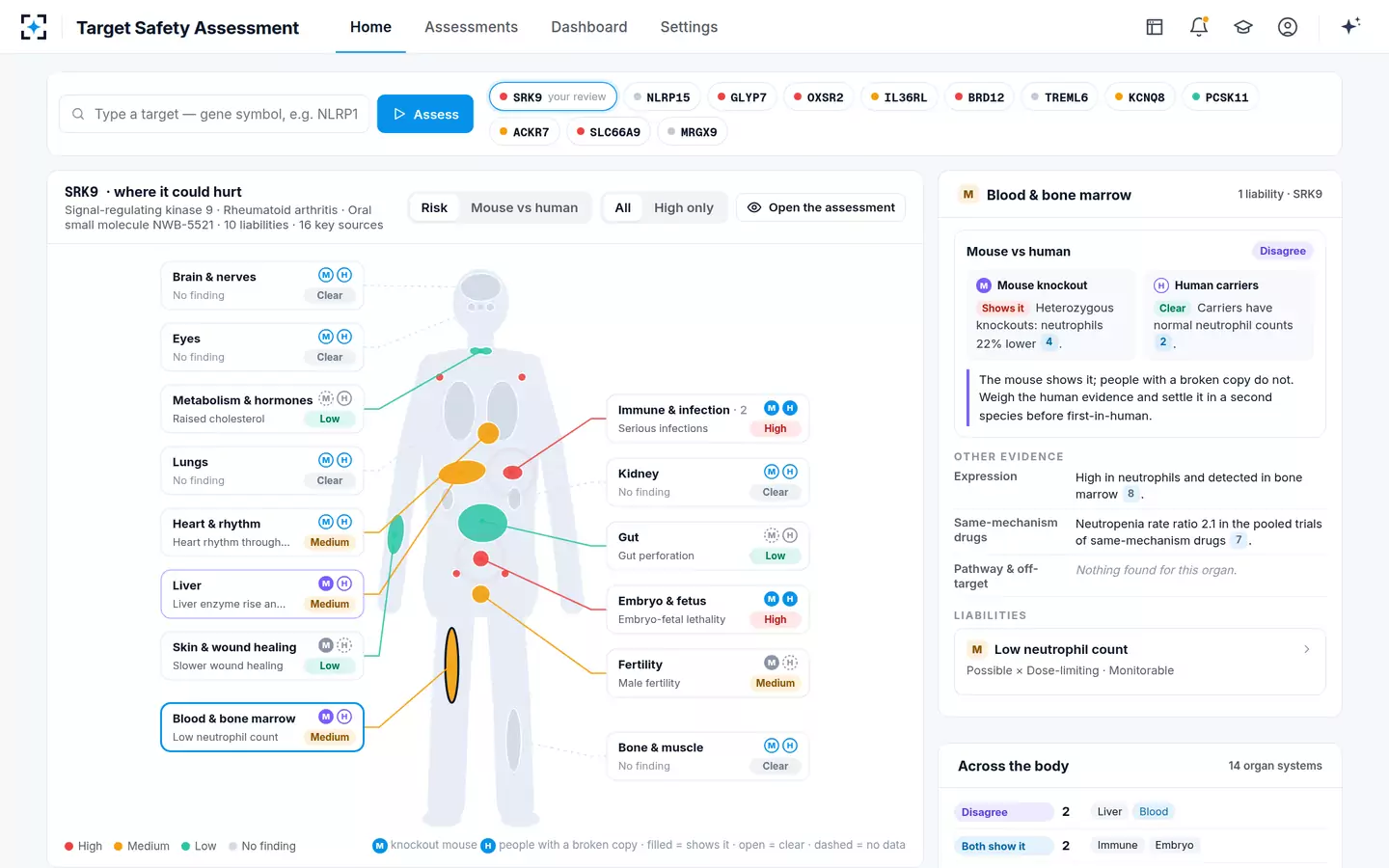
Two views of the same fourteen organs answer two different questions, and the second one is the working view. Coloured by risk, the body says where the danger is concentrated; coloured by verdict, it says where the evidence has not yet made up its mind. A programme that only ever looks at the first picture will spend its study budget on the organ with the highest score, which is often the organ that is already settled.
One switch in Target Safety Assessment turns a risk map into a disagreement map
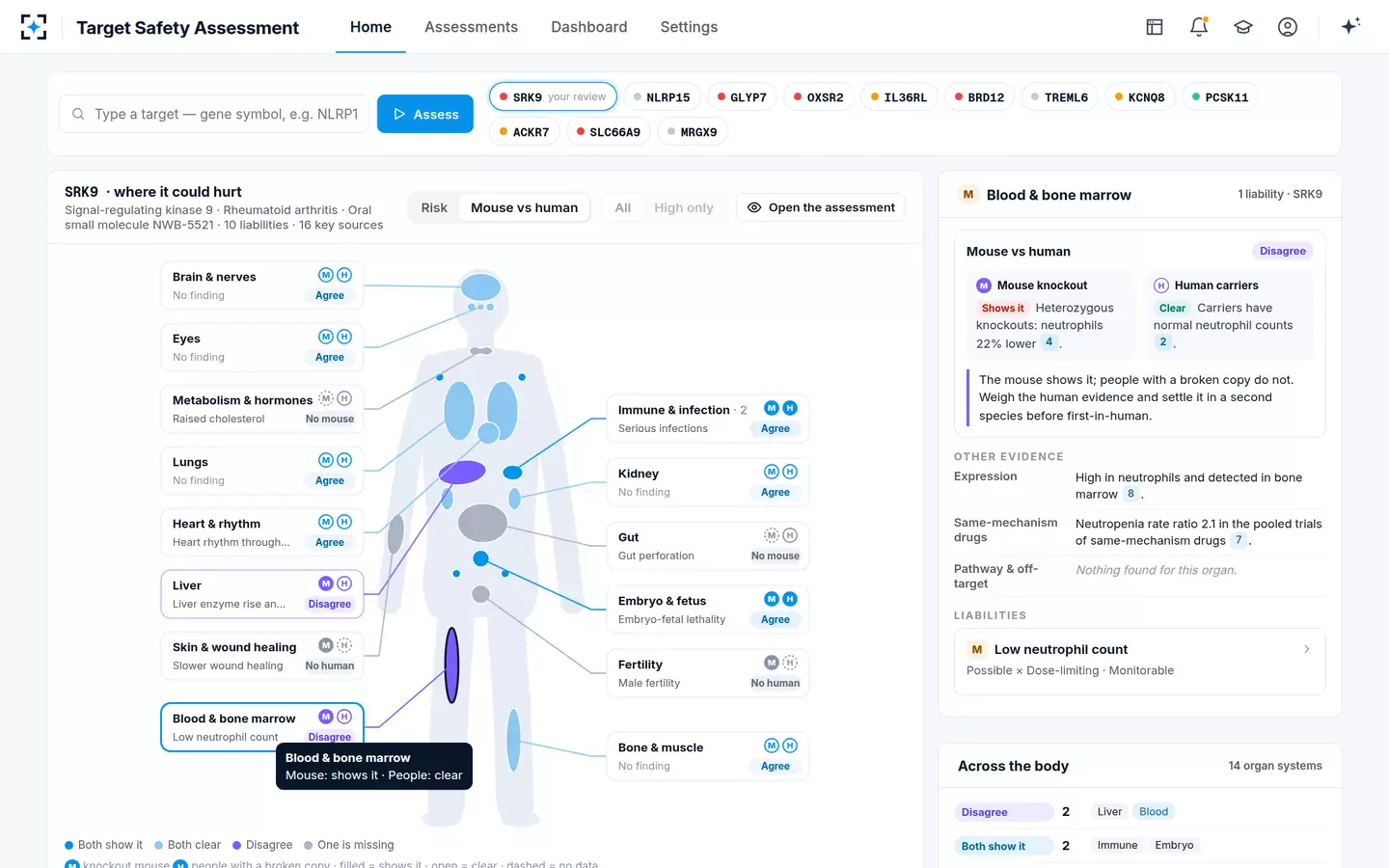
On the fictional sample target SRK9 the split is two organs where the species disagree — the liver and blood and bone marrow — two where both show a finding, four with no human evidence at all and six clear in both. On the second sample target, NLRP15, three organs disagree, the heart among them. Both sets of figures are sample data on fictional targets, not a customer's result.
Where a disagreement goes next: one study, tied to the liability it answers
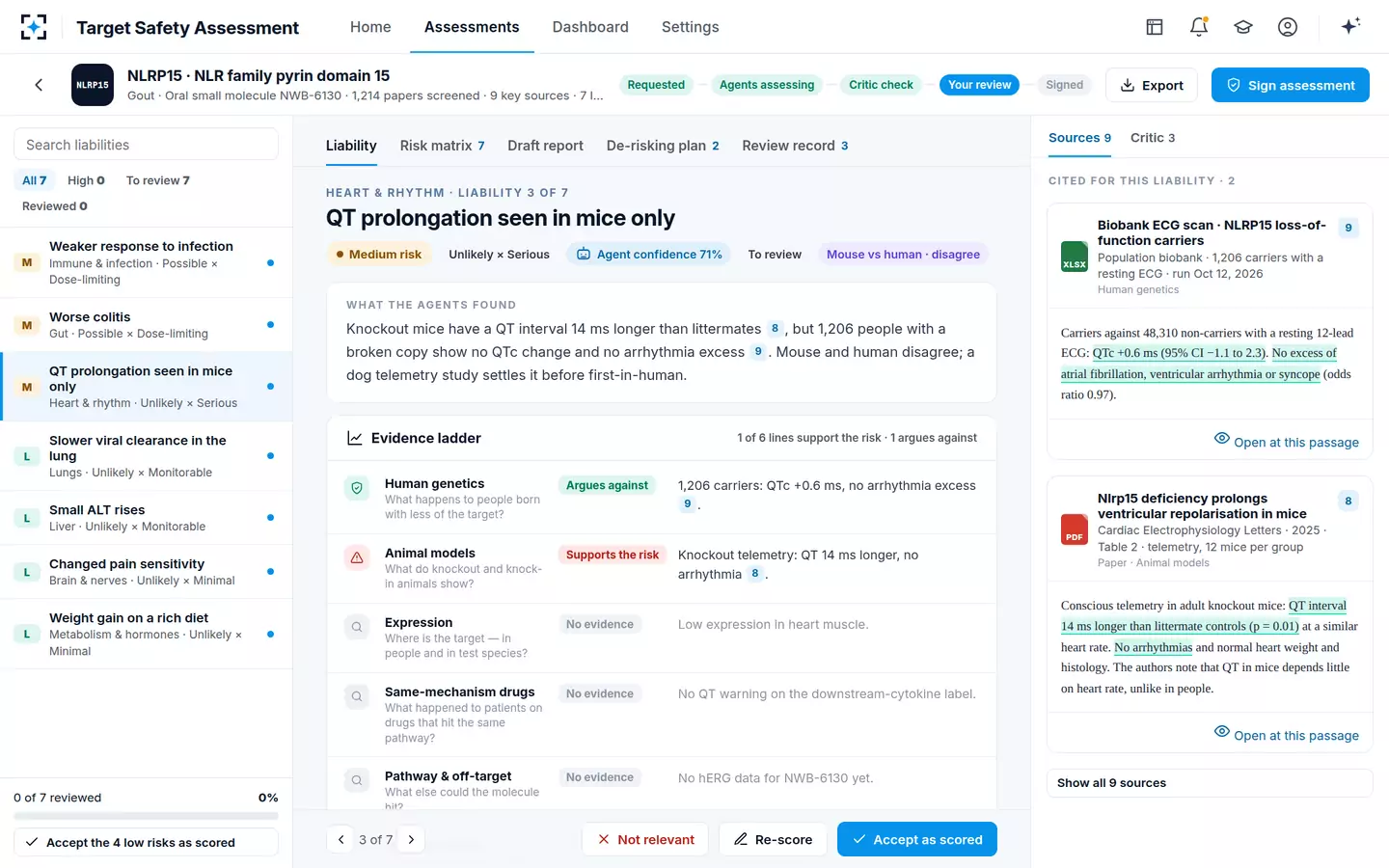
The design argument is simple enough to state in one line: a contradiction between species is the most informative thing a target assessment can find, and the most likely thing for a written report to lose. Giving it a state, a colour and an owner is what keeps it from being lost. To see the rest of the evidence lines it is set against, start from Target Safety Assessment, or read what a target safety assessment tool must show you.
Questions people ask
What is the concordance between animal and human toxicity?
In the most widely cited survey, 71% of human toxicities had been identified in a rodent or non-rodent species, 63% by non-rodents alone and 43% by rodents alone. A later blinded database of 182 molecules measured sensitivity at 48% and specificity at 84%. The two studies ask slightly different questions — the first looks only at compounds that caused harm, the second includes those that did not — which is why both numbers are worth carrying.
Does a lethal knockout mouse mean the target is undruggable?
No. Homozygous knockouts of the genes encoding the targets of statins and aspirin are lethal in mice, and both are inhibited chronically in enormous numbers of people. A lethal germline knockout is a statement about development with both copies absent from conception; a drug is partial inhibition in an adult. The lethal call is a reason to look at conditional and heterozygous animals and at human carriers, not a reason to stop.
Which species is most predictive of human adverse effects?
It depends on what is being asked of it. In the industry database, the non-human primate was strongest at predicting adverse effects, particularly gastrointestinal and nervous system ones, and the beagle dog was strongest at predicting an absence of adverse effects. Rodents alone were the weakest predictors of human toxicities in the earlier survey. Pharmacological relevance to the target still governs the choice for any specific programme.
Is a negative animal study evidence of safety?
It is better evidence than most people give it credit for, with two conditions. The organ has to have been examined — an untested organ is not a negative result — and the claim should stay inside the exposure the studies covered. On that basis, the industry database measured a negative predictive value of 86% for phase 1, and it rose further when neither the rodent nor the non-rodent showed the organ.
Which organ systems translate best from animals to people?
The Olson survey found the highest overall concordance in haematological, gastrointestinal and cardiovascular toxicities, and the lowest in cutaneous ones. That ordering is a prior for how much weight to put on a species' silence, not a licence to skip an organ: a programme whose feared liability is dermatological should expect animal work to be least informative exactly where it most wants an answer.
Who decides when the evidence conflicts?
A named discovery toxicologist, and on a high risk a second signer. Tooling can lay the two species' findings beside each other, propose a score and challenge the weak parts of it; weighing a controlled animal experiment against an uncontrolled but human observation is a judgement, and the person who makes it is the person whose signature the programme relies on.