Target safety assessment software is judged on what it can show, not on what it can read. The work it has to support is the discovery-toxicology review of what switching a target off could do to the body, written before chemistry commits: knockout and conditional phenotypes, human loss-of-function genetics, tissue expression across people and the toxicology species, the labels and regulatory reviews of drugs on the same pathway, pathway and selectivity, and the company's own studies — turned into a ranked list of liabilities, each scored and each tied to the study that would settle it. Eleven demands follow from that description, and every one of them can be made to fail inside a two-week trial. Botminds' Target Safety Assessment is built against them; this guide is written so that it can be tested against them too, and is explicit about the cases where a spreadsheet or a literature search platform is still the right answer.
Figures naming a target, a person or a company come from the solution's sample data on fictional targets. Where a figure is a design target rather than a measurement, it says so.
What should target safety assessment software do?
It should produce the artefact a toxicologist would otherwise write by hand, with every claim traceable to the sentence it came from, and it should leave the judgements with the people who are accountable for them. That is a short answer, and it rules out most of what gets demonstrated.
A published target safety assessment is a good specification to hold a tool against. In an assessment of two malaria proteases, the authors recorded that "based on mammalian aspartic protease physiology and adverse drug reactions (ADRs) to FDA-approved human immunodeficiency virus (HIV) aspartic protease inhibitors, we predicted several potential toxicities including β-cell and congenital abnormalities, hypotension, hypopigmentation, hyperlipidaemia, increased infection risk and respiratory, renal, gastrointestinal, dermatological, and other epithelial tissue toxicities". Three things are visible in that one sentence: the reasoning is organ by organ, it rests on named evidence lines, and the output is a set of predictions specific enough to be wrong. Software that produces a readable summary instead of that has not done the job.
Eleven demands, and how to test each one in a trial
Each demand below comes with the test that proves it and the answer that should end the conversation. Run them on one of your own targets — ideally one you have already assessed by hand, so you have something to compare against.
Eleven demands, each with the test that proves it
- All six evidence lines, not just the literature
Test: ask for the sources behind one organ. You should see animal phenotypes, human genetics, expression, same-mechanism drugs, pathway and selectivity, and your own studies. Disqualifying: “we search the literature and it finds everything”.
- The organ system as the unit of the answer
Test: ask it to show the target by organ and count how many organs have an entry. Disqualifying: an answer that is a document with headings rather than a structure you can filter, count and sort.
- Both species marks on every organ, and a verdict where they differ
Test: find an organ where the animal and human evidence disagree and see whether the tool says so. Disqualifying: a single blended sentence per organ, or a confidence score standing in for a verdict.
- A cited passage behind every claim
Test: pick five claims at random and open the passage behind each; check that the sentence says what the claim says. Disqualifying: a reference list without passages, or passages that paraphrase.
- Proposed scores a named person can accept, re-score or dismiss
Test: change a score and see whether you are required to give a reason, and whether the original proposal survives beside it. Disqualifying: scores that cannot be changed, or changes that overwrite silently.
- Challenges to single-source and species-weak findings, in plain view
Test: plant a liability resting on one paper and see whether the tool flags it to you rather than quietly down-weighting it. Disqualifying: an internal adjustment you cannot see or override.
- A report in your template, every statement referenced
Test: export a full assessment into your own house template and count the unreferenced statements. Disqualifying: any, in the evidence sections.
- De-risking studies tied to the liability each one answers
Test: ask what study would settle your worst liability, and check it comes with weeks, cost and an owner. Disqualifying: a generic list of assays with no link to a specific liability.
- A signature with a stated meaning, and a second one on a high risk
Test: sign an assessment with a high risk left in it and see what the tool does. Disqualifying: a signature that is a status change, or no second signer rule at all.
- A re-check after sign-off
Test: ask what happens when a label changes next month, and whether a signed assessment re-opens. Disqualifying: “you can re-run it” — a manual re-run is not a re-check.
- Internal study data that never leaves your environment
Test: ask where your toxicology reports are processed and stored, and get it in writing. Disqualifying: anything that cannot be answered precisely by the person in the room.
Six evidence lines, read in parallel
A tool that searches the literature well is solving one of six problems, and not the one that settles most organs. Human loss-of-function genetics answers what happens to people born with less of the target; animal phenotypes answer what happens when it is absent, with the allele and zygosity attached; expression answers which organs are even in scope, in people and in the species a study will run in; same-mechanism drugs answer what the mechanism has already done in patients; pathway and selectivity answer what a future molecule will have to avoid; and the company's own archive answers what it already knows and has forgotten.
Reading them in parallel rather than in sequence is not a speed trick. It is what makes a contradiction visible, because a contradiction only exists once two lines have spoken about the same organ. A tool that reads the literature first and then "checks" the other sources against its conclusions will reproduce the failure mode of the manual process it is replacing — the places where the species disagree surface last, which is the subject of what to do when mouse and human evidence disagree.
From a request to a signed assessment, and what each step may not do
Agent
Assessment plannerResolves the target symbol, its aliases and paralogs, sets the indication and modality, and starts the six evidence lines together.
Never: Stops and asks if the symbol is ambiguous.
Agent
Six evidence agentsRead in parallel and land each finding on an organ system with its species, zygosity, cohort and cited passage.
Never: Internal study data never leaves the company’s environment.
Agent
Risk scorer and criticMerge findings into liabilities by organ, propose probability against impact with a monitorability judgement, and challenge single-source and species-weak claims.
Never: Propose only; a challenge is never applied silently.
A person decides
Discovery toxicologistAccepts, re-scores with a written reason or dismisses each liability, and switches on the studies that answer the ones left open.
Never: A re-score without a reason is not accepted.
A person decides
The signature, and the re-checkSigns with a stated meaning and one of four recommendations; a second signer is required while a high risk remains, and the assessment is re-checked against new evidence afterwards.
Never: A signed assessment is not frozen; new evidence re-opens it.
The organ is the unit of the answer
This sounds like a presentation choice and is a data-structure choice with consequences. A monitoring plan is written per organ. A histopathology report is read per organ. A stopping rule in a first-in-human protocol names an organ and a measurement. If the assessment's own unit is the paragraph, every one of those downstream uses requires someone to re-derive the organ-level view by hand, and the re-derivation is where things are dropped.
The structural test is simple: ask the tool how many of the body's organ systems have no evidence at all for this target. A tool that can answer has the right unit. A tool that cannot has produced a document, and an organ it never examined is indistinguishable from an organ it examined and cleared — the distinction that matters most, since one is a silence and the other is a result.
Every claim to its passage — and why that is a hard requirement
The citation demand is not fastidiousness; it answers a measured failure mode of language models. Walters and Wilder examined the bibliographic citations produced by two widely used systems and found that "within this set of documents, 55% of the GPT-3.5 citations but just 18% of the GPT-4 citations are fabricated", and further that "43% of the real (non-fabricated) GPT-3.5 citations but just 24% of the real GPT-4 citations include substantive citation errors".
Why a reference is not enough, and the passage is
55%
of one model’s bibliographic citations were fabricated outright
18%
of the newer model’s citations were fabricated — better, and not zero
43%
of the older model’s real citations still carried substantive errors
24%
of the newer model’s real citations carried substantive errors
Read the two pairs together and the design requirement follows. Checking that a reference resolves to a real paper catches the first failure and misses the second. Only the passage — the sentence relied on, shown beside the claim — lets a reviewer see that the paper says what the assessment says it says. That is why "every liability cites its passage" is a structural demand rather than a nicety, and why a tool that offers a bibliography should be treated as offering nothing on this point.
Scoring: who proposes, who decides, who signs
The division of labour here is the whole governance question, and it has an established answer in the discipline's own literature. Brennan's chapter on target safety assessment is explicit that "the role of an experienced discovery toxicologist in synthesizing the available information into an actionable set of recommendations for a safety evaluation strategy is critical to its successful application in early discovery programs". The synthesis is the specialist act. Software can assemble, propose and challenge; it cannot be the person whose judgement the programme relies on.
The same conclusion is reached from the automation side. Reviewing the machine-learning tools used in research synthesis, Marshall and Wallace observe that "in all of the available systems, human reviewers first need to screen a set of abstracts and then review the system recommendations". Assistance, in other words, with a person in the loop by design rather than by policy.
Practically that means three testable properties. A proposed score must be visibly a proposal. A change must require a reason and preserve what was proposed, so a reviewer can see where the human and the machine differed. And the rules themselves — what counts as high, who the second signer is, whether low risks can be accepted in one step, whether preprints are read at all, how often a signed assessment is re-checked — must be yours, set in one place and recorded when changed.
The rules that decide the output are settings, not assumptions
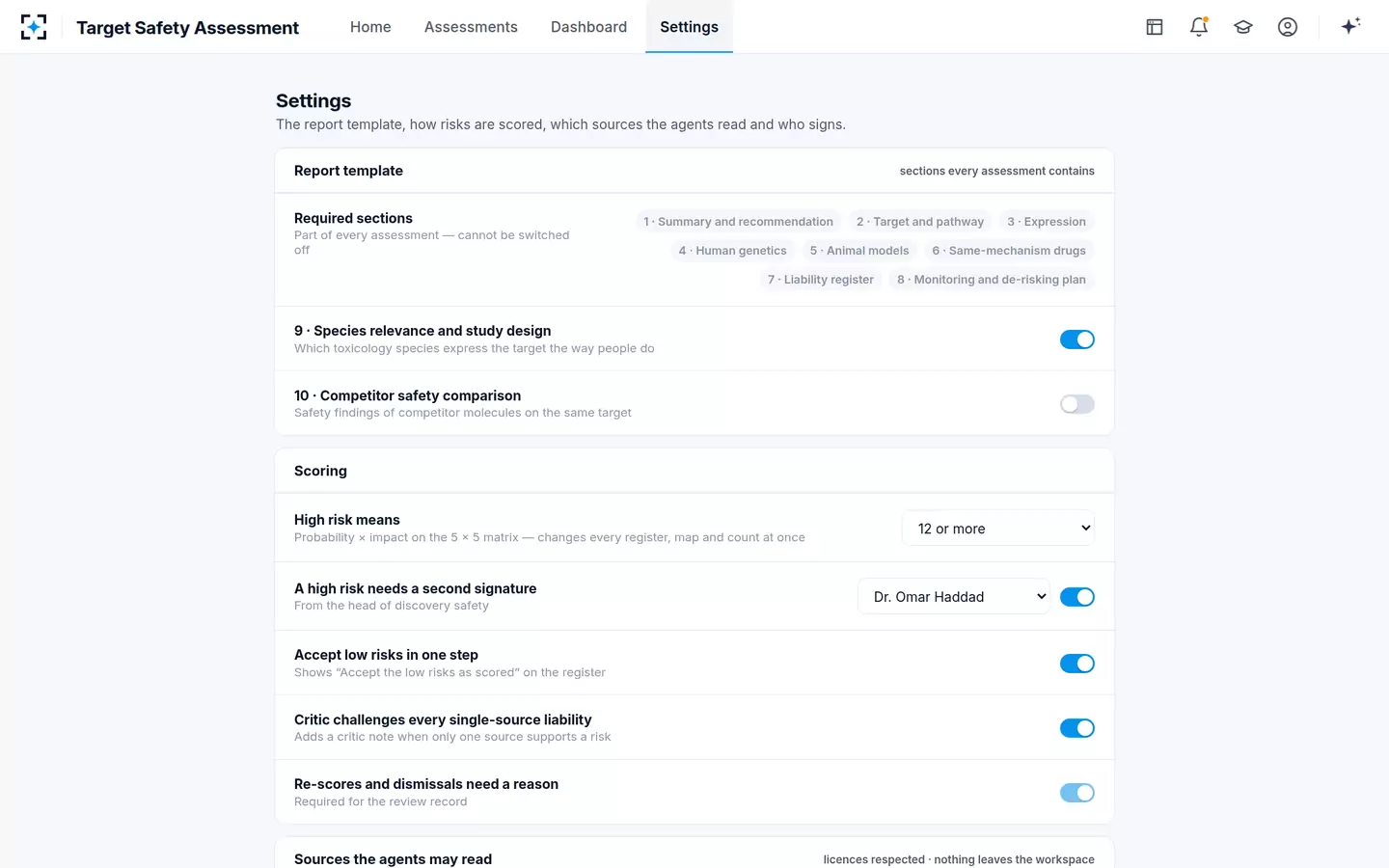
How do you check that a target safety assessment is right?
You cannot check a conclusion; you can check the chain that produced it. Four tests do most of the work, and all four can be run on a trial output in an afternoon.
Sample the passages. Take ten claims across different organs and open the source behind each. You are looking for two different errors: a citation that does not resolve, and a citation that resolves but does not support the claim. The second is more common and more dangerous.
Check the silences. List the organ systems with no evidence and confirm they are genuinely unexamined rather than quietly dropped. Then check one organ you know has published evidence and confirm the tool found it.
Re-run it against an assessment you already wrote. The useful output is not agreement but the differences: liabilities you had and it missed, liabilities it raised that you had considered and rejected, and scores that differ by more than one step. Each difference is a conversation, and the quality of the tool shows in whether its side of each one is defensible.
Ask what it would take to be wrong. For the two or three liabilities that drive the recommendation, ask which single piece of evidence, if withdrawn, would change the score. A tool that can answer has a structure; one that cannot has a narrative.
The broader framing is worth borrowing from outside the discipline. The National Institute of Standards and Technology sets out that "characteristics of trustworthy AI systems include: valid and reliable, safe, secure and resilient, accountable and transparent, explainable and interpretable, privacy-enhanced, and fair with harmful bias managed". Most of those are unverifiable claims in a sales conversation and all of them are visible in a trial, if the trial is designed to make the tool fail rather than to watch it succeed.
Keeping the company's own studies inside the company
The sixth evidence line is the one no vendor can supply and the one most likely to decide whether the tool is adopted: your own toxicology reports, selectivity panels and discontinued-programme data. It is also the most sensitive material in the evaluation, and the demand is simple to state — internal study data is read where it lives and does not leave the environment it lives in.
Ask three questions and write the answers down. Where is the document processed, physically and legally? What is retained afterwards, and for how long? And is anything derived from it used to improve a model that other customers benefit from? The third is the one that is most often answered with a reassurance rather than a term, and it is the one a legal review will come back to.
The European Medicines Agency's reflection paper on AI in the medicinal product lifecycle, adopted in September 2024, states the governing principle without hedging: the clinical trial sponsor, the marketing authorisation applicant or holder, or the manufacturer is responsible for making sure that every algorithm, model, dataset and data-processing pipeline it uses is fit for purpose and meets the legal, ethical, technical, scientific and regulatory standards that apply (EMA, 2024).
That principle settles the question of where accountability sits, and it should change what a buyer asks for. Responsibility for the model and its output stays with the sponsor whatever the vendor says, so the evaluation is not really about trusting the vendor — it is about whether the tool produces something your own organisation can stand behind. Every demand on this page is a version of that question.
What happens after sign-off: the re-check
A target assessment is a statement about a body of evidence on a date, and the evidence moves. A label gets a new warning. A regulatory review is published. A knockout paper appears for a gene that had none. Three months after an assessment is signed, part of it is out of date, and in most organisations nobody finds out until the next programme asks the same question.
The demand is that signed work is re-checked on a stated cadence against labels, regulatory reviews and new animal literature, and that an assessment re-opens when new evidence would change a score — with the owner told, rather than a report quietly updated underneath them. Two details separate a real re-check from a marketing line: it must have an interval you set, and re-opening must be visible as a change to a signed document rather than an edit to it.
A Target Safety Assessment signature with a meaning, and the recommendation it carries
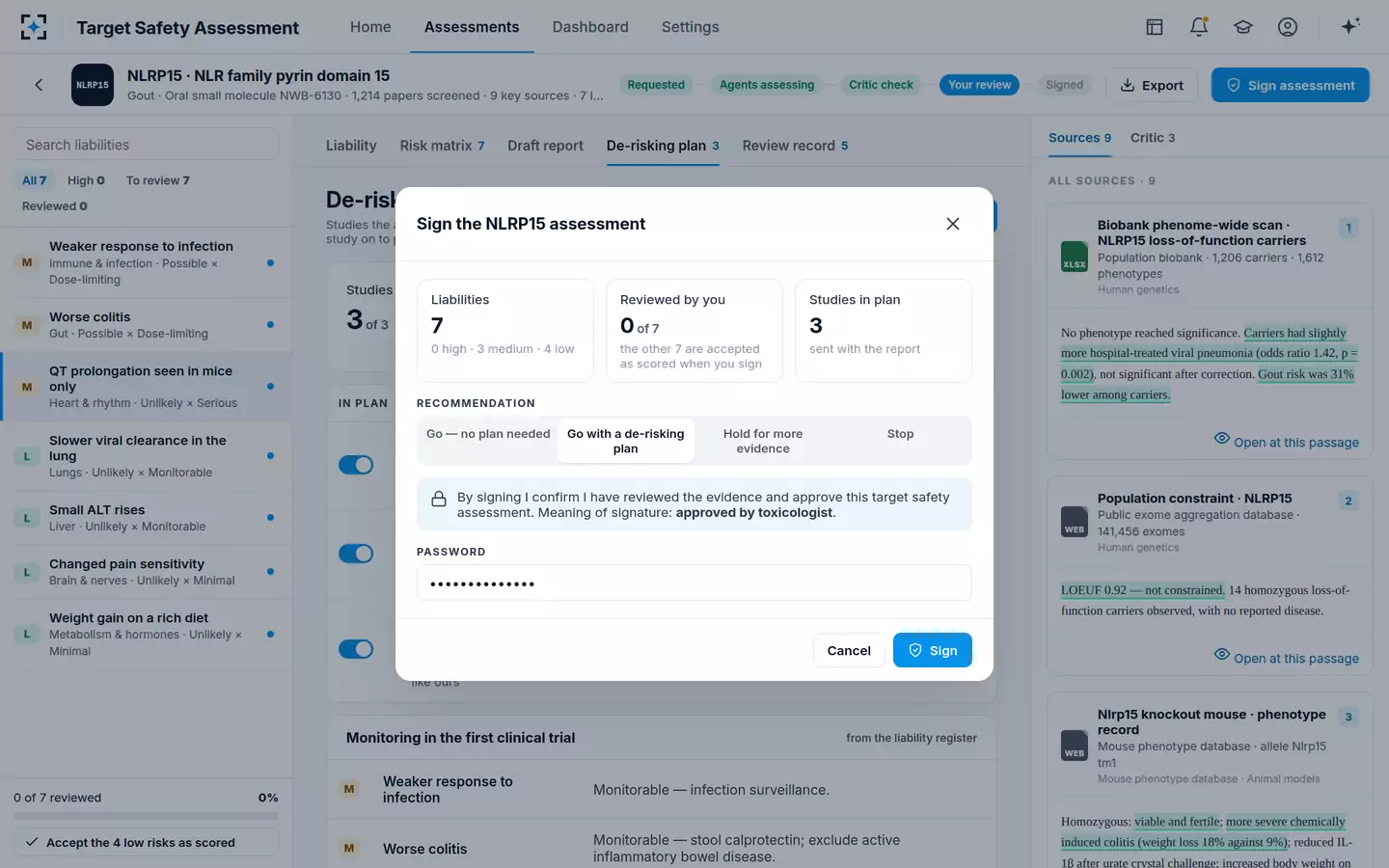
Where Target Safety Assessment sits against a spreadsheet and a search platform
Three ways of running this work are genuinely in use, and two of them are sometimes right. A spreadsheet plus the literature is the honest baseline for an organisation assessing a handful of targets a year, where the toxicologist doing it has the history in their head. A literature search platform helps most when the bottleneck is genuinely finding papers rather than reconciling evidence lines. An agentic solution earns its place when the volume is high enough, or the evidence spread wide enough, that reconciliation is the bottleneck and the audit trail has to survive the author leaving.
Three ways to run the work, compared on the things that decide a trial
| By hand, with a spreadsheet | A literature search platform | An agentic solution | |
|---|---|---|---|
| Evidence lines covered | All six, if the toxicologist has time for all six. | Literature, thoroughly; the others by hand around it. | All six, read in parallel, each landing on an organ. |
| Time from request to signature | About two weeks for a target of typical scope, by our estimate. | Shorter reading time; the same reconciliation work afterwards. | 1.6 days median — a design target of the solution, not a measured customer result. |
| Cited passages | Whatever the author pasted in. | Links to papers; the passage behind a claim is still manual. | Required: no liability is scored without at least one cited passage. |
| Scoring | The author’s judgement, usually undocumented. | Not addressed. | Proposed on a 5 × 5 matrix; accepted, re-scored with a reason or dismissed by a named toxicologist. |
| Mouse against human, per organ | In the author’s head, and in the prose if they thought to write it. | Not addressed. | An explicit verdict on every organ, including no data in either species. |
| Signature | A document and an email. | Not addressed. | A signature with a stated meaning, and a second signer while a high risk remains. |
| After sign-off | Nothing, until someone asks again. | A new search, if someone runs one. | Re-checked on an interval you set; the assessment re-opens when a score would change. |
| Where your own study data lives | Inside the company. | Usually outside the scope of the tool. | Inside the company’s environment; it is never sent out. |
Two cases where this software is not the answer, stated plainly. If the real problem is that nobody in the organisation is accountable for target safety decisions, a tool will produce better documents for the same unowned decision. And if the target is so novel that four of the six evidence lines are genuinely empty, the output will be a well-structured statement of how little is known — which is useful, and which a toxicologist could have written in an afternoon.
What the work looks like once it is a process rather than a document
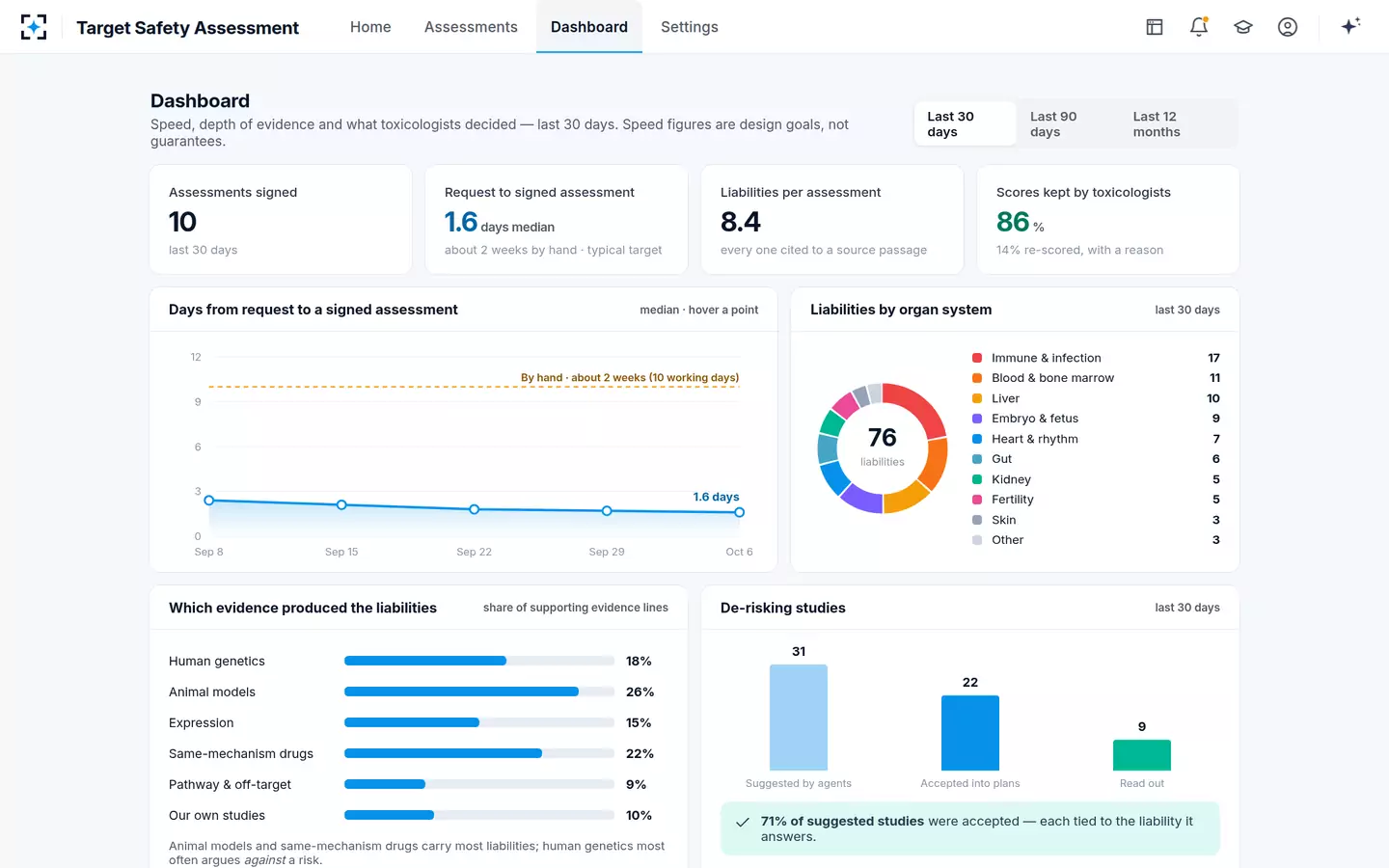
The artefact everything else exists to produce
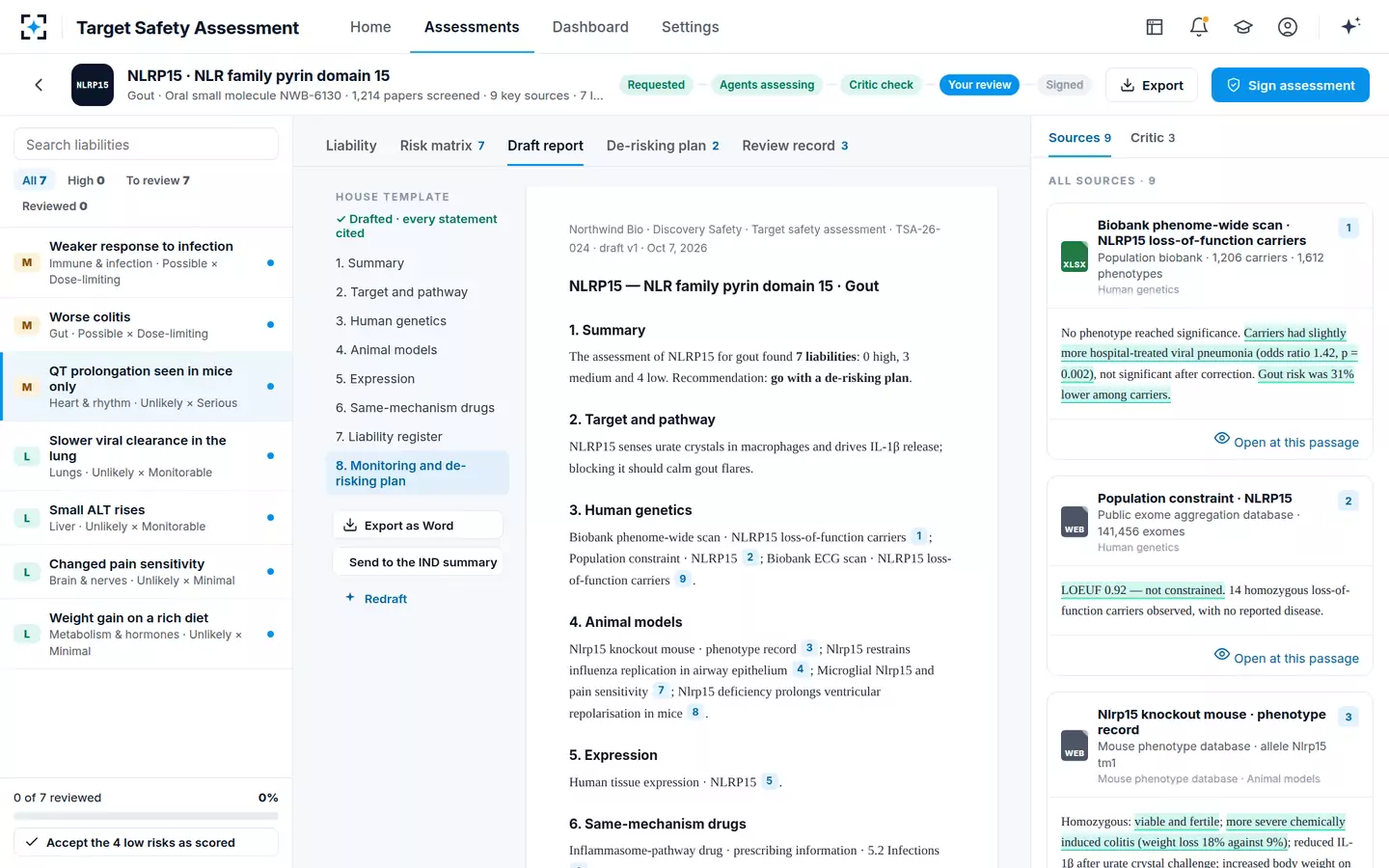
The report itself is the artefact everything else exists to produce, written section by section in the house template — summary and recommendation, target and pathway, human genetics, animal models, expression, same-mechanism drugs, the liability register, and the monitoring and de-risking plan — with every statement tied to a numbered reference. For the evidence lines behind it, see which risks a target carries and what a healthy carrier proves, or start from Target Safety Assessment.
Questions people ask
How long should a target safety assessment take?
By hand, about two weeks of a toxicologist's time for a target of typical scope — our estimate, split across reading the animal phenotypes, the human genetics, expression across the toxicology species, same-mechanism labels and reviews, then scoring and writing. The design target for the solution on this page is a median of 1.6 days from request to signature. Treat both numbers as what they are: an estimate and a design target, not a benchmark from a customer's programme.
Can software write a target safety assessment?
It can assemble one, propose the scores and draft the document. It cannot be accountable for the recommendation, and the discipline's own literature is clear that synthesising the evidence into an actionable set of recommendations is the experienced toxicologist's part. The useful question for a buyer is not whether the software writes it but whether the toxicologist can see, change and reverse everything it proposed.
What evidence sources does a target safety assessment need?
Six: animal phenotypes including conditional and knock-in alleles, human loss-of-function genetics and biobank carrier scans, tissue expression in people and in the toxicology species, drugs acting on the same target or pathway with their labels and regulatory reviews, pathway and selectivity including paralogs and secondary pharmacology, and the company's own toxicology archive. A tool that covers one of those well and gestures at the rest will still leave the reconciliation work undone.
How should liabilities be scored?
On probability against impact — the solution proposes scores on a 5 × 5 matrix running from remote to expected and from minimal to programme-stopping — with a separate judgement about whether the organ could be monitored in a patient before harm occurred. What counts as high should be your threshold, not the tool's default, because it decides how often a second signature is required.
Does the tool need to show the source passage?
Yes, and a reference list is not a substitute. Fabricated citations are a measured failure mode of language models, and so are citations that resolve to a real paper but misstate what it found — the second being invisible to anyone checking that references exist. Showing the sentence relied on beside the claim is what lets a second reader disagree with the right thing.
What happens when new evidence appears after sign-off?
In a tool worth buying, the signed assessment is re-checked against labels, regulatory reviews and new animal literature on an interval you set, and re-opens with its owner notified when new evidence would change a score. The two things to insist on are that the interval is a setting rather than a vendor's choice, and that a re-opening is visible as a change to a signed document rather than an edit made underneath it.