A target liability assessment is the discovery-toxicology review of what switching a target off could do to the body, produced before chemistry commits to it: a ranked list of on-target liabilities, each scored for probability and impact, each tied to the evidence behind it and to the study that would settle it. Most teams are not choosing whether to produce one — the committee asks for it — but how: write it in-house, commission it outside, or run it on agents with a toxicologist deciding. Botminds' Target Safety Assessment is the third of those, and this page compares all three on the measures that actually differ.
Product figures here are sample data on fictional targets, people and companies in the product, and the speed numbers are stated design targets rather than measured customer results. Research figures are linked where they appear.
What a target liability assessment has to contain
Whatever your template says, four things have to be in it or the document cannot be used. A ranked list of liabilities, filed by organ system rather than by evidence line, because that is how a reviewer thinks about harm. A score for each one that separates probability from impact, so that a rare catastrophe and a common nuisance do not collapse into the same word. The evidence behind each entry, with the passage it came from, including the lines that found nothing. And, for each liability that matters, what would settle it — a study, or a measurement in the first trial.
The specialist literature is blunt about why it is worth the effort at all. The reference chapter on the discipline opens with the claim that an in-depth evaluation of target safety is an invaluable resource throughout drug discovery and development
(Brennan, Methods in Molecular Biology, 2017) — a resource rather than a deliverable, because the same document is read at candidate selection, at study design and again when a competitor's label changes.
The sections a committee-ready assessment carries, and the two that are optional
- Summary and recommendation
The conclusion in one page: how many liabilities, how many high, and which of go, go with a plan, hold or stop is being recommended.
- Target and pathway
What the target does, what the drug is meant to do to it, the indication and the modality — because the modality changes what a finding is worth.
- Human genetics
Constraint, carriers, Mendelian disease and case reports: what happens to people born with less of the target.
- Animal models
Knockout, knock-in and conditional phenotypes, with allele and zygosity, and developmental findings kept apart from adult ones.
- Expression
Where the target is, by organ, in people and in the toxicology species, with RNA and protein distinguished.
- Same-mechanism drugs
Every clinical finding from the labels, regulatory reviews and trial results of drugs on the same target or pathway, with rates and intervals.
- Liability register
The ranked list itself: organ, probability, impact, monitorability, the evidence for and against, and the verdict where species disagree.
- Monitoring and de-risking plan
The studies that would settle each liability, and what is watched in the first clinical trial where a study cannot.
- Optional: species relevance and study design
Which toxicology species express the target the way people do — switched on in the sample settings.
- Optional: competitor safety comparison
Safety findings on competitor molecules against the same target. Useful commercially, and the first section to be switched off when it is not.
How long does a target safety assessment take?
By hand, for one target of ordinary scope, about two working weeks of a toxicologist's time. That figure is not a law of nature; it is the sum of six reading jobs, and it is dominated by three of them. Knockout and conditional phenotypes take about two days. Human genetics — constraint, carrier scans, Mendelian cases — another two. Same-mechanism labels, regulatory reviews and trial results, another two. Expression takes about a day, scoring and choosing studies a day and a half, and writing and getting it signed another day and a half.
Where the working days go in one assessment: by hand, and with agents reading
The shape of that split is the argument for every route on this page. Four of the six jobs are reading, and reading is what parallelism and machines are good at. Two of them — scoring the liabilities and writing the conclusion a person will sign — are judgement, and they do not compress in the same way. A route that promises to shrink the judgement work is promising the wrong thing.
By hand: what the specialist contributes, and what paces them
Written by an experienced discovery toxicologist, an assessment is the gold standard, and the reason is explicitly the synthesis rather than the search. The published guidance on the discipline identifies the specialist's contribution as turning the available information into an actionable set of recommendations for a safety evaluation strategy, and calls that role critical to whether the assessment is used at all in early discovery. Nobody who has read a good one disputes it: the value is in which findings were believed, and why.
What paces that person is the literature. The US National Library of Medicine's own count of MEDLINE citations by year of publication shows 1,063,140 citations indexed for publication year 2021, against 769,279 for 2011 — close to two-fifths more in a decade, and more than a million a year before the preprint servers are counted. One reader searching, skimming and extracting across six evidence lines is working against that, which is why the honest in-house estimate is a fortnight per target and why the backlog forms at the fifth target rather than the first.
The reading one assessment runs against, and the pace it is asked for
1,063,140
MEDLINE citations indexed for publication year 2021, against 769,279 for 2011
~2weeks
the estimated elapsed time for one assessment of ordinary scope written by hand
1.6days
median from request to a signed assessment — a design target for the live product, not a measured customer result
Outsourced: what you buy, and what leaves with the report
Commissioning the work outside buys two real things: depth from people who do nothing else, and independence from the programme that wants the target to be fine. Published examples show what good looks like — the plasmepsin IX/X assessment written for an antimalarial programme ends with a specific, testable instruction rather than a summary, recommending that potential plasmepsin IX/X inhibitors should be assayed for inhibitory activity against the main human aspartic proteases and particularly CatD/E
(Barber et al., Toxicology Research, 2021). That is a target assessment doing its job: it tells the chemistry what to measure.
Three things do not come back with the report. The reading does: the searches, the rejected papers, the judgement about which cohort was large enough — so the next assessment on a related target starts from nothing again. Your own archive usually stays out: unpublished study reports and selectivity panels are rarely in scope for an outside team, and they are often the most relevant evidence you have. And the document is static; nothing re-reads it when a label changes eight weeks later.
With agents: parallel reading, cited passages, one decider
The third route keeps the specialist and changes what they spend their fortnight on. Evidence lines are read in parallel rather than in sequence, each finding arrives attached to the passage it came from, and the toxicologist's work starts where it is worth most: at the contradictions, the single-source claims and the scores. The reading is repeatable, which matters more than it sounds — a second target, or the same target six months later, is read the same way rather than at whatever depth the week allowed.
The price is a discipline, not a saving. Someone must still decide, and the decision has to be visible as a decision. The EMA's reflection paper puts responsibility for every model, dataset and pipeline on the sponsor rather than the supplier, and the FDA's draft guidance asks sponsors to establish and document the credibility of a model's output for its context of use, which means the thing you must be able to show is the human step: who accepted a score, who changed one, and why. What that line looks like in practice is set out in the guide to AI tools for toxicology.
The three routes compared, and where Target Safety Assessment sits
| By hand, in-house | Commissioned outside | With agents, one decider | |
|---|---|---|---|
| Evidence coverage | As deep as one person can read in the time; depth varies with the week. | Deep, by specialists who do this full time, within the agreed scope. | Every line read to the same depth every time, including the lines that find nothing. |
| Elapsed time for one target | About two working weeks of a toxicologist. | Weeks to months, set by the queue and the contract. | Reading in parallel; the time that remains is review and signature. |
| Cited passages | Depends on the writer; often a reference list rather than a passage. | Usually a referenced document; opening the passage means finding the paper. | Every claim opens the passage it came from, including the challenges against it. |
| Your own archive | Readable, if the toxicologist knows it exists. | Normally out of scope and out of reach. | Readable inside your environment, where your agreements require it to stay. |
| Re-checked after signing | When somebody remembers. | Not unless re-commissioned. | On a schedule, and re-opened when new evidence would change a score. |
| Who decides | The toxicologist who wrote it. | You, from a document written by someone else. | Your toxicologist, from proposals they can accept, re-score or dismiss with a reason. |
| What it costs | Two weeks of a scarce specialist, per target. | A fee per assessment, plus the time to brief and review. | A subscription, plus the review time that does not compress. |
Should you outsource a target safety assessment?
Yes, when the target is outside your therapeutic area and the question is one-off, when you need independence for a committee that will not believe the project team, or when you have no discovery toxicologist and are not about to hire one. The published assessments in the literature exist because somebody made that choice, and they are better than most internal documents.
No, when the target is one of twelve you will assess this year, when your own study archive carries the most relevant evidence, or when the assessment will have to be re-opened — because none of those survive the handover. The decision is less about quality than about how many times you will need the same work done and whether the knowledge has to stay.
Twelve targets, with stage, risk mix, owner and the committee clock
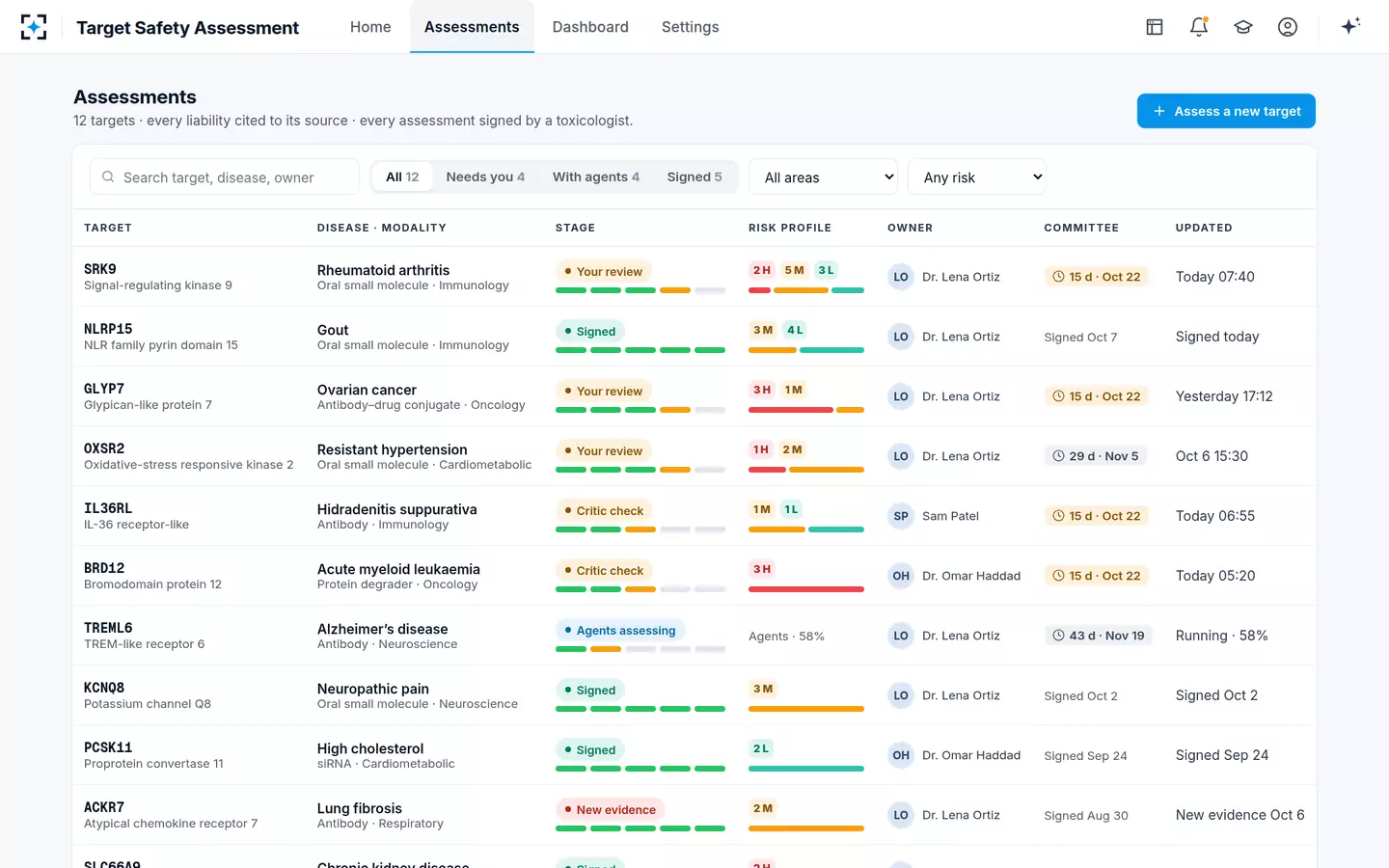
Keeping an assessment current after it is signed
A signed assessment ages from the day it is signed, and it ages unevenly: the knockout literature moves slowly, the labels and regulatory reviews of same-mechanism drugs move whenever a competitor's molecule does. An assessment nobody re-reads is a document; one that re-opens when the evidence moves is an asset, and the difference shows up precisely when a programme is committed enough for a surprise to be expensive.
The same target, re-opened by a label change and not
Signed and filed: Nothing, unless somebody happens to read the update and remember the assessment.
Signed and re-checked: The change is found, the relevant liability is re-opened, and its owner is asked to review it.
Signed and filed: Eventually, often from the programme that hit the problem first.
Signed and re-checked: That a new adverse reaction has been reported on the pathway, with the rate and the source passage.
Signed and filed: A re-run of the assessment, at the stage where chemistry has already committed.
Signed and re-checked: One liability reviewed, one score changed with a reason, one study considered.
Signed and filed: A document dated before the evidence changed.
Signed and re-checked: A current assessment, with the change and the date it arrived.
The economics: targets per year against the cost of a late finding
A widely cited pipeline framework came out of a review of one company's project history, and it is worth seeing in full because of where safety sits in it. The authors describe a framework based on the five most important technical determinants of project success and pipeline quality, which we describe as the five 'R's: the right target, the right patient, the right tissue, the right safety and the right commercial potential
(Cook et al., Nature Reviews Drug Discovery, 2014). A target liability assessment is the fourth of those, asked at the moment it is cheapest to answer.
The cost of asking it late is the cost of the programme. The median capitalised investment to bring a new drug to market has been estimated at $985.3 million after accounting for failed trials (Wouters, McKee and Luyten, JAMA, 2020). Against that, the arithmetic of throughput is what actually binds: a fortnight per target is about twenty-five a year for someone doing nothing else, and nobody does nothing else, so a portfolio with more targets than that either waits or gets assessments written in an afternoon.
There is a quieter reason to care about the quality of the answer. In the multi-company analysis of how well non-clinical studies predicted first-in-human outcomes, the authors reported that specificity was 84% with an 86% negative predictive value (NPV)
(Monticello et al., 2017) — the current paradigm is good at predicting the absence of a clinical problem. What it is less good at is prediction in the positive direction, which is exactly where a target assessment earns its place: it is the work that decides which questions the studies are asked to answer.
The NPV was the stronger predictive performance measure across test species and target organs indicating that an absence of toxicity in animal studies strongly predicts a similar outcome in the clinic.
Monticello et al., Toxicology and Applied Pharmacology, 2017
How Target Safety Assessment is set up on your own template and rules
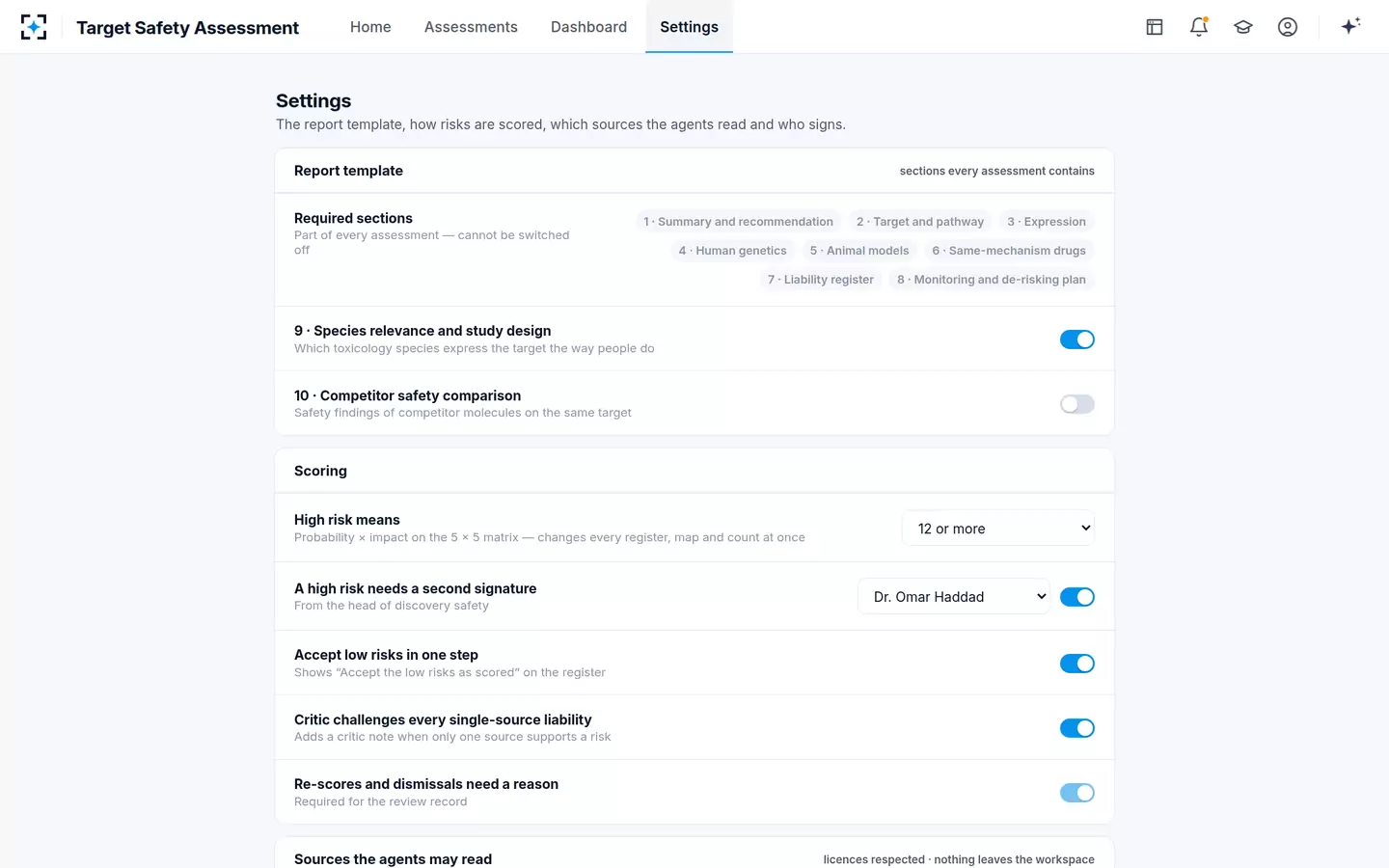
Whichever route a team takes, the assessment has to come out in that team's own shape, or it will be retyped. In the product the report template is a setting: which sections every assessment contains, and which optional ones are switched on. So is what counts as a high risk on the five-by-five matrix, whether a remaining high risk needs a second signature and from whom, whether low risks can be accepted in one step, whether the critic challenges every single-source liability, and whether re-scores need a written reason — that last one locked on rather than optional.
The template and the scoring rules are settings, changed in one place
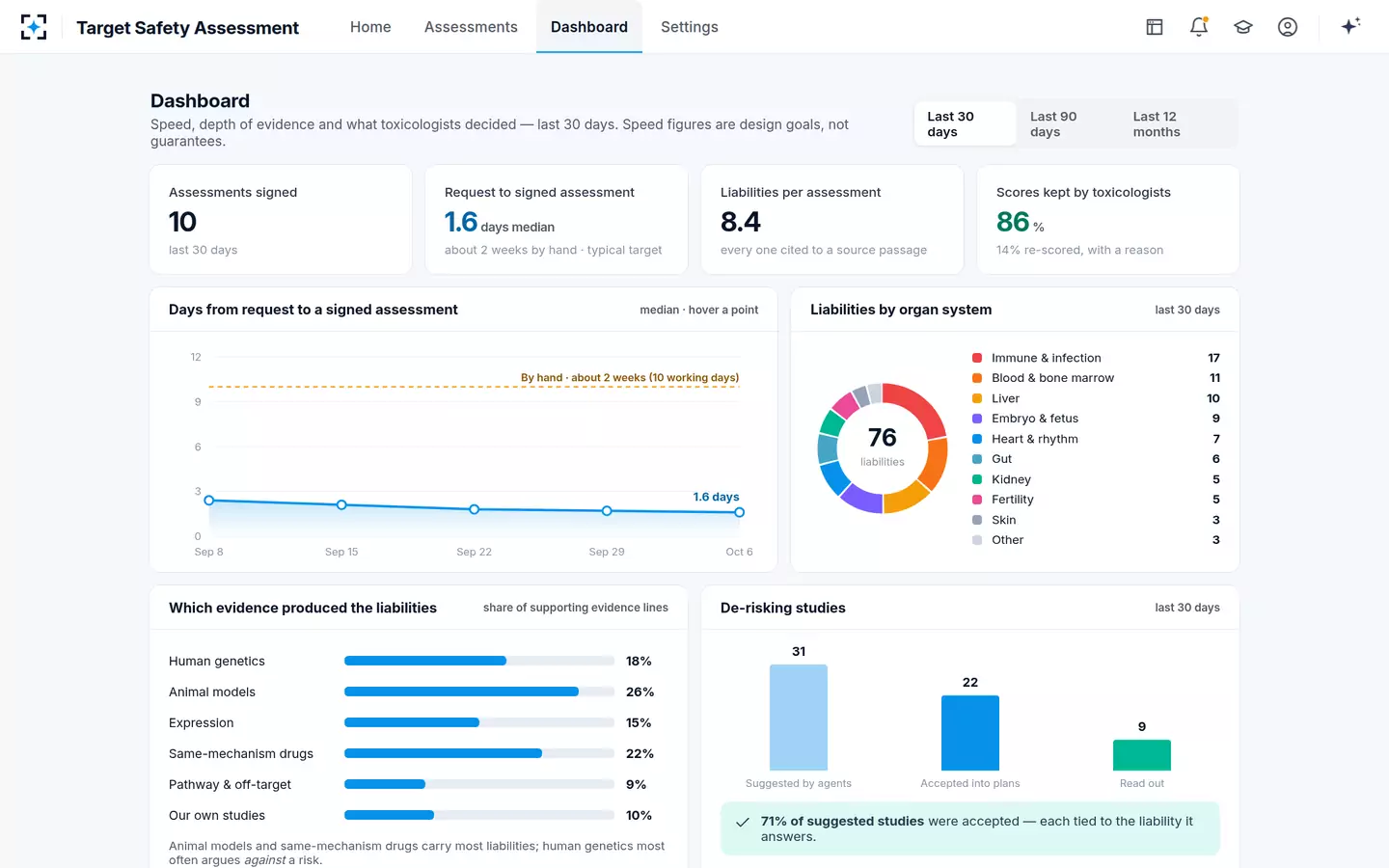
What the work looks like in aggregate is the other half of the case. The dashboard counts assessments signed, days from request to signature against the by-hand line, liabilities per assessment, the share of proposed scores the toxicologists kept, which evidence lines produced the liabilities and how many suggested studies were accepted into plans. Those are management numbers rather than scientific ones, and they answer the question a discovery safety leader actually has: is the queue moving, and are the people still deciding?
Is the queue moving, and are the toxicologists still deciding?
The decision rule that survives all three routes is coverage first. An assessment that cannot show its sources, name the person who decided, and be re-opened when a label changes is not an asset whichever way it was produced. To see the three routes against one worked target, start from Target Safety Assessment; the evidence lines behind each liability are described in the guide to mouse and human evidence that disagree.
Questions people ask
What is a target liability assessment?
It is the review, written before chemistry commits, of what switching a target off could do to the body: a ranked list of on-target liabilities by organ system, each scored for probability and impact, each tied to its evidence and to the study or clinical measurement that would settle it. It is sometimes called a target safety assessment or a target safety review; the content is the same.
How long does a target safety assessment take?
By hand, about two working weeks for one target of ordinary scope — roughly two days each on knockout phenotypes, human genetics and same-mechanism labels, a day on expression, and three more on scoring, writing and signature. Commissioned outside it is paced by the supplier's queue. With agents reading in parallel the reading compresses and the review does not, which is why the time that remains is mostly judgement.
What goes in a target safety assessment report?
In the solution's sample template, eight sections do the work: summary and recommendation, target and pathway, human genetics, animal models, expression, same-mechanism drugs, the liability register, and the monitoring and de-risking plan. Two more are common and optional — species relevance and study design, and a comparison with competitor molecules on the same target.
How many targets can one toxicologist assess in a year?
At a fortnight each, about twenty-five a year for someone doing nothing else — and no discovery toxicologist does nothing else, so the practical number is lower. That arithmetic, rather than the cost of any one assessment, is what usually forces the choice between hiring, commissioning and running the work differently.
How do you keep an assessment current after sign-off?
By re-checking it against the sources that move: drug labels, regulatory reviews and new knockout papers. The product does this weekly by default and re-opens an assessment when new evidence would change a score, routing it to the owner. Done by hand it needs a named person and a diary entry, or it does not happen.
When is an assessment good enough to take to a committee?
When every liability cites the passage it rests on, the contradictions between evidence lines are visible rather than averaged away, each material risk names what would settle it, and a qualified person has signed it with a stated meaning. If a remaining high risk is in the register, a second signature before it goes in the pack is a sensible rule; in the solution's sample settings it is switched on.