Off-target toxicity is harm from hitting something other than the intended target; on-target toxicity is harm that follows from hitting the target itself, in the tissue you meant or in one you did not. The distinction is not taxonomy, it decides who can fix the problem. An off-target finding is a chemistry problem: a selectivity campaign, a different scaffold or a lower dose can all move it. An on-target finding belongs to the biology of the target and travels with every molecule that works, so it has to be found before chemistry commits. Finding it means reading what people born with less of the target show, what the knockout and conditional mice show, where the protein sits in the body, and what drugs on the same pathway did in the clinic — four separate literatures, usually read one at a time, which is why the places where they contradict each other surface late. Botminds' Target Safety Assessment reads those lines in parallel and scores each liability by organ system, for a discovery toxicologist to accept, re-score with a reason or dismiss, and then sign.
Every figure on this page that describes a target, a person or a company comes from the solution's sample data on fictional targets — SRK9 and NLRP15 — and is labelled where it appears. The research figures are from published work by regulators, consortia and peer-reviewed journals, linked at the point they are used.
Three on-target findings from the published record
6of 6
volunteers with a systemic inflammatory response within 90 minutes of a first dose of an anti-CD28 superagonist
Low
ERBB2 on lung epithelium: the authors’ explanation for one fatal cell-therapy case
1.80OR
for a drug side effect in an organ system where the target already has a genetic link to that organ
What is the difference between on-target and off-target toxicity?
On-target toxicity is an adverse consequence of modulating the intended target — the pharmacology working as designed, in a place or to a degree nobody wanted. Off-target toxicity is an adverse consequence of the molecule binding something else: a related protein, an ion channel, a receptor it was never meant to touch. The first is a property of the target. The second is a property of one molecule.
That is why the two are investigated by different people with different tools. An off-target risk is settled by counter-screens, selectivity panels and structure–activity work on a compound that exists. An on-target risk has to be settled from evidence about the target, usually before any compound is worth making, because the answer will not change when the compound does.
The two kinds of liability, and who owns the fix
Off-target
Harm from the molecule binding something other than the target.
- Who owns the fix
- Medicinal chemistry, with safety pharmacology.
- Evidence that establishes it
- Selectivity panels, a hERG assay, secondary pharmacology, a finding that tracks one chemical series and not another.
- Decision it forces
- Design against it: a new scaffold, a selectivity objective, a margin to hold in the lead series.
- When it is cheap to find
- While more than one series is still alive.
On-target
Harm that follows from engaging the target, anywhere in the body.
- Who owns the fix
- Nobody, in the sense chemistry means. It is managed, not removed.
- Evidence that establishes it
- People born with less of the target; knockout and conditional animals; where the protein sits; drugs already on the pathway.
- Decision it forces
- Accept with a monitoring plan, buy a study that narrows it, change modality or route — or stop.
- When it is cheap to find
- Before the target is chosen.
Two famous cases make the difference concrete, and both were on-target. TGN1412, an anti-CD28 superagonist antibody, did exactly what it was designed to do: stimulate T cells. In the first trial, "within 90 minutes after receiving a single intravenous dose of the drug, all six volunteers had a systemic inflammatory response characterized by a rapid induction of proinflammatory cytokines", and two needed intensive organ support for 8 and 16 days. No selectivity improvement was available, because there was nothing to be selective against.
The second is a cell therapy against ERBB2. The patient died, and the investigators' own reading of the case was that the cells "localized to the lung immediately following infusion and were triggered to release cytokine by the recognition of low levels of ERBB2 on lung epithelial cells". The target was correct, the recognition was correct, and the tissue was wrong. A target can be perfectly valid for the disease and still be present, at low levels, somewhere that cannot tolerate being attacked.
The test that separates them: would a better molecule help?
There is a single operational test, and it is worth applying out loud in a meeting. Ask: if a perfectly selective molecule achieved the same engagement of the same target in the same tissue, would the finding still happen? If yes, it is on-target. If no, it is off-target, and the fix is a chemistry objective with a number on it.
The test is useful because it cuts through the way findings arrive. A toxicology observation does not announce which kind it is. It arrives as an organ, a dose and a histology, and the same observation can be either. A liability written as an off-target risk gets handed to chemistry and disappears from the safety plan; written as an on-target risk it gets a monitoring plan in the first trial and a line in the investigator's brochure. The two readings commit different budgets.
One finding, two readings — and the two different programmes that follow
Read as off-target: Neutrophil counts fall in the 4-week rat study at the top dose.
Read as on-target: The same histology and the same counts, at the same exposure.
Read as off-target: A second protein the series also binds is responsible.
Read as on-target: Engaging the target in myeloid cells is responsible.
Read as off-target: A selectivity panel, then a counter-screen against the suspected protein, then a structurally unrelated tool compound.
Read as on-target: What people with one broken copy of the target show, and what the conditional knockout shows in adult animals.
Read as off-target: The series is the problem. Change the series.
Read as on-target: Nothing about the molecule. The risk belongs to the mechanism and stays.
Read as off-target: Nothing, if the new series is clean.
Read as on-target: A monitoring plan: counts at a stated frequency, a stopping rule, an exclusion for recent infection.
Read as off-target: Medicinal chemistry.
Read as on-target: The toxicologist who signs, and the clinician who writes the protocol.
The honest answer is often that the finding is both, in different proportions at different exposures. That is not a reason to leave it unclassified. It is a reason to write down which part of the effect each explanation accounts for, and what would distinguish them — which is the one piece of the assessment a reviewer will look for first.
On-target risk is read from the target, not from a compound
Before chemistry commits there is no molecule to test, so the evidence has to be about the target. This is the whole premise of a target safety assessment, and it is also why the discipline has a literature of its own rather than being a sub-paragraph of toxicology.
“The goal of a target safety evaluation is to identify potential unintended adverse consequences of target modulation, and to propose a risk evaluation and mitigation strategy to shepherd compounds through the discovery and development pipeline, to confirm and characterize unavoidable on-target toxicities in a timely manner to assist in early program advancement decisions, and to anticipate, monitor, and manage potential clinical adverse events.”
Brennan RJ, “Target Safety Assessment: Strategies and Resources”, Methods in Molecular Biology 1641, 2017
Read that sentence as a specification and it names three deliverables, not one. Identify the consequences. Propose what to do about them. And distinguish the unavoidable ones — the on-target ones — so that they can be confirmed and characterised deliberately rather than discovered in a regulatory study. The word that does the work is unavoidable: it is the admission that some liabilities are not going to be designed away, and that the programme's job is to know them early enough to plan around them.
Target Safety Assessment: fourteen organ systems, each coloured by its highest on-target liability
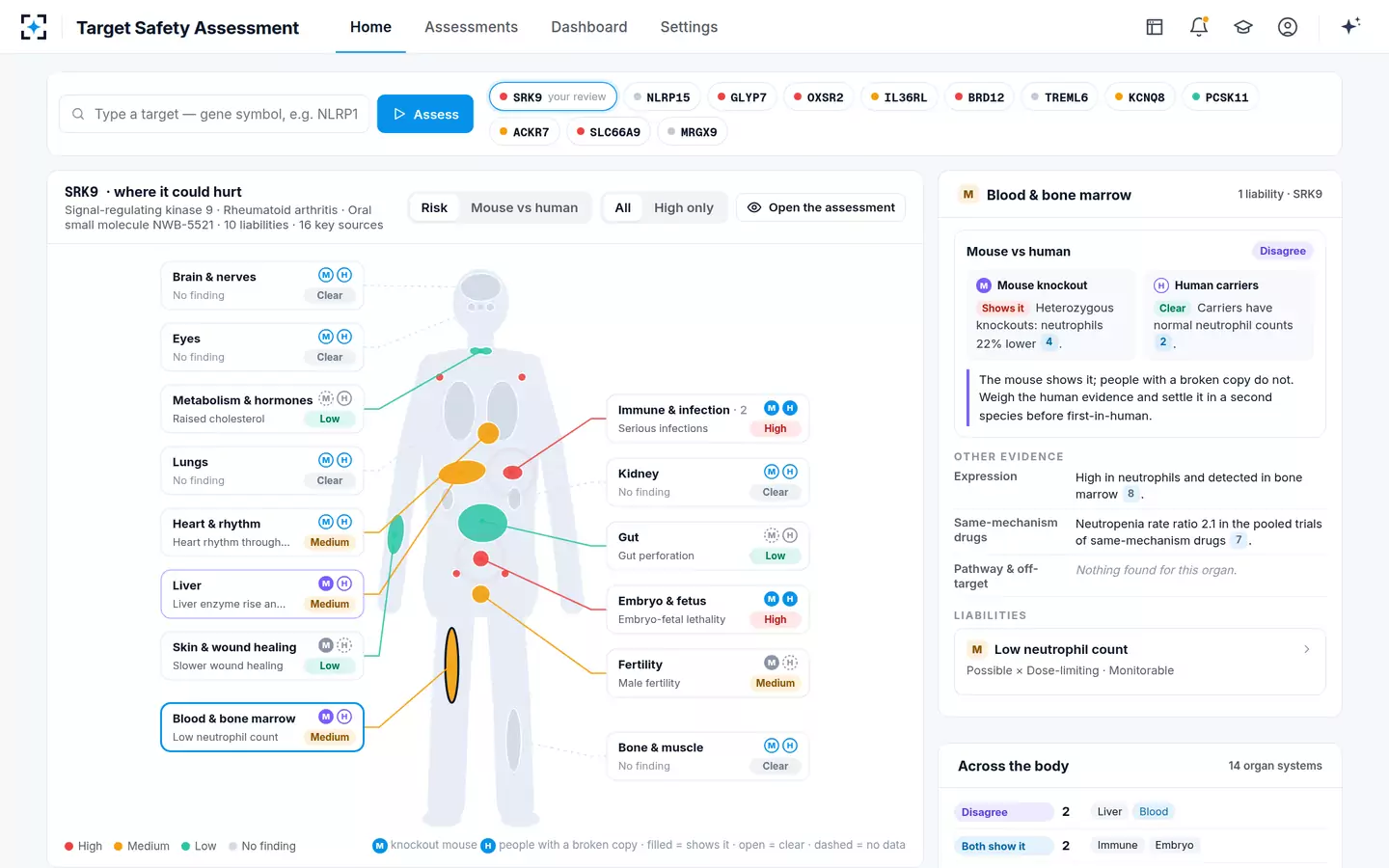
Four evidence lines, and what each one can prove
Four lines of evidence can establish an on-target liability without a compound, and each has a different failure mode. A claim that rests on one of them, with no statement of what the other three say, is the most common weakness in an assessment written under time pressure.
People born with less of the target. Loss-of-function genetics is the strongest line, because the organism is the right species and the exposure is lifelong. It also carries the clearest warning about over-reading. Constraint against loss-of-function variation is not a verdict on druggability: the authors of the largest such survey found that heavily constrained genes include the targets of chronically used medicines, and concluded that "these human in vivo data further the evidence from other species and models that essential genes can be good drug targets". What carriers prove, and what they cannot, is worked through in what a healthy heterozygous carrier proves.
Knockout and conditional animals. This is the most systematic organ-by-organ evidence a target has, because one consortium phenotypes every line the same way — and the most often misquoted, because a germline homozygous knockout is a developmental experiment and an adult inhibitor is not. The allele, the zygosity, the genetic background and whether the organ you care about was tested at all change the answer; how to read a knockout mouse record sets out the six questions to ask of any such claim.
Where the protein sits. Expression is what turns a mechanism into an organ. It is also the line most likely to be read as reassurance when it is not: a tissue with low expression is not a tissue with no exposure, as the ERBB2 case shows, and the species in which a toxicology study will run may not have the human pattern at all.
Drugs already on the pathway. A marketed or failed drug against the same target is the nearest thing to a read-out of the mechanism in people. The evidence is specific — a warning section, a pooled adverse-event rate with its confidence interval, a regulatory review's own analysis — and it is the line most often summarised too loosely, as "class effect", when what matters is the rate, the denominator and whether the drug's selectivity was the same.
The lines are also informative when they disagree with each other, and that is the claim worth making precisely. Nguyen and colleagues tested it across 1,819 drugs and 21 phenotype categories: where a drug's target had a genetic link to a phenotype in an organ system, a side effect turned up in that organ system 30.0% of the time, against 19.2% where there was no such link — an odds ratio of 1.80 (Nguyen et al., Nature Communications, 2019). Genetic evidence in an organ raises the probability of a side effect in that organ by a measurable amount. It does not determine it — which is exactly why a liability is scored rather than declared.
What an on-target claim must carry before it can be scored
- The evidence line, named
Human genetics, animal model, expression, same-mechanism drug, pathway and selectivity, or the company’s own study. "The literature says" is not an evidence line.
- The species, and for an animal finding the allele and zygosity
A homozygous germline null and a conditional adult knockout support different claims about an inhibitor.
- Developmental or adult
An embryo-fetal finding belongs to reproductive toxicology and to the label, not to the organ it was filed under.
- The organ system
The unit a monitoring plan, a histopathology report and a clinical stopping rule are written in.
- The cited passage, not the citation
A reference number proves a paper exists. The sentence relied on is what a second reader has to be able to disagree with.
- What the other three lines say about the same organ
Including "nothing" — a silence that is recorded is evidence; a silence that is omitted reads as agreement.
The same target recoloured by whether the mouse and the human evidence agree
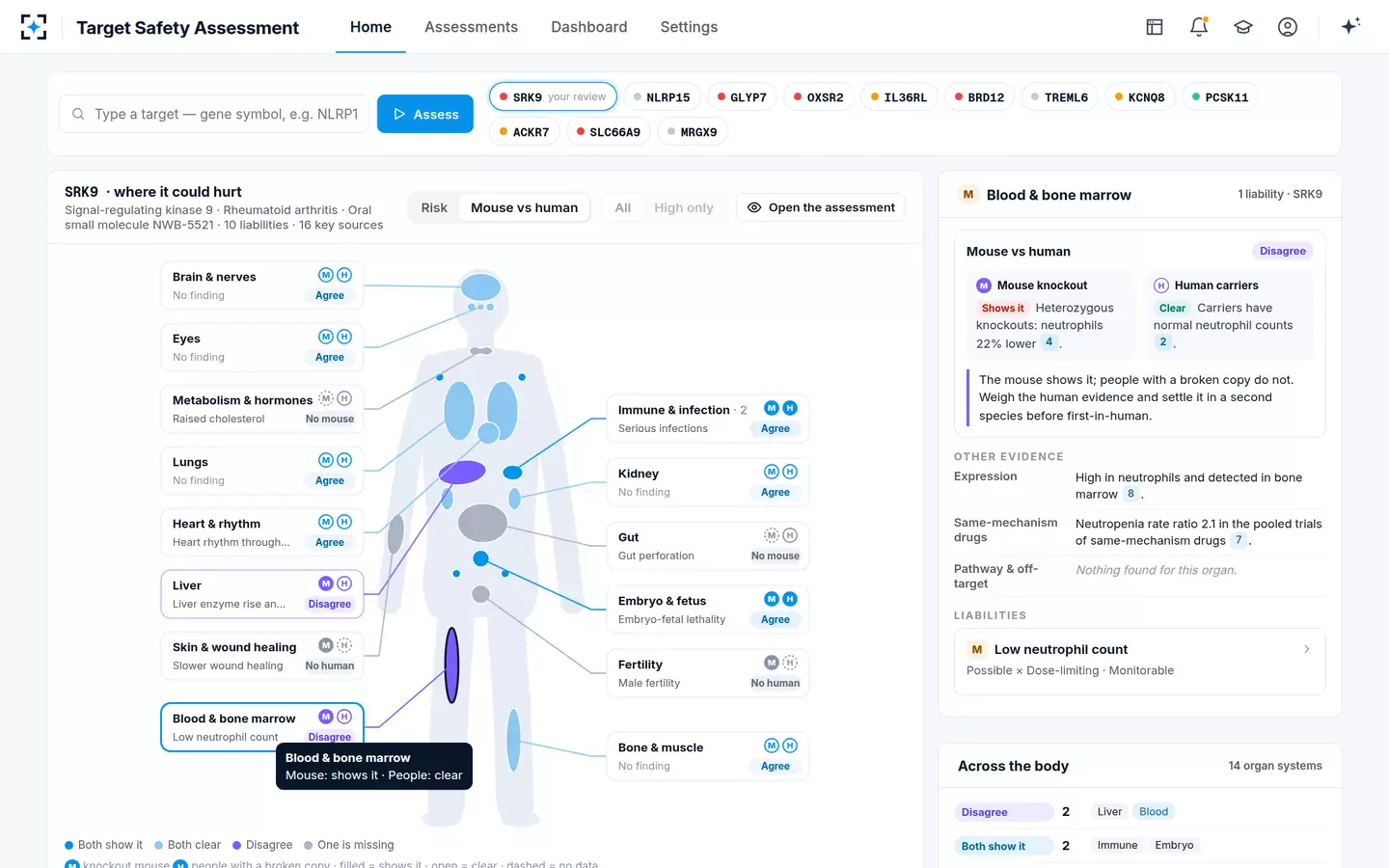
Can you engineer away on-target toxicity?
Not by selectivity. Selectivity is defined against other proteins, and an on-target liability is caused by the protein you are trying to hit, so a more selective molecule engages the mechanism more cleanly rather than less. What chemistry and pharmacology can genuinely change is where, how much and for how long the target is engaged — and sometimes that is enough to make a liability manageable.
Four levers do real work. Exposure: if the therapeutic effect saturates below the exposure at which the liability appears, there is a window, and the whole programme becomes an argument about that margin. Distribution: a molecule that does not reach the tissue where the liability lives — kept out of the brain, confined to the gut lumen, delivered to a joint — avoids the consequence without changing the biology. Duration and schedule: a reversible inhibitor given intermittently is a different exposure to the mechanism than a covalent one given daily, and for a liability that needs sustained suppression to develop, that difference is the mitigation. Degree: partial inhibition is often the thing carriers of one broken copy are actually a model of, and a programme that only needs 50% suppression is not reaching for the phenotype of a complete knockout.
What none of those levers does is remove the liability from the assessment. They convert it from a property of the target into a property of a design, with a number attached that the molecule has to keep hitting, and a readout in the first trial that shows whether it did. The one place where an on-target risk can genuinely be engineered out is further upstream, at target selection, by choosing biology the patient does not share. In a target safety assessment of two malaria proteases, the authors put the principle plainly: "focusing on parasite-specific targets where no human homologue exists reduces the possibility of on-target drug toxicity". That decision was available to them because they asked before the chemistry, not after.
When low expression in a healthy tissue is the whole story
A target's therapeutic rationale is usually built on where it is high. Its safety is decided by where it is at all. That asymmetry is the single most useful thing to hold in mind when reading an expression panel for a safety purpose, and it is why "expressed at low level" belongs in the liability register rather than in the reassurance paragraph.
The ERBB2 cell-therapy case is the extreme version, because the modality removed every buffer: a very large number of cells, a binding event that triggers an effector response rather than inhibition, and a first-pass through the lung. But the shape of the argument recurs with small molecules. A tissue with modest expression and no functional reserve — the conduction system, the proximal tubule, a stem-cell compartment — can be the organ that limits dose, while a tissue with high expression and large reserve tolerates full suppression without a visible finding. Expression level, functional reserve and the consequence of losing the function are three different quantities, and a panel gives you only the first.
The species question sits on top of it. A toxicology study answers the question in the species it is run in, and the human expression pattern is the one the patient has; where those differ, the study may be measuring the wrong organ. Where a target is, and in which species takes that comparison on its own terms.
Selectivity against relatives of the target is a safety question
Selectivity is usually filed as a chemistry objective, and it is one. It is also a target-level question, because which proteins a future molecule will have to be selective against is determined by the target's family, not by the molecule — and knowing the list before chemistry starts is the difference between a selectivity objective and a surprise.
Three parts of that list belong in a target assessment. The paralogs: close relatives whose own loss-of-function phenotypes are, in effect, a preview of the worst case if selectivity fails, and whose published knockouts and human variants can be read now. The cross-cutting liabilities that a whole chemotype tends to carry, hERG being the standing example, which decide how large a selectivity margin the programme will have to hold and whether a cardiac readout belongs in the de-risking plan from the start — a question taken up in settling a cardiac risk between hERG, ICH S7B and a mouse QT finding. And the company's own archive: if a previous programme ran selectivity panels against the same family, the hardest part of the work is already done and sitting in a study report nobody has read.
Writing the paralog list into the assessment also makes a specific kind of late failure less likely. A finding attributed to the target, when it was really a paralog the series also binds, leads a programme to abandon good biology; a finding attributed to a paralog, when it was really the target, leads it into a selectivity campaign that cannot succeed. Both are avoidable by knowing which proteins are in play before anyone has a stake in the answer.
What a target assessment can and cannot settle before chemistry
A target assessment is a probability exercise, not a verdict, and it is worth being precise about its limits — partly because the limits are what make the exercise defensible. It can name the liabilities the target carries, score each for probability and impact, say whether each is monitorable in a first trial, name the one study that would most reduce the uncertainty, and say which organs have no evidence at all. That last output is routinely the most valuable, and the one a narrative report tends to lose.
It cannot settle dose, exposure margin or therapeutic index, because those are properties of a molecule. It cannot anticipate a species-specific metabolite, an idiosyncratic immune reaction or a formulation effect. And it cannot replace the in vivo work: across a multinational survey of compounds whose human toxicities were known, animal studies identified the concordant target-organ toxicity in 71% of cases for rodent and non-rodent species together, with rodents alone predictive for 43% — numbers good enough to be worth running and far from good enough to be skipped. What the assessment changes is which studies get run, in which species, and what the clinical protocol watches; the full concordance picture is in the predictive validity of animal models when mouse and human differ.
Where the on-target question sits, and what answering it late costs
- Target chosen
- Assessment, one to two weeks
- Chemistry, with the liability as an objective
- Candidate selection
- Regulatory safety studies
- First trial, monitored for the liability
- Target chosen
- Chemistry, unaware of the liability
- Candidate selection
- Regulatory studies find the organ
- Back to chemistry, or stop
Where Target Safety Assessment fits in the decision
Target Safety Assessment answers the on-target question as a piece of work with a named owner and a signature, rather than as a reading exercise. Nine agents do the work, six of them reading. An assessment planner resolves the target symbol, its aliases and its paralogs, and starts six evidence lines in parallel: human genetics, animal models, expression across people and the four toxicology species, same-mechanism drugs and their labels and regulatory reviews, pathway and selectivity, and the company's own toxicology archive. Each agent has a stated limit — the human genetics agent says whether a finding is homozygous or heterozygous and never infers a direction of effect without a source; the animal model agent labels developmental findings separately from adult ones and records the allele and zygosity.
The pathway and selectivity agent is where this page's two categories meet. It checks paralogs, selectivity panels, hERG and secondary pharmacology, and what the company's own archive already showed — the off-target work that has to be known at target level — while the other five lines build the on-target picture. A risk scorer then merges findings into liabilities by organ system, scores probability against impact with a monitorability judgement, sets the mouse-versus-human verdict for each organ, and suggests the studies that would settle the open ones. It proposes only: a discovery toxicologist accepts, re-scores with a written reason, or dismisses each liability, and a critic's challenges to single-source findings and species-weak claims sit beside the liability rather than being applied silently.
One liability, its six lines of evidence, and the passage behind each
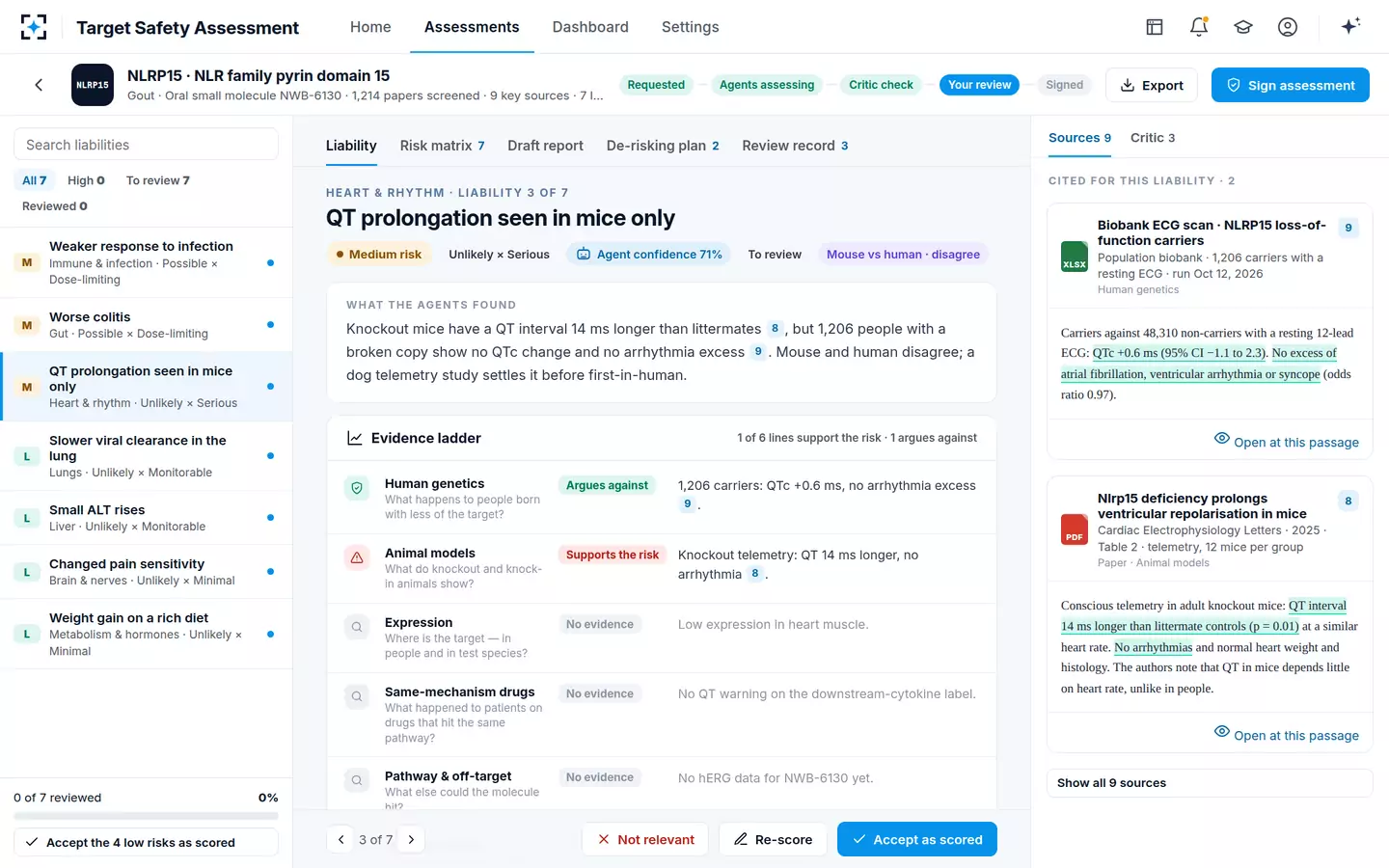
Two things in that design are there because of the distinction this page is about. The organ system is the unit of the answer, because an on-target liability is managed in an organ — a monitoring plan, a histopathology endpoint, a stopping rule. And every liability carries its own cited passage, because an on-target claim is a claim about biology that a second reader has to be able to argue with. To see how a buyer can test both, what a target safety assessment tool must show you sets out the eleven demands; to see it on one of your own targets, start from Target Safety Assessment.
Questions people ask
What is on-target off-tumour toxicity?
It is on-target toxicity in oncology: the therapy correctly recognises its target, but on healthy tissue that also expresses it. The ERBB2 cell-therapy case is the canonical example — the investigators attributed it to recognition of low levels of the target on lung epithelial cells (Morgan et al., 2010). It is the hardest version of the problem because cell therapies and bispecifics are effector mechanisms: recognition triggers destruction, so there is little room for low-level engagement that does no harm.
Is selectivity a safety problem or a chemistry problem?
Both, and in that order. Which proteins a molecule will have to be selective against is set by the target's family and is knowable before chemistry starts; holding a margin against them is a chemistry objective with a number. The failure mode is treating selectivity only as a chemistry problem, so the paralog list is assembled after the series is chosen rather than before.
When should a target safety assessment be done?
Before the target is committed to — at target selection or validation, when the output can still change the decision — and then revisited at candidate selection, when a molecule exists and the on-target liabilities can be set against real exposure. An assessment first written to support a regulatory submission has been written too late to do the job it is for: by then the unavoidable liabilities are being characterised rather than chosen.
Who writes a target safety assessment?
A discovery or investigative toxicologist, usually with a computational biologist for the genetics and expression work and a safety pharmacologist for the cardiovascular and secondary pharmacology questions. Brennan's chapter is explicit that the synthesis is the specialist part: it calls an experienced discovery toxicologist's role in turning the available information into actionable recommendations critical (Brennan, 2017). Tooling can do the reading; the recommendation and the signature belong to a person.
Does an on-target risk stop a programme?
Usually not on its own. It stops a programme when the liability is serious, likely at the exposure the therapy needs, and not monitorable — and even then the judgement depends on the disease. A serious on-target risk in a fatal cancer is accepted routinely and would be unacceptable in a chronic therapy for a benign condition. The scored output exists so that the trade-off is made explicitly by the people who own it, rather than implied by a narrative.
What is a target liability?
A specific, organ-level statement of what could go wrong if the target is modulated, with the evidence behind it, a probability, an impact and a note on whether it could be detected in a patient before it did harm. "Possible immune suppression" is not a liability; "serious bacterial infection, blood and bone marrow and respiratory, probable at full suppression, monitorable by neutrophil count" is one, because every part of it can be argued with.