ICH S7B is the guideline that governs the non-clinical evaluation of delayed ventricular repolarization, and the two pillars it describes are an in vitro assay of the current carried by the hERG channel and an in vivo QT study in an animal. It also says, in plain terms, which animals cannot be used: the ionic mechanisms of repolarization in adult rats and mice differ from larger species, so a QT change measured in a mouse is not evidence of a QT risk in a person. That is awkward, because the knockout mouse is often the first and sometimes the only cardiac evidence a new target has. Botminds' Target Safety Assessment handles the case the way a toxicologist does — it keeps the mouse finding, sets the human carrier evidence against it, marks the organ as a disagreement, and ties the liability to the one study that would settle it.
The worked case on this page is a fictional target in the product's sample data, and every figure attached to it — the millisecond difference, the carrier count, the cost and the weeks — is sample data, not a measured result or a published study. The regulatory and research figures are linked where they appear.
What ICH S7B asks for, and in which species
The guideline describes a non-clinical testing strategy with two core components and a set of follow-up studies. The in vitro assay measures the effect of a compound on the rapidly activating delayed rectifier potassium current, carried in people by the hERG channel; the in vivo study measures the QT interval, usually by telemetry in a conscious animal. The 2022 ICH E14/S7B questions and answers restate how much weight the in vitro side carries: as outlined in ICH S7B, the in vitro IKr/hERG assay plays a critical role in assessing the risk for delayed repolarization and QT interval prolongation prior to first administration in humans
(ICH E14/S7B Q&As, 2022).
On species the guideline is unusually direct, and the sentence is the one a target assessment most often needs.
The ionic mechanisms of repolarization in adult rats and mice differ from larger species, including humans (the primary ion currents controlling repolarization in adult rats and mice is Ito); therefore, use of these species is not considered appropriate.
ICH S7B, Non-Clinical Evaluation of the Potential for Delayed Ventricular Repolarization, 2005
It then names what is used instead: laboratory animal species used for in vivo electrophysiology studies include dog, monkey, swine, rabbit, ferret, and guinea pig
. The absence of the rat and the mouse from that list is not an oversight or a matter of taste. It is a statement about which currents repolarize the heart in each species, and it is the reason a cardiac finding from a rodent cannot be carried into a risk score as though it were a cardiac finding from a dog.
Why is the mouse not used for QT studies?
Because the mouse repolarizes its heart with a different set of currents, and the consequence is not a difference of degree. A review of the murine electrocardiogram in The Journal of Physiology puts the mechanism plainly — the set of ion currents that underlie repolarization in mice is different from that in humans
— and then gives the test case that settles the argument: a mutation affecting, for example, IKs will not alter murine repolarization whereas it leads to long QT syndrome in man
(Boukens et al., 2014). A genetic lesion that causes long QT syndrome in a person can leave the mouse's repolarization untouched. A model that misses the human disease cannot be relied on to detect a drug effect that produces it.
There is a second, more technical problem. The QT interval has to be corrected for heart rate, and the relationship between the two is, as ICH S7B notes, inverse, non-linear
, varying among species and between animals within a species. The mouse's heart beats on average about ten times faster than a person's, and the correction formula adapted for it can fail; the same review reports that the correction formula used in mice is not adequately corrected with variable heart rates during anaesthesia with isoflurane
. So a mouse QT number is a measurement whose unit is in doubt, taken in an animal whose repolarization works differently, sometimes under an anaesthetic that disturbs the correction.
What a mouse QT signal is worth, and why it is not zero
None of that makes a mouse finding worthless, and a target assessment that deletes it is as wrong as one that scores it as a human risk. The finding is evidence about the target: something about losing this protein changed cardiac electrophysiology in a living animal. What it is not is evidence about the magnitude, the direction or the clinical meaning of that change in a person.
The practical reading is therefore narrow and useful. A mouse QT signal raises the cardiac question from "no evidence" to "a question with a named study attached". It does not justify a high score on its own, and it does not justify closing the organ either. It justifies asking for a readout in a species whose ECG behaves like ours — which is exactly what the guideline's list of species is for.
The evidence ladder on one heart liability: what each line can and cannot prove
| Evidence line | What it can establish | What it cannot establish |
|---|---|---|
| Knockout mouse telemetry | That losing the target changes cardiac electrophysiology in a living animal, with a statistic and an allele behind it. | The size or the direction of the effect in a person: the repolarizing currents differ, and the rate correction is unreliable. |
| Carrier ECGs from a population cohort | What the resting ECG looks like in people who have lived their whole lives with one broken copy, at the sample size the cohort allows. | What happens under full pharmacological blockade, in disease, or with a second drug on board — partial loss is not inhibition. |
| hERG assay with a margin | The concentration at which the molecule blocks the current, and how far that sits above the exposure the clinic plans. | Anything about the target itself: the assay tests the molecule, so a clean result does not clear an on-target cardiac risk. |
| Labels and reviews of same-mechanism drugs | Whether people dosed with a drug on this pathway showed QT prolongation or arrhythmia, in numbers, with the label section quoted. | Much at all when no such drug exists, or when the approved molecule is not selective for this target. |
| Non-rodent in vivo QT telemetry | A rate-corrected QT readout in a species whose repolarization resembles the human one, at defined exposures. | Proof of safety at every exposure or in every patient; it answers the species question, not the whole risk. |
The hERG assay and its safety margin
The hERG assay is a patch-clamp measurement on cells expressing the channel, giving the concentration at which the compound blocks half the current. Its value in a risk discussion comes from the comparison, not the raw number: the margin between that blocking concentration and the free plasma concentration the clinical dose is expected to reach. A wide margin is reassuring; a narrow one moves the cardiac question to the front of the development plan.
Two cautions belong in any assessment that relies on it. The first is that the assay interrogates the molecule, not the target — it is the off-target cardiac screen, and it cannot speak to a liability that arises from switching the intended target off. The second is that at target stage, before a candidate exists, there is often no hERG number at all; in the sample assessment used on this page the pathway line reads that no hERG data exist for the molecule yet. A liability register that quietly treats "not measured" as "clear" is the most common way a cardiac risk is lost.
Do carrier ECGs count as evidence for a cardiac risk?
They count, and on an on-target question they often count for more than the mouse. People who carry one broken copy of the gene are the nearest thing to a long-term, lifetime experiment in partial loss of the target, in the right species. If several hundred or several thousand of them have had a resting ECG and show no shift in the corrected QT interval and no excess of arrhythmia, that is direct human evidence about the consequence of having less of this protein.
What the carrier scan cannot do is settle the pharmacological case. A drug can block a target far more completely than a single broken copy reduces it, and it does so at a chosen moment, in patients who may be older, sicker and on other drugs than the cohort. So the honest conclusion from a reassuring carrier ECG scan is lowered probability, not a closed question — which is precisely the kind of statement a probability-times-impact score is designed to carry. How far a healthy carrier's silence reaches is worked through in the guide to what a healthy carrier proves.
One cardiac finding, scored two ways
The mouse read on its own: QT prolongation is likely; the knockout shows it directly.
The mouse read with the human evidence: QT prolongation is unlikely in people but would be serious if it occurred; the species that showed it is not a QT species.
The mouse read on its own: One telemetry study in the species the guideline excludes, treated as the finding.
The mouse read with the human evidence: The telemetry study kept as a target signal; the carrier ECGs weighted as the human readout; the hERG result recorded as absent.
The mouse read on its own: A high cardiac risk, argued from a species whose repolarizing currents differ from ours.
The mouse read with the human evidence: A medium risk, monitorable, flagged as a disagreement between mouse and human evidence.
The mouse read on its own: The programme either over-reacts — redesigning around a risk that may not exist — or quietly discounts the whole entry.
The mouse read with the human evidence: One named study in a non-rodent species, with weeks, cost and an owner, resolves the disagreement before the first dose in people.
The organ turns amber, and the badge says the evidence disagrees
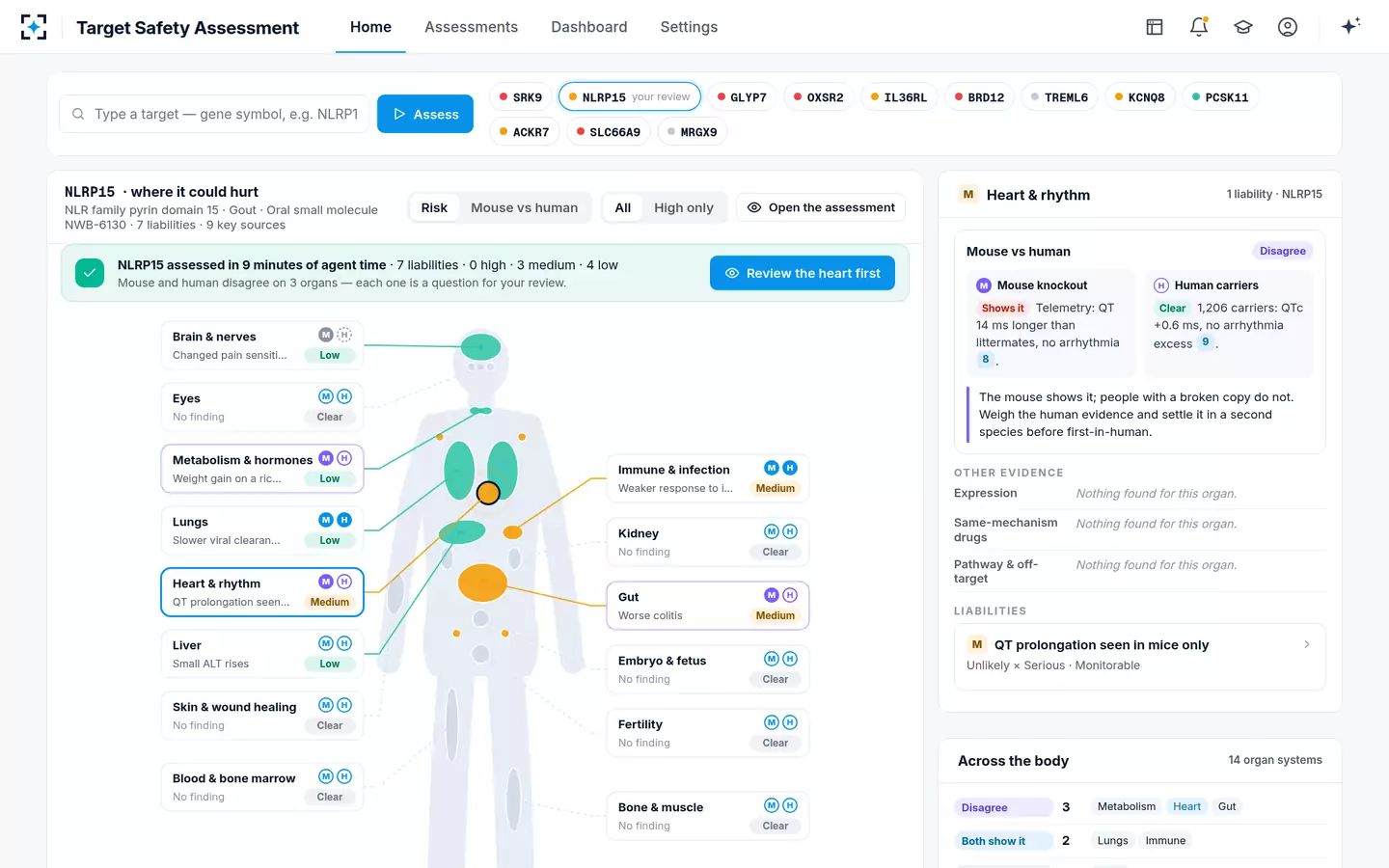
How do you settle a cardiac finding seen only in mice?
With one study, chosen for the species rather than for the endpoint. The question is whether the repolarization change survives in an animal whose repolarizing currents resemble the human set, so the readout has to come from one of the species ICH S7B lists, with rate-corrected QT at defined exposures. In the sample plan this is a telemetry readout in the dog, added to a repeat-dose study already planned, with a hERG patch clamp run alongside once a molecule exists.
Three details decide whether the study answers the question. It has to be run at exposures that cover the clinical range, or it proves only that a low dose was safe. It has to be sensitive enough to see a small shift: the 2022 ICH E14/S7B questions and answers ask that an in vivo study used in an integrated risk assessment can detect a QTc effect of a size similar to dedicated clinical QT studies, and give a hypothetical minimal detectable difference of 5 milliseconds when exposure covers only the high clinical exposure (ICH E14/S7B Q&As, 2022). And it has to be tied in writing to the liability it answers, so that the result closes a specific entry in the register rather than becoming a general reassurance. The wider mapping of liabilities to the studies that settle them is set out in the guide to the safety pharmacology core battery.
From a mouse signal to a named study in Target Safety Assessment
Agent
Animal model readingCollects the knockout telemetry finding with its allele, its zygosity and its statistic, and files it against the heart.
Never: treats a rodent QT change as a human QT risk
Agent
Human genetics readingFinds the carrier ECG scan in the population cohort and records the corrected QT difference with its confidence interval and the arrhythmia counts.
Never: infers a direction of effect without a source
Agent
Expression, pathway and drug-label readingAdds what the other lines have, including their silences: low expression in heart muscle, no QT warning on a same-mechanism label, no hERG data for the molecule yet.
Agent
Risk scoringProposes probability times impact for the organ, sets the mouse-versus-human verdict to disagree, and suggests the study that would settle it.
Never: decides the score — it proposes one
Agent
ChallengeRaises the species-relevance objection in plain view: mouse QT is a weak guide, weight the carrier ECGs, ask for a non-rodent readout.
Never: applies its own challenge silently
A person decides
The discovery toxicologistReads the cited passages, accepts or re-scores the liability with a written reason, switches the non-rodent study into the plan and signs the assessment.
Does human genetics predict cardiac side effects?
It does, measurably, and it is worth knowing by how much. An analysis in Nature Communications of 1,819 drugs across 21 phenotype categories compared the side effects seen in clinical trials with the genetic phenotypes of each drug's targets. For the heart, a side effect was recorded for 45.2% of drugs whose target had a genetic link to a cardiac phenotype, against 30.1% of drugs whose target had none — an odds ratio of 1.91. The gastrointestinal tract, by contrast, showed no enrichment at all: 36.0% against 35.8% (Nguyen et al., 2019, Table 1).
Where genetic evidence about a target raises the chance of a trial side effect
1.91OR
heart: side effects in 45.2% of drugs whose target had a cardiac genetic link, against 30.1% without
1.01OR
gastrointestinal: 36.0% against 35.8%, no enrichment
1.80OR
all organ systems together: 30.0% with genetic evidence, against 19.2% without
Read with the first half of this page, that result is a double instruction. Human genetic evidence about a cardiac target deserves weight — which is the argument for taking the carrier ECGs seriously. And genetic signals pointing at the heart turn into clinical side effects often enough that a cardiac liability deserves attention even when the only animal evidence comes from a species the guideline excludes. The two together are why the honest score on a mouse-only QT finding is usually medium rather than low: unlikely, but serious, and worth one study.
The integrated risk assessment, as the guideline means it
ICH S7B does not ask for a single number. It asks for an integrated risk assessment, and it specifies the manner of it: the integrated risk assessment should be scientifically based and individualized for the test substance
. That phrasing matters for target work, because it licenses exactly what a target assessment does — set the lines of evidence beside each other, say what each can carry, and reach a conclusion that names its own weak points rather than hiding them in an average.
Concretely, an integrated reading of a mouse-only QT finding says four things: the rodent signal exists and is about the target; the human carrier evidence shows no resting shift at the cohort's size; the molecule's own hERG behaviour is unknown until there is a molecule; and the gap between these is closed by a rate-corrected readout in a listed species. Writing those four sentences down is the assessment. A score of medium with no sentences behind it is not.
What a cardiac liability entry has to carry before a toxicologist signs it
- The species of every cardiac finding, named in the entry itself
A QT change belongs to the animal it was measured in. Rodent findings are labelled as such, not merged into a single cardiac claim.
- The rate correction used, and whether the animal was anaesthetised
An uncorrected or badly corrected interval is not comparable; anaesthesia disturbs the correction in small rodents.
- The human evidence, with its size and its limits
How many carriers, which ECG, what was and was not screened for — silence in a small cohort is not a negative result.
- The hERG position, including its absence
No molecule yet means no margin yet. The entry says so rather than leaving the field blank for a reader to misread as clear.
- Monitorability, stated as a clinical measure
A QT effect is detectable on an ECG in the first trial; that is part of the score, and part of the monitoring plan if the study does not settle it.
- The study that would settle it, with species, weeks, cost and owner
A cardiac entry without a named study is an opinion. The species is chosen from the guideline, not from convenience.
How Target Safety Assessment scores a heart liability and names the study
In the worked example the heart entry reads "QT prolongation seen in mice only", scored unlikely times serious — medium — with a mouse-versus-human disagreement marked and the agents' confidence shown as a number rather than implied. The evidence ladder beneath it shows one of six lines supporting the risk and one arguing against, each with the passage it came from: the knockout telemetry paper on one side, the population biobank ECG scan on the other. Three lines report that they found nothing, which is a different statement from not having looked, and the panel says which it is.
The challenge sits beside the entry rather than inside the score. In the sample case it argues that mouse QT is a weak guide to people, suggests keeping probability at unlikely, weighting the carrier ECGs, and asking for a non-rodent readout. The toxicologist can accept the entry as scored, re-score it with a written reason, or dismiss it; whichever she does is kept with the reason attached.
The disagreement becomes a study, with weeks, cost and an owner
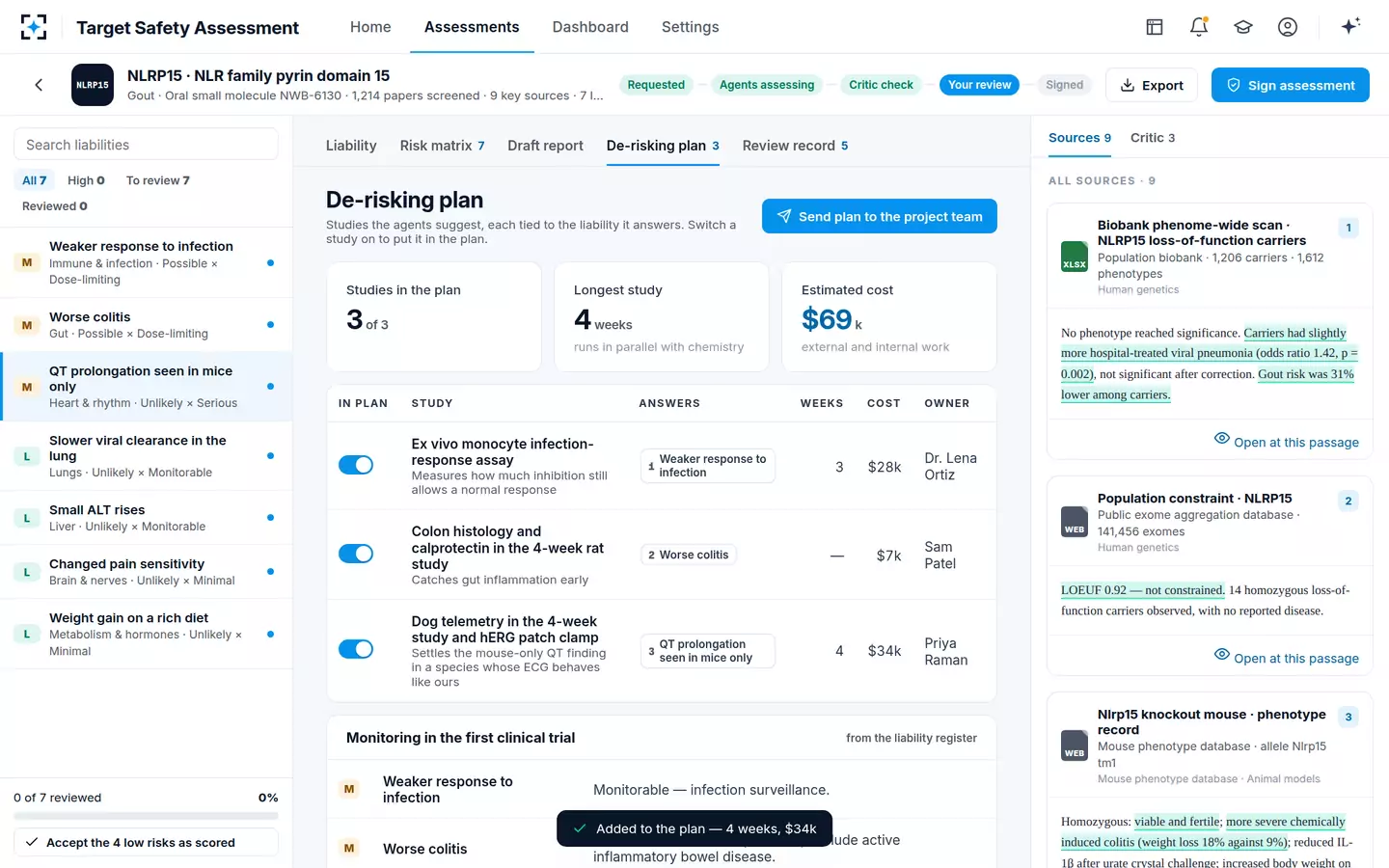
What makes this defensible is not the score but the trail behind it: a species named on every finding, a human comparison with its interval, an absent hERG result recorded as absent, and one study whose result will close the entry. To see the heart case end to end, with the passages behind each line, start from Target Safety Assessment; how the same machinery handles a contradiction in any other organ is set out in the guide to mouse and human evidence that disagree.
Questions people ask
What does ICH S7B require for hERG?
It describes an in vitro assay of the rapidly activating delayed rectifier current, carried by the hERG channel, as one of two core non-clinical components alongside an in vivo QT study, with follow-up studies where needed. The 2022 E14/S7B questions and answers describe that assay as playing a critical role in assessing the risk of delayed repolarization and QT prolongation before the first administration in humans, and set out best-practice expectations for how it is run.
Is a mouse a valid model for QT prolongation?
No. ICH S7B states that the ionic mechanisms of repolarization in adult rats and mice differ from larger species including humans, and that the use of these species is therefore not considered appropriate; the species it lists for in vivo electrophysiology are dog, monkey, swine, rabbit, ferret and guinea pig. A mouse finding can still raise a question about the target, but it cannot answer it.
What is a hERG safety margin?
It is the ratio between the concentration at which a compound blocks the hERG current in vitro and the free plasma concentration expected at the clinical dose. A wide margin is reassuring and a narrow one makes cardiac work a priority. It is a property of the molecule, so it says nothing about a risk that comes from inhibiting the intended target.
Do carrier ECGs count as evidence for a cardiac risk?
Yes, as the human readout on an on-target question — people with one broken copy are a lifetime experiment in partial loss, in the right species. Their limits are real: partial loss is not full pharmacological blockade, cohorts are healthier than patients, and a small cohort can only exclude a large effect. They lower probability rather than closing the question.
When is an in vivo QT study needed?
ICH S7B says its non-clinical studies, the in vivo QT study among them, should be considered before the first administration in humans, run in a species whose repolarization resembles the human one. At target stage the useful question is different: a cardiac liability found in the reading is a reason to design that study to answer it specifically — at exposures covering the clinical range and sensitive enough to detect a small QTc shift — rather than to run a generic one.
What is an integrated risk assessment?
It is the guideline's term for weighing the in vitro and in vivo results together with everything else known about the substance, rather than reducing them to a single threshold. ICH S7B says it should be scientifically based and individualized for the test substance. For a target assessment that means writing down what each line of evidence can carry, including the ones that found nothing and the ones not yet run.