The Reg CC cheat sheet for 2026 has three dollar amounts at its center: the first $275 of most check deposits is available the next business day, $550 must be available in cash by 5:00 p.m. when an institution delays cash withdrawals, and $6,725 is the line for large-deposit holds, new-account limits and repeated overdrafts. All three have applied since July 1, 2025 under 12 CFR 229.11, nothing in Regulation CC's availability rules changed in 2026, and the next adjustment is due on July 1, 2030. The rest of the sheet is days: which day counts as the deposit day, which business day each part becomes available, and how many extra days an exception buys. A cheat sheet is only as good as the date on it, which is why Botminds' Deposit Compliance Search answers staff hold questions from the rule text in force on the day and cites the section behind every amount.
The three Regulation CC amounts in force throughout 2026
$275
available the next business day from most check deposits (was $225)
$550
in cash by 5:00 p.m. on the availability day, when cash is delayed (was $450)
$6,725
large-deposit, new-account and repeated-overdraft line (was $5,525)
The Reg CC cheat sheet for 2026, line by line
Every line below is a rule with a section number, and every amount is the one in force since July 1, 2025. Business days exclude Saturdays, Sundays and the federal holidays Regulation CC lists in its definition (12 CFR 229.2(g)), so a deposit made on a Friday before a Monday holiday counts forward from Tuesday.
Reg CC cheat sheet 2026: availability, exceptions and notices
| What | Amount or day | Section |
|---|---|---|
| Cash deposited in person to an employee | Next business day | 229.10(a)(1) |
| Cash deposited otherwise (for example, at the institution's own ATM) | Second business day | 229.10(a)(2) |
| Electronic payments (ACH credits, wires received) | Next business day after the banking day received | 229.10(b) |
| U.S. Treasury checks to the payee's account | Next business day | 229.10(c)(1)(i) |
| Postal money orders; Federal Reserve, Federal Home Loan Bank, state and local government, cashier's, certified and teller's checks | Next business day if deposited in person to the payee's account (with any special slip required); second business day otherwise | 229.10(c)(1)(ii)–(v), (c)(2) |
| On-us checks (same institution, same state or region) | Next business day | 229.10(c)(1)(vi) |
| The first $275 of other check deposits in a banking day | Next business day | 229.10(c)(1)(vii) |
| All other checks | Second business day | 229.12(b) |
| Cash withdrawal of check funds | May be delayed one business day; $550 by 5:00 p.m. on the availability day | 229.12(d) |
| Deposits at an ATM the institution does not own | Fifth business day | 229.12(f) |
| Funds available from | The later of 9:00 a.m. local time or when tellers or ATMs open for withdrawals | 229.19(b) |
| Cutoff for the deposit day | 2:00 p.m. or later at branches; noon or later at ATMs and off-premises sites | 229.19(a)(5) |
| Large deposits | Checks over $6,725 in one banking day may be held beyond the schedule | 229.13(b) |
| Repeated overdrafts | Negative on 6 banking days in 6 months, or 2 days at $6,725 or more; exception lasts 6 months | 229.13(d) |
| Extra time for an exception hold | Up to 1 business day for on-us checks, 5 for checks on the second-day schedule, 6 for fifth-day items | 229.13(h)(4) |
| New accounts (first 30 calendar days) | Cash and electronic: next day. Next-day-type checks: first $6,725 on schedule, the rest by the ninth business day. Other checks: no schedule | 229.13(a) |
| Exception notice | At the deposit if in person and the reason is known; otherwise by the first business day after the deposit or the facts, whichever is later | 229.13(g)(1)(ii) |
| Notice of a policy change, consumer accounts | 30 days before; a faster schedule may be disclosed up to 30 days after | 229.18(e) |
| Records | Evidence of compliance kept for at least two years | 229.21(g) |
| Civil liability, individual action | $125 to $1,350, plus actual damages | 229.21(a)(2)(i) |
What counts as day zero for a check hold?
The banking day of deposit, which is not always the calendar day the member walked in. A deposit made after the institution's cutoff, which may be no earlier than 2:00 p.m. at a staffed branch and no earlier than noon at an ATM or off-premises facility, or on a day that is not a banking day, may be treated as made on the next banking day (12 CFR 229.19(a)(5)). Every date on the sheet counts from day zero, so an error here moves every line by one.
Two other rules shape day zero. Funds mailed in are deposited when received, and funds in a night depository when removed for processing (229.19(a)(2) and (3)). And "next business day" means available at the start of that day: by the later of 9:00 a.m. local time or the time the institution's tellers or ATMs open for withdrawals (229.19(b)). A Reg CC hold calculator that counts the rule's way works through the counting in detail.
Reg CC next-day availability: which items, and the first $275
The next-day amount is $275, under 12 CFR 229.10(c)(1)(vii): the lesser of $275 or the day's total of checks not already entitled to next-day availability (12 CFR 229.10(c)). It is a minimum, applied across all of a customer's accounts for the banking day, not per check. Cash deposited to an employee, electronic payments and a list of low-risk checks get next-day availability in full, subject to the conditions in the table: the payee's own account, in person for most of them, and a special deposit slip where the institution requires one.
The largest single source of wrong answers is the old figure. From July 1, 2020 through June 30, 2025 the amount was $225; before that, $200. A laminated chart from 2024 is now wrong on every next-day line, and so are training slides, scripts and procedure PDFs that typed the number instead of citing the section. What changed in July 2025, and where the old amounts still survive covers the transition.
Second business day, and the $550 cash rule
Every check that does not qualify for next-day availability is available by the second business day. Regulation CC's text still carries a fifth-day schedule for "nonlocal" checks, but the Federal Reserve has said that "there is now a single national check-processing region and all checks are local" (82 FR 27552, 2017). A cheat sheet that still shows a five-day line for out-of-area checks is describing a category that no longer exists; the fifth business day survives only for deposits at an ATM the institution does not own (229.12(f)).
As there is now a single national check-processing region and all checks are local, these requirements are no longer necessary.
Federal Reserve Board, Regulation CC final rule, 82 FR 27552 (2017)
Cash is different from availability. An institution may make check funds available for cash withdrawal one business day later than the schedule, but must allow $550 of them in cash by 5:00 p.m. on the day they become available, in addition to the $275 already available the day before (12 CFR 229.12(d)). The delay covers cash and "similar means", which the rule defines to include electronic payments and cashier's or teller's checks, so "available" and "available in cash" can fall on different days.
Exception holds: how many extra business days
A reasonable period beyond the normal schedule, which Regulation CC defines: up to one extra business day for on-us checks, five for checks on the second-day schedule and six for fifth-day items, with a longer period allowed only if the institution can show it is reasonable (12 CFR 229.13(h)(4)). For a typical check, that makes the seventh business day after the banking day of deposit the latest date without a special justification.
The exceptions themselves are six: new accounts, large deposits, redeposited checks, repeated overdrafts, reasonable cause to doubt collectibility and emergency conditions. Only the large-deposit and repeated-overdraft exceptions have dollar figures, both $6,725. The large-deposit exception reaches checks only, never cash or electronic payments, and it can apply even to checks that would otherwise get next-day availability.
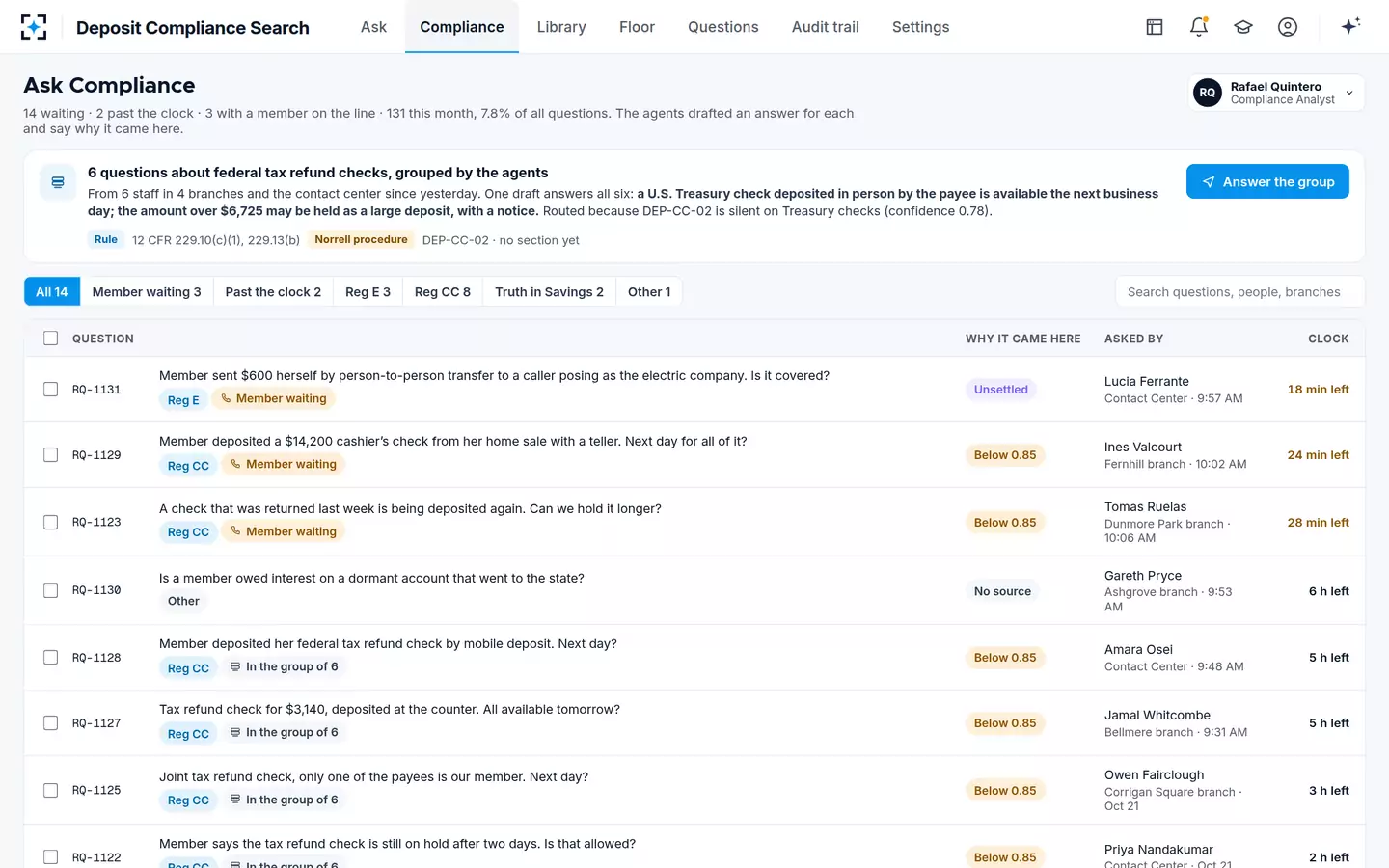
Take the question a teller at the fictional sample credit union asked on a live call: a member deposits a $14,200 cashier's check from a home sale at the counter. Assume the check is payable to her and the account is not new. The first $6,725 follows the next-day rule for cashier's checks deposited in person. The other $7,475 may be held as a large deposit, but only with a written notice given at the counter, and no later than a reasonable period after the second business day, the day it would have been due had it been an ordinary check (229.13(h)(2)): the seventh business day at most.
New accounts: the first 30 days on the chart
A new account is one in its first 30 calendar days, unless every customer on it has had another account at the institution for at least 30 days (12 CFR 229.13(a)(2)). During that period, cash and electronic payments still become available the next business day. Treasury checks, money orders and the other next-day items get next-day availability only on the first $6,725 deposited in a banking day, with the rest due by the ninth business day. Other checks have no required schedule at all, which is the only place in Regulation CC where a hold has no fixed outer date. The new account hold rules in full sit with the Reg CC Exception Holds guides.
Notices: what must be handed over, and when
Large-deposit, redeposited-check, repeated-overdraft and reasonable-cause holds need a written notice with five things: an account identifier, the deposit date, the amount delayed, the reason and when the funds will be available. It is due at the time of the deposit when the deposit is made in person to an employee and the reason is already known; otherwise it must be mailed or delivered as soon as practicable, and no later than the first business day after the later of the deposit and the day the bank learns the facts (229.13(g)(1)(ii); the reasonable cause hold guide quotes the timing rule). Emergency holds need a simpler notice, and the new-account exception has no notice of its own in 229.13(g). Business customers can receive a single one-time notice for large-deposit and redeposited-check holds that will be applied to most of their deposits.
The Reg CC notices a deposit desk owns
- Exception notice
Five elements; at the counter for in-person deposits when the reason is known; otherwise by the next business day. 229.13(g)(1).
- Reasonable-cause records
Each reasonable-cause notice kept with a brief statement of the facts behind the doubt. 229.13(g)(5).
- Lobby posting
The availability periods posted conspicuously wherever employees take consumer deposits. 229.18(b).
- Deposit slips and ATMs
Preprinted slips and ATM locations must say deposits may not be available for immediate withdrawal. 229.18(a), (c).
- Policy on request
The specific availability policy to any person who asks, orally or in writing. 229.18(d).
- Change of policy
30 days' notice to consumer account holders before a slower policy; a faster one may be disclosed within 30 days after. 229.18(e).
How long this chart stays right: until July 1, 2030
Until July 1, 2030, when the amounts are next adjusted by the change in the CPI-W from July 2023 to July 2028. Section 229.11 fixes the schedule: an adjustment on July 1, 2020, another on July 1, 2025, and one every fifth year after that, each adjustment rounded to the nearest multiple of $25, with no adjustment if prices fall and any small change carried forward to the next period (12 CFR 229.11(a), (b)). The adjusted figures are published in the Federal Register after each measurement period; the 2025 figures were published more than a year ahead, on May 20, 2024.
Three amounts, three steps, and the next step in 2030
- 2011–2020$200
- 2020–2025$225
- 2025–2030$275
- to 2020$400
- 2020–2025$450
- 2025–2030$550
- to 2020$5,000
- 2020–2025$5,525
- 2025–2030$6,725
Where cheat sheets go wrong
A cheat sheet fails in three predictable ways. It keeps an old number after the rule moves, as every $225 chart did on July 1, 2025. It keeps a category the rule no longer uses in practice, as five-day "nonlocal" lines do. And it flattens conditions into a single figure: "cashier's checks are next day" omits in person, the payee's own account, any special deposit slip and the large-deposit line, each of which can change the answer for a real check.
The fix is the one a cheat sheet cannot make on its own: tie each line to its section and the date it took effect, and check it against the rule text on the day of the question. On the fictional sample credit union, "check holds and the next-day amount" was the most asked topic in a month, 196 questions in 22 days, and the hold questions that fell below the solution's confidence threshold went to Compliance with a drafted answer rather than a guess. Regulation CC's numbers beside Reg E's and Truth in Savings' make the same point across the deposit rules.
Hold questions that need a person: routed with the rule, a draft and a clock
Questions people ask
What are the Reg CC hold times on the 2026 chart?
For most checks to an established account, until the second business day after the banking day of deposit, with $275 available the next business day. With an exception such as a large deposit over $6,725, up to five more business days for those checks, so the seventh business day, unless the institution can show a longer period is reasonable.
What is the large deposit threshold in 2026?
$6,725 of checks in one banking day, across the customer's accounts if the institution chooses to aggregate. It has applied since July 1, 2025, replacing $5,525, and only the amount above it may be held under the large-deposit exception, with a written notice.
Does Reg CC apply to savings accounts?
Regulation CC's definition of account covers transaction accounts and excludes savings deposits, even those that permit some transfers (12 CFR 229.2(a)). An institution may apply the same schedule to savings deposits by policy; its availability disclosure says which.
Does Reg CC apply to credit unions?
Yes. Its definition of bank includes insured credit unions and credit unions eligible for insurance, so the same amounts, days and notices apply. Credit union staff use the same cheat sheet as bank staff.
What is the Reg CC civil liability amount?
In an individual action, actual damages plus between $125 and $1,350; in a class action, up to the lesser of $672,950 or 1 percent of the institution's net worth, plus costs and attorney's fees. Those amounts also changed on July 1, 2025.