The Reg CC changes that took effect on July 1, 2025 were an inflation adjustment of every dollar amount in the funds availability rules: the next-day amount rose from $225 to $275, the cash-withdrawal amount from $450 to $550, the large-deposit, new-account and repeated-overdraft amount from $5,525 to $6,725, and the civil liability amounts from $100, $1,100 and $552,500 to $125, $1,350 and $672,950. The Federal Reserve Board and the CFPB published them on May 20, 2024 as required by the Expedited Funds Availability Act, using the CPI-W's rise of 21.8 percent from July 2018 to July 2023 (89 FR 43737). The schedules, the six exceptions, the reasonable extensions and the notice rules did not change, and the eCFR shows no amendment to these sections since; the next adjustment is due on July 1, 2030 (12 CFR 229.11). What made the change hard was not the rule but the paper around it: disclosures, hold-notice templates, core parameters, teller scripts and even the regulators' own guides that still carry $5,525. Botminds' Reg CC Exception Holds keeps every amount as a setting with a version and an effective date, approved by the compliance officer before the agents use it.
What changed on July 1, 2025: each indexed amount, by how much it rose
Reg CC threshold changes 2025: the full table
Six amounts in five sections moved together. Three of them shape the hold desk's day: the next-day amount decides how much of a held deposit the customer gets tomorrow, the $6,725 decides which deposits can be held as large and which accounts count as repeatedly overdrawn, and the same $6,725 decides how much of a new account's cashier's and government checks must be next-day. The liability amounts decide what a mistake costs in court.
Every Regulation CC amount, before and after July 1, 2025
| Amount | Where it applies | July 1, 2020 to June 30, 2025 | From July 1, 2025 |
|---|---|---|---|
| Next-day amount | 229.10(c)(1)(vii): the first part of a day's other check deposits | $225 | $275 |
| Cash withdrawal amount | 229.12(d): cash available by 5:00 p.m. when a bank delays cash by a day | $450 | $550 |
| New-account amount | 229.13(a): next-day items into a new account | $5,525 | $6,725 |
| Large-deposit threshold | 229.13(b): the day's checks above it can be held | $5,525 | $6,725 |
| Repeatedly overdrawn threshold | 229.13(d)(2): negative by this much on two days in six months | $5,525 | $6,725 |
| Civil liability, individual action | 229.21(a)(2)(i): court-set amount on top of actual damages | $100 to $1,100 | $125 to $1,350 |
| Civil liability, class action cap | 229.21(a)(2)(ii)(B): lesser of this or 1% of net worth | $552,500 | $672,950 |
Why did the amounts change on July 1, 2025?
Because the Act now indexes them. Since the Dodd-Frank Act added section 607(f), the EFA Act requires the amounts to be adjusted for inflation every five years, and the Board and the CFPB wrote the method into 229.11: the change in the CPI-W for urban wage earners and clerical workers over a five-year measurement period, applied to each amount and rounded to the nearest multiple of $25, with no change when inflation is zero or negative. When rounding produces no change, the inflation carries forward to the next period, and that is why the liability floor jumped a quarter: in 2020 it stayed at $100, and in 2025 two periods of inflation were applied at once. The final rule says so in a footnote: "The civil liability minimum threshold did not change in the previous five-year inflation measurement period due to rounding to the nearest $25" (89 FR 43737, note 15).
The timing was set in advance too. The 2019 rule that implemented the indexing fixed the effective dates as July 1, 2020, July 1, 2025 and July 1 of every fifth year after, and the 2025 amounts were published on May 20, 2024, more than a year before they applied. A bank had over a year to change its forms, which makes an old amount on a notice in 2026 hard to explain to an examiner.
The large-deposit amount and the next-day amount since 2011
- To June 2020$5,000
- July 2020 to June 2025$5,525
- From July 2025$6,725
- July 2011 to June 2020$200
- July 2020 to June 2025$225
- From July 2025$275
What the July 2025 changes did not change
Everything that is counted in days stayed where it was. Local checks are still due by the second business day, deposits at ATMs the bank does not own by the fifth, and the reasonable extension for an exception is still one, five or six business days by kind of check. The six exceptions, the new-account period of 30 calendar days, the six-month look-back for overdrafts, the content and timing of hold notices and the two-year retention rule are as they were.
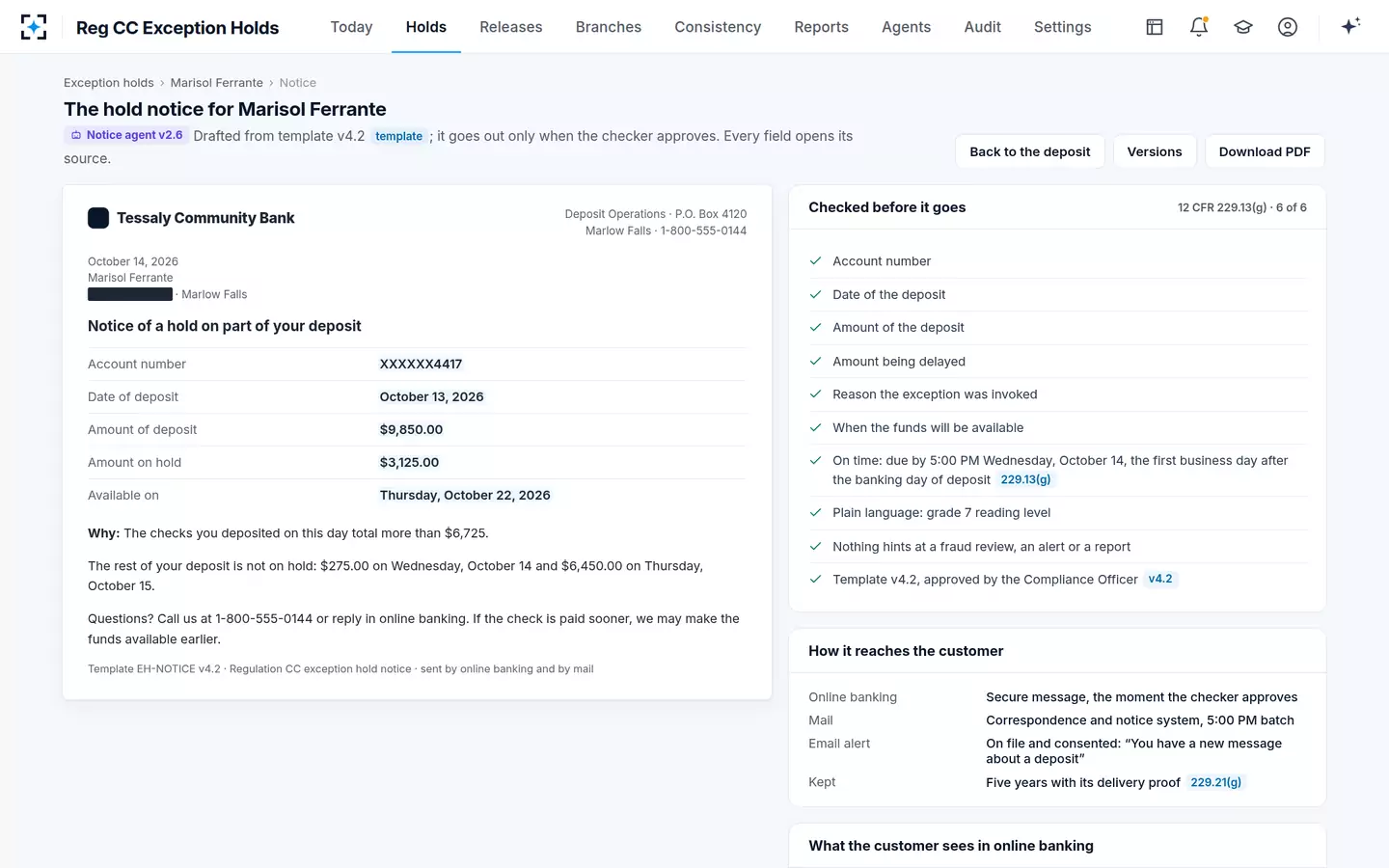
So the change touched amounts, not logic, and that is what made it easy to miss. A hold desk whose parameters were edited on July 1 went on working; one whose template still said "more than $5,525" went on working too, and sent a notice that mis-stated the threshold to every large-deposit customer. That reason line is what separates an exception notice from the reasonless notice of a hold inside the schedule, as the case-by-case versus exception hold guide explains. Marisol Ferrante's deposit at the fictional sample bank shows the difference on one hold: with $9,850.00 deposited, the old threshold would have held $4,325.00, the new one holds $3,125.00, and $1,200.00 more is available on the second business day.
A notice drafted from the current amount, with nothing typed by hand
Where the old Reg CC amounts still survive
Old figures outlive a rule change in documents nobody owns any more, and in this case some of those documents are official. A bank that builds its procedures, training or audit tests from a regulator's guide, rather than from the regulation, can import an amount that has not applied since June 30, 2025. On October 26, 2026 we found the following.
Official sources and the amounts they print, checked October 26, 2026
What the source still says: Model C-12: "The checks you deposited on this day exceed $5,000." Model C-3 and the lobby notice C-17 print a next-day amount of $100.
The amount in force since July 1, 2025: $6,725 and $275. The models are deemed compliant only when banks adapt them to their own policy.
What the source still says: "The first $5,000 of funds deposited to a new account on any one banking day", followed by "Thus, the first $6,725" in the next sentence.
The amount in force since July 1, 2025: $6,725, as 229.13(a) itself reads.
What the source still says: Procedures for "the $225 availability rule" and "the $450 cash withdrawal rule"; large deposits "exceeding $5,525".
The amount in force since July 1, 2025: $275, $550 and $6,725.
What the source still says: The "$225 rule", the $450 cash rule and deposits "in excess of $5,525".
The amount in force since July 1, 2025: The chapter predates the May 2024 rule; $275, $550 and $6,725 apply.
What the source still says: "Amounts over $5,525 are generally available within seven business days."
The amount in force since July 1, 2025: $6,725.
What the source still says: Current: "Large deposits (greater than $6,725)" and the first $275.
The amount in force since July 1, 2025: Matches the rule.
None of this changes the law: the regulation's own text is current, and a bank is bound by it. It changes where the risk sits. A hold notice built on the C-12 model, an audit worksheet copied from an examination guide, or a customer script taken from the CFPB's page can each put a superseded amount in front of a customer or an auditor. The model forms' commentary already cautions banks against using them "without reviewing their own policies and practices" (commentary to Appendix C), and the 2025 change is the clearest reason yet to read that sentence literally.
Do customers have to be told about the July 2025 amounts?
The disclosures had to change, and the Board treats an adjustment as a change in availability policy. Its paperwork estimate for Regulation CC says the inflation adjustments "are considered a change in policy that cause banks to need to update their disclosures to match the new information and send notice to holders of consumer accounts", and it budgets eight hours a bank for the disclosures and four for the notices, annualized over five years (FR CC supporting statement, 2025).
The timing follows 229.18(e): a change in availability policy needs notice to consumer account holders at least 30 days before it takes effect, except that a change that makes funds available sooner may be disclosed up to 30 days after it takes effect (229.18(e)). On our reading, every 2025 change made funds available sooner or reduced what could be held, so the later deadline was open; a bank that also changed its own policy at the same time, such as lengthening a hold, needed the 30-day advance notice for that part.
Is Regulation CC changing? Reg CC changes in 2026 and after
No amendment to the funds availability sections has taken effect since July 1, 2025: the eCFR's version history for part 229 shows that date as the last change, and the Federal Register lists no final or proposed rule amending these sections through late October 2026. The amounts are fixed until July 1, 2030, when the next adjustment will use the CPI-W change from July 2023 to July 2028, published in the Federal Register after the measurement period ends.
The bigger questions are open but not proposed. In June 2025 the Board, the FDIC and the OCC asked for comment on payments fraud, including whether faster check processing now justifies shorter availability for local checks and ATM deposits, and whether the reasonable-cause exception works as intended (90 FR 26293). The comment period closed on September 18, 2025. A shorter schedule would move dates on every hold; a clarified reasonable-cause standard would change how holds are written. A hold desk that keeps its periods and thresholds as settings, rather than as code, can absorb either. How the reasonable-cause exception is decided today is set out in the exception hold reasons.
Where a superseded Reg CC amount can still be hiding
- The funds availability disclosure and the lobby notice
Model-based text often still says $100, $225 or $5,000 in the new-account and large-deposit paragraphs.
- Hold notice templates and their reason lists
A reason that reads "exceed $5,525" is wrong on every large-deposit notice since July 1, 2025.
- Core and item-processing parameters
Large-deposit threshold, overdraft threshold, next-day amount, cash withdrawal amount, each with its own table.
- Repeated-overdraft logic
The two-day test uses $6,725; a flag set under the old threshold may need re-testing.
- Teller scripts, quick cards and training quizzes
The figures people say out loud at the window.
- Website and app help pages
Answers that quote an amount, often copied from a regulator's page.
- Audit and testing workpapers
Test steps copied from an examination guide that has not been updated.
- Liability estimates in risk assessments
$125 to $1,350 per individual action, and $672,950 for a class.
Finding every document that quotes a changed number is its own discipline, traced end to end on this very change in policy version control. In Reg CC Exception Holds the amounts live in one place, the settings, each with its effective date, and the next review is set for July 1, 2030; templates draw the figures from there, and a new value is used only after the compliance officer approves it. To see that on a hold desk, start from Reg CC Exception Holds.
Questions people ask
What is the Reg CC next-day availability amount?
$275 since July 1, 2025, up from $225. It is the first part of a banking day's check deposits not already entitled to next-day availability, and it must be available on the next business day. It does not apply to new accounts, and a bank invoking reasonable cause, repeated overdrafts or an emergency need not release it.
What is the Reg CC large deposit amount for 2025 and 2026?
$6,725 for both years, since the amount changed on July 1, 2025 and stays until the next adjustment on July 1, 2030. Only the part of a day's check deposits above $6,725 can be held under the large-deposit exception.
When is the next Reg CC adjustment?
July 1, 2030. It will apply the CPI-W change from July 2023 to July 2028, rounded to the nearest $25, and the new amounts will be published in the Federal Register after the measurement period. If inflation over the period were zero or negative, the amounts would not change.
Did the July 2025 changes shorten hold times?
No. Only dollar amounts changed. The availability schedules and the reasonable extensions for exception holds stayed the same; whether local-check availability should be shortened was raised as a question in the June 2025 request for information, with no proposal so far.
Do the Reg CC model notices show the new amounts?
No. The models in Appendix C still print $5,000 and $100, and the commentary says banks must adapt the models to their own policies. A bank using model C-12 needs to put $6,725 in the large-deposit reason itself.