Under Reg CC new account hold rules, an account is new during the first 30 calendar days after it is established, and the Board's commentary adds that an account is opened "when the first deposit is made to the account." It is not new at all if each customer on it already had another account at the bank, at least 30 days old, within the 30 days before it was opened (12 CFR 229.13(a)). While the exception lasts, the local-check schedule, the next-day $275 and next-day availability for on-us checks do not apply, and the regulation sets no maximum hold for ordinary checks; but cash and electronic payments stay next-day, and the first $6,725 a day of Treasury, cashier's, certified, teller's and government checks keeps next-day treatment, with any excess due by the ninth business day. The test sounds like a date check, and the errors come from the second sentence: an existing customer opening a second account is treated as new, or a flag stays on past day 30. Botminds' Reg CC Exception Holds reads every owner's relationship history from the core before it proposes a new-account hold, and refuses one when the account has aged out.
The examples come from Regulation CC's own commentary and, where marked, from a fictional sample bank, Tessaly Community Bank, as it runs through the solution in October 2026.
The new-account exception in four numbers
30days
calendar days after the account is established; it is opened with its first deposit
$6,725
a day of Treasury, cashier's, government and similar checks that stays next-day
9th
business day: the latest for the excess over $6,725 of those checks
None
the regulation's maximum for ordinary checks during the 30 days
When does a new account stop being new?
On its 31st calendar day, counted from the day the account was established, which the commentary ties to the first deposit. An account opened on paper and funded two weeks later starts its 30 days at the funding, not at the signature. Calendar days are used here, not business days, so weekends and holidays count toward the 30; the business-day counting in the rest of Regulation CC only starts once a deposit has to be dated.
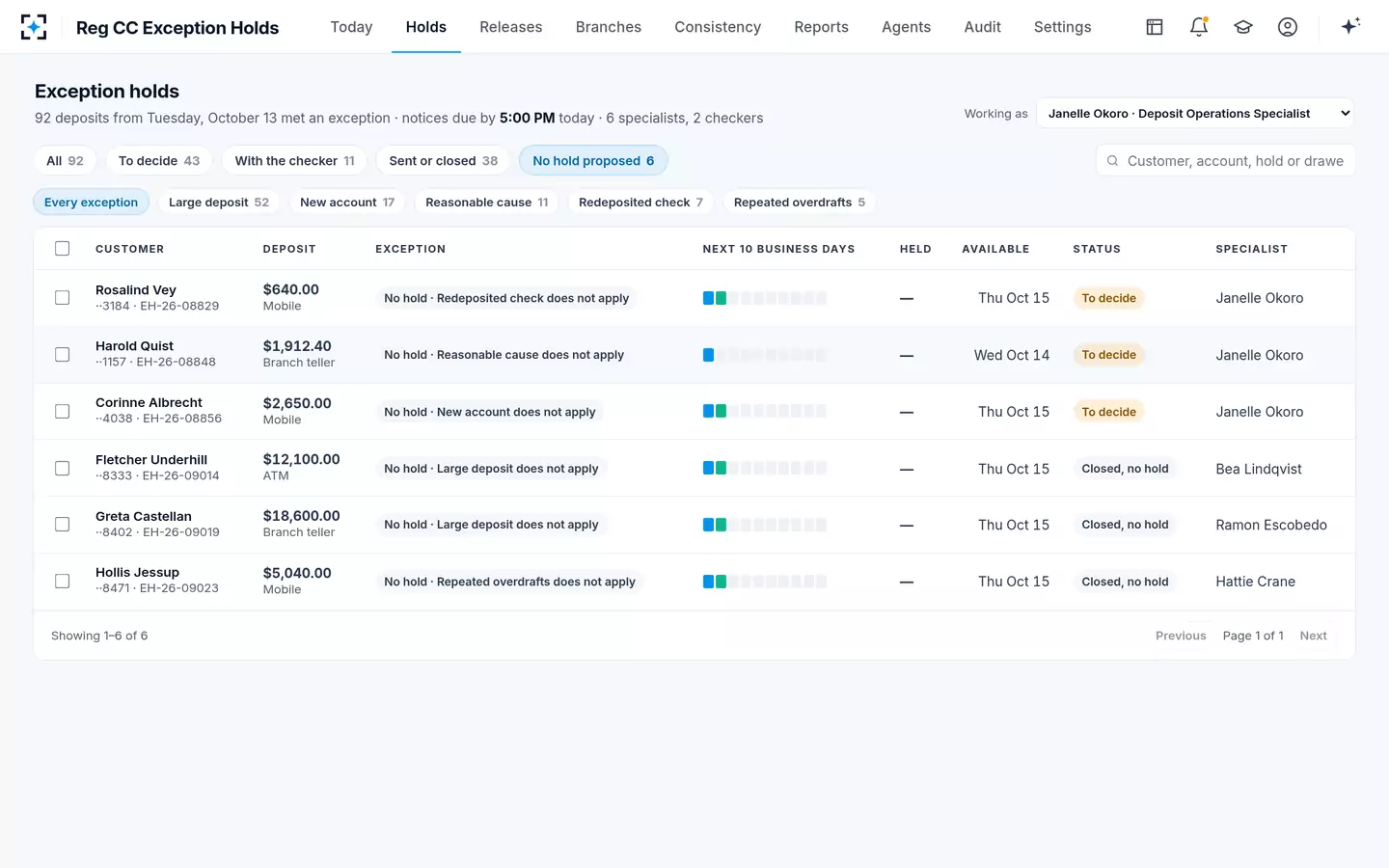
Day 31 is where hand processes slip. A new-account flag set by the core at opening is often cleared by a batch job or by a person, and a flag that clears a few days late turns every hold in those days into a hold the rule does not allow. At the sample bank, Corinne Albrecht's $2,650.00 mobile deposit was flagged by the core as a new-account hold; the hold agent noticed the account had turned 31 days old, proposed normal availability instead, and cited 229.13(a).
The second way an account stops being new is that it never was. The rule's own sentence is the one to train on: an account "is not considered a new account if each customer on the account has had, within 30 calendar days before the account is established, another account at the depositary bank for at least 30 calendar days." Each customer, not one of them; another account, which the commentary widens to any transaction account relationship, dormant ones included; and that other account must be at least 30 days old.
Is a second account a new account under Reg CC?
Not if every owner already banks there. The commentary gives six examples, and between them they settle most of the cases a branch meets (commentary to 229.13(a)).
New account or not? The commentary's six cases
Not a new account: An established customer opens a second account.
A new account: The customer's only other relationship is a savings deposit that is not an "account" under the rule.
Not a new account: An account opened to replace one closed after stolen checks or a stolen card, where the old relationship was at least 30 days old.
A new account: The old account was itself less than 30 days old.
Not a new account: A customer closes an established account and opens another within 30 days.
A new account: More than 30 days passed with no account at the bank.
Not a new account: A joint owner of an established account opens an individual account.
A new account: The individual's only link is signing authority on a corporate account.
Not a new account: Each has an established individual account.
A new account: One of them has no current or recent account, even if the other does.
Two practical rules follow. First, the test is per customer, so a joint account is new as soon as one owner is new to the bank. Second, the bank may rely on what the customer says: the commentary lets the depositary bank rely on the customer's representation that they have no established account relationship and have had none in the past 30 days. A bank that asks the question at opening and keeps the answer has a defensible file even when its systems cannot see an old relationship under a different customer number.
Mergers have their own rule. Merged banks may be treated as separate banks for a year after the merger for most of subpart B, but not for this exception: a customer with an established account at one party may not be treated as a new account holder at another party to the merger (commentary to 229.19(g)).
What the new account hold rules still require
The exception lifts some limits and leaves others in place, and a hold policy that treats a new account as "anything goes" breaks the ones that remain. The table follows the rule clause by clause.
New account hold rules: what is still owed during the first 30 days
| Deposit into a new account | When it must be available | Rule |
|---|---|---|
| Cash deposited in person; wire and ACH credits | Next business day after the banking day of deposit | 229.13(a)(1)(i), 229.10(a)–(b) |
| Treasury, cashier's, certified, teller's, traveler's, Federal Reserve, FHLB, state and local government checks, in person, to the payee | First $6,725 a banking day on the next business day | 229.13(a)(1)(ii), 229.10(c) |
| The same checks, not in person (e.g. by ATM or mobile) | First $6,725 on the second business day; a Treasury check still on the next business day | 229.10(c)(2) and commentary |
| Any of those checks above $6,725 in a day | By the ninth business day | 229.13(a)(1)(ii) |
| On-us checks and the first $275 of other checks | No next-day requirement | 229.13(a)(1)(iii) |
| Local checks | No maximum in the regulation; the bank's disclosed policy governs | 229.13(a)(1)(iii) |
The Federal Reserve's small-entity guide states the result in one line: during the new-account period "Next-day availability applies only to cash, electronic payments, and the first $6,725 of any other next-day items", and the bank "may choose any availability schedule for deposits of other checks" (A Guide to Regulation CC Compliance). The FDIC's examiners have the same note in their procedures: "No regulatory time limits are set forth for funds availability for local check deposits into new accounts" (FDIC CCEM VI-1).
How long is a new account hold?
As long as the bank's disclosed policy says, for ordinary checks, and no longer than the ninth business day for the excess of next-day items over $6,725. The absence of a regulatory maximum for local checks is not an absence of limits: the bank must hold to the period it disclosed before opening the account (229.17), and the hold must stop when the account stops being new. A bank can choose a period close to the exception-hold extension, as the sample bank does: its policy, FA-4.3, makes checks into new accounts available on the seventh business day.
Two $9,000 checks into the same new account, deposited in person on Tuesday, October 13, 2026
- First $6,725: next dayOct 14
- Excess $2,275: 9th business dayOct 26
- Held under the bank's policy: 7th business dayOct 22
The cashier's check lane is the one teams get wrong. Because a new account has no ceiling for personal checks, a desk can come to treat it as having no ceiling for anything, and hold a $9,000 cashier's check for a fortnight. The rule protects the first $6,725 of it with next-day availability, if deposited in person to the payee's account, and fixes the ninth business day for the rest; a hold past either date needs a separate exception, such as reasonable cause, with a fact behind it.
Does a new account hold need a notice?
No individual notice is required. The exception-notice rule in 229.13(g) covers the large-deposit, redeposit, repeated-overdraft and reasonable-cause exceptions; the commentary says notices are due when a bank invokes the exceptions "other than the new account or emergency conditions exception". The FDIC's procedures carry the same carve-out: "With the exception of new accounts, determine whether the bank provides the customer with an exception-hold notice."
The disclosure carries the weight instead. Before opening the account the bank must give the specific availability policy disclosure, and the model forms include a "Special Rules for New Accounts" section that tells the customer which deposits are next-day and when other checks will be available (229.16, 229.17). A bank may still choose to send a hold notice on new-account deposits, because the customer will ask why the money is not there; doing so is good service, and a notice that states a wrong date is evidence against the bank like any other.
Three refusals the rule requires, including an account past day 30
New account holds and fraud: the overlap, and its limit
The new-account exception exists because new accounts carry more risk; the commentary calls it one of the "safeguard exceptions" Congress wrote into the Act. It is the bank's lawful tool for the first 30 days, and it needs no suspicion at all. What it does not do is outlast day 30, and a bank that wants to keep holding a new customer's checks after that needs a reason the rule recognises for each deposit.
Reasonable cause is the tempting substitute, and the wrong one when the only reason is the customer's newness: a belief based on a class of depositor is excluded by the rule. The warning signs a new account can show in its first weeks are set out in new account fraud red flags, day by day; the point for the hold desk is that a red flag is a reason to look, and only a fact about a particular check is a reason to hold it past the schedule. The six reasons and the line between them are in the exception hold reasons.
Four new-account mistakes examiners find
The FDIC's procedures tell examiners to "Determine how the bank defines a new-account relationship" and whether that definition complies, then to review a new-account report, sample deposits and check that holds stayed "within regulatory limits with respect to time and amount" (FDIC CCEM VI-1). The four mistakes below are the ones that procedure is built to find.
The first is a definition by account number. A core that marks any account younger than 30 days as new, without looking at the owners, catches every second account the commentary excludes. The second is the late flag: the 30 days are calendar days, and a flag cleared on the next business day after day 30 is already late. The third is the cashier's check held like a personal check, which ignores the $6,725 and the ninth business day. The fourth is the joint account where only one owner was checked, which can err either way.
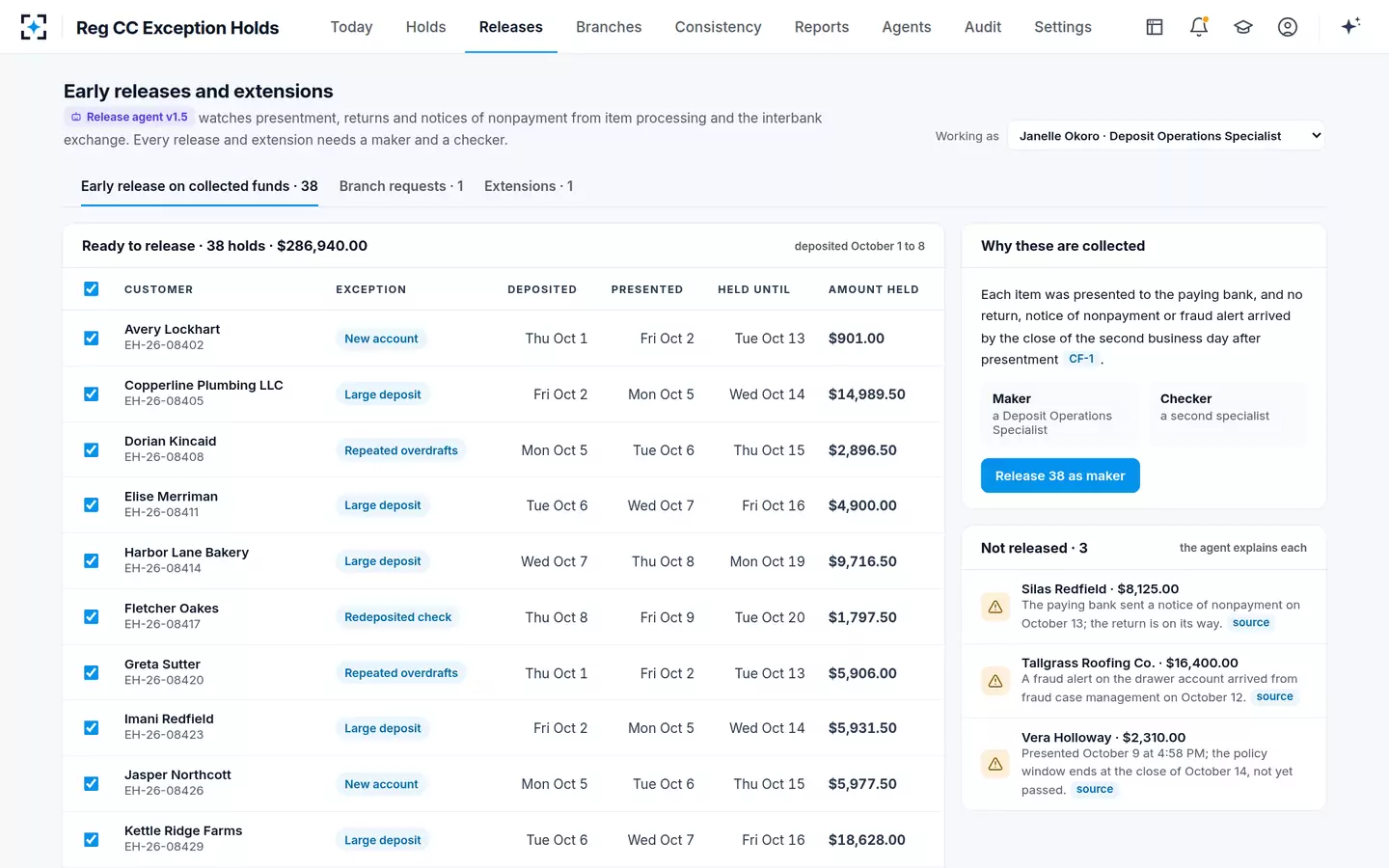
In Reg CC Exception Holds the intake agent reads the account's age and every owner's relationships from the core, the hold agent applies the 30-day test and the next-day carve-outs, and the date agent counts the ninth business day for the excess. Where the core's history is incomplete, the specialist sees it and decides, with the customer's representation if the bank took one. At the sample bank, holds on new accounts released early once funds were collected went through the same maker and checker as any other.
New-account holds released early on collected funds, with a checker
To see the 30-day test and the owners' history applied to your own new accounts, start from Reg CC Exception Holds. How a new-account deposit's dates are counted alongside the other exceptions is worked through in the hold calculator guide.
Questions people ask
What is the Reg CC new account hold definition?
An account during its first 30 calendar days after it is established, opened with its first deposit, unless each customer on it already had another account at the bank for at least 30 days within the 30 days before. Inside that window the bank may delay ordinary checks beyond the normal schedule. Cash, electronic payments and the first $6,725 of next-day checks keep their protection.
How many days is a Reg CC new account hold?
For ordinary checks, whatever the bank's disclosed policy says, because the regulation sets no maximum. For Treasury, cashier's, certified, teller's and government checks, the first $6,725 a day is next-day and the excess is due by the ninth business day after the banking day of deposit.
Does the $275 next-day rule apply to new accounts?
No. During the 30 days the next-day requirement for the first $275 of other checks and for on-us checks does not apply. The exception for next-day items covers only the special check types the rule lists.
Can a bank use the new account exception for a business account?
Yes. The exception turns on whether the account and its customers are new to the bank, not on whether it is a consumer account. The commentary's example of a corporate account's signer opening a personal account, which counts as new, shows the test follows the customer on the account rather than the people behind it.
Can a bank rely on the customer saying they have no other account?
Yes. The commentary allows the bank to rely on the customer's representation that they have no established account relationship and have had none in the past 30 days. Keeping that answer with the account opening papers is what makes the decision defensible later.
Is a new account hold the same as a large deposit hold?
No. The new-account exception applies to every check deposit for 30 days, with no amount threshold and no individual notice. The large-deposit exception applies to any account but only to the part of a day's checks above $6,725, needs a notice, and is limited to a reasonable extension.