A Reg CC case by case hold and an exception hold differ in one line: the regulation's availability schedule. A case-by-case hold, under 12 CFR 229.16(c), is open only to a bank whose usual policy is faster than the rule, and it lets that bank delay a particular deposit back up to the schedule, with no reason required. An exception hold, under 229.13, goes past the schedule, and it needs one of six exceptions, a notice that states the reason, and an extension limited to a reasonable period. Branch staff and back-office specialists mix the two up because both produce a "notice of hold" and both sit in the same field in the core, and the mix-up produces the two classic findings: a case-by-case hold that ran past the schedule with no exception behind it, and an exception notice sent for a delay that never needed one. Botminds' Reg CC Exception Holds decides which kind of hold a deposit needs before anything is drafted, then counts the dates and writes the matching notice for a specialist to approve.
Where this guide uses an example from the solution, it is the fictional sample bank, Tessaly Community Bank, and its customers on October 14, 2026.
Two kinds of notice, both written one customer at a time
2,000
exception hold notices a year per state member bank, in the Federal Reserve's paperwork estimate
700
case-by-case hold notices a year per bank in the same estimate
3min
the Board's estimated time per notice, 0.05 hours, because each is customer-specific
668
state member banks and foreign bank offices the estimate covers
What is a case by case hold?
A case-by-case hold is a delay a bank places on a particular deposit, at its discretion, when its general policy gives faster availability than Regulation CC requires. A bank that releases everything the next day can, from time to time, hold a particular deposit until the regulation's own deadline, such as the second business day for a local check, provided its funds availability disclosure warned the customer that it might. The rule calls these "Longer delays on a case-by-case basis" (229.16(c)).
The warning has three required parts: a statement that availability may be extended in some cases, with the latest time funds will be available; a statement that the bank will notify the customer when it does; and a statement that customers should ask if they need to know when a particular deposit will be available. The Board's model disclosure C-3 and the lobby notice C-18 are written for this kind of policy (Appendix C).
A bank whose policy already holds to the statutory limits on every deposit has no room for case-by-case holds at all: its normal schedule is the schedule. For that bank, every additional delay is an exception hold or a violation.
Reg CC case by case hold vs exception hold: the schedule is the line
The commentary draws the line in two sentences that should be on every hold desk: "If the bank imposes a delay on a particular deposit that is not longer than the availability required by § 229.12 for local and nonlocal checks, the reason for the delay need not be based on the exceptions provided in § 229.13. If the delay exceeds the time periods permitted under § 229.12, however, then it must be based on an exception provided in § 229.13, and the bank must comply with the § 229.13 notice requirements" (commentary to 229.16(c)).
So the question is never "how suspicious is this deposit?" but "what date am I about to put on it?" A date on or before the schedule makes it a case-by-case hold, whatever the motive. A date past the schedule makes it an exception hold, whatever the bank calls it in the core, and it is lawful only if an exception applies on the facts.
Which hold applies? Four questions, asked in order
1Is the money cash or an electronic payment?
YesNo hold beyond next-day availability. Neither kind of hold reaches it.
NoContinue: only check deposits can be held.
2Will the funds be available by the Reg CC schedule for this check?
YesAt most a case-by-case hold, and only if the bank's disclosed policy is faster than the schedule and says it may hold case by case.
NoContinue: past the schedule, only an exception will do.
3Does one of the six exceptions apply on the facts?
YesAn exception hold: name it, give the reason in the notice, extend by a reasonable period.
NoNo hold past the schedule. Release on the schedule date.
4Is it the new-account exception?
YesNo 229.13(g) notice is required and no maximum applies to local checks, but the disclosure must describe it.
NoSend the exception notice by the business day after the deposit or after the facts became known.
Reg CC hold types, side by side
The comparison below puts the two holds against each other on everything a desk has to get right. The notice rows are where most errors sit: the case-by-case notice is the shorter of the two, and copying an exception notice onto a case-by-case hold is harmless, while the reverse leaves out the reason the rule requires.
Case-by-case hold vs exception hold on every point a file is tested on
Case-by-case hold, 229.16(c): A bank whose disclosed policy is faster than the schedule, and that disclosed case-by-case delays.
Exception hold, 229.13: Any bank, for the exceptions its disclosure describes.
Case-by-case hold, 229.16(c): The Reg CC schedule: 2nd business day for a local check, 5th for a nonproprietary ATM.
Exception hold, 229.13: The schedule plus a reasonable period: up to 1, 5 or 6 more business days by kind of check.
Case-by-case hold, 229.16(c): None in law, and none in the notice.
Exception hold, 229.13: One of six exceptions, true on the facts; for reasonable cause, the facts themselves.
Case-by-case hold, 229.16(c): Account code, date of deposit, amount delayed, day the funds will be available.
Exception hold, 229.13: The same, plus the reason the exception was invoked.
Case-by-case hold, 229.16(c): At the time of deposit, or by the business day after the banking day of deposit.
Exception hold, 229.13: At deposit, or by the business day after the deposit or after the facts become known, whichever is later.
Case-by-case hold, 229.16(c): No overdraft or returned-check fees caused by the delay if the check is paid, unless the notice offers refunds.
Exception hold, 229.13: The same rule, for the reasonable-cause exception.
Case-by-case hold, 229.16(c): C-16, which carries no reason.
Exception hold, 229.13: C-12, or C-13 for reasonable cause; C-14 and C-15 for one-time notices.
Does a case by case hold need a reason?
Not in law, and not in the notice. The commentary to the model form is explicit: C-16 "does not require a statement of the specific reason for the hold, as is the case when a § 229.13 exception hold is placed" (commentary to Appendix C). That is the trade the rule offers a bank with a generous policy: discretion inside the schedule, in return for never going past it without an exception.
A reason the customer does not see is still a reason the bank should keep. Discretion applied unevenly across branches or neighbourhoods is a fair-treatment question an examiner can ask about even when every hold is inside the schedule, and the bank can answer it only from its own reasons. The FDIC's procedures also ask examiners to "Sample a few of the case-by-case holds" for timing and notices, and to review whether the case-by-case policy was disclosed at all (FDIC CCEM VI-1). In Reg CC Exception Holds every decision, including a case-by-case delay, carries a reason code, and the consistency agent shows how the bank decided comparable deposits before anyone decides this one.
Before deciding: how the bank treated 500 comparable deposits

How long can a case by case hold last?
No later than the regulation's schedule for that deposit: the second business day after the banking day of deposit for a local check, the fifth for a deposit at a nonproprietary ATM, and the next business day for items that must be next-day, such as cash in person, a Treasury check to the payee or the first $275 of the day's other checks (229.12). A bank that limits cash withdrawals may add one business day for cash under 229.12(d), provided $550 is available for cash by 5:00 p.m. on the normal day.
One trap sits in the model forms themselves. Model C-3, written when nonlocal checks existed, says funds "may not be available until the fifth business day after the day of your deposit", and the lobby notice C-18 says that held funds "will generally be available by the fifth business day". With one Reserve Bank check-processing region, every check is now local and the schedule's latest day for a check deposited at a branch is the second business day. A bank that copied the models' fifth-day wording into its disclosure has promised a latest time its case-by-case holds can no longer lawfully reach for local checks; the commentary to Appendix C warns banks not to adopt the models before checking them against their own policies and practices (Appendix C; commentary).
When a case-by-case hold has to become an exception hold
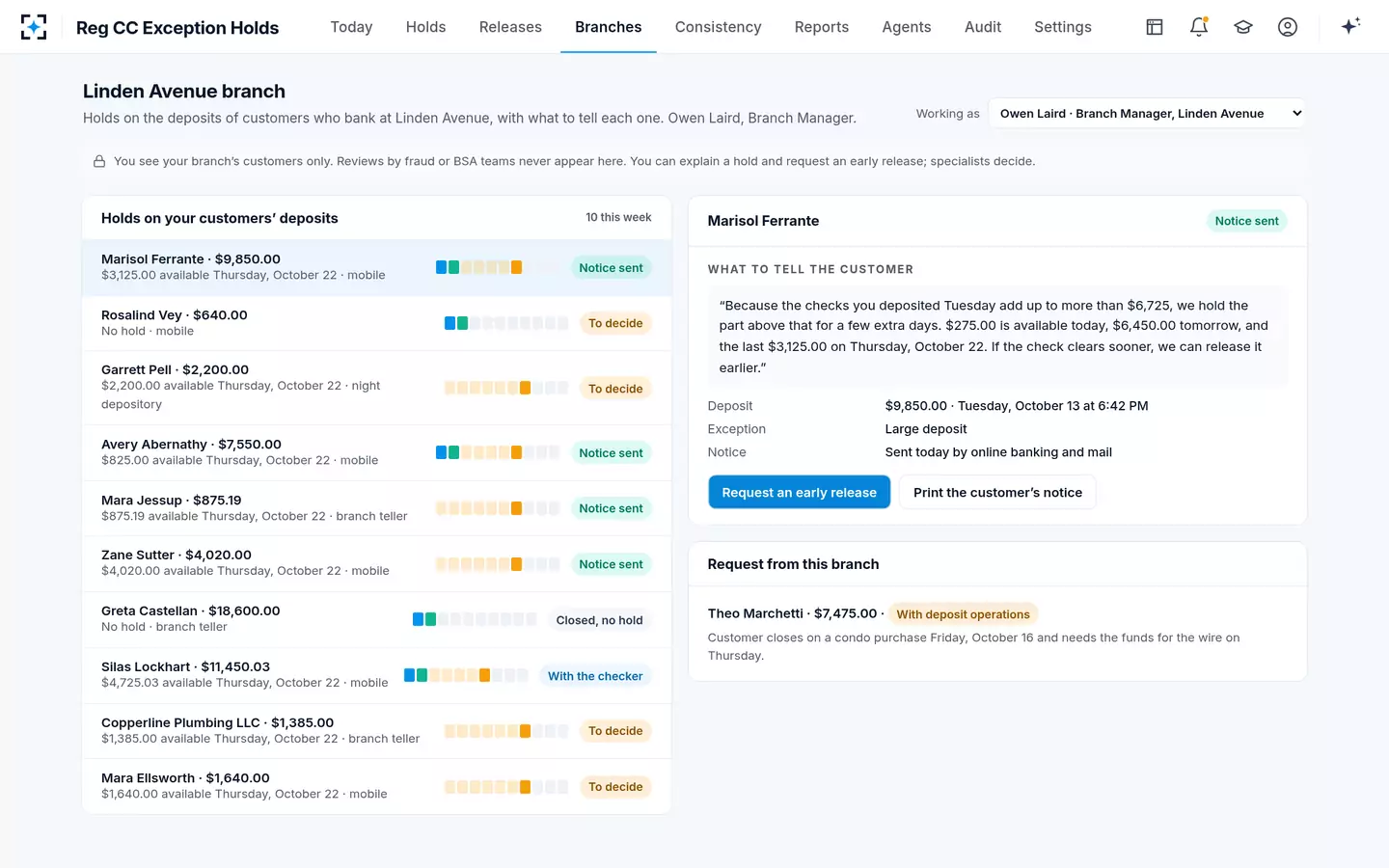
The same deposit can be either kind of hold depending on the date chosen. Take a bank whose policy is next-day availability for everything, and Marisol Ferrante's $9,850.00 mobile deposit at the sample bank. Holding all of it to the second business day is a case-by-case hold. Holding $3,125.00 of it to the seventh business day is a large-deposit exception hold. The first needs a four-item notice; the second needs a five-item notice with the reason, "The checks you deposited on this day total more than $6,725", as the sample bank's notice puts it.
One $9,850 deposit under three treatments: share available on each day
Policy: next day for all
- Day 1, all of it · 100%
Case-by-case hold to the schedule
- Day 1 · $275 · 2.8%
- Day 2 · $9,575 · 97.2%
Large-deposit exception hold
- Day 1 · $275 · 2.8%
- Day 2 · $6,450 · 65.5%
- Day 7 · $3,125 · 31.7%
The arithmetic shows why the line matters to the customer. A case-by-case hold costs the depositor one business day on 97% of the deposit; the exception hold costs one day on two-thirds and six days on the rest. Both are lawful, but only the second needs a reason, and the reason has to be true.
It also shows how a desk drifts into violations. A specialist who extends a case-by-case hold "for a few more days" because the item still feels doubtful has turned it into an exception hold without an exception. If the doubt rests on facts, the hold becomes reasonable cause, with a new notice stating the reason, due by the business day after the facts became known; if it does not, the money is released on the schedule date. The commentary's own example of an extension, a return notice arriving the day before a hold expires, requires a second notice with the new date. The reasonable-cause side of that call is set out in the six exception hold reasons.
Reg CC hold types: every kind of delay a bank can put on deposited money
| Hold type | Where in the rule | Notice | Limit |
|---|---|---|---|
| Schedule hold (the bank's normal policy) | 229.10, 229.12, disclosed under 229.16 | None per deposit; the disclosure, posted notice and deposit slip notice | The schedule itself |
| Case-by-case hold | 229.16(c) | Per deposit: account, date, amount delayed, day available | The schedule |
| Exception hold (five exceptions) | 229.13(b)–(f) | Per deposit, with the reason; one-time notices for some | Schedule plus a reasonable period |
| New-account hold | 229.13(a) | No 229.13(g) notice; disclosed in the policy | Next-day items: 9th business day for the excess; local checks: none |
| Hold on other funds when cashing or depositing a check | 229.19(e) | Disclosed with model clause C-6 or C-7 | No more than the check, and no longer than the schedules |
Reg CC case by case hold notice: four items and the next business day
A case-by-case notice must give a number or code identifying the account (no more than four digits are needed), the date of the deposit, the amount being delayed and the day the funds will be available. It goes to the person making the deposit at the time of a deposit made to an employee, or by mail or delivery no later than the first business day following the banking day of deposit when the deposit came in another way or the decision was made later (229.16(c)(2)).
The person who receives the notice at the counter is the depositor, who need not be the account holder; the commentary is explicit that the counter notice goes to whoever hands over the deposit. For ATM, night depository, mail and armored-car deposits, the commentary sets the deadline as "the close of the business day following the banking day on which the deposit was made". The exception notice has the same baseline, with one difference: when the facts arrive after the deposit, its clock starts from the day the bank learns them.
Both notices share the fee rule. If no written notice was given at the time of deposit, the bank may not charge overdraft or returned-check fees that would not have occurred without the delay, if the deposited check is later paid, unless the notice tells the customer they may be entitled to a refund and how to ask for one, and the bank refunds on request. The model forms carry that paragraph in brackets for exactly this purpose. What the hold notice must say, and what the bank must keep, is worked through in the file behind each hold.
At the branch: the words for each hold, and a way to ask for release
Which one should a bank's policy use?
Case-by-case holds suit a bank that wants to advertise faster availability and keep a lever for the deposits it is unsure of; exception holds suit a bank that holds to the schedule and needs time beyond it in specific situations. Many banks disclose both, with model C-3 as the starting point, and that is where training matters most: the same specialist needs to know, on each deposit, which regime the date puts them in.
The more consequential choice is operational. A desk that decides the kind of hold from the date it proposes, and drafts the notice from the same date, cannot send a four-item notice for a seven-day hold. A desk that picks "case-by-case" or "exception" from a menu first and types the date afterwards can, and notices are where examiners find fault: the Federal Reserve cited the exception notice rule, 229.13(g), 12 times at state member banks in 2025 (Consumer Compliance Outlook). Reg CC Exception Holds does it in the first order: the date agent counts, the hold agent names the regime and the exception, and the notice agent drafts the matching form for the specialist's approval. Seeing that on your own deposits starts from Reg CC Exception Holds.
Questions people ask
What is a Reg CC hold?
Any delay a bank puts on the availability of deposited funds under Regulation CC, the Federal Reserve's rule implementing the Expedited Funds Availability Act. It may be the bank's normal schedule, a case-by-case hold inside that schedule, or an exception hold past it. Each kind has its own disclosure and notice rules.
What are case by case hold reasons?
The bank may use any reason that is not unlawful, such as an unusual amount or an unfamiliar drawer, because the hold stays within the schedule. The notice need not state it. Keeping the reason internally is still prudent, because uneven use across branches or customer groups is a fair-treatment question.
Can a case-by-case hold be placed on a new account?
During the first 30 days the new-account exception already lifts the schedule for local checks, so a separate case-by-case hold is rarely needed. The bank's disclosure must describe its new-account availability, and next-day items still follow the $6,725 and ninth-business-day rules.
Is a one-time notice allowed for case-by-case holds?
Not as such, but the commentary allows a bank that imposes case-by-case delays to use the one-time notice provisions of 229.13(g)(2) and (3) for deposits those provisions cover: large-deposit and redeposit exceptions on nonconsumer accounts, and repeated overdrafts.
Do examiners test case-by-case holds?
Yes. The FDIC and NCUA procedures ask examiners to check that the case-by-case policy was disclosed, to sample holds for timing against the schedule, to review the notices' content and timing, and to check fee refunds where no notice was given at deposit.