If your check is on hold for 7 days, your bank has almost certainly placed a Regulation CC exception hold on it. A check deposited in the U.S. must normally be available by the second business day after the day of deposit, and when one of six exceptions applies the rule allows the bank up to five more business days for a local check, which today means almost every check (12 CFR 229.12(b); 229.13(h)(4)). Two plus five is the seventh business day, which on a calendar is usually 9 to 13 days. The exceptions are a new account, a deposit over $6,725 in a day, a check that bounced and was deposited again, an account that has been overdrawn repeatedly, reasonable cause to believe the check will not be paid, and emergencies such as a systems outage. The bank must tell you which one, how much is held and when it will be available. For the bank, each of those days is a customer's money out of reach and a call to the branch, which is why Botminds' Reg CC Exception Holds gives every hold its reason, its dates and its notice before a specialist approves it, and watches for the moment the money can be released early.
The bank-side examples come from a fictional sample, Tessaly Community Bank, on October 14, 2026. The rules and the official figures are linked where they appear.
A seven-day hold, in four numbers
7
business days: the latest a local check can be held under an exception without more proof
9–13
calendar days that seven business days usually takes, depending on weekends and holidays
10.5%
of 8,127 consumer complaints at Fed-supervised banks in 2024 were about funds availability and access
$6,725
the amount above which a day's check deposits can be held as a large deposit
Why is my check on hold?
Because the bank invoked one of the six exceptions, or because your account is new, or because its own policy delays some deposits up to the normal schedule. The hold notice tells you which: for an exception hold, the notice must state the reason, the amount held and when the funds will be available, and if it was not handed to you at the counter it must be mailed or delivered by the next business day (229.13(g)).
Why a check is on hold, and how long the rule lets it last
| What the notice says | What it means | Usual latest day for a local check |
|---|---|---|
| The checks you deposited exceed $6,725 | Only the amount over $6,725 is held; the rest follows the normal schedule | 7th business day for the excess |
| Your account is new | Fewer than 30 days since the first deposit, and you had no other established account there | The bank's own policy; next-day items above $6,725 by the 9th business day |
| A check was previously returned unpaid | The check bounced once and was deposited again | 7th business day |
| Your account has been overdrawn repeatedly | Negative balances on 6 days in 6 months, or on 2 days by $6,725 or more | 7th business day, for 6 months after the last such overdraft |
| We believe the check will not be paid | The bank has a specific fact about this check, stated on the notice | 7th business day |
| An emergency has occurred | An outage or event beyond the bank's control delayed collection | A reasonable time after the emergency ends |
Why does a bank hold a check for 7 days?
Because a bank usually has to give you the money before it can know whether the check will be paid. A check deposited on Monday must be available on Wednesday, but a check the paying bank refuses can take longer than that to come back. The exceptions exist for deposits where that risk is higher, and the extension is sized to the return time: one business day for an on-us check, five for a local check and six for a deposit at a nonproprietary ATM, the commentary says, "should provide adequate time for the depositary bank to learn of the nonpayment of virtually all checks that are returned" (commentary to 229.13(h)).
That sizing is now being questioned. In June 2025 the Federal Reserve, the FDIC and the OCC asked whether "technological advancements in check processing reduced the time it takes for depository institutions to learn of nonpayment or fraud such that funds availability requirements for local checks and nonproprietary ATMs should be shortened", and what the effects would be on consumers who rely on timely access to funds (90 FR 26293, question 14). The same request asked how often consumers and businesses are affected by holds and how responsive banks are to their questions. No rule had followed by October 2026, so the seven-day ceiling stands; how the amounts did change in 2025 is in the July 2025 changes.
A seven-business-day hold, laid out on the calendar
- Normal schedule: 2 business daysOct 15
- Exception: 5 more, with a weekendOct 22
- Normal: over ChristmasDec 28
- Exception: over New YearJan 5
Why is my check on hold for 9 days, or 11?
Usually because seven business days is nine calendar days or more. A check deposited on Monday, Tuesday or Wednesday of an ordinary week and held to the seventh business day is available nine calendar days later; one deposited on Thursday or Friday waits eleven, because two weekends fall inside the count. A holiday adds a day, and the late-December example above runs to thirteen.
Calendar days a 7-business-day hold lasts, by the day of deposit
Nine business days has a specific source: in a new account, cashier's, certified, teller's and government checks above $6,725 a day must be available by the ninth business day. Eleven business days is the ceiling for a deposit at an ATM the bank does not own: five days of normal schedule plus six. Anything longer needs the bank to show why it was reasonable, and in a new account the rule sets no ceiling at all for ordinary checks, so the bank's disclosed policy decides.
Can a bank hold a cashier's check for 7 days?
Yes, in some cases. A cashier's check deposited in person into the payee's account is normally next-day money. But the large-deposit, redeposit, repeated-overdraft and reasonable-cause exceptions all reach checks that would otherwise be next-day, and the commentary treats the extension as added to the schedule the check would have had without next-day treatment, which for today's checks is the local schedule: second business day plus five, the seventh (commentary to 229.13(h)). For a large cashier's check, only the amount above $6,725 can be held that way; the first $6,725 stays next-day.
A teller's impression that a cashier's check "looks wrong" is not enough on its own. Reasonable cause needs facts about the check, such as a paying bank that says it was not issued, and the reason has to be on the notice. In a new account the first $6,725 still comes the next business day and the excess by the ninth. The six reasons and what each needs are compared in the exception hold reasons.
What each hold day costs the customer
Each hold day is money the customer owns and cannot use, and the costs show up in three places. The first is the bills: rent, payroll for a small business, a car payment that the deposit was meant to cover. The second is fees: a hold that makes a later payment bounce can trigger an overdraft or returned-item fee. The rule limits those for reasonable-cause and case-by-case holds: if the bank did not give written notice at the time of deposit and the check is paid, it may not charge fees that would not have occurred but for the delay, unless its notice says the customer may be entitled to a refund and how to ask, and it refunds on request (229.13(e)(2)).
The third is trust, and it is measurable. In 2024 the Federal Reserve logged 8,127 consumer complaints about the state member banks it supervises; 850 of them, 10.5%, were about "Funds Availability/Withdrawals/Unable to Access Funds", the fourth-largest topic after restricted accounts, fraud and error resolution (Consumer Compliance Outlook, 2025). A hold the customer understands, with a date that turns out to be right, rarely becomes a complaint; a hold with no reason or a date that moves usually does.
For the bank the arithmetic runs the other way. A hold that is longer than the rule allows, or lacks a proper notice, exposes the bank to the customer's actual damages plus a court-set amount of $125 to $1,350 in an individual action, and up to the lesser of $672,950 or 1% of net worth in a class action (229.21(a)). A hold that is shorter than needed exposes it to a returned check. The aim of a hold desk is not fewer holds but the right ones, each as short as the facts allow.
The regulator's own answer still quotes the old amount
Depositors who look the rules up get a mixed picture. The CFPB's consumer answer on deposit holds, reviewed on August 28, 2026, still gives the pre-2025 figures: $5,525 as the point above which funds can generally wait up to seven business days, and $225 as the amount due the next business day (Ask CFPB: How long can a bank or credit union hold funds I deposited?). Both amounts were raised on July 1, 2025, to $6,725 and $275, and the Federal Reserve's own small-entity guide carries the new figures (A Guide to Regulation CC Compliance).
The lesson for a bank is to make its own notice the source the customer trusts. A notice that states the amount held, the reason in plain words and a calendar date, such as "Thursday, October 22", answers the question before the customer searches for it. A notice that says "the seventh business day after the day of your deposit" sends them to a search engine and, in this case, to an out-of-date number.
What the branch can tell the customer, in words a customer uses
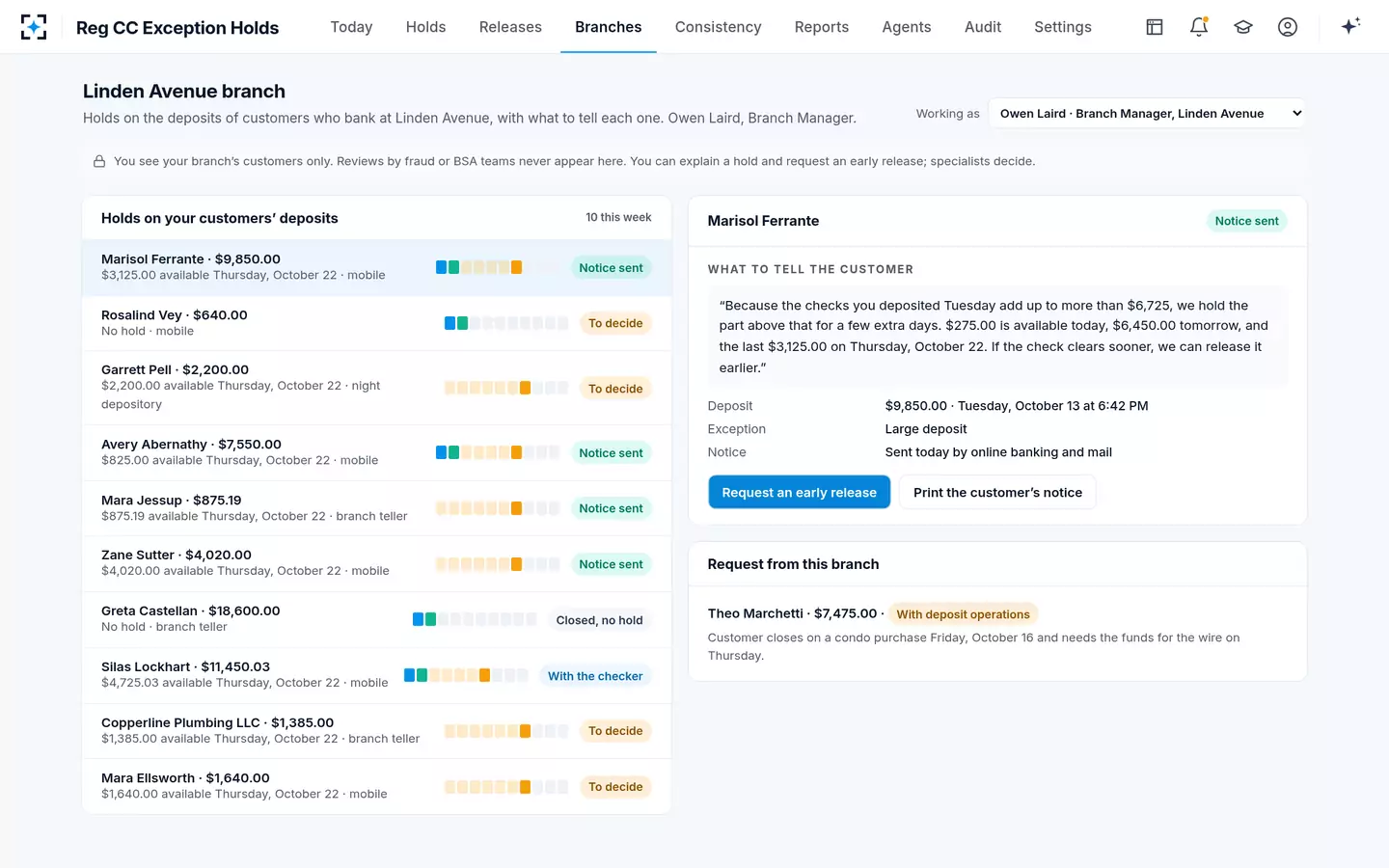
Can a bank release a check hold early?
Yes. Regulation CC sets maximums, not minimums, and it says plainly that it does not prohibit a bank from making funds available sooner (229.19(c)(1)). Many holds outlive their purpose: the check was presented, no return or notice of nonpayment arrived, and the risk the hold covered is gone. A bank that releases those holds when its own collected-funds test is met shortens the customer's wait without taking on the risk the exception was meant to cover.
At the sample bank that test is a written rule, CF-1: an item is treated as collected when it was presented to the paying bank and no return, notice of nonpayment or fraud alert arrived by the close of the second business day after presentment. On October 14 the release agent found 38 holds deposited October 1 to 8, $286,940.00 in all, that met it. A specialist released them as the maker and a second specialist posted them. The agent left out three and said why: a notice of nonpayment on one, a fraud alert on another, and a third whose window had not yet closed.
38 holds released early on collected funds, and three that were not
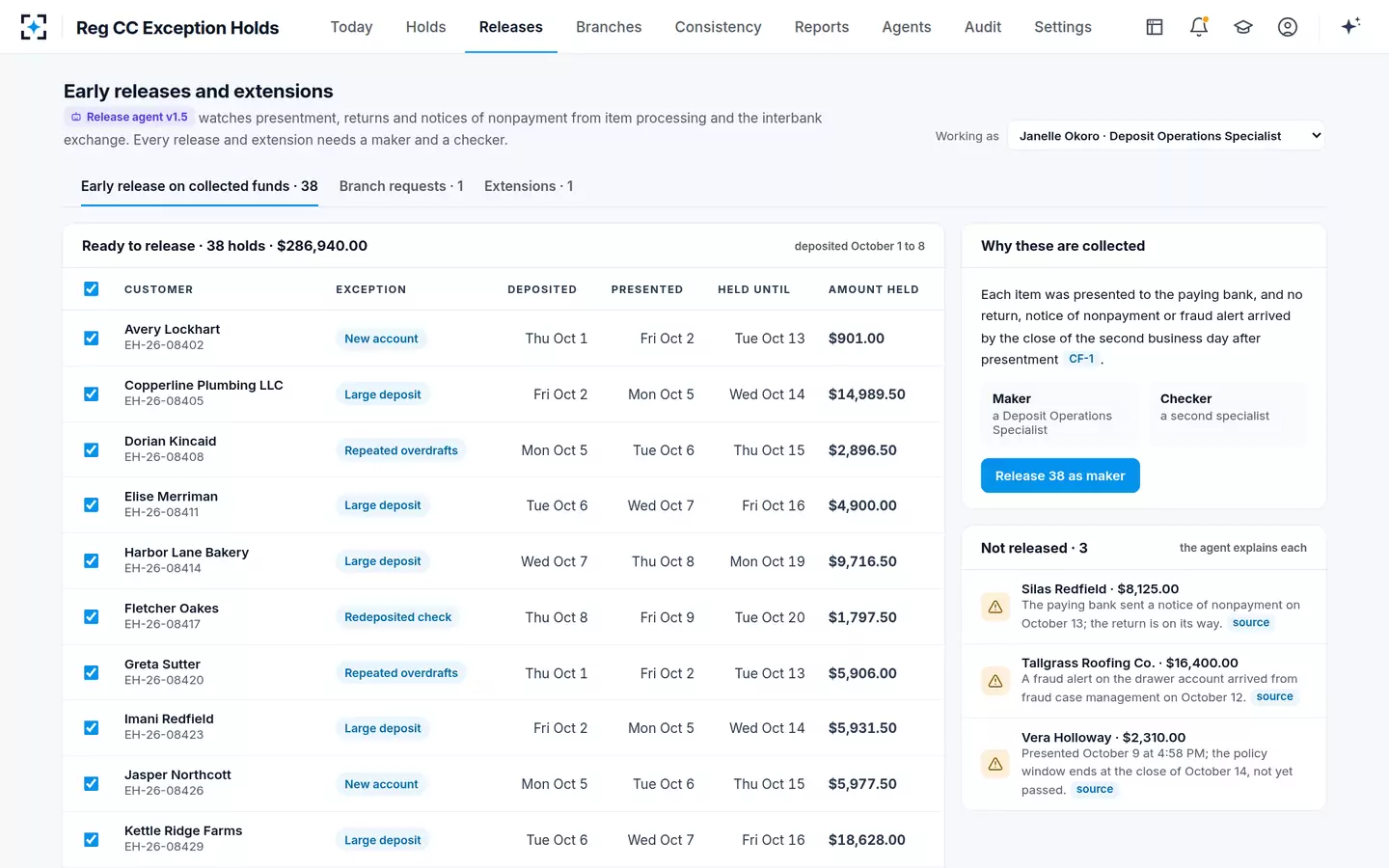
Branch requests take the same path. A branch manager whose customer needs funds for a closing can ask for an early release with a reason, and deposit operations decides it from the collected-funds evidence, not from the urgency. The release is recorded with the same care as the hold, because a release that turns out wrong is a loss, and a release refused without a look is the complaint the Federal Reserve's numbers count. How the dates themselves are counted is in the hold calculator, and the solution's full morning on one large deposit starts from Reg CC Exception Holds.
Questions people ask
How long can a bank hold a check?
Normally until the second business day after the day of deposit for an ordinary check, with $275 of it available the next day. With an exception, up to five more business days for a local check, so the seventh business day. A longer hold is lawful only if the bank can show it was reasonable, and new accounts follow their own rules.
How long can a bank hold a deposit of cash?
Cash deposited in person to a bank employee must be available the next business day, and none of the exceptions reach cash. Cash deposited at an ATM or by mail can take until the second business day, or the fifth at an ATM the bank does not own.
What does a deposited check on hold mean?
The bank has credited the deposit to your account but will not let you withdraw all of it until a stated date, because the check has not yet been collected from the paying bank. The hold notice says how much is held, why and until when. Funds on hold are still yours; the bank simply is not obliged to let you spend them before that date.
Do weekends count in a check hold?
No. Holds are counted in business days, which exclude Saturdays, Sundays and the federal holidays listed in Regulation CC. That is why a hold of seven business days usually lasts nine to eleven calendar days, and longer across a holiday.
Can I ask the bank to release a hold early?
Yes, and the bank is allowed to agree, because the rule sets maximum hold times, not minimums. A bank is most likely to release when it can see the check has been presented and nothing has come back. If a hold made a payment bounce and the check was later paid, ask about a refund of the fee.