Reg CC training for tellers has one legal anchor and one practical aim. The anchor is 12 CFR 229.19(f): every bank must set procedures for complying with the funds availability rules and give each employee whose duties the rules touch a statement of the procedures that apply to that employee. The aim is narrower than most courses make it. A teller needs to know when a deposit counts as received, what the customer can withdraw and when, which deposits might be held and why, how to hand over a hold notice at the window, and which decisions are not the teller's to make alone, above all a reasonable-cause hold resting on how a customer seemed. Training is hard to keep current because the people turn over and the amounts change: the $6,725 threshold has applied only since July 1, 2025. Botminds' Reg CC Exception Holds takes the hold decision to deposit operations, where a specialist approves and a second specialist checks, and gives each branch the plain words for every hold on its customers' deposits.
The day below is one deposit day at a fictional sample bank, Tessaly Community Bank, on Tuesday, October 13 and Wednesday, October 14, 2026, as it runs through the solution.
Who touches a held deposit, and what Reg CC asks of each
Today
Takes the deposit, guesses whether a hold will follow, and is asked to pick a hold reason from a menu at the window.
With agents
Takes the deposit, tells the customer when funds will be available, requests a hold with the facts seen, and hands over the notice when the hold is decided at the counter.
Still theirs: The conversation with the customer and the first look at the check.
Today
Picks a reason from a fixed list, counts business days by hand and types the notice.
With agents
Opens each flagged deposit with the exception proven, every slice dated and the notice drafted, and approves as the maker.
Still theirs: The decision, above all on reasonable cause.
Today
Catches a wrong date only by recounting it.
With agents
Works a five-point check beside the same dates and notice, and never checks a decision of their own.
Still theirs: The second signature.
Today
Has no words ready when a customer asks why money is held.
With agents
Sees the branch's holds with a plain explanation for each and requests early releases with a reason.
Still theirs: The customer relationship.
Today
Learns how branches apply the policy from samples, complaints and exams.
With agents
Reads a quarterly consistency report by branch, channel and neighbourhood, and approves the training fixes it calls for.
Still theirs: The policy, the templates and the training content.
What does Regulation CC require for training?
Procedures, and a written statement of them for each employee who carries them out. The rule reads that each bank "shall provide each employee who performs duties subject to the requirements of this subpart with a statement of the procedures applicable to that employee" (229.19(f)). The commentary explains where that comes from: the Act requires banks to "inform fully each employee that performs duties subject to the EFA Act" and to keep procedures "reasonably designed to assure and monitor employee compliance" (commentary to 229.19(f)).
The rule sets no hours and no frequency. Examiners judge adequacy instead. The FDIC's procedures tell them to identify who does each Reg CC task, naming "Determining case-by-case holds or exceptions" among them, to review training manuals and written procedures, to "Determine the extent and adequacy of the instruction and training received by those employees", and to "Verify that the bank provides each employee with a written statement regarding the bank's procedures that pertain to that employee's function" (FDIC CCEM VI-1). The Federal Reserve's small-entity guide gives the practical version: "employees who issue hold notices should be instructed on when to hold funds and how to notify customers that funds are being held" (A Guide to Regulation CC Compliance).
That last sentence is the test of a teller course. A slide deck on the history of the Expedited Funds Availability Act passes no examiner's adequacy test on its own; a one-page procedure for the teller's actual decisions, matched to the bank's disclosure and cutoffs, does.
Why teller training never stays done
340,820
tellers employed in the U.S. in May 2023
26,800
teller openings projected each year, 2025 to 2035, despite falling employment
−13%
projected change in teller employment, 2025 to 2035
2025
the year the $6,725 and $275 amounts replaced $5,525 and $225
One deposit day, from the window to the notice
Hold decisions are made in three places on a deposit day: at the window when the deposit comes in, in the back office the next morning when the day's deposits are read, and whenever a return or a paying-bank notice arrives. A training plan that covers only the first misses where most holds are decided.
One deposit day at the sample bank: where each hold decision is made
- Teller deposits, holds decided at the counterto 4 PM
- After cutofffrom 4 PM
- ATM until 2 PM2 PM
- Mobile until 8 PM8 PM
- Agents readby 6:15 AM
- Specialists decide 92 exceptionsto 3 PM
- Checker and noticesby 5 PM
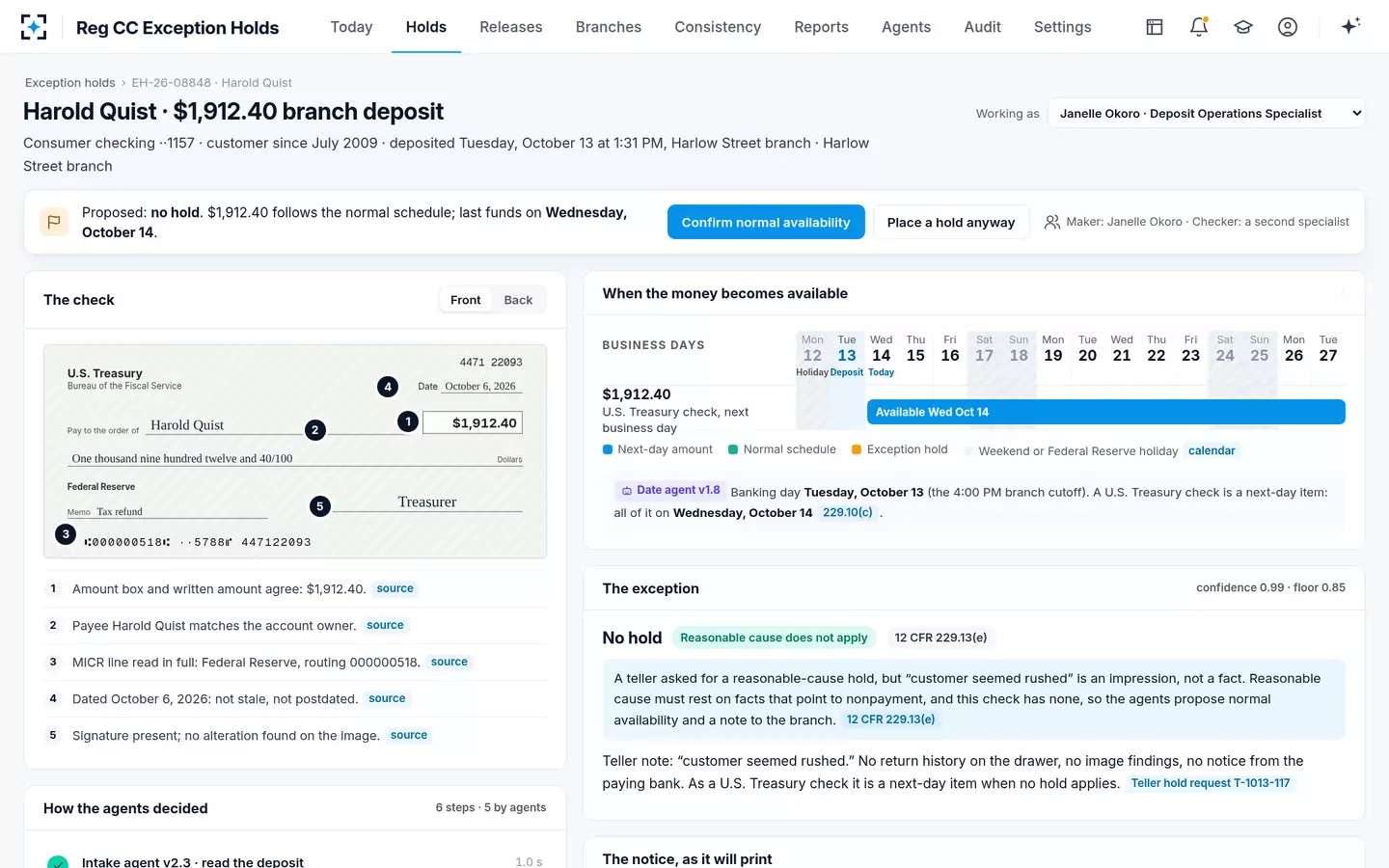
At the window, 1:31 PM. Harold Quist, a customer since 2009, deposits a $1,912.40 U.S. Treasury tax refund at the Harlow Street branch. The teller asks for a reasonable-cause hold and writes "customer seemed rushed." That is the moment the training has to have reached: the teller has noticed something, which is useful, and turned it into a hold request with no fact about the check behind it, which the rule does not accept.
Overnight. Monday was Columbus Day, so the agents read two days of deposits from item processing, mobile and ATM capture and the core: 14,860 checks, 92 meeting an exception. Marisol Ferrante's $9,850.00 mobile deposit at 6:42 PM fell inside the 8:00 PM mobile cutoff, so its banking day is Tuesday and its notice is due on Wednesday.
Wednesday morning. The specialists work through the proposals. Harold Quist's request is turned down with the reason, the check is available on Wednesday as a next-day item, and the branch gets a plain note. Marisol Ferrante's large-deposit hold is approved as the maker at 9:24 AM and checked by a second specialist at 9:26 AM, and the notice goes to her by online banking at once and on paper in the 5:00 PM batch.
A teller's hold request, refused for want of a fact
What should tellers know about Reg CC?
Less law than most courses teach and more about their own window. The checklist below is the content a teller-level statement of procedures needs, in the order a deposit meets it.
What tellers should know about Reg CC: a teller's statement of procedures
- When a deposit counts as received
The branch cutoff, the ATM cutoff, and that a deposit after it, or on a weekend or holiday, belongs to the next banking day.
- What is available tomorrow
Cash in person, wires and ACH, Treasury checks to the payee, on-us checks at a branch, cashier's and government checks in person, and the first $275 of other checks.
- When the rest is available
Local checks by the second business day; the bank's own disclosure may be faster.
- The six reasons a deposit can be held longer
In plain words: new account, more than $6,725 in checks in a day, a check that bounced before, repeated overdrafts, a specific doubt about the check, an emergency.
- The new-account question to ask
Whether every owner already has an account here; the bank may rely on the answer, so record it.
- How to request a hold
Write what you saw on the check or heard from the paying bank, not how the customer seemed; the request goes to deposit operations.
- How to hand over a hold notice
When a hold is decided at the counter, give the notice to the person making the deposit, account holder or not.
- What never to say
Nothing about fraud reviews, alerts or reports; the notice and the branch script carry the reason the rule allows.
- How to ask for an early release
Through the branch manager, with the customer's reason, decided by deposit operations.
Does a teller give the hold notice at the window?
Yes, when the hold is decided while the customer is at the counter. An exception notice must be provided at the time of the deposit unless the deposit was not made in person to an employee, or the facts behind the hold came to light afterwards (229.13(g)(1)(ii)). The commentary adds that the notice goes to the depositor, meaning whoever is at the counter with the deposit, even if that person does not hold the account; a business's runner gets the notice, not the business owner who is not there.
If the decision is made later, by the back office or because a return notice arrives, the teller's part is over and the notice is mailed or delivered by the business day after the deposit or after the facts became known. That split is why the notice a teller prints must come from the same source as the back office's: two notices for one deposit, with two different dates, are a complaint and an exam finding at once. The notice rules for each kind of hold, and what the bank must keep, are in the file behind each hold.
The teller also owns the posted notice. A bank must post its availability policy for consumer accounts in each place where employees accept consumer deposits (229.18(b)); the small-entity guide notes it need not be at every window, but must be where customers see it before they deposit, and is not required at drive-through windows or night depositories. A lobby notice still printed from a pre-2025 model is the first thing an examiner reads in a branch.
Can a teller place a reasonable cause hold?
The rule does not name job titles, but it makes the bank answer for whoever decides. When facts arrive after a deposit, the bank is treated as knowing them once they reach the person or persons responsible for the decision, or would have with due diligence; and the FDIC's examiners are told to find out who starts reasonable-cause holds at the bank. A bank that lets every teller place reasonable-cause holds has made every teller that person, and has to train, monitor and document each of them accordingly.
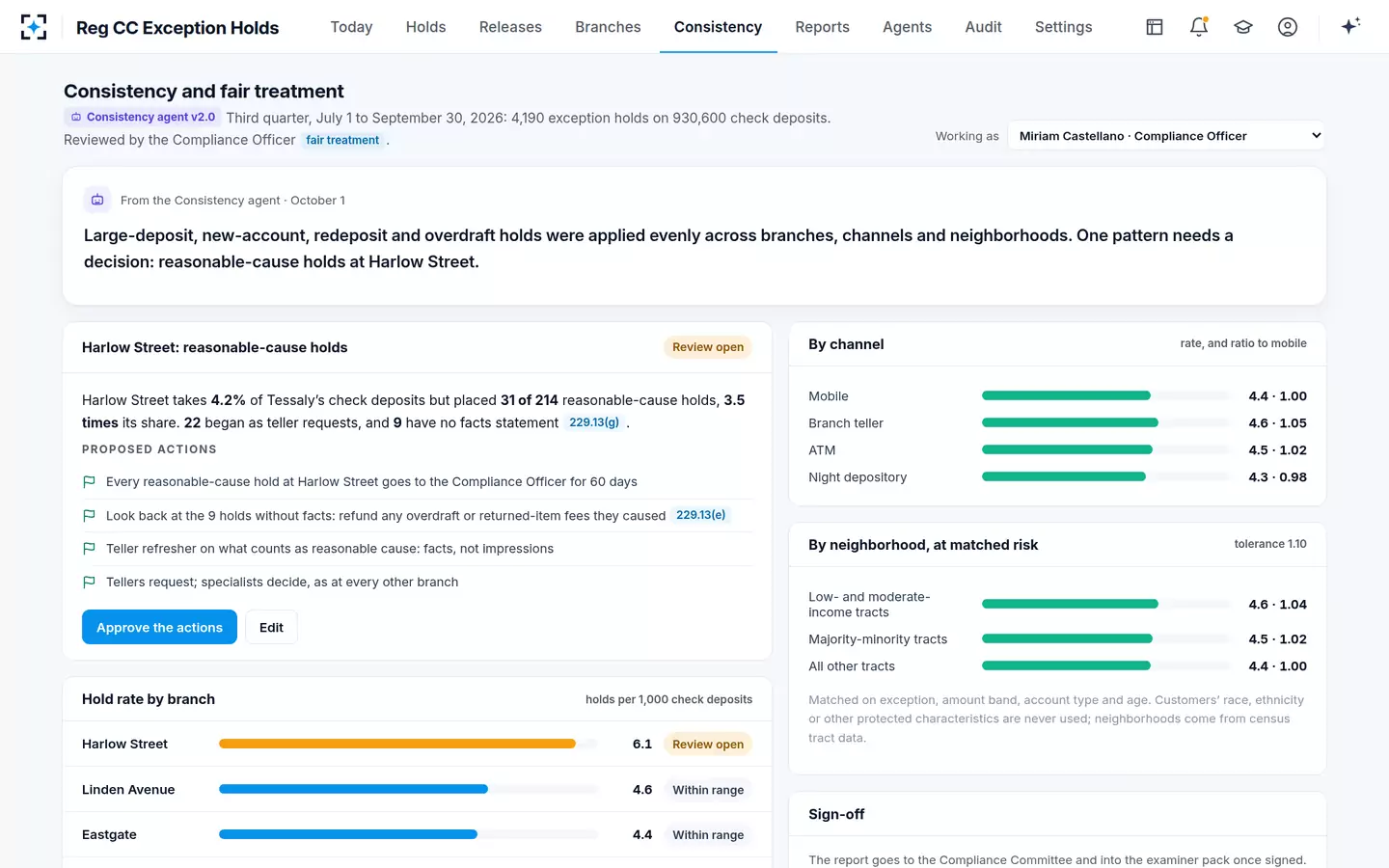
The sample bank's quarterly numbers show why most banks should not. Harlow Street takes 4.2% of the bank's check deposits but placed 31 of its 214 reasonable-cause holds last quarter, 3.5 times its share. Twenty-two of those began as teller requests, and nine had no facts statement at all. Large-deposit holds, decided from arithmetic, were even across branches. The pattern is what a teller-led reasonable-cause process tends to produce: holds that follow who is at the window rather than what is on the check. The proposed fix was training on what counts as reasonable cause to doubt collectibility, and a rule that tellers request and specialists decide, as at every other branch.
One branch, 3.5 times its share of reasonable-cause holds
Reg CC hold scenarios for a teller course
Scenarios teach faster than rules, provided each has one right answer and the reason for it. The six below cover the triggers a teller meets most, and each answer comes from the rule's text or its commentary.
Six Reg CC hold scenarios with their answers
| At the window | What happens | Why |
|---|---|---|
| Monday: $2,000 in cash and a $9,000 local check | $2,275 Tuesday, $6,450 Wednesday; $2,275 may be held longer as a large deposit | The commentary's own example; cash never counts toward $6,725 |
| A Treasury check; the customer seems rushed | Available next business day; no hold | An impression is not a fact about the check |
| A redeposit returned only for a missing indorsement, now indorsed | Normal schedule | The redeposit exception excludes this return reason |
| A joint account opened today; one owner has banked here for years | A new account | The test is every owner; one new owner makes it new |
| A $7,000 cashier's check, in person, into a 10-day-old account | $6,725 next business day; $275 by the ninth | New-account rule for next-day items |
| A deposit at 4:30 PM, after a 4:00 PM cutoff, on the Friday before Columbus Day | Treated as received Tuesday | After cutoff, and Monday is not a business day |
A scenario set like this also makes a fair training quiz, because each answer can be checked against a sentence of the rule. It pairs with the fraud side of the window, the red flags a teller can still see on a paper check, which is covered in check fraud training for tellers. The difference between the two courses is the hand-off: the fraud course teaches what to notice, this one teaches what to do with it under Regulation CC. The reasons themselves are compared in the six exception hold reasons.
Where the solution fits the branch
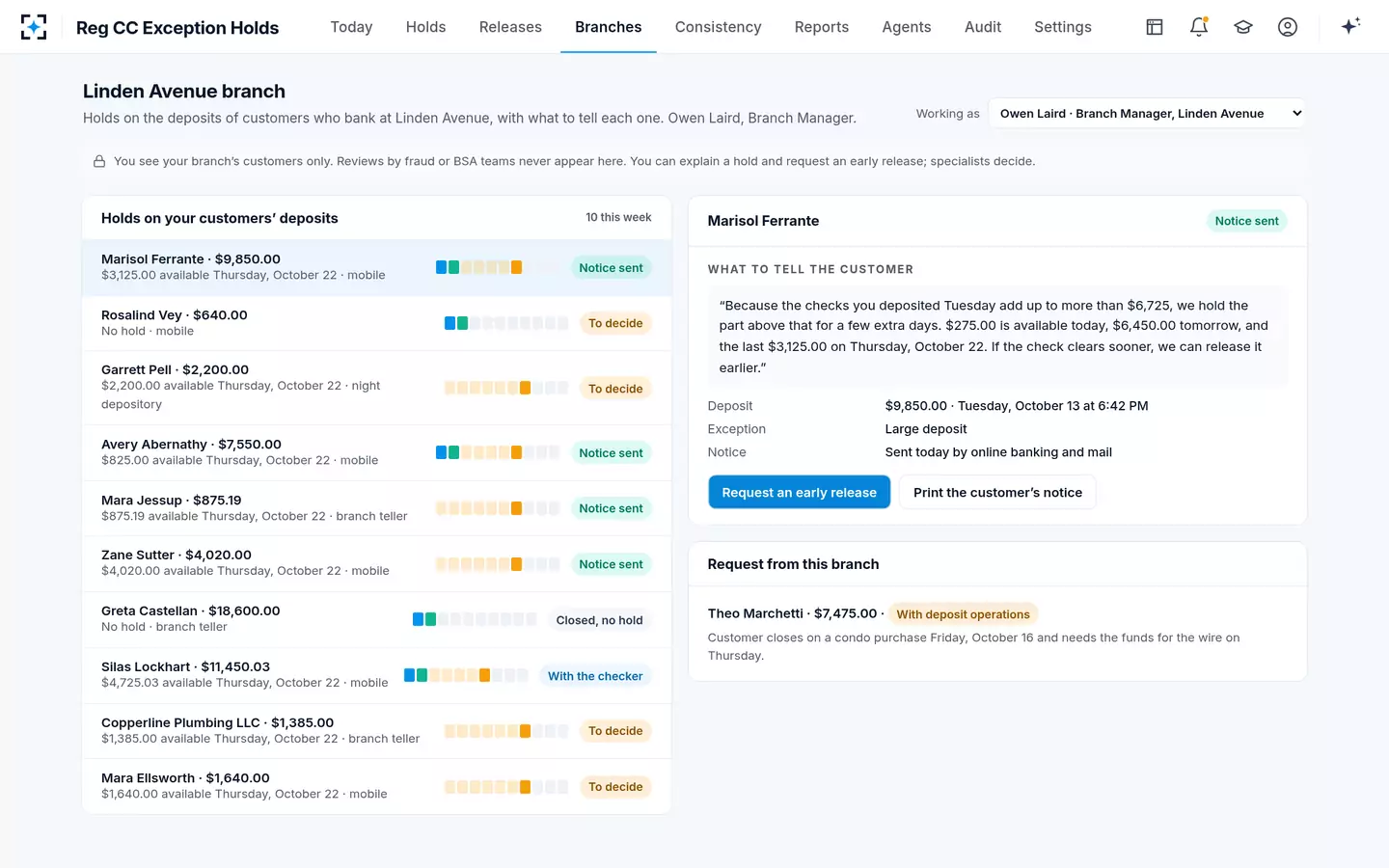
Reg CC Exception Holds does not train anyone; it narrows what a teller has to decide and makes the rest visible. Tellers request holds with what they saw; the hold agent proposes the exception or refuses it, with the rule; a specialist decides and a second specialist checks. The branch manager sees holds on the branch's own customers only, with the words to explain each one, and never sees reviews by fraud or BSA teams. That keeps the teller's statement of procedures short, which is what makes it learnable at 26,800 new openings a year.
The branch view: the words for each hold, ready at the desk
To see the branch view and the hold desk working on the same deposits, start from Reg CC Exception Holds.
Questions people ask
Is Reg CC training required?
The regulation requires procedures and a written statement of them for each employee whose duties the rules touch, and the Act requires banks to inform those employees fully. It sets no format or frequency; examiners judge whether the instruction is adequate for each person's job.
How often should tellers get Reg CC training?
The rule does not say. Sensible triggers are joining the bank, any change in the bank's availability policy or cutoffs, any change in the regulation's amounts, such as July 1, 2025, and evidence of uneven practice, such as one branch placing far more holds than its share.
What is on a Reg CC training quiz?
Good quizzes test decisions, not definitions: when a deposit counts as received, what is available tomorrow, which of six facts allows a longer hold, who gets the notice at the window and what to do with a doubt about a check. Each answer should trace to a sentence of the rule or the bank's disclosure.
Should tellers tell customers why a check is held?
Yes, in the terms the notice uses, and with the date. An exception notice must state the reason; a teller should not add suspicions, fraud reviews or anything the bank's fraud and BSA teams have not cleared for a customer.
Do tellers need to know the $6,725 threshold?
Yes, because a customer depositing several checks will ask why part of the money is held, and because a deposit can cross the threshold across accounts. Since July 1, 2025 only the part of a day's checks above $6,725 can be held as a large deposit.