Reg CC hold record retention is two years at least: every bank must keep evidence of compliance with the funds availability rules for that long (12 CFR 229.21(g)(1)), which in practice means the hold notices, the hold history and the dates behind them. On top of that, for each hold placed for reasonable cause to doubt collectibility, the bank must keep a record of the notice with a brief statement of the facts that gave it reason to doubt the check would be paid (229.13(g)(5)). If the bank learns it is being investigated, is under an enforcement proceeding, or is sued over the rule, the records for that matter must be kept until it is finally resolved. The hard part is not storage; it is that the facts, the dates and the notice live in different systems, and a file assembled before an exam rarely shows when the facts reached the person who decided, which is what starts the notice clock. Botminds' Reg CC Exception Holds builds the file as the hold is decided: each fact with its source, each date with its count, the notice as sent with its delivery, and both people who approved it.
The examples are from a fictional sample bank, Tessaly Community Bank, on October 13 and 14, 2026, as it runs through the solution.
The retention rule in four numbers
2years
minimum retention for evidence of compliance with the availability rules
1year
for a customer to sue after a violation, under 229.21(d)
5
items every exception notice must carry, the reason among them
12
Federal Reserve citations of the exception notice rule in 2025
How long to keep Reg CC hold notices?
Two years from the notice, at least, for every kind of hold notice, because each is evidence that the bank complied with subpart B. The reasonable-cause notice is the only one the regulation names separately, and it is the only one that must be kept with a statement of the facts. The FDIC's examination procedures test exactly that pair: "Determine that the bank retains for two years the notices required when a 'reasonable cause' exception is invoked" (FDIC CCEM VI-1).
The two-year floor stretches in one situation. If the bank has actual notice that it is being investigated by its regulator, is subject to an enforcement proceeding, or has been served with a suit under the rule, it must keep the records that concern the matter "pending final disposition of the matter", unless the agency or the court orders an earlier date (229.21(g)(2)). A retention schedule that deletes on the second anniversary without a hold check is a schedule that can destroy evidence the bank was obliged to keep.
Many banks keep these files longer as a matter of policy. The sample bank keeps hold files, facts statements and notices with delivery proof for five years; that is its own choice, and two years is the regulation's floor. Format is open: the rule allows microfiche, microfilm, magnetic tape "or other methods capable of accurately retaining and reproducing information", so an image of the notice as sent is as good as paper, provided it can be produced as it was.
What must a Reg CC hold notice include?
An exception notice must identify the account by a number or code (no more than four digits are required), and state the date of the deposit, the amount being delayed, the reason the exception was invoked and when the funds will be available (229.13(g)(1)). For reasonable cause, the reason has to be the bank's actual reason for believing the check will not be paid. The commentary allows the actual availability date in place of a count of business days, and a total for each date in place of a date for each check, as long as the customer can tell what arrives when.
The other notices are shorter or broader, and a file has to hold the right one; the four-item notice for a hold inside the schedule, with no reason at all, is compared with the exception notice in the case-by-case versus exception hold guide. The table sets them side by side; every row is a different form, with a different trigger and a different deadline.
Reg CC hold notices: what each must say and when it is due
| Notice | Must state | Due | Rule |
|---|---|---|---|
| Exception hold notice (large deposit, redeposit, overdrafts, reasonable cause) | Account code, date of deposit, amount delayed, reason, when funds will be available | At deposit if made in person; otherwise by the business day after the deposit or the day the facts became known, whichever is later | 229.13(g)(1) |
| Reasonable cause, in addition | Why the bank believes the check will not be paid; a refund paragraph if fees may be charged | As above | 229.13(e) |
| One-time notice, nonconsumer account (large deposit, redeposit) | The reasons an exception may be invoked and when such deposits will generally be available | At or before the first individual notice would be due | 229.13(g)(2) |
| Repeated overdraft notice | Account number, that the exception applies, when deposits will generally be available, how long the exception lasts | At or before the first individual notice would be due | 229.13(g)(3) |
| Emergency conditions notice | The reason and when funds will be available, unless the duration is unknown in good faith | In a reasonable form and time; none if funds are available first | 229.13(g)(4) |
| Case-by-case hold notice | Account code, date of deposit, amount delayed, day available; no reason | At deposit, or by the business day after the banking day of deposit | 229.16(c)(2) |
A common file defect is a notice that carries more than the rule asks and less than it needs. The sample bank's notice adds the total amount deposited, which is helpful; a notice that gives the total and the release date but not the amount delayed leaves out one of the five items. The model notices in Appendix C are deemed compliant when used properly, but the commentary cautions that a bank using them complies only "if the bank's disclosures correspond to its availability policy", and the models still print the dollar amounts of an earlier decade (Appendix C). The amounts behind that warning are traced in the July 2025 changes.
A Reg CC hold notice example: the five items, the dates, and the checks before it goes
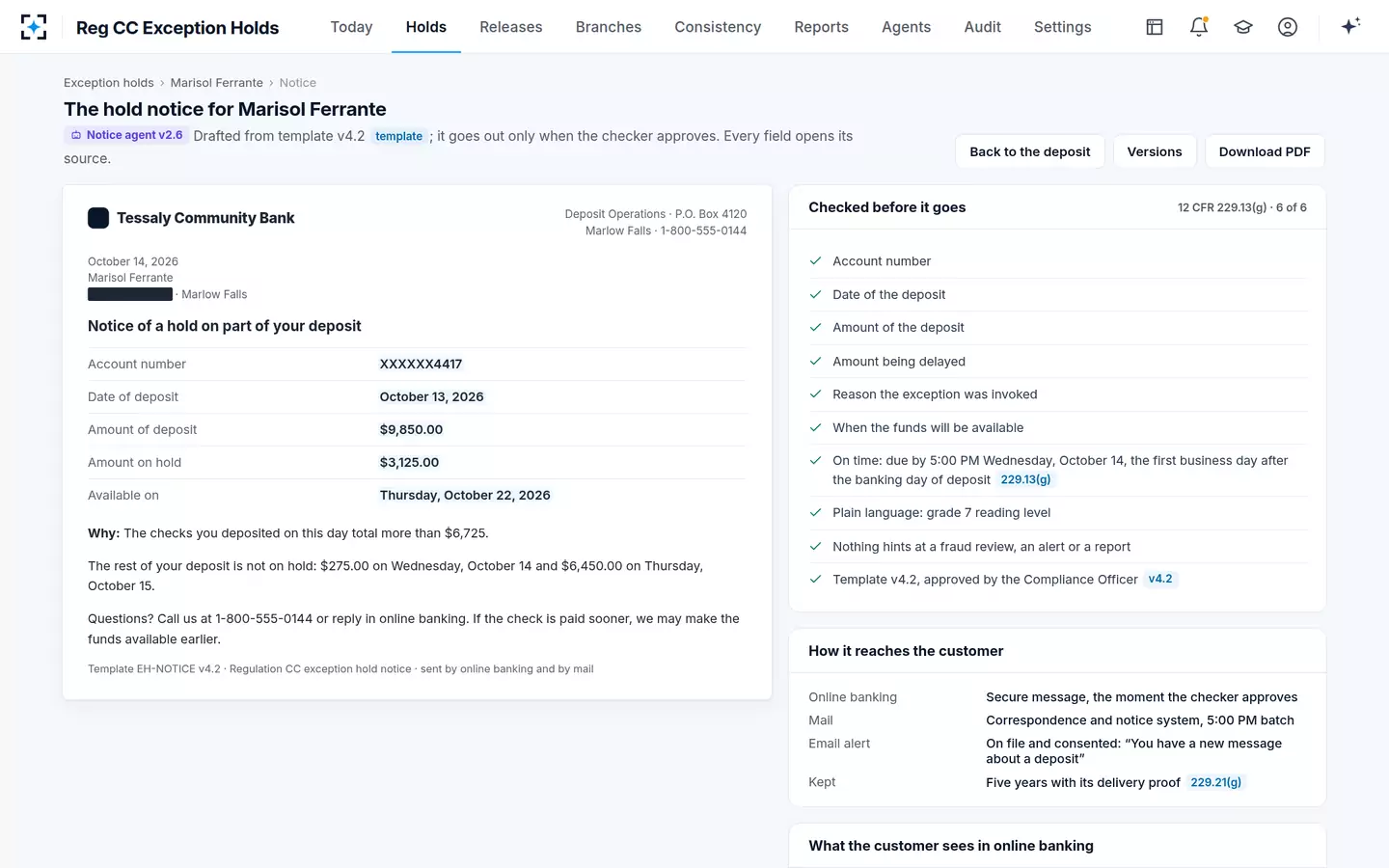
When is a Reg CC hold notice due?
At the time of deposit, if the deposit was made in person to an employee; otherwise by the first business day after the deposit, or after the day the bank learned the facts, whichever is later. The commentary sets the outer edge for deposits by ATM, night depository or mail as the close of the business day after the banking day of deposit, and for facts learned later as no later than the business day after they become known. The bank-wide clock that matters is therefore not the deposit date but the knowledge date, and the knowledge date is fixed by the commentary as the moment the facts reach the person responsible for the decision, or would have reached them with due diligence.
Three holds on the same morning, three different notice clocks
- Notice handed over with the receiptsame moment
- Banking day TueOct 13
- Notice by close of WedOct 14
- Deposit Tue, first notice at counterOct 13
- Facts known Tue; changed-hold notice by WedOct 14
The third lane is the one a file most often cannot prove. Pruitt Lawn & Landscape deposited a $7,940.00 check at a branch on Tuesday, October 13, with a large-deposit hold on $1,215.00 and a notice at the counter. At 4:12 PM the paying bank reported through the interbank exchange that the drawer said check 40118 was stolen. That is a fact pointing to nonpayment, so the hold can move to reasonable cause on $7,665.00, with $275.00 already released, and the bank owes a new notice by the next business day. The file has to show the time the report arrived and when it reached the specialist, or the bank cannot show the notice was on time.
New facts, a changed hold and a new notice the same day
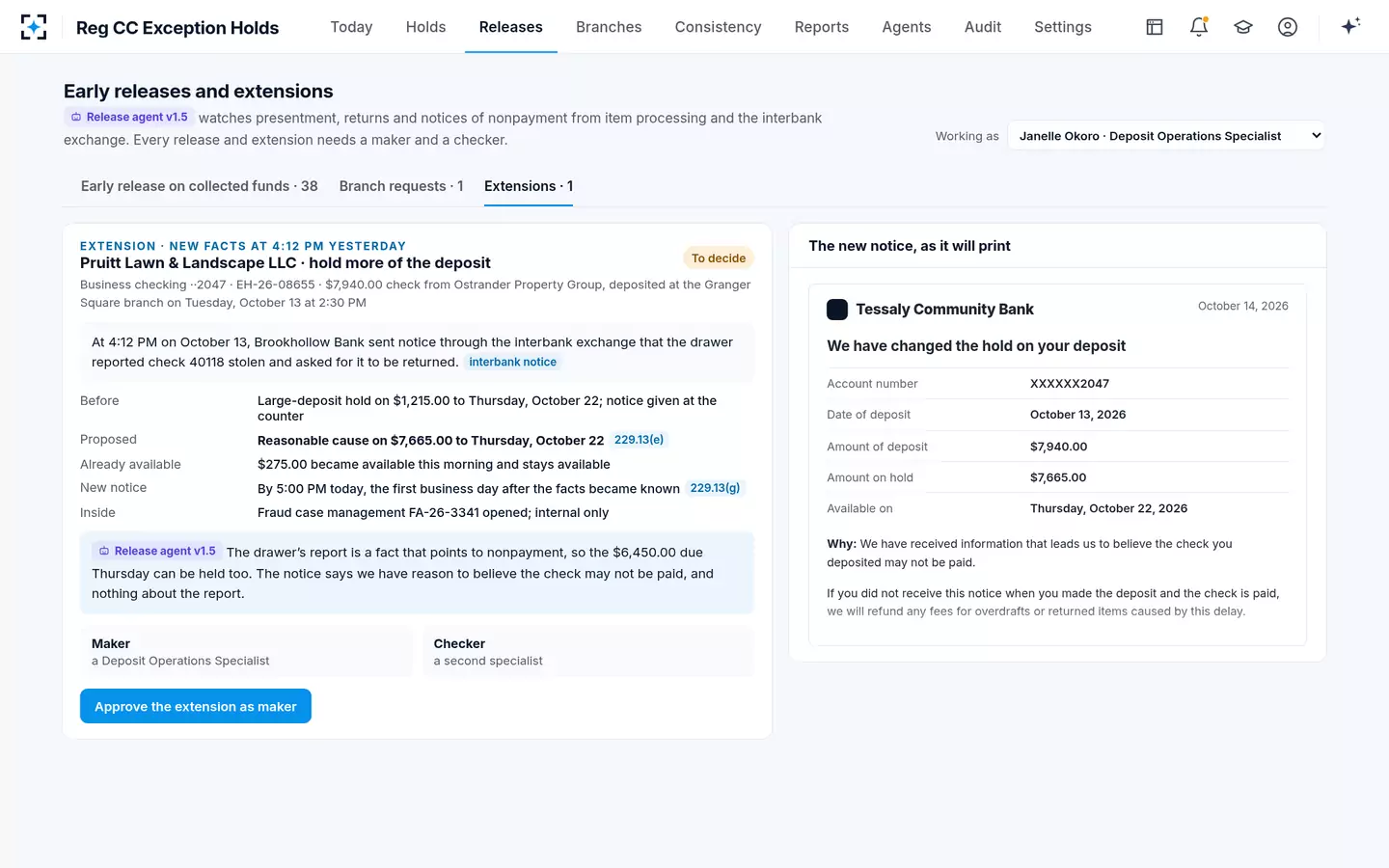
The brief statement of facts: what it must hold
The facts statement is the part of the file the rule writes for the bank's benefit. The commentary says the record "must contain a brief description of the facts on which the depositary bank based its judgment", and it accepts that for some holds a copy of the notice is enough, such as one placed because a notice of nonpayment arrived. Where the hold rests on information the notice does not spell out, confidential information in particular, the statement has to describe it more fully than the customer's notice does. Which facts can carry such a hold in the first place is the subject of the reasonable cause to doubt collectibility guide.
A useful statement answers four questions an examiner will ask years later. What was the fact? Where did it come from, by document and date? Who in the bank knew it, and when? And why did it make non-payment likely for this check, rather than for checks like it? Lyle Brandt's statement at the sample bank answers all four: two checks on the same drawer account returned for insufficient funds on October 2 and October 8, from the return file; the payee line written over a lighter, earlier name, pinned on the check image; the time each fact reached the desk, logged at intake; and why it is specific to this drawer and this item. A specialist approves the statement as the maker and a second specialist checks it.
One thing the statement should never become is the customer's notice. The agencies' June 2025 request for information asked whether disclosure rules meet customers' needs when funds are held for suspected fraud, and whether "changes be considered with respect to permissible customer communications under SAR confidentiality rules" (90 FR 26293, question 12(b)). Until anything changes, the safe pattern is two documents: a notice that states the reason in the rule's terms, and a facts statement that can be fuller, kept apart from any fraud referral.
The file behind each hold: what a defensible exception-hold file holds
- The deposit as received
Channel, time, the cutoff that applied, the banking day, and the day's total across the customer's accounts.
- The check image and what was read from it
Amounts, payee, date, MICR line and any finding, each pinned to the image.
- The exception and the rule it rests on
One of the six, with the test it met: age, amount, return reason, overdraft days, or the facts.
- For reasonable cause, the brief statement of facts
Each fact with its source document and date: required by 229.13(g)(5).
- The knowledge time
When the facts reached the person responsible for the decision; it starts the notice clock for holds placed after deposit.
- The dates, with the count behind them
Each slice's availability date and the business days counted, matching the hold on the core.
- The notice as sent, and its delivery
The text the customer received, the channel, the time, and consent for electronic delivery to a consumer.
- Who decided and who checked
Names, times and reason codes for any change to the proposal; nobody checking their own decision.
- What happened next
Release, extension with its second notice, return, or fee refund on request.
Electronic hold notices: consent and a form the customer can keep
A hold notice must be written, and electronic delivery counts only on conditions. For a customer who is not a consumer, an electronic notice satisfies the rule if it displays the text and is "in a form that the customer may keep", and the customer agreed to that means of notice; downloading or printing is enough. For a consumer, the notice must comply with the E-SIGN Act, which includes "obtaining the consumer's affirmative consent to such means of notice" (commentary to 229.13(g)).
For the file, that means the consent belongs next to the notice. A bank that sends a secure online-banking message to a consumer who never gave E-SIGN consent has sent nothing, as far as the rule is concerned, and the paper copy in the evening mail is the notice that counts. The sample bank sends both: the online message when the checker approves, and paper in the 5:00 PM mail batch, with delivery proof for each.
What examiners do with the file
Examiners sample. The FDIC and NCUA procedures tell them to review hold reports from branches and the main office, sample a few exception holds, check when funds were actually made available, and review the notices for "timing and content requirements for each type of exception hold". For reasonable cause they go further: they obtain the list of checks held, review the notice, and judge whether the bank's reason for using the exception was a reasonable one (FDIC CCEM VI-1). The facts statement is what answers that last test, and a file without one leaves the examiner to judge reasonableness from the notice alone.
The workload is real even at the regulator's own estimate. The Federal Reserve assumes each of the 668 institutions it supervises sends about 2,000 exception notices a year, at three minutes each, and classes them as customer-specific, which is why they take longer than the machine-generated disclosures (FR CC supporting statement, 2025). Three minutes is the notice alone; the decision, the facts and the dates behind it are what a file has to carry, and what a hand-built file usually loses. The test matrix examiners use is laid out in the Reg CC audit checklist.
One trail for every decision, and an examiner package built from it
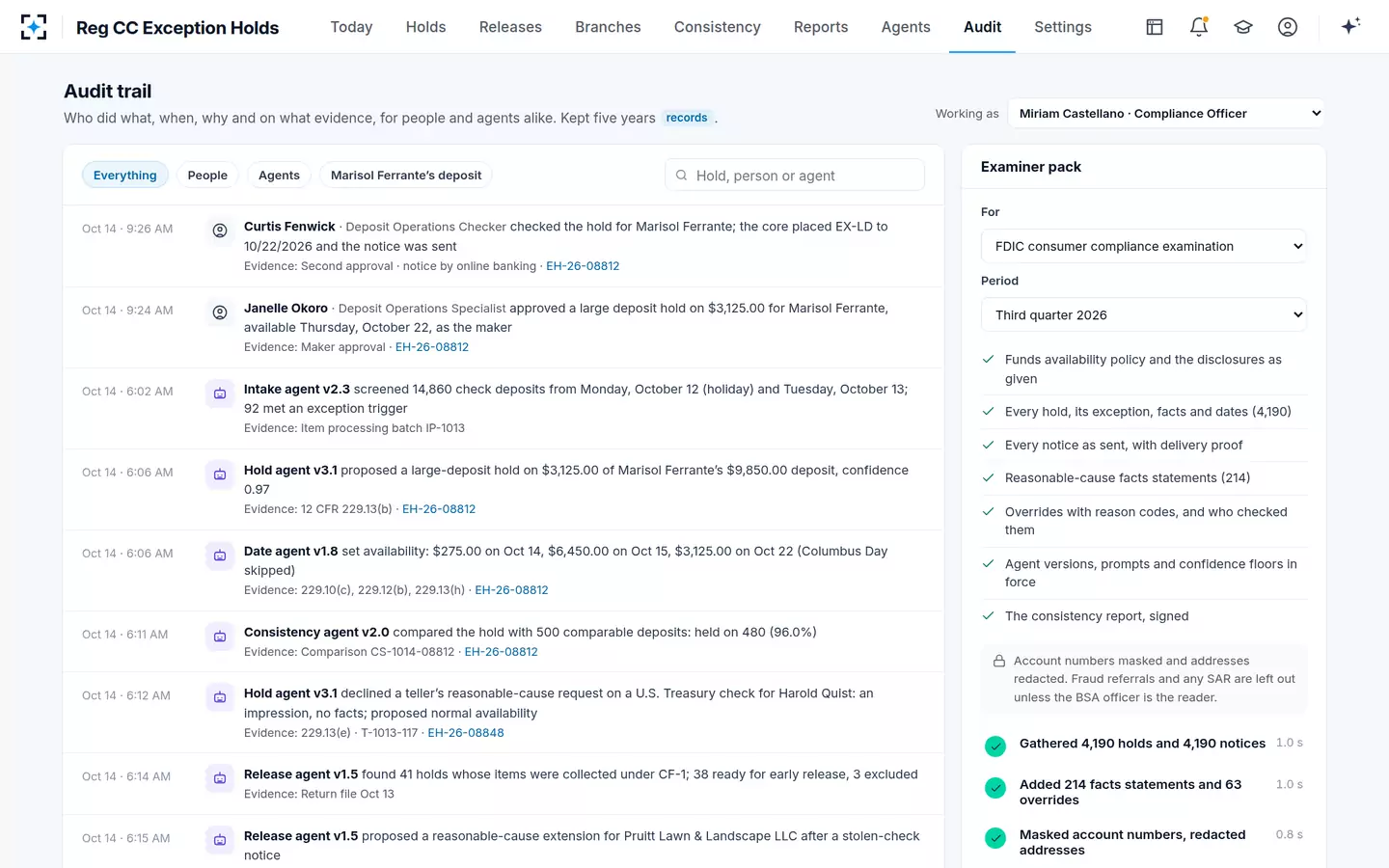
Where the solution stops is worth stating. It keeps the file it builds and can hand it to the bank's records system on whatever schedule the bank sets; it does not replace that system, and the retention period, the litigation-hold process and the decision to keep longer than two years remain the bank's. To see the file assembled on one deposit, start from Reg CC Exception Holds.
Questions people ask
What are the Reg CC retention requirements?
Keep evidence of compliance with the funds availability rules for at least two years, and for each reasonable-cause hold keep the notice with a brief statement of the facts. Records about a matter under investigation, enforcement or suit must be kept until it is finally resolved. Any reliable storage method that can reproduce the record accurately is allowed.
Do I have to keep large deposit hold notices?
The regulation singles out reasonable-cause notices, but every exception notice is evidence that the bank complied with the notice rule, and the general two-year requirement applies to that evidence. Examiners sample large-deposit holds and check their notices, so a bank that discards them cannot show compliance.
Is a copy of the notice enough as the statement of facts?
Sometimes. The commentary accepts the notice alone when the hold rests on something the notice states fully, such as a notice of nonpayment from the paying bank. When the hold rests on confidential information, such as suspected kiting or a drawer's insolvency, the bank's record needs a fuller description than the notice gives.
Can a hold notice be sent only through online banking?
For a consumer, only if the customer has given affirmative consent under the E-SIGN Act; otherwise the notice must be on paper. For a business customer, an electronic notice works if the customer agreed to it and can download or print it.
What happens if a hold notice is late?
A late notice is a violation of 229.13(g), and for a reasonable-cause hold with no notice at the time of deposit, the bank also loses the right to keep overdraft or returned-check fees the delay caused if the check is paid, unless the notice offered refunds. A customer has one year from the violation to sue for actual damages plus a court-set amount between $125 and $1,350.