Reg CC automation is software that does the mechanical part of a Regulation CC exception hold: reading each check deposit, testing it against the six exceptions, counting every slice's availability date, drafting the notice and watching for the moment a hold can be released early, while a named person decides and a second person checks. Done well, it goes live in stages: first the bank's funds availability policy is turned into settings the compliance officer approves (amounts, reasonable periods, cutoffs, the holiday list, notice templates), then the software replays the bank's own past holds, then it runs beside the current desk before it carries any live decision. Our plan for Botminds' Reg CC Exception Holds takes about eight weeks along those lines; it is a plan, set out below with its assumptions, not a measured result. What makes the work hard is that a hold touches the core, item processing, mobile and ATM capture, the interbank return feed and the notice system, and that one exception, reasonable cause, should never be decided by software at all.
Product figures on this page are from a fictional sample bank, Tessaly Community Bank, as it runs through the solution, or are our estimates and targets, labelled as such.
The work Reg CC automation takes on, in four numbers
3min
the Federal Reserve's paperwork estimate for one exception notice, the notice alone
24min
our estimate of a specialist's time on one exception hold by hand, from deposit to notice
6min
our estimate of the same hold with the agents, including the second specialist's check
1,200
decided holds a new agent version is replayed on before the compliance officer can approve it
What is Reg CC automation?
It is the step past the core's hold codes. Every core system can place a hold with a release date; what it cannot usually do is decide whether the hold is lawful, prove why, count the dates the way the rule counts, and draft a notice from the same dates. Those are the steps where the errors sit, and they are mostly done by hand: a specialist picks a reason from a list, counts business days around a holiday, and types the notice. Automation in the useful sense covers five of them.
The first is intake: reading each deposit from item processing, remote deposit capture and the ATM network with its image, channel and cutoff, and adding up the day per customer. The second is the exception test, applied from data where the rule is a test and drafted as facts where it is a judgment. The third is the date count, slice by slice. The fourth is the notice, drafted from an approved template and checked for content, timing and wording. The fifth is release and extension: watching presentment, returns and notices of nonpayment, and proposing early releases or extensions when the facts change. Reg CC Exception Holds assigns one agent to each, plus a consistency agent that shows how the bank decided comparable deposits before anyone decides this one.
Where a specialist's minutes on one exception hold go: by hand and with the agents
By hand: 24 minutes
- Reading the deposit and account, 4 min · 16.7%
- Picking the exception and the reason, 5 min · 20.8%
- Counting business days, 4 min · 16.7%
- Typing and checking the notice, 6 min · 25%
- Second specialist's check, 5 min · 20.8%
With the agents: 6 minutes
- Reading, 1 min · 16.7%
- Exception, 1 min · 16.7%
- Dates, 1 min · 16.7%
- Notice, 1 min · 16.7%
- Second specialist's check, 2 min · 33.2%
Policy first: the settings that have to exist before go-live
A hold desk applies a policy, and software applies it exactly. So the first two weeks of the plan are spent turning the bank's funds availability policy into settings, each with a value, a version and an approver, before a single deposit is read. This is also where most of the bank's real decisions are made, which is why the compliance officer owns this phase rather than IT.
The settings a Reg CC hold desk runs on, with the sample bank's values
| Setting | Sample bank's value | Where it comes from |
|---|---|---|
| Large-deposit, new-account and overdraft amount | $6,725, next-day amount $275; next review July 1, 2030 | 12 CFR 229.11(c), effective July 1, 2025 |
| Reasonable period for exception holds | 5 business days local, 1 on-us | Bank policy within 229.13(h)(4) |
| New accounts: ordinary checks available on | Business day 7 (policy FA-4.3) | Bank policy; the rule sets no maximum |
| Cutoffs by channel | Mobile 8:00 PM ET; teller and courier 4:00 PM; ATM 2:00 PM; night depository next banking day | Bank policy within 229.19(a)(5) |
| Holiday list | The 229.2(g) holidays, with a written decision on June 19 | Rule text and the bank's policy |
| Collected funds for early release | 2 business days after presentment (rule CF-1) | Bank policy |
| Notice deadline and escalation | Notices by 5:00 PM; undecided holds escalate at 3:00 PM | Bank policy inside 229.13(g) |
| Agent confidence floors | Hold agent 0.85, release agent 0.90; at least 200 comparable deposits | Solution settings, approved by compliance |
| Retention | Five years, against a two-year rule | Bank policy; 229.21(g) floor |
Two rows deserve the most care. Cutoffs differ by channel and often by system, and a mismatch moves every date downstream by a day. The holiday list looks trivial and is not: Regulation CC's definition of business day names ten holidays and not June 19, while the Reserve Banks close on Juneteenth and the Board's own plain-language materials speak of federal holidays. The bank should decide, in writing, before the software decides for it; the arithmetic is in the hold calculator guide.
Settings have a legal side too. If the policy itself changes in the process, for example a shorter reasonable period or a later cutoff, the bank owes consumer account holders notice at least 30 days before a change that slows availability; a change that speeds it up may be disclosed within 30 days after (229.18(e)). And the disclosure must keep describing the policy the bank follows "in most cases" (229.16(a)).
The eight-week plan, week by week
Reg CC Exception Holds: our proposed eight weeks from policy to live decisions
- Policy as settings, templates approvedwk 1–2
- Core, item processing, capture, returns, noticeswk 3
- Replay on past flagged depositswk 4
- Parallel run beside the current deskwk 5–6
- Data-tested exceptions and releaseswk 7
- Reasonable cause drafts; full deskwk 8
Weeks 1 and 2: the policy. The compliance officer and the head of deposit operations confirm every setting in the table above, approve the notice templates (exception, reasonable cause, changed hold, case-by-case) and write the reason codes that will be required for any override. The output is a versioned policy the software can read and an examiner can read in the same form.
Week 3: the connections. Deposits and images from item processing, mobile and ATM capture; account facts from the core, including age, owners and overdraft history; returns, notices of nonpayment and stolen-check reports from the interbank exchange; alerts from fraud case management; and the correspondence system for notices and delivery proof. Where a feed is not ready, the plan slips here, and nowhere else should absorb it.
Week 4: the replay. The solution runs on a sample of the bank's past flagged deposits and their notices, and every difference from what the bank actually did is explained: a date one day apart, an exception the bank used that the rule did not allow, a notice missing an item. Some differences are the software's errors, to fix; many turn out to be the bank's, and become the first findings the project hands to compliance.
Weeks 5 and 6: the parallel run. The agents propose on live deposits while the existing desk decides as before; specialists see both and record where they differ and why. This is where the confidence floors are tested: below 0.85 the hold agent proposes nothing and the specialist picks, and the rate at which that happens is a measure of how much the bank's data supports the tests.
Weeks 7 and 8: live in stages. The data-tested exceptions go live first, large deposits, new accounts, redeposits and repeated overdrafts, with early releases on collected funds; reasonable cause follows as drafted facts for a specialist's decision. Every hold, change and release needs a maker and a checker from the first day.
The first live morning: proposals, refusals and the notice clock
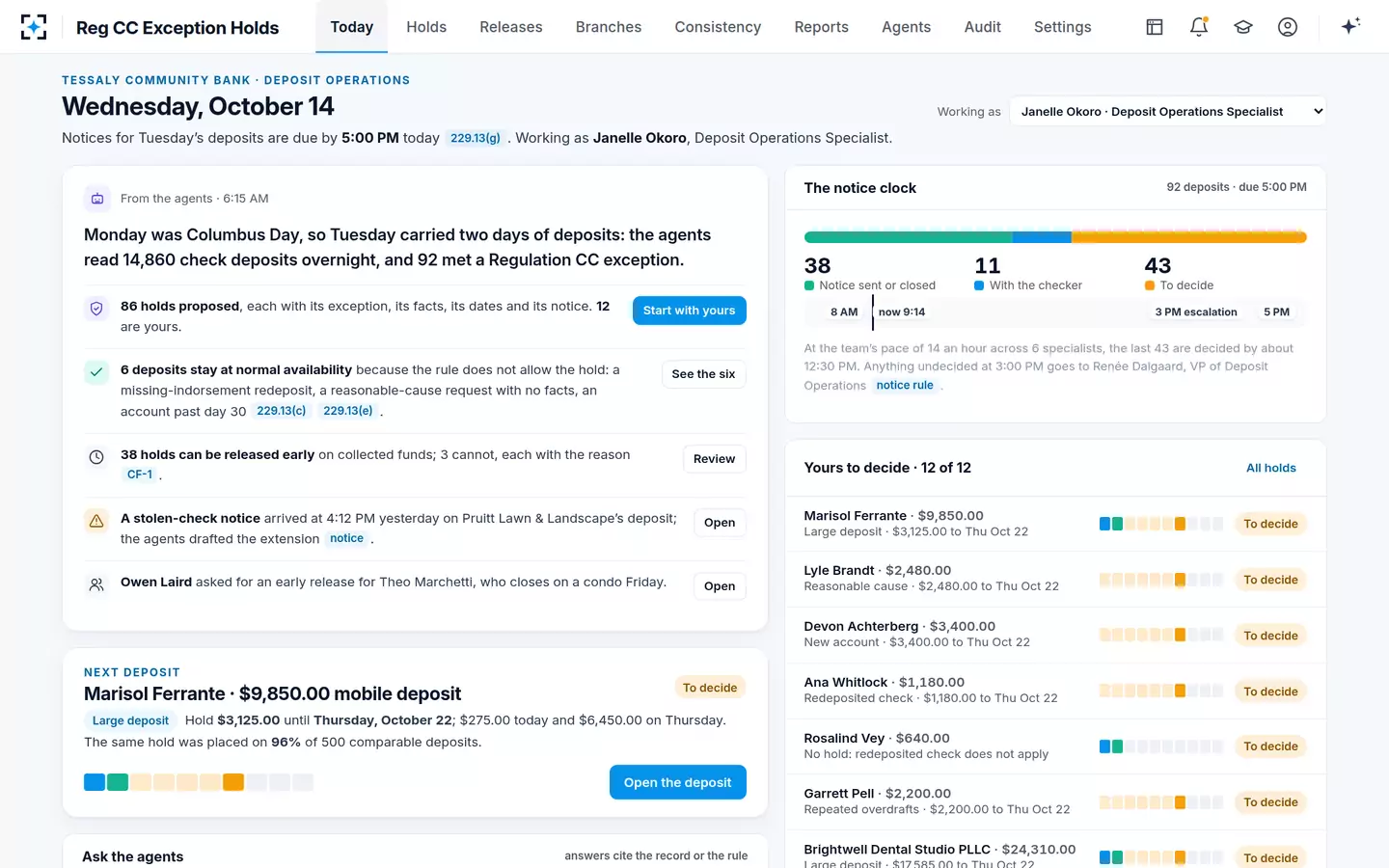
How to automate check holds without automating the judgment
Draw the line where the rule draws it. Four exceptions are tests on data and can be proposed by software every time: new accounts, large deposits, redeposited checks and repeated overdrafts. Emergency conditions is declared by an officer, once, for a population of deposits. Reasonable cause requires facts that would make a reasonable person believe a particular check will not be paid; software can find and assemble those facts, but the belief has to be a person's, and the commentary ties the bank's knowledge of those facts to the people responsible for the decision, which presumes there are such people (commentary to 229.13(g)).
The controls follow from that line. A confidence floor below which the software proposes nothing. A refusal, with the rule, when a hold is requested that the rule does not allow. A reason code for every departure from the proposal, with written words when the code is "Other". A maker and a checker on every hold, extension and release, with nobody checking their own decision. A stop, not a guess, when a holiday or a cutoff is missing. And a replay of every new agent version on the bank's last 1,200 decided holds before the compliance officer approves it, so that a change in the software is tested like a change in the policy.
A reasonable-cause hold drafted as facts, each opening its source
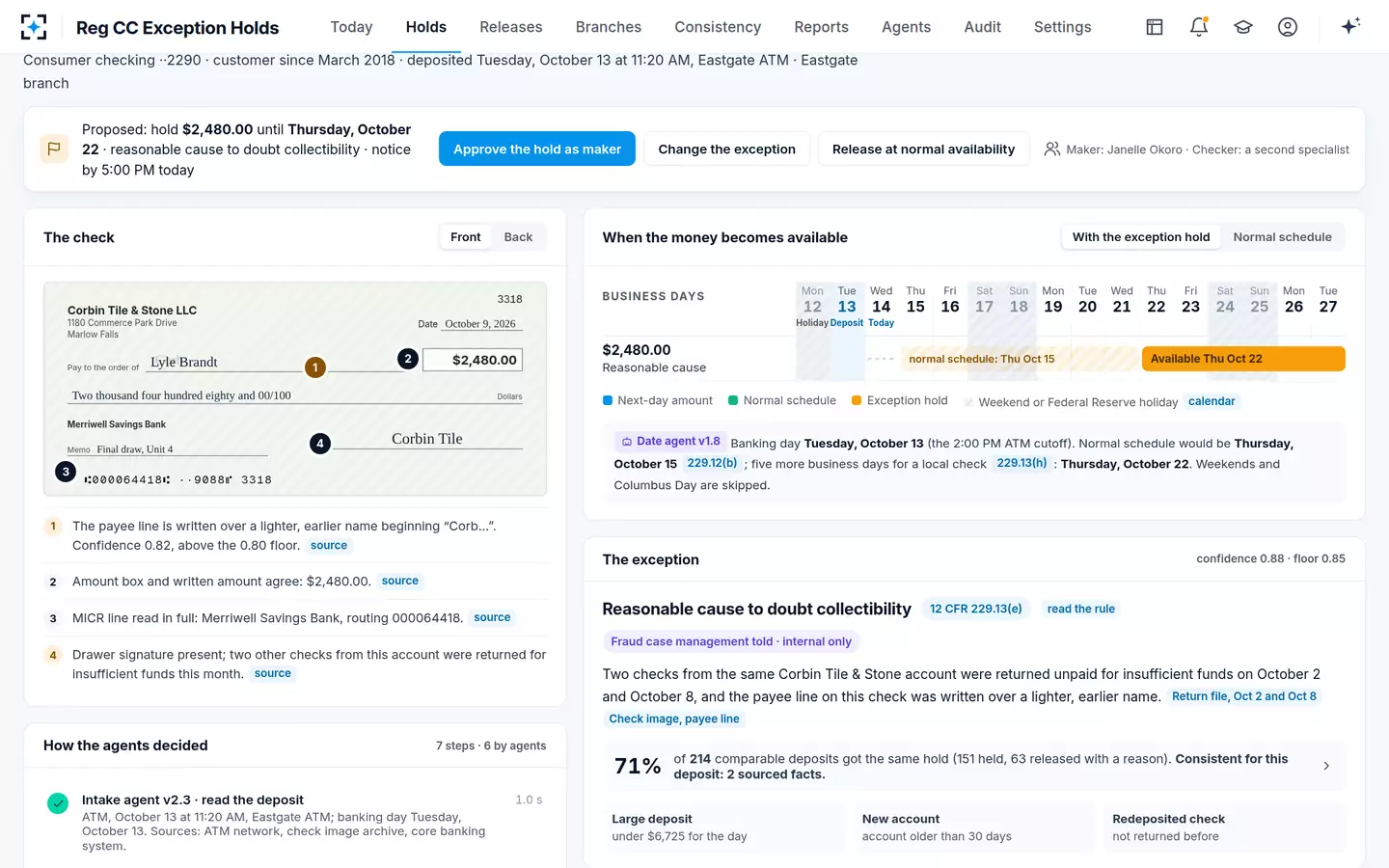
Reg CC compliance software: what to judge it on before go-live
Judge it on the bank's own past deposits, against criteria set before the replay starts. The examiners' test matrix gives the categories: whether an exception was available, whether the right amount was held, whether the date was lawful, whether the notice carried the five items on time, whether reasonable cause rested on facts, whether records were kept. The full evaluation list, built from the FDIC and NCUA procedures, is in the Reg CC audit checklist; the acceptance criteria below turn it into go-live targets.
Go-live targets for a Reg CC hold desk: measured on the replay and the parallel run
- Every date matches a recount
Each slice's availability date agrees with an independent count on the bank's holiday list and cutoffs; any difference is explained.
- No hold the rule does not allow is proposed
Missing-indorsement redeposits, aged-out new accounts and short overdraft counts are refused, with the rule cited.
- Every notice carries the five required items
And its date matches the hold placed on the core.
- Every notice has a deadline and a send time
Measured against the business day after the deposit or after the facts became known.
- Every reasonable-cause proposal carries facts with sources
Target: 100%. A proposal without a fact is a defect, whatever its confidence.
- Below the floor, the specialist decides
The share of deposits below the confidence floor is reported, not hidden.
- Overrides carry reason codes
Every change to a proposal has a code, and "Other" has words.
- The examiner package builds from live data
Holds, notices, facts statements and overrides for a test period, masked.
Can software decide a reasonable cause hold?
It should not, and the rule's structure explains why. Reasonable cause is the only exception defined by a belief, the belief must rest on facts about the particular check, never on its class or the depositor's, and the notice must state the reason for it (229.13(e)). A model score is not a fact about a check; it is a statement about checks like it. What software can do is find the facts a person would want: a return on the drawer's account, a notice from the paying bank, a stale date, an alteration visible on the image, and present each with its source. The commentary's full list of qualifying facts is worked through in the reasonable cause to doubt collectibility guide.
That is how Reg CC Exception Holds treats it. The hold agent drafts the facts statement, the specialist decides whether it amounts to reasonable cause, and a second specialist checks. When a teller requests a reasonable-cause hold on an impression, the agents propose no hold and explain why, and a specialist who has facts can still place one. Fraud detection, the scoring of images and accounts for counterfeits and alterations, is a separate job with separate software, covered in check fraud detection software; the hold desk receives its alerts as one source of facts among several.
How long does Reg CC software take to implement?
Our plan is about eight weeks, and the honest variable is the connections, not the software. A bank whose core, item processing, capture and notice systems can deliver files from week 3 can follow the plan; a bank waiting on a vendor for a returns feed should start the policy work anyway, because the settings, templates and holiday decision are useful on their own and are the part an examiner reads first. The replay needs a sample of past flagged deposits and their notices, which the bank already has.
Scale shapes the economics more than the timeline. The Federal Reserve's estimate assumes each institution it supervises sends about 2,000 exception notices a year, and 700 case-by-case notices (FR CC supporting statement); our own estimate for a $3.4 billion community bank is about 1,400 exception holds a month. Check volumes are falling, too: the Federal Reserve's latest payments study, released in July 2026, found that check payments fell again in 2024, by number and by value (Federal Reserve, July 1, 2026). A bank with a few holds a week may not need a desk built around agents. A bank with hundreds a day, several channels and branches that decide differently is the one where the five mechanical steps cost most and the errors are most likely. To see the plan applied to a sample of your own past holds, start from Reg CC Exception Holds.
Consistency before every decision, from the bank's own past holds
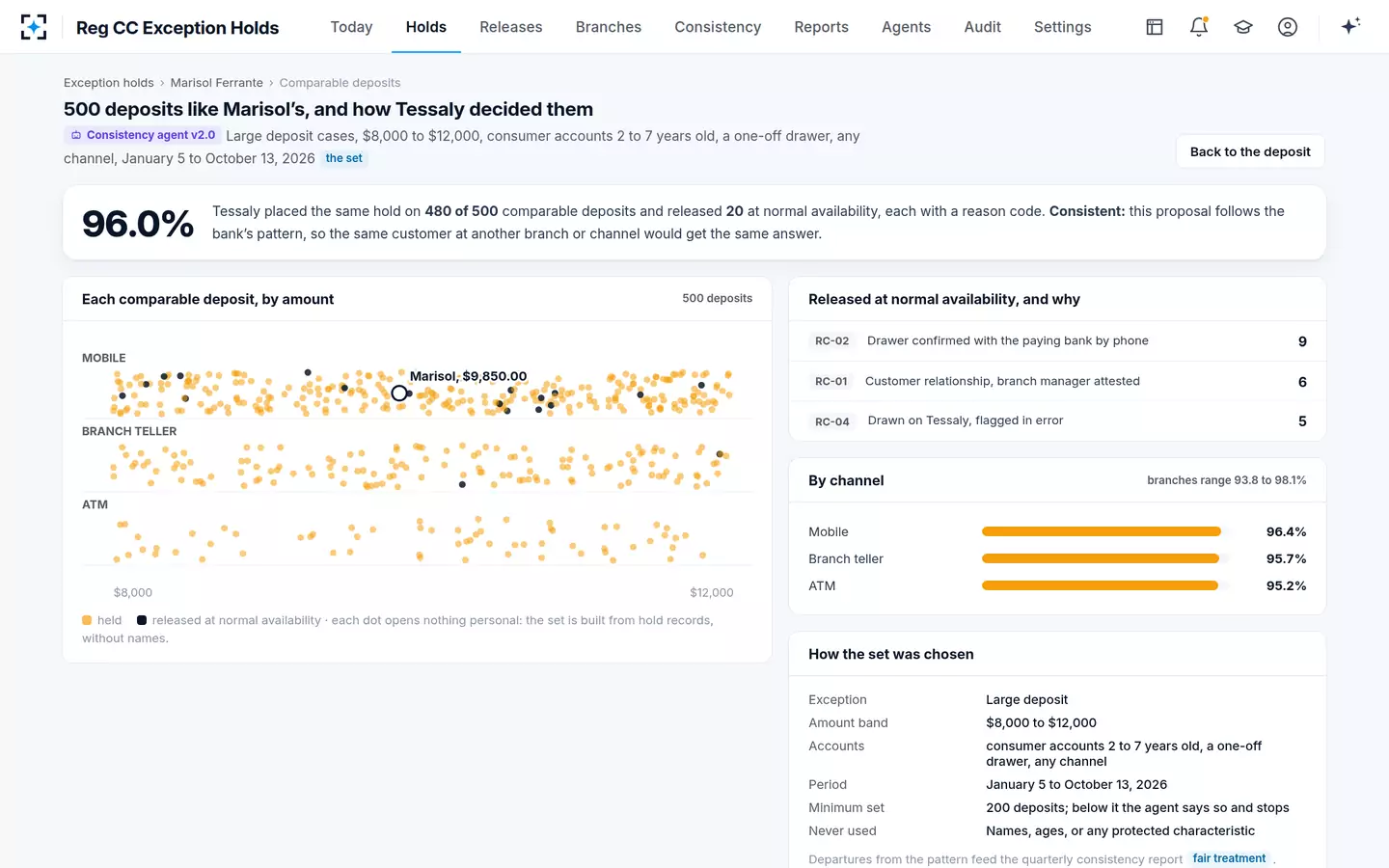
Questions people ask
What is reg cc automation in banking?
Software that applies a bank's funds availability policy to check deposits: it tests each deposit against the Regulation CC exceptions, counts the availability dates, drafts the hold notice and watches for early releases. In a sound design it proposes and a person decides, with a second person checking, because the bank, not the software, is liable for each hold.
Does Reg CC automation replace the core's hold function?
No. The core still places and releases the hold; the automation decides what hold to place and when to release it, and sends the decision to the core after approval. In Reg CC Exception Holds the hold reaches the core only after the maker and the checker approve it.
Can automation send hold notices by itself?
It can draft them; whether it sends them is a control choice. Reg CC Exception Holds never sends a notice before the checker approves the hold, so the notice and the hold always reflect the same decision. Electronic delivery to consumers still needs E-SIGN consent.
What data does Reg CC automation need?
Deposits and images from item processing and mobile and ATM capture with their times and channels; account facts from the core, including age, owners and overdraft history; returns and notices of nonpayment; fraud alerts; the bank's policy, cutoffs, holiday list and templates; and a sample of past holds to replay.
How do examiners view automated hold decisions?
They test the outcome the same way: sampled holds checked for lawful dates, complete and timely notices, reasonable reasons and retained records, and they ask who initiates reasonable-cause holds. Automation helps only if it makes those answers easier to show, which is why a decision trail with named approvers matters more than the model.