Regulation CC gives a bank six exception hold reasons that let it keep deposited check funds past the normal availability schedule: a new account, a large deposit (checks over $6,725 on one banking day), a redeposited check, an account that has been repeatedly overdrawn, reasonable cause to doubt the check will be paid, and emergency conditions (12 CFR 229.13). Four of them are tests on facts the bank already holds: the account's age, the day's total, the return reason, the overdraft history. A fifth, emergency conditions, is declared once for every deposit an outage or a storm delays. The sixth, reasonable cause, is a judgment about one check that a person has to be able to defend. Deposit operations teams make these calls by the hundred under a notice deadline, and the errors examiners find are rarely about the law; they are about the wrong reason picked from a list. Botminds' Reg CC Exception Holds is built on that split: its agents run the four data tests, refuse the holds the rule does not allow, and draft the reasonable-cause facts with their sources, while a specialist decides every hold and a second specialist checks it.
The examples come from a fictional sample bank, Tessaly Community Bank, on the morning of Wednesday, October 14, 2026, as it runs through the solution. Monday was Columbus Day, so Tuesday's deposits carried two days of checks: 14,860 read overnight, 92 meeting an exception.
The six Reg CC exceptions in four numbers
6
exceptions in 12 CFR 229.13, from new accounts to emergency conditions
$6,725
the large-deposit, new-account and overdraft amount since July 1, 2025
30days
the calendar days an account counts as new
12
Federal Reserve citations of the exception notice rule, 229.13(g), in 2025
What are the six Reg CC exceptions?
The six Reg CC exceptions are new accounts, large deposits, redeposited checks, repeated overdrafts, reasonable cause to doubt collectibility, and emergency conditions. Each suspends the schedules in 229.10(c) and 229.12 for the deposits it covers, and each, except new accounts, then allows only a reasonable extension. They differ in what triggers them, in how much of a deposit they reach and in what the customer must be told.
The Board's commentary explains where they came from. Congress wrote the new-account and reasonable-cause safeguards into the Expedited Funds Availability Act itself; the Board added the large-deposit, redeposit and overdraft exceptions under authority the Act gave it, because "Many checks will not be returned to the depositary bank by the time funds must be made available for withdrawal" (Reg CC commentary, 229.13). The exceptions exist to cover the gap between availability and the news that a check bounced, which is why each one is tied to a reason to expect that news.
The six exception hold reasons: the test, the evidence, and who can decide
| Reason | The test in the rule | Evidence that proves it | Can a system decide it? |
|---|---|---|---|
| New account, 229.13(a) | First 30 calendar days after the account is established, unless each owner had another account at the bank, at least 30 days old, in the 30 days before | Account open date, first deposit, every owner's relationship history | Yes: dates and relationships |
| Large deposit, 229.13(b) | The part of a banking day's check deposits above $6,725, aggregated across the customer's accounts if the bank chooses | The day's deposits per customer, from every channel, after cutoffs | Yes: arithmetic |
| Redeposited check, 229.13(c) | A check returned unpaid and deposited again, unless returned only for a missing indorsement or a postdate that has passed | The return item and its reason for return | Yes: the return reason |
| Repeated overdrafts, 229.13(d) | Negative on 6 banking days in 6 months, or on 2 days by $6,725 or more | Daily balance history, excluding bank errors and refundable fees | Yes: balance history |
| Reasonable cause, 229.13(e) | Facts that would make a reasonable person believe this check will not be paid; never a class of check or depositor | Return notices, paying-bank information, the check image, the date on the check | No: a person decides on the facts |
| Emergency conditions, 229.13(f) | An outage, a suspension of payments by another bank, war, or an emergency beyond the bank's control, with due diligence | The incident and its effect on collection | No: a person declares it |
Four tests on data, one declaration, one judgment about a check
The useful way to read the list is by what each reason rests on. Four are pure tests: a date, a sum, a return reason, a run of negative balances. The answer is in the bank's own systems, and two people looking at the same data should never disagree. These are the holds where errors are mechanical: a $5,525 threshold left in a parameter table after July 1, 2025, a redeposit held although the return said "missing indorsement", an account treated as new on its thirty-first day.
Emergency conditions is a factual test too, but a rare one, and it is declared for a whole population of deposits, not decided item by item. Reasonable cause is the outlier. The rule asks for facts that make a well-grounded belief, and it forbids two shortcuts by name: a belief based on the kind of check, or on the kind of person depositing it. The same customer, the same amount and the same channel can justify a hold on Tuesday and not on Wednesday, depending on what the bank learned in between.
That difference is what an automated hold desk should be designed around. A system can be trusted to apply the four tests every time, and should be, because a person counting overdraft days by hand will miscount. It should not be trusted to form a belief on the bank's behalf. In Reg CC Exception Holds the hold agent runs every test, cites the passage each answer rests on, and declines to propose a hold the rule does not permit: a redeposit returned for a missing indorsement, say, or a reasonable-cause hold with nothing behind it but a feeling about the depositor. Below its 0.85 confidence floor it does not propose at all; the specialist picks.
Large deposit hold rules: only the amount over $6,725
A large deposit hold reaches only the part of a banking day's check deposits above $6,725; the first $6,725 keeps its normal availability. The commentary's own example shows the arithmetic: a customer deposits $2,000 in cash and a $9,000 local check on a Monday. On Tuesday $2,275 must be available (the cash and $275 of the check), on Wednesday another $6,450 under the local schedule, and only the remaining $2,275 can be held for the additional period (Reg CC commentary, 229.13(b)).
Three details catch desks out. Cash and electronic payments never count toward the threshold or the hold. The bank may add up deposits to all of the customer's accounts, even accounts the customer holds jointly with different people, which is how a deposit split across a personal and a joint account stays a large deposit. And when a deposit mixes checks with different schedules, the bank chooses which portion to hold, but its notice has to let the customer work out what arrives when.
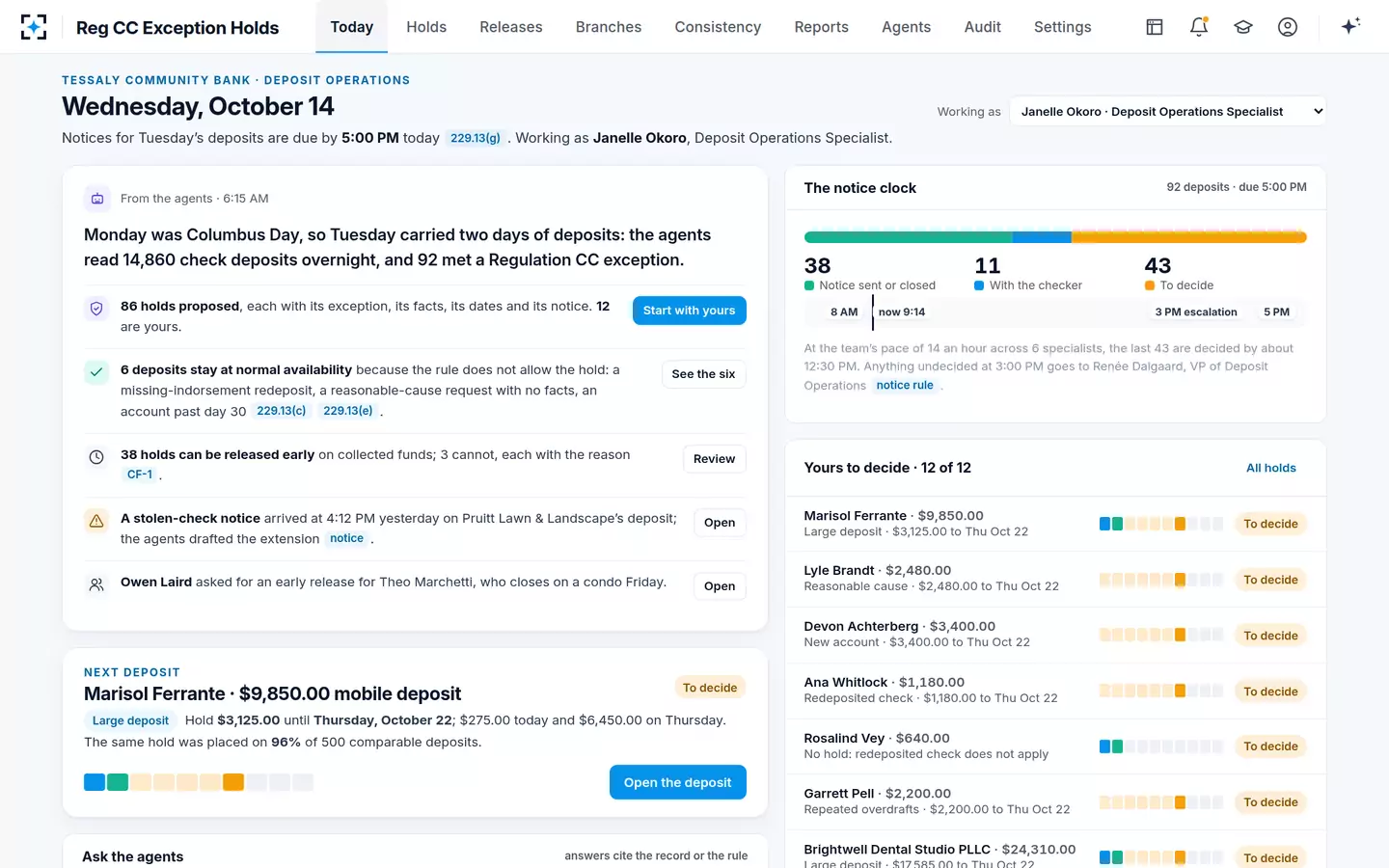
Marisol Ferrante's $9,850.00 mobile deposit at the sample bank is the textbook case. Deposited at 6:42 PM on Tuesday, October 13, inside the 8:00 PM mobile cutoff, it splits into $275.00 on Wednesday, $6,450.00 on Thursday, and the $3,125.00 above $6,725 on Thursday, October 22, five business days after the normal date. The business-day count behind those three dates is worked step by step elsewhere.
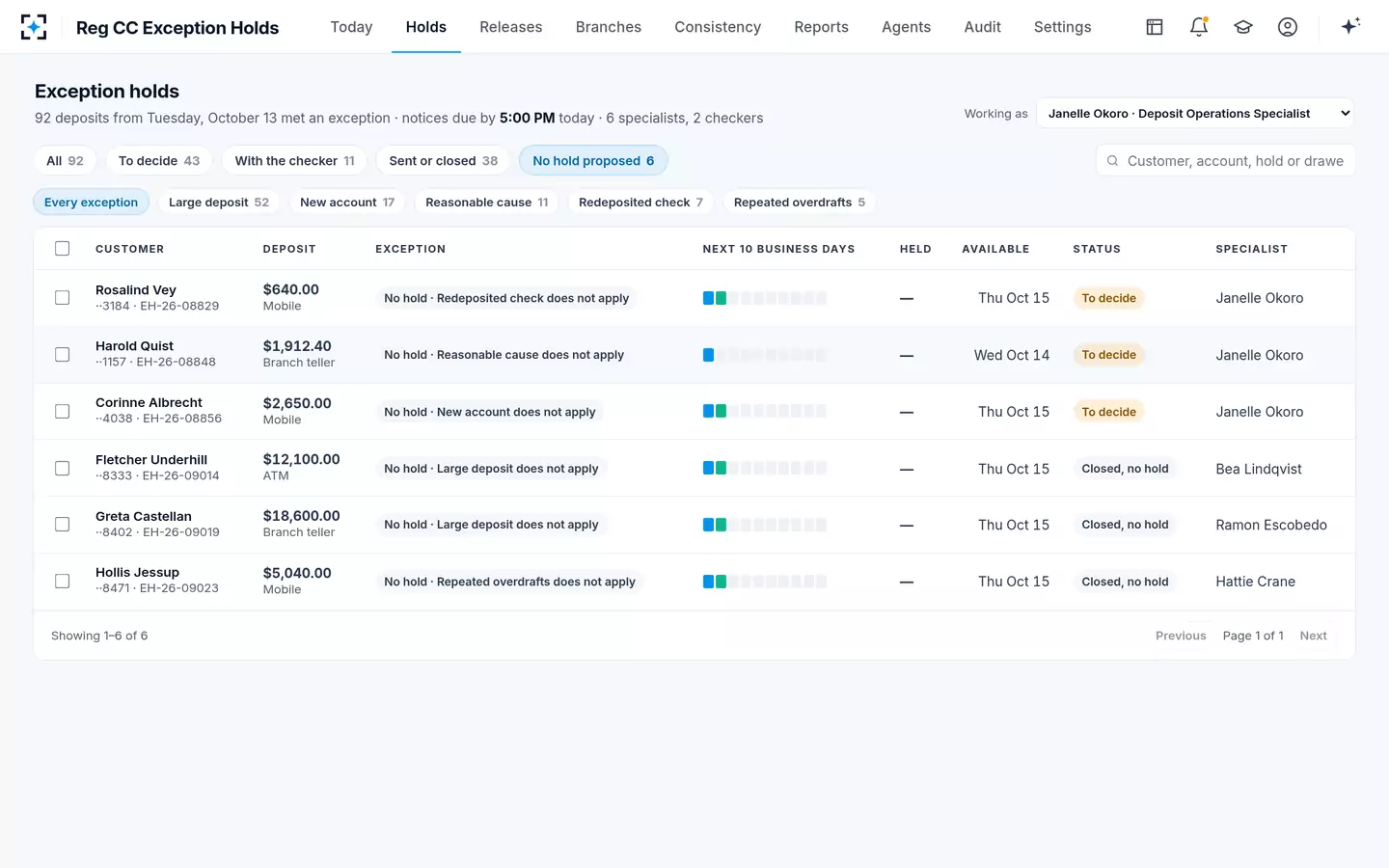
Six proposals of no hold, each with the rule or the bank's reason
Repeated overdraft hold under Reg CC: two tests and a six-month tail
An account is repeatedly overdrawn if its balance was negative, or would have been had items been paid, on six or more banking days in the preceding six months, or on two or more days by $6,725 or more (229.13(d)). Once it qualifies, the exception covers all of that customer's accounts for six months after the last such overdraft.
The commentary narrows the count in ways a hand review tends to miss. One negative balance that lasts six banking days meets the first test on its own. A check the bank dishonoured instead of paying counts as an overdraft only on that day. An overdraft caused by the bank's own error, or by a fee the customer is entitled to have refunded under the reasonable-cause or case-by-case rules, does not count at all. And an account with an overdraft line of credit is outside the exception unless the line was exceeded.
The FDIC's procedures add the end of the tail: examiners check that the bank "returns the account to the bank's normal account status" once six months pass without qualifying overdrafts (FDIC Consumer Compliance Examination Manual, VI-1). A flag that never expires is a schedule violation on every deposit after the date it should have dropped. In the sample, the agents left Hollis Jessup's $5,040.00 deposit at normal availability: five overdrawn days, not six, and none near $6,725.
Redeposited checks: the two returns the rule excludes
A check returned unpaid and deposited again can be held, because a check that bounced once is more likely to bounce twice. The rule carves out two returns where the Board saw no extra risk: a check returned only for a missing indorsement and redeposited with the indorsement, and a check returned as postdated that is no longer postdated, in each case only if the return reason on the item says so.
Two practical consequences follow. The date of redeposit is the day of deposit for the new schedule, and the $275 the bank may already have released on the first deposit need not be released again. And the decision depends on reading the return reason, not on the fact of a return. Rosalind Vey's $640.00 redeposit in the sample came back marked for a missing indorsement; the hold agent proposed no hold and cited 229.13(c)(1).
Reg CC reasonable cause hold: a fact about this check, written down
A reasonable cause hold needs facts that point to this check not being paid, the reason has to appear in the notice, and the bank keeps the notice with a brief statement of those facts. The commentary's examples are all specific to the item: a notice from the paying bank that the check is being returned; information from the paying bank before presentment that payment was stopped or the drawer's account is short; a check more than six months old, which a paying bank "has no duty to its customer to pay" under U.C.C. 4-404; a postdated check; or confidential information, such as a belief that the depositor is kiting or that the drawer is insolvent (Reg CC commentary, 229.13(e)).
Where a hold rests on a combination of factors, the commentary tells the bank to disclose its primary reasons in the notice, and the model reasonable-cause notice adds two rules of its own: when more than one check is held, each check is described separately, and a box marked "Other" must be filled in with the reason. That is why a free-text "Other" on a hold screen is a liability: the reason the customer reads has to be the reason the bank relied on, and a file that cannot reproduce it is a file an examiner will question. The fraud-side view of the same exception, with the model notice's list of reasons, is set out in the reasonable cause to doubt collectibility hold.
Lyle Brandt's $2,480.00 ATM deposit shows what a fact looks like. Two checks from the same drawer account came back unpaid for insufficient funds on October 2 and October 8, and the payee line was written over a lighter, earlier name. Each fact opens its source: the return file and the region of the check image. The notice says the bank has reason to believe the check may not be paid. Fraud case management is told separately, and nothing about it reaches the customer.
Same request, two outcomes: what turns a hunch into a reason
Not a reason the rule accepts: "Customer seemed rushed."
Facts that can carry a hold: The paying bank says payment on this check was stopped.
Not a reason the rule accepts: "Large check from an unfamiliar business."
Facts that can carry a hold: The payee line is written over an earlier name, shown on the image.
Not a reason the rule accepts: "Drawn on a bank far away."
Facts that can carry a hold: Two checks on the same drawer account returned for insufficient funds this month.
Not a reason the rule accepts: "Old-looking check."
Facts that can carry a hold: Dated more than six months before deposit, so stale under U.C.C. 4-404.
Not a reason the rule accepts: "New customer, first big deposit."
Facts that can carry a hold: Use the new-account exception if it applies; reasonable cause needs a fact about the check.
Can a Reg CC hold be placed on a U.S. Treasury check?
Yes. A Treasury check is normally next-day money, but the large-deposit, redeposit, repeated-overdraft and reasonable-cause exceptions all reach checks that would otherwise get next-day availability. The commentary sets the date by treating the check as if next-day availability had never applied and adding the extension to the schedule its paying bank's location would give (Reg CC commentary, 229.13(h)). In practice that means a Treasury check held for reasonable cause is treated as a local check, available on the second business day, plus the reasonable extension.
New accounts work differently. During the first 30 days, the first $6,725 a day of Treasury, cashier's, certified, teller's and government checks keeps next-day availability, and the excess must be available by the ninth business day; a Treasury check keeps next-day treatment even when it is not deposited in person (229.13(a), 229.10(c)).
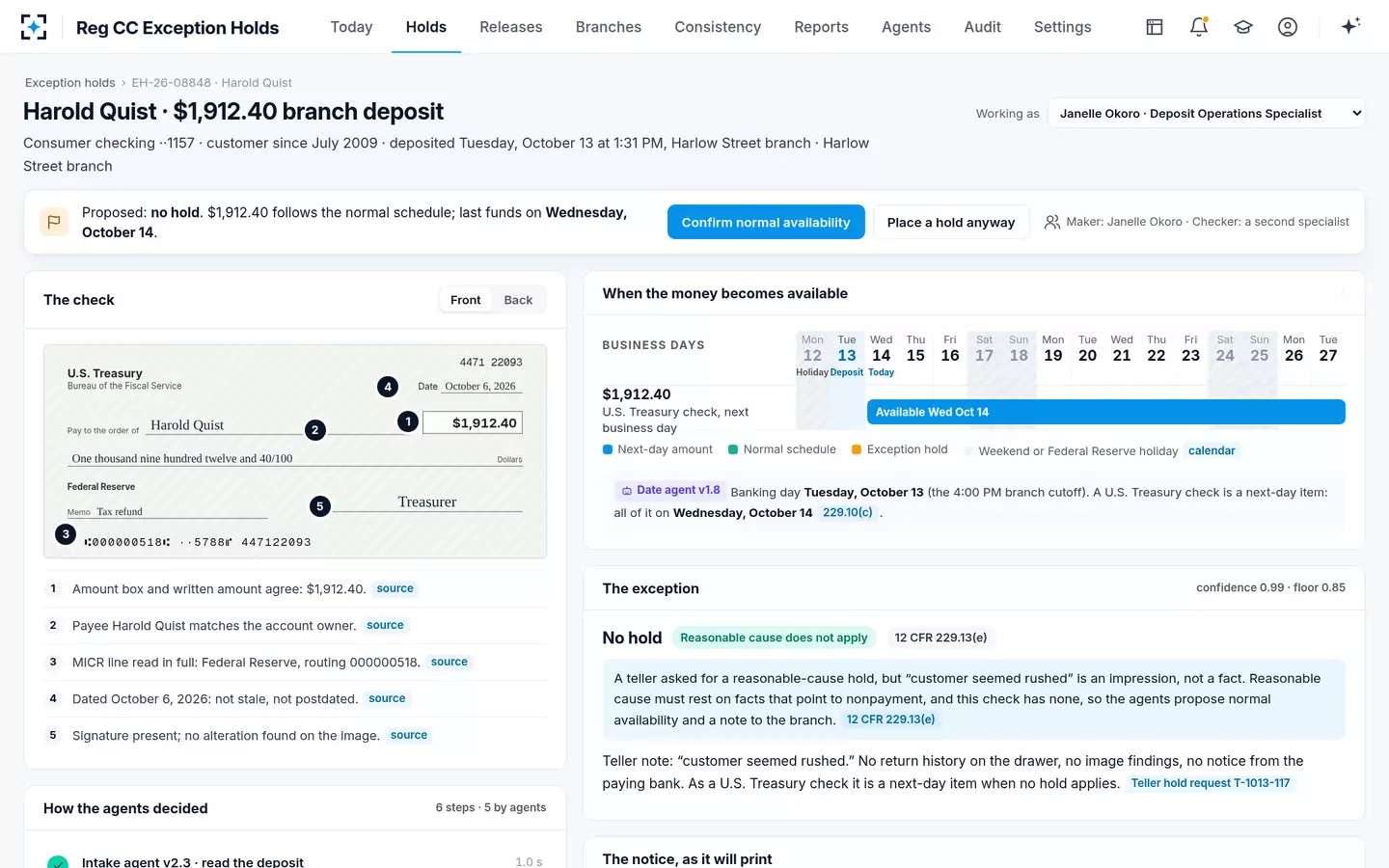
What a Treasury check cannot be held for is the impression of the person at the window. Harold Quist, a customer since 2009, deposited a $1,912.40 tax refund at the Harlow Street branch, and the teller asked for a reasonable-cause hold because he "seemed rushed." The check had no return history, no image findings and no word from the paying bank. The agents proposed normal availability, all of it on Wednesday, and a specialist confirmed. A specialist who has facts can still place the hold, and it goes to the checker like any other.
A Treasury check the teller wanted held, and why the agents said no
Reg CC emergency conditions exception: declared, not decided per item
The emergency conditions exception covers check deposits delayed by an interruption of communications or equipment, a suspension of payments by another bank, a war, or an emergency beyond the bank's control, and only if the bank "exercises such diligence as the circumstances require" (229.13(f)). The commentary's example is a check delayed in collection by severe weather. The extension runs a reasonable period after the emergency ends or the normal schedule, whichever is later.
It is the one exception where the notice can be general. A bank whose own branches are hit may post the notice at branches and ATMs or use local media; a bank affected by a paying bank's outage would normally notify as for any other exception. If the funds become available before the notice is due, no notice is needed. And the exception does not reach cash or electronic payments at all; a delay there can only be defended as a bona fide error, such as an unavoidable computer malfunction.
Because an emergency is declared once for many deposits, the right place for it in an automated desk is a setting a named officer switches on, with the start and end recorded, not a reason a specialist picks on one deposit. Used as a per-item reason, it invites exactly the misuse examiners look for: an "emergency" that is really a backlog.
Who decides a Reg CC exception hold?
The regulation does not name a job title, but it does say whose knowledge counts. For a hold placed after the deposit, the clock runs from when the bank knows the facts, and "A bank is deemed to have knowledge when the facts are brought to the attention of the person or persons in the bank responsible for making the determination, or when the facts would have been brought to their attention if the bank had exercised due diligence" (Reg CC commentary, 229.13(g)). A bank therefore has to be able to say who that person is. The FDIC's procedures ask the same question in plainer words: examiners "determine who initiates reasonable-cause holds" (FDIC CCEM VI-1).
Reg CC Exception Holds: who does what on one flagged deposit
Agent
Intake agentReads the deposit, image, channel and cutoff, adds up the day per customer and flags exception triggers.
Never: places a hold or contacts a customer
Agent
Hold agentPicks the exception that applies, or none, and writes the facts with each source; refuses holds the rule does not allow.
Never: proposes below its 0.85 confidence floor
Agent
Date and notice agentsCount each slice's business days and draft the notice from the approved template, from the same dates.
Never: send a notice before the checker approves
A person decides
Specialist, as makerApproves, changes the exception with a reason code, or releases at normal availability.
A person decides
Second specialist, as checkerWorks a five-point check and approves or returns it. Nobody checks their own decision.
Reason by reason, the split looks like this. On the four data tests the person's job is to confirm, and to catch the rare case the data gets wrong, such as an owner's earlier account the core did not link. On reasonable cause the person's job is the decision itself: the agent's facts are a draft of the statement the bank will keep, and the specialist is the one who decides they are enough. Override codes make the difference visible. Any change to the agents' proposal carries a reason code, and "Other" needs written words, so a quarterly look at overrides shows where people and the rule's tests part company.
The same split explains why some deposits should never reach an exception at all. A hold that stays inside the bank's disclosed schedule is a case-by-case hold with its own notice and no required reason; the case-by-case hold versus the exception hold is a separate decision with a different file. And the new-account test, the simplest on paper, has its own trap in the owners' history, set out in the new account hold rules.
The morning summary: 92 exceptions, 86 proposed, 6 kept at normal availability
Exception reasons also carry money. A bank that fails to comply is liable for actual damages plus, in an individual action, between $125 and $1,350 set by the court since July 1, 2025, and up to the lesser of $672,950 or 1% of net worth in a class action (229.21(a); amounts from 229.11(c)(4)). A clerical or programming error can be a defence; an error of legal judgment, such as holding a redeposit the rule excludes, cannot. To see the six reasons decided on one morning's deposits, start from Reg CC Exception Holds.
Questions people ask
What are the Regulation CC hold reasons a bank can give?
Six: new account, large deposit over $6,725 in a banking day, redeposited check, repeated overdrafts, reasonable cause to doubt collectibility, and emergency conditions. The bank's funds availability disclosure has to describe the exceptions it may invoke and promise a notice when it does (229.16(b)(3)). The reasons printed on the model reasonable-cause notice are examples, not a closed list: the Board says another reason may be given if it meets the test.
How long can a Reg CC exception hold last?
For every exception except new accounts, a reasonable period beyond the normal schedule: up to one business day for an on-us check, five for a local check and six for a deposit at an ATM the bank does not own; with a single Reserve Bank check-processing region every check is now a local check. A local check normally due on the second business day can therefore be held to the seventh, and an ATM deposit due on the fifth to the eleventh. A longer hold is possible only if the bank can show it was reasonable.
Does the large deposit exception apply to cash?
No. Only check deposits count toward the $6,725, and only check funds above it can be held; cash and electronic payments keep their normal availability, which for cash handed to an employee is the next business day. A customer who brings $10,000 in cash and a $7,000 check has a large deposit only on the check side: $275 can be held, and none of the cash.
Can one hold use two exception reasons?
Yes, if both apply. The commentary to the model exception notice says each check need not be described, but where different reasons apply, each reason must be shown. A large deposit into a repeatedly overdrawn account is the common case. Two reasons do not double the extension: the safe-harbour period in 229.13(h)(4) depends on the kind of check, not on how many exceptions apply.
Is a stale-dated check reasonable cause for a hold?
The commentary says it is a reasonable indication, because a paying bank has no duty to pay a check more than six months old under U.C.C. 4-404. The notice should say the check is stale-dated, and the bank keeps that statement with the notice. A postdated check can be treated the same way.
What happens if the reason on a hold notice is wrong?
It depends on what was wrong. If no exception actually applied, the hold itself breaks the availability schedule; if an exception applied but the notice named the wrong one, the notice breaks 229.13(g), the provision the Federal Reserve cited 12 times at state member banks in 2025. Either way the customer has one year from the violation to sue for actual damages plus a court-set $125 to $1,350.