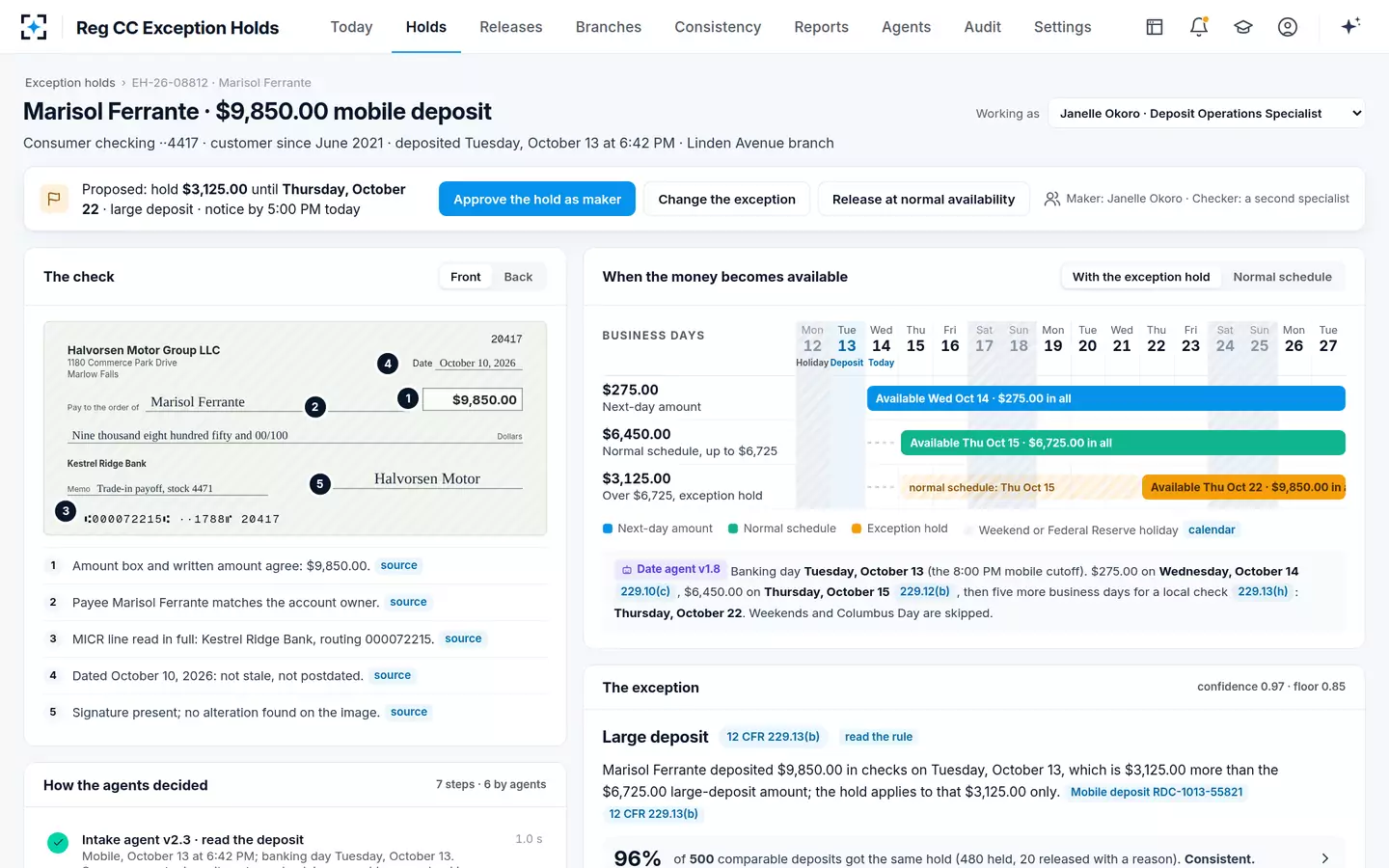
A Reg CC hold calculator answers one question for each slice of a check deposit: on which business day must the money be available? To get it right it has to do four things in order: find the banking day of deposit from the channel and its cutoff; count business days starting with the next business day, as 12 CFR 229.15(b) prescribes; skip only weekends and the holidays Regulation CC names; and apply the right schedule to each slice, from the next-day $275 to the normal schedule to an exception's extension. Most wrong hold dates are not legal mistakes but counting mistakes, made by hand around a holiday or a cutoff on a busy morning, and a wrong date on a notice is a schedule violation the customer can read. Botminds' Reg CC Exception Holds puts a date agent in front of that count: it lays every slice of a flagged deposit on a strip of business days, stops when a holiday is not in its calendar, and the notice is drafted from the same dates.
The worked counts below use the 2026 calendar. Where a case comes from the solution it is the fictional sample bank, Tessaly Community Bank, and its customers; where it comes from the Federal Reserve Board's commentary, it says so.
One large deposit, counted day by day: $9,850.00 becomes three dates
- Mon 12Columbus Day
- Tue 13Deposit, 6:42 PM
- Wed 14Day 1 · $275.00
- Thu 15Day 2 · $6,450.00
- Fri 16Day 3
- Sat 17Not counted
- Sun 18Not counted
- Mon 19Day 4
- Tue 20Day 5
- Wed 21Day 6
- Thu 22Day 7 · $3,125.00
- Banking day of deposit
- Tuesday, October 13
- Next-day amount
- $275.00 on Wednesday, October 14
- Normal schedule, rest of $6,725
- $6,450.00 on Thursday, October 15
- Large-deposit extension
- $3,125.00 on Thursday, October 22
How many business days can a bank hold a check?
Under the normal schedule, a local check must be available by the second business day after the banking day of deposit, next-day items (cash in person, Treasury checks, on-us checks at a branch, the first $275 of other checks) by the first, and any deposit at an ATM the bank does not own by the fifth (229.10, 229.12). With an exception other than new accounts, the rule treats as reasonable up to one more business day for an on-us check, five for a local check and six for a deposit at a nonproprietary ATM (229.13(h)(4)). The Federal Reserve's own small-entity guide puts the local case in one line: five additional business days, "total of seven" (A Guide to Regulation CC Compliance).
Two cases sit outside that arithmetic. A new account has no maximum at all for local checks during its first 30 days, while the excess over $6,725 of its next-day items must be available by the ninth business day. And a bank may add one business day for withdrawals in cash under 229.12(d), provided $550 of the funds is available for cash by 5:00 p.m. on the normal day. A calculator that knows only "2 and 7" will get those deposits wrong. The new-account count is set out separately in the new account hold rules.
Reg CC exception hold is how many days? The latest day for each kind of deposit
| Deposit | Normal availability | With an exception hold | Rule |
|---|---|---|---|
| Check drawn on the same bank, deposited at its branch | 1st business day | 2nd business day | 229.10(c)(1)(vi), 229.13(h)(4) |
| Local check (with one Reserve Bank check region, every check) | 2nd business day | 7th business day | 229.12(b), 229.13(h)(4) |
| Treasury, cashier's or government check otherwise next-day | 1st business day | Local schedule plus the extension: 7th | 229.13(h)(2) and commentary |
| Any deposit at a nonproprietary ATM | 5th business day | 11th business day | 229.12(f), 229.13(h)(4) |
| New account: next-day items above $6,725 | 9th business day | Not extended by 229.13(h) | 229.13(a)(1)(ii) |
| New account: other checks | No maximum in the rule | Not extended by 229.13(h) | 229.13(a)(1)(iii) |
Step one: fix the banking day of deposit
The count starts from the banking day of deposit, not the calendar day, and the banking day depends on where and when the check came in. A bank may treat a deposit as made on the next banking day if it arrives on a day that is not a banking day, or after a cutoff hour of 2:00 p.m. or later at a branch, or noon or later at an ATM, contractual branch or other off-premises facility (229.19(a)(5)). Night depositories and lock boxes count from the day the deposit is removed and available for processing; a remote ATM emptied no more than twice a week counts from the day it is emptied.
The commentary adds a rule that hand counts often miss: a day is not a banking day just because a drive-in window is open. A branch that closes its lobby at noon and keeps the drive-up open may treat later deposits as received the next banking day; a branch may not, however, close individual teller stations before 2:00 p.m. and start the next day's business early. The choice of cutoff must be in the bank's internal procedures, and the bank must tell a customer what it is on request.
Channels multiply the cutoffs. The sample bank runs four: mobile 8:00 PM ET, branch teller and courier 4:00 PM, ATM 2:00 PM, and the night depository taken on the next banking day. Each is a setting with a version, because a cutoff changed in one system and not in another moves every date downstream by a day.
Step two: count business days, not calendar days
Regulation CC counts availability in business days, and its definition is a list: every weekday except January 1, the third Monday in January, the third Monday in February, the last Monday in May, July 4, the first Monday in September, the second Monday in October, November 11, the fourth Thursday in November and December 25 (229.2(g)). The counting convention is in 229.15(b): "the first business day is the business day following the banking day the deposit was received, and the last business day is the day on which the funds are made available." The commentary gives the arithmetic its plainest form: a bank that imposes "four intervening business days" describes the funds as available on "the fifth business day after" the deposit.
Two consequences of the list are worth a test case each. November 11 is never a business day under the rule, even at a bank that opens its branches on Veterans Day, so for a local check deposited on Tuesday, November 10, 2026 the next-day $275 is due on Thursday the 12th and the rest on Friday the 13th, not on Wednesday and Thursday. And a business day does not depend on the bank being open: on the Friday after Thanksgiving, which is a business day under the rule, the count runs whether or not a branch opened.
Business days stretch on the calendar: four 2026 holds, 9 to 15 days
- NormalOct 15
- Extension: 5 moreOct 22
- Normal, over ThanksgivingNov 30
- Extension: 5 moreDec 7
- Normal, over ChristmasDec 28
- Extension, over New YearJan 5, 2027
- Normal: 5 business daysOct 20
- Extension: 6 moreOct 28
Does Juneteenth count as a business day under Reg CC?
Read literally, yes: June 19 is not among the ten holidays in the regulation's definition of business day, in the text the eCFR publishes as current to October 23, 2026. The Reserve Banks, though, close for Juneteenth National Independence Day: their published schedule lists it for every year from 2026 to 2030 (Federal Reserve, Holidays Observed). Three official sources pull in different directions: the commentary explains that "Business day generally follows the standard Federal Reserve Bank holiday schedule"; the Board's small-entity guide says business days are "Mondays through Fridays except federal holidays"; and the model disclosures tell customers that "every day is a business day, except Saturdays, Sundays, and federal holidays" (commentary to 229.2(g); small-entity guide; Appendix C).
The difference is one day, and which way it cuts matters. A local check deposited on Thursday, June 18, 2026 and held under an exception is due on Monday, June 29 if June 19 counts, and on Tuesday, June 30 if it does not. A bank that skips June 19 is one business day later than the regulation's text allows; a bank that counts it follows the text but none of the three plain-language sources above. This is not a question a calculator should settle quietly. It is a policy decision for the compliance officer, written into the funds availability policy and the disclosure in the same words, and then applied the same way on every channel. The wider gap between the rule's list and the Reserve Banks' calendar is set out in Federal Reserve holidays 2026.
Step three: split the deposit into slices
A single deposit can carry three or four different dates, and a calculator that returns one date per deposit is wrong whenever an exception applies to part of it. The first $275 of a day's checks not already next-day is due on the first business day. The rest of the checks follow their schedule. An exception moves only what it covers: the amount above $6,725 for a large deposit, or the particular check for reasonable cause, in which case the $275 need not be released at all.
The commentary's own worked example is the one to put in any test file. A customer deposits a $7,000 cashier's check drawn on a nonlocal bank, and the bank applies the large-deposit exception: "$6,725 must be available for withdrawal on the first business day after the day of deposit and the remaining $275 must be available for withdrawal on the eleventh business day following the day of deposit" (commentary to 229.13(h)). Today every check is local, so the same deposit would end on the seventh business day, but the example still shows the method: the next-day treatment survives for the first $6,725, and the extension is added to the schedule the check would have had without it.
Multiple checks add a choice. When a large deposit mixes checks with different schedules, the bank decides which portion the exception falls on, and the commentary asks only that the notice let the customer work out what arrives when. A calculator should apply the bank's stated order every time, so that two specialists placing the same hold produce the same dates.
The business-day strip: each slice of the deposit on its own row
Reg CC hold calculator in Excel, or inside the hold decision?
A spreadsheet calculator is better than counting on fingers, and most banks have one. It fails in three predictable places. The holiday table has to be maintained by hand each year, and the Juneteenth question above shows that copying the Federal Reserve's list is itself a policy choice. The inputs are typed: a cutoff, a channel, a day's total across accounts, which is where most date errors start. And the answer lives in a different place from the notice and the core hold, so a correct calculation can still produce a notice with a different date.
The last point is the one examiners see. The FDIC and NCUA procedures ask examiners to sample exception holds and check "when the bank makes the funds available for withdrawal", which compares the core's release date with the schedule, and separately to check the notice's content and timing. A calculator that is not wired to both can be right while the file is wrong. The cost of a wrong date is set by statute: actual damages plus, in an individual action, $125 to $1,350 (229.21(a)). A calculation error can be excused as a bona fide error if the bank kept procedures built to prevent mistakes of that kind, the same defence that appears in the Regulation E penalty rules; an error of legal judgment, such as a wrong holiday policy, cannot.
What a Reg CC hold calculator should show before anyone relies on it
- The banking day of deposit, and why
Channel, time received, the cutoff that applied and whether the day was a banking day.
- Every counted day, by number
Day 1 to the release day, with weekends and holidays visibly skipped, so a checker can audit the count.
- The holiday list it used, with its version
The ten in 229.2(g), and the bank's written decision on June 19.
- Each slice and its own date
The $275, the normal schedule, the excepted amount, and any cash-withdrawal day under 229.12(d).
- The day's total across the customer's accounts
Large deposits are measured per banking day and may be aggregated across accounts.
- The account's status on the deposit day
New-account day count, repeated-overdraft status and its six-month expiry.
- The same date on the notice and the core
One computation feeding both, or a check that they match before the notice goes.
- A stop, not a guess
When the calendar or a cutoff is missing, the count should halt and ask a person.
What should a Reg CC hold calculator show the customer?
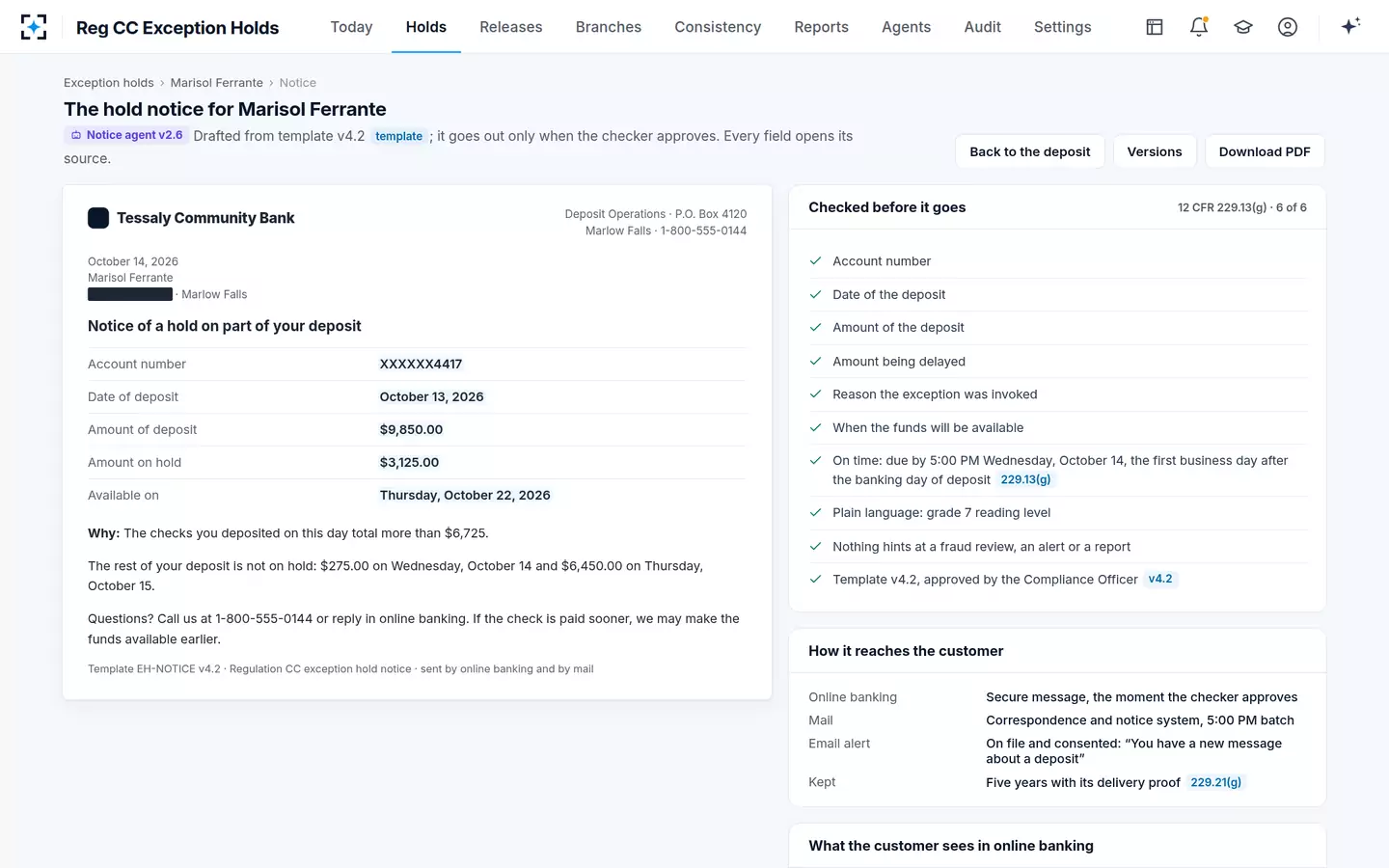
The customer should see dates, not a count. The commentary to Appendix C allows a bank to "use the actual date when funds will be available for withdrawal rather than the number of the business day" on an exception notice, and for a deposit of several checks it may give a total for each date rather than a date for each check (commentary to 229.13(g) and Appendix C). A notice that counts seven business days from the deposit is compliant and almost useless to someone with rent due; "Thursday, October 22" is compliant and useful. The reason line has its own rules, and a hold inside the normal schedule carries none; the case-by-case versus exception hold guide sets the two notices side by side.
Dates also force the calculator to be honest. A notice that says "seventh business day" hides a holiday error; one that says "Thursday, October 22" exposes it to anyone with a calendar, including the customer. The sample bank's notice for Marisol Ferrante lists all three dates, $275.00 on October 14, $6,450.00 on October 15 and $3,125.00 on October 22, drafted from the strip above, so the notice and the hold cannot disagree. How long a customer actually waits, in calendar days and in money, is the subject of why a check is on hold for 7 days.
The notice prints the dates the strip counted
Where a calculator stops and a decision begins
A calculator can only date a hold someone has decided to place. Whether the deposit meets an exception at all, whether the bank has facts for reasonable cause, whether the account is really new: those come first, and a perfectly counted date on a hold the rule does not allow is still a violation. That is why, in Reg CC Exception Holds, the date agent sits after the hold agent and before the notice agent, and why its limit is written as "Never guesses a date; an unknown holiday stops it." The specialist approves the hold and the dates together, and a second specialist checks both.
It is also where the solution does not fit. A teller who needs to tell a walk-in customer when a check will clear needs a quick answer at the window, and the sample bank's branch screen gives one, with the words to say it; but the bank's binding count runs once, in the back office, on the deposit as it was actually received. Banks that want a standalone calculator for the teller line can have one; they should make sure it reads the same holiday list and cutoffs as the desk. To see the strip, the count and the notice on one deposit, start from Reg CC Exception Holds.
Questions people ask
How do you calculate a Reg CC hold date?
Find the banking day of deposit from the time and the cutoff, then count business days starting with the next business day, skipping weekends and the holidays in 229.2(g). For a local check held under an exception, the funds are due on the seventh business day: two for the normal schedule and five more for the extension.
Is there a Reg CC funds availability calculator from the regulators?
The regulation and its official materials do not include one. The Federal Reserve's small-entity guide, the model disclosures in Appendix C and the commentary's worked examples give the rules and the arithmetic, and banks build their own counts or buy them. Whatever the tool, the bank remains liable for the dates.
Does Saturday count as a business day for a check hold?
Never. Saturday and Sunday are excluded from the definition, and the commentary notes that even a bank open on Saturday does not make it a banking day for Regulation CC. A deposit made on a Saturday may be treated as received on Monday, or Tuesday if Monday is a holiday.
When a holiday falls on a weekend, which day is skipped?
If January 1, July 4, November 11 or December 25 falls on a Sunday, the next Monday is not a business day under the rule. When one of them falls on a Saturday, the rule makes no adjustment, so the Friday before stays a business day; in 2026, Friday, July 3 counted.
Can a calculator error be excused as a bona fide error?
It can, if the bank shows the error was unintentional and happened despite procedures reasonably adapted to avoid it; the rule lists calculation and programming errors as examples. An error of legal judgment, such as a policy that skips a day the rule counts, is not a bona fide error.