Most bank compliance questions from the front line are deposit questions: whether a transfer is covered by Reg E, how long a check can be held, whether a fee change needs notice. When the person asking cannot get an answer during the call, the cost is not only the time a compliance analyst spends answering later. The rule clocks those questions touch keep running from the moment the member spoke: a Regulation E investigation is due 10 business days after the notice, not after the answer, and a Regulation CC hold notice is due by the next business day at the latest. A question that waits overnight spends the institution's own deadline. Botminds' Deposit Compliance Search exists to close that gap: staff type the member's situation, the agents answer with the rule and the institution's procedure while the member is on the line, and only the questions that genuinely need a person go to Compliance, with a draft and a clock.
Three clocks a compliance question can spend while it waits
10bus. days
to investigate a Reg E error, or credit provisionally, counted from the member's notice
1bus. day
latest for a Reg CC exception notice not given at the counter, after the deposit or the facts
30days
of written notice before an adverse change to a disclosed deposit term takes effect
How long should a bank compliance question take to answer?
As long as the member's deadline allows, which for a live call is usually the call itself. No regulation sets a response time for internal questions, but the questions are not internal in their effects. If a representative is unsure whether a scam transfer is a Reg E claim, the honest deadline is the end of the conversation, because the notice has already been given. If a teller is unsure whether a hold is allowed, the deadline is before the member leaves, because that is when the notice is due.
The rest can wait a business day, and many institutions treat that as the standard. The trouble is that a mailbox does not sort questions by deadline: the scam call and the question about next year's certificate rates sit in the same queue. The fictional sample credit union used on this page answers questions with the member waiting on a 30-minute clock and everything else within one business day, settings its Compliance Officer chose and can change.
When does the Reg E clock start?
When the institution receives the member's notice, oral or written. The error-resolution section applies to a notice of error in any form, spoken or written, received within 60 days of the statement, and the institution then has 10 business days from receiving it to decide whether an error occurred (12 CFR 1005.11(b)(1), (c)(1); the clock is quoted and followed hour by hour in first response time and the Reg E clock). The liability rules point the same way: notice is given when the consumer takes the steps reasonably necessary to tell the institution, "whether or not a particular employee or agent of the institution actually receives the information" (12 CFR 1005.6(b)(5)(i)).
So a representative who promises a call back has not paused anything. If the claim is opened the next morning, the investigation window is a business day shorter. If the call is logged as a general inquiry and the member calls again a week later, the claim is already a week into its window, and the file will show it. Error resolution under 1005.11(c) and (d) accounted for 74 percent of the Regulation E violations the FDIC cited in 2025 (FDIC Supervisory Highlights, March 2026), and timing is where a late start shows.
The Reg E window is counted from the call, whatever happens to the question
- Investigation window10 bus. days
- Waiting on Compliance1
- Investigation window left9 bus. days
- Notice given, no claim5
- Window left5 bus. days
What the clock does not wait for: holds and fee notices
Regulation CC has the shortest deadline in deposit compliance. When a hold rests on an exception, such as a large deposit or reasonable cause to doubt collectibility, the written notice is due at the time of the deposit if it is made in person and the reason is known, and otherwise no later than the first business day after the deposit or after the facts become known, whichever is later (12 CFR 229.13(g)(1)(ii)). A teller who sends the member home and asks Compliance overnight whether the hold is allowed has already used the whole allowance.
The reasonable-cause exception adds a direct cost. A bank that invokes it without giving written notice at the time of deposit may not charge overdraft or returned-check fees that the hold caused, if the deposited check is later paid, unless its notice told the customer how to get those fees refunded (229.13(e)(2)). On the fictional sample credit union, a test of 25 sampled mobile and ATM hold notices found 3 sent two to four business days after the deposit, which is how the question of hold timing reached Compliance in the first place.
Truth in Savings questions run on a longer clock, but a costly one. A fee increase needs written notice at least 30 calendar days before it takes effect (12 CFR 1030.5(a)(1)). A product team that asks Compliance three weeks before launch whether its new fee is "adverse" has, in effect, asked whether the launch date moves. The four change-in-terms clocks set out each rule's notice period.
How to sort compliance questions by the clock they touch
By the deadline each question puts at risk, not by when it arrived. A queue sorted that way answers the scam call and the hold at the counter first and lets the certificate question wait, which is the opposite of what a first-in, first-out mailbox does on a busy morning. The table below is one way to write the sort into a procedure.
Front-line compliance questions, sorted by the rule clock they touch
| Question type | The clock it touches | Answer needed by |
|---|---|---|
| Member reports a transfer she did not make | Reg E investigation: 10 business days from her notice | Before the call ends, so the claim carries the call's date |
| Teller unsure whether a hold is allowed | Reg CC exception notice: at the counter for an in-person deposit | Before the member leaves the window |
| Institution wants written confirmation of a claim | Reg E: the member must be told of the requirement and the address when giving oral notice | During the same call |
| Product team plans a higher account fee | Truth in Savings: 30 calendar days before the effective date | Before the notice mailing date is fixed |
| Operations plans slower availability on consumer accounts | Reg CC: 30 days' notice before the change | Before the notice mailing date is fixed |
| How a certificate renews | Maturity notices: 30 days before maturity, or 20 before the grace period ends | Within a business day |
| How a rule works in general | None | Within a business day |
The cost of one question, priced
A routed question has four costs, and only one of them shows up in a compliance budget. The analyst's time is the visible one; the median compliance officer in the United States earned $38.81 an hour in 2025, or $80,730 a year (O*NET OnLine, compliance officers, 13-1041), and personnel is "by far" the largest compliance cost for banks of every size (Federal Reserve Bank of St. Louis, 2016). The others sit in the contact center and in the rule exposure.
What one compliance question that waits for a call back costs
Front-line time
(search + hold + supervisor) minutes × loaded hourly cost
Searching procedure PDFs, putting the member on hold, asking a supervisor. Two people's time if the supervisor is pulled in.
Contact center
Compliance time
answer minutes × analyst hourly cost
The median compliance officer wage was $38.81 an hour in 2025, before benefits and overhead.
Compliance
The second contact
call-back or repeat-call minutes × loaded hourly cost
Calling the member back, or taking the call when the member rings again first.
Contact center
Rule exposure
questions with a running clock × chance the wait makes it late × cost of a late item
A Reg E claim opened late, a hold notice sent after its due date, fees that must be refunded under 229.13(e)(2).
Compliance and Deposit Operations
The sample credit union's figures show where the hours go. For one question a representative cannot answer alone, the solution's own estimate puts today's path at about 9.2 hours from question to answer, of which 8 hours is waiting on the compliance mailbox and the call back; with the agents, most such questions are answered on the call, and a routed one with the member waiting has a 30-minute clock. That is an estimate, not a measurement, and the split below shows its parts.
Where the time goes on one question a representative cannot answer alone
Today, about 9.2 hours
- Waiting on the mailbox and the call back · 87%
- Opening the claim and writing up the facts · 6%
- Searching PDFs, the printed chart, a vendor manual · 3%
- Telling rule from own choice; asking a supervisor · 4%
With the agents, about 0.6 hours
- Routed question, member waiting: answered within the 30-minute clock · 88%
- Opening the claim · 9%
- Searching and sorting sources · 3%
What are the most common bank compliance questions?
From the front line, the ones members bring: transfers they did not make, holds on deposits, and fees. The CFPB's 2025 complaint report found that the most common checking and savings complaint concerned deposits and withdrawals, and that many "involve fraudulent—or fraudulently induced—withdrawals" (CFPB Consumer Response Annual Report 2025). The same report records members describing long waits on hold, dropped calls nobody returned and transfers to the wrong department, which is the call-back problem seen from the other end.
On the sample credit union, staff asked 1,684 questions in the first 22 days of October, about 2,300 a month at its usual pace; 775 concerned Regulation E, 522 Regulation CC and 236 Truth in Savings. Check holds and scam-call transfers led. The solution sent 131 of them, 7.8 percent or about one in thirteen, to the compliance team, and opened 58 Reg E claims on the call with the call as the notice date. Built into a training outline, the same list shows what staff do not yet know.
Who answers compliance questions in a bank today?
Usually whoever is nearest: a supervisor on the floor, a senior teller, a procedure PDF, a vendor's compliance manual, and finally the compliance mailbox. None of those sources says which part of an answer is the rule and which is the institution's own choice, which is why the same question gets different answers in different branches. At a community bank the mailbox may be one person; small banks spend a larger share of their budgets on compliance, 8.7 percent of noninterest expense for banks under $100 million in assets against 2.9 percent for banks of $1 billion to $10 billion in the St. Louis Fed's 2014 data.
Three ways to answer a front-line compliance question
Compliance mailbox or hotline: Within a business day, after the member has left or hung up.
Agents on the call, Compliance on the exceptions: During the call for most questions; a routed question with the member waiting has a 30-minute clock.
Compliance mailbox or hotline: The queue's order, not the rule's clock.
Agents on the call, Compliance on the exceptions: Each routed question carries its own clock; members waiting go first.
Compliance mailbox or hotline: An email in one analyst's words, often without citations.
Agents on the call, Compliance on the exceptions: Three layers, each line labeled rule, official interpretation, regulator guidance or own procedure.
Compliance mailbox or hotline: Every question, including the ones a procedure already answers.
Agents on the call, Compliance on the exceptions: Questions below the confidence threshold, unsettled points and gaps in the procedure, with a drafted answer.
Compliance mailbox or hotline: Little: questions sit in inboxes.
Agents on the call, Compliance on the exceptions: Which questions recur, which procedure sections are silent, who received which answer.
Where Deposit Compliance Search fits, and where it does not
It fits the questions with a source: a rule, an official interpretation, regulator guidance or an approved procedure section. Those are most of what the front line asks, and the agents answer them with the passage cited and the words to say to the member. When the answer is a Reg E claim, one click opens it in the dispute system with the call as the notice date and both clocks filled in; Deposit Operations decides it.
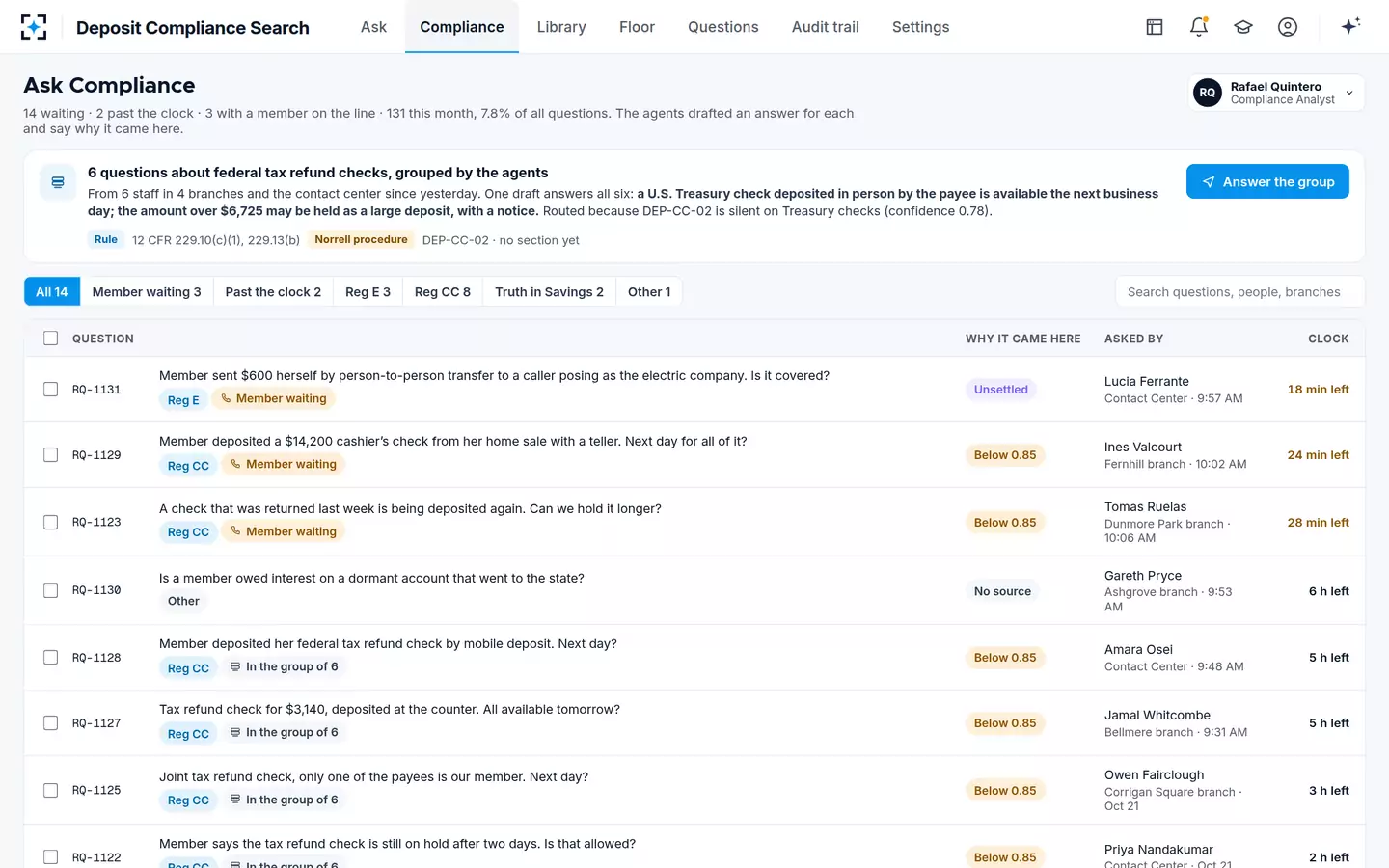
It does not fit the questions that need judgment the institution has not yet exercised. A member who sent money herself to a scammer and asks about a goodwill credit gets an answer that says Compliance decides, and the agents will not propose an amount. Six questions about federal tax refund checks on which the procedure was silent were grouped and sent to Compliance as one, to be answered once. The wait does not disappear for those questions; it becomes visible, ordered by clock and attached to a draft.
Ask Compliance: every routed question with its reason and its clock
Questions people ask
What if a Reg E claim is not logged on the call?
The notice date does not move. Regulation E counts its deadlines from receipt of the consumer's oral or written notice, so a claim opened days later is already days into its window, and the record of the call will show when notice was given. The fix is a procedure that logs the notice date on first contact, even if the claim waits.
What does a compliance hotline cost?
The visible cost is analyst time, at a median wage of $38.81 an hour for compliance officers in 2025 before overhead. The larger costs are the second contact with the member and the deadlines that run while the question waits, which is why a hotline should sort questions by the clock they touch rather than by arrival.
How much time do reps spend looking up rules?
No public survey measures it for banks. On the fictional sample credit union, the product's estimate puts searching procedure PDFs, a printed availability chart and a vendor manual at about 0.3 hours for one question a representative cannot answer alone, before any wait for Compliance; a representative there handles about 45 calls a day, three or four needing a rule she is unsure of.
Who should answer compliance questions in a bank?
The front line, for questions an approved procedure or the rule answers clearly; the compliance team, for unsettled points, gaps in procedure and anything involving a goodwill decision or a report. The design question is how fast the first kind reaches the front line with its source, and how visibly the second kind reaches Compliance.
Do compliance questions from staff need to be recorded?
No deposit rule requires a log of internal questions, but Regulation E and Truth in Savings require evidence of compliance to be kept for two years, and a question that led to a claim, a hold or a fee notice is part of that evidence. A log also shows an examiner what staff were told and when.