Regulation E's change in terms rule, 12 CFR 1005.8(a), requires a financial institution to mail or deliver written notice to the consumer at least 21 days before the effective date of a change to a disclosed electronic fund transfer term, when the change would increase fees, increase the consumer's liability, reduce the types of transfers available or tighten limits on how often or how much the consumer can transfer. A change needed at once to keep an account or system secure is the one exception. The rule is short; the work around it is not, because the same account also answers to Truth in Savings and Regulation CC, each with its own 30-day clock, and because the institution's own procedures change more often than the terms, leaving staff who gave last month's answer with no way to know it is now wrong. Botminds' Deposit Compliance Search answers staff from the terms and procedures in force on the day, and when a procedure changes it finds every answer built on the old text and the person who received it.
A financial institution shall mail or deliver a written notice to the consumer, at least 21 days before the effective date, of any change in a term or condition required to be disclosed under § 1005.7(b) of this part if the change would result in: (i) Increased fees for the consumer; (ii) Increased liability for the consumer; (iii) Fewer types of available electronic fund transfers; or (iv) Stricter limitations on the frequency or dollar amount of transfers.
12 CFR 1005.8(a)(1), Regulation E
What is the Reg E change in terms notice period?
Twenty-one days before the change takes effect, and they are calendar days: the FDIC's examination manual notes that "day" in Regulation E means a calendar day unless the rule says business day (FDIC Consumer Compliance Examination Manual, section VI-2). The notice must be written, mailed or delivered, and it covers only terms that 12 CFR 1005.7(b) requires in the initial disclosures: the consumer's liability, the number to call about unauthorized transfers, business days, types of transfers and their limits, EFT fees, documentation, stop-payment rights, the institution's liability, confidentiality, error resolution and ATM operator fees (12 CFR 1005.7(b)).
No particular form is required. The official interpretation says the notice "may appear on a periodic statement, or may be given by sending a copy of a revised disclosure statement, provided attention is directed to the change (for example, in a cover letter referencing the changed term)" (comment 8(a)-1). A revised disclosure booklet mailed without anything pointing to what changed does not meet that standard.
What counts as an adverse change under Reg E?
Only the four effects the rule names: more in fees, more liability, fewer kinds of transfers, or tighter limits on frequency or amount. A change that helps the consumer, such as a lower ATM fee or a higher daily limit, needs no advance notice under 1005.8, though the institution's disclosures should still be kept accurate. The official interpretation lists changes that need no notice at all: "Closing some of an institution's ATMs" and "Cancellation of an access device" (comment 8(a)-2).
Two edge cases come up often. An institution that never disclosed a transfer limit and adds one for the first time must disclose at least the fact that limits now exist, even if the details stay confidential for security (comment 8(a)-3). And changing the phone number or address for reporting unauthorized transfers needs a change-in-terms notice only if the institution will impose liability on the consumer for unauthorized transfers (comment 8(a)-4).
When can a bank change terms without notice?
When the change is needed immediately "to maintain or restore the security of an account or an electronic fund transfer system" (12 CFR 1005.8(a)(2)). Lowering the limits on a card after a data breach is the textbook case. If the change becomes permanent and saying so would not compromise security, the consumer must be told in writing on or with the next regularly scheduled periodic statement or within 30 days of making it permanent. Outside that exception, and outside changes that are not adverse, the 21 days apply.
Reg E, Reg DD, Reg CC and Part 707: four notice clocks
A consumer account answers to more than one change-in-terms rule, and the clocks are different. Truth in Savings requires notice 30 calendar days or more before a change to any disclosed term that could lower the annual percentage yield or otherwise work against the consumer (12 CFR 1030.5(a)(1)); Part 707 imposes the same at credit unions (12 CFR 707.5(a)(1)). Regulation CC requires notice to consumer account holders 30 days or more before a change to the availability policy takes effect, while a faster policy may be disclosed up to 30 days after (12 CFR 229.18(e)).
Four change-in-terms clocks, counted back from the effective date
- Notice out21 days
- Notice out30 calendar days
- Notice out30 calendar days
- Notice out30 days
The clocks meet on fees. An increase in a fee for electronic transfers, such as an ATM withdrawal fee, is a Regulation E change and a Truth in Savings change at the same time. The Truth in Savings commentary settles which clock wins: compliance with Regulation E "is deemed to satisfy the disclosure requirements" of Regulation DD, for example when an institution "changes a term that triggers a notice under Regulation E, and uses the timing and disclosure rules of Regulation E for sending change-in-term notices" (Regulation DD, comment 3(c)-1). Part 707's commentary says the same for credit unions.
Which notice a fee or term change needs
| Change | Rule that applies | Minimum notice |
|---|---|---|
| ATM withdrawal fee rises from $2 to $3 | Regulation E; Truth in Savings satisfied by a Reg E notice | 21 days |
| Monthly maintenance fee rises from $5 to $8 | Truth in Savings (Reg DD or Part 707) | 30 calendar days |
| Daily debit card limit cut from $1,000 to $500, not for security | Regulation E | 21 days |
| Same cut, made at once after a breach | Regulation E security exception | None in advance; tell the member later if permanent |
| Variable rate on a savings account falls | Truth in Savings exempts variable-rate changes | None |
| Holds extended from the second to the third business day by policy | Regulation CC | 30 days, consumer accounts |
| ATM fee lowered | Not adverse | None required in advance |
Does a fee increase need 21 days' notice?
It depends on what the fee is for. A fee for electronic fund transfers or for the right to make them is a Regulation E term, so 21 days is the minimum, and a notice that meets Regulation E's timing also satisfies Truth in Savings for that fee. A fee that has nothing to do with electronic transfers, such as a monthly maintenance fee or a paper statement fee, is a Truth in Savings term only, so the minimum is 30 calendar days. A representative who answers "21 days" to a maintenance fee question is nine days short.
On the fictional sample credit union, a representative asked exactly this about a monthly fee on its everyday checking account going from $5 to $8. The answer: yes, members must be told in writing at least 30 days before the higher fee takes effect, under NCUA Part 707, and the credit union's own procedure sends the notice 45 days ahead. The rule and the procedure are separate lines in the answer, because they can change separately.
Changes that need no notice because the disclosures already said so
Truth in Savings has one more exception that front-line staff are rarely taught: a term that changes automatically on a stated event. The Regulation DD commentary says an institution "need not send an advance notice of the change provided the institution fully describes the conditions of the change in the account opening disclosures" (Regulation DD, comment 5(a)(1)-3). Part 707's commentary gives the credit union examples: the end of a fee waiver for employee-members when their employment ends, and the expiry after one year of a promotion that promised to "waive $4.00 monthly service charges for one year".
The exception has a condition worth reading closely. The disclosure must describe the change fully at account opening, and Part 707's commentary adds a caution that applies to every notice: "unless credit unions have reserved the right to change terms in the account agreement or disclosures, a change-in-terms notice may not be sufficient to amend the terms under applicable law" (Part 707 commentary, 707.5(a)(1)-1). A timely notice satisfies the regulation; whether it changes the contract is a question of the agreement and state law, and an answer to staff should not blur the two.
When your own procedure changes, not the account
No regulation requires an institution to give its staff 21 days' notice of its own procedure changes, but the effect of a change is the same kind of problem: everyone who learned the old version keeps using it. Regulation CC comes closest to saying so, requiring procedures and a statement of them for each employee whose duties the rule touches (12 CFR 229.19(f)). Version control for policies and procedures keeps the document straight; the harder question is the answers already given from it.
The sample credit union's case is a Regulation CC procedure. Its exception-hold notice section, version 4, let a notice be mailed "within five business days"; a test of 25 sampled mobile and ATM hold notices found 3 sent two to four business days after the deposit. The compliance analyst drafted version 5, matching 12 CFR 229.13(g): no later than the first business day after the deposit, or after the facts become known, whichever is later. The Compliance Officer approved it the next morning; the drafter could not.
Every answer built on the old text, and every person who received one
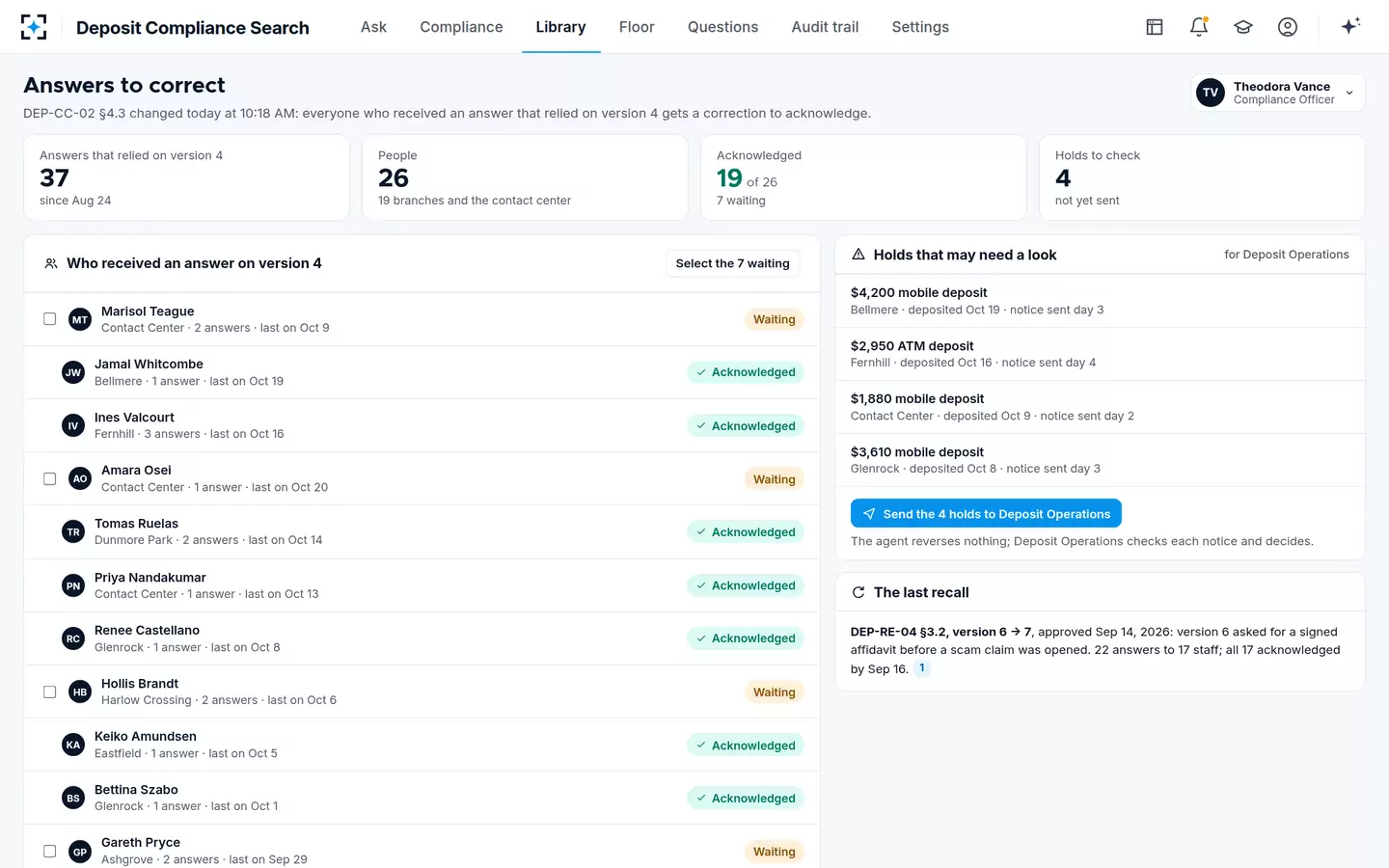
Who was given the old answer?
Without a record of answers, nobody knows: the memo goes out, some people read it, and the representative who told a teller "five business days is fine" last month is not on any list. With a record, the question has an answer. On the sample change, the solution's Change-watch agent found 37 answers since August 24 that relied on version 4, given to 26 staff, and 4 holds whose notices may have gone out late, $4,200, $2,950, $1,880 and $3,610, which went to Deposit Operations to check.
Who had acknowledged the correction one hour after approval
26 staff who received an answer on the old text
- Acknowledged within the hour: 19 · 73%
- Waiting: 7 · 27%
17 staff in the previous recall (September)
- Acknowledged within two days: 17 · 100%
The design target is that every answer which relied on a changed procedure is flagged to whoever received it: 100 percent, measured in the live solution. The acknowledgments are a second measure, and the waiting seven can be reminded in one step. The same mechanism covers changes to sources outside the institution, such as an amended rule or withdrawn guidance, because each answer keeps the version of every source it used. Which sources can change under an answer, and how fast, is set out with the Regulation E source ladder.
How to version compliance answers
Treat an answer like a disclosure: it has an effective date, it rests on named sources in named versions, and it is superseded rather than edited. That makes three things possible that a mailbox cannot do: showing an examiner what a member was told on a given day and why, finding everyone affected when a source changes, and proving the correction reached them.
What each saved answer should carry so it can be recalled later
- The date and time it was given, and to whom
Without the member's name or account, which belong in the core system, not the answer.
- Every source with its version
Rule text in force on the day, official interpretation, guidance and the procedure section with its version number.
- The facts it relied on
So a later reader can see whether a change to a source changes this particular answer.
- What happened next
A claim opened, a hold placed, a notice sent, with references, so affected cases can be checked after a change.
- Approvals for reuse
Who drafted and who approved an answer before it was reused; never the same person.
- The correction trail
When a correction went out, to whom, and when each person acknowledged it.
Questions people ask
When must customers be told of fee changes?
At least 21 days before the effective date for fees on electronic fund transfers under Regulation E, and at least 30 calendar days before for other account fees under Truth in Savings. Lower fees need no advance notice. At a credit union, Part 707 supplies the 30-day rule.
How far ahead must a Reg CC policy change be noticed?
At least 30 days before a change that slows availability on consumer accounts, under 12 CFR 229.18(e). A change that makes funds available sooner may be disclosed up to 30 days after it takes effect.
Can a change-in-terms notice go on the periodic statement?
Yes, under Regulation E, as long as it reaches the consumer at least 21 days before the effective date and attention is directed to the change. Part 707's commentary similarly allows a notice on or with a statement, or in a highlighted part of a newsletter or insert.
What if a rep gave the old answer?
Find every answer given under the old text, tell each person who gave it, and check the cases those answers touched, such as holds placed or notices sent. On the sample change, 37 answers to 26 staff led to 4 holds sent to Deposit Operations to review; nothing was reversed automatically.
Does Regulation E require a change-in-terms notice for closing ATMs?
No. The official interpretation lists closing some of an institution's ATMs and cancelling an access device as changes that do not require disclosure. Raising the fee at the remaining ATMs would.