The official staff commentary for Regulation E is Supplement I to 12 CFR Part 1005, titled "Official Interpretations": a section-by-section set of numbered comments, such as comment 2(m)-3 or comment 11(c)-2, that explain how the CFPB reads each provision of the rule. It is not the rule itself, but it is more than guidance, because Regulation E's Appendix C says interpretations issued by duly authorized CFPB officials "provide the protection afforded under section 916(d) of the Act": an institution that acts in good faith in conformity with them is shielded from civil liability even if the interpretation is later changed. Above it sit the Electronic Fund Transfer Act and the regulation; below it sit the CFPB's FAQs, supervisory guidance and the institution's own procedures. Answers to deposit questions go wrong when those layers are blended, which is why Botminds' Deposit Compliance Search labels every line of an answer Rule, Official interpretation, Regulator guidance or the institution's procedure.
The Regulation E source ladder: what each level is, and how it binds
1Statute
Electronic Fund Transfer Act, 15 U.S.C. 1693 and following
Binds everyone; courts decide what it means.
Example: The definition of "account" in 1693a(2)
2Rule
Regulation E, 12 CFR 1005
Binds institutions; written through notice and comment.
Example: 1005.11(c): 10 business days to investigate
3Official interpretation
Supplement I to Part 1005, the official staff commentary
Interprets the rule; good-faith reliance protects from liability under EFTA section 916(d).
Example: Comment 2(m)-3: access device obtained by fraud
4Regulator guidance
CFPB Electronic Fund Transfers FAQs; supervisory guidance; circulars
Does not have the force of law; FAQs are labeled Compliance Aids; can be withdrawn.
Example: EFT FAQs, Error Resolution Q4: no police report first
5Own procedure
The institution's deposit procedures and account agreements
Binds the institution's staff; may give members more than the rule, never less.
Example: A procedure that sends fee notices 45 days ahead
What is the official staff commentary for Regulation E?
It is the CFPB's official interpretation of Regulation E, published as Supplement I to Part 1005 and kept on eCFR beside the rule (Supplement I to Part 1005). Each comment is numbered to the paragraph it interprets: "6(b)(5)" comments explain 12 CFR 1005.6(b)(5), and comment 6(b)(5)-1 is the first of them. The commentary began as the Federal Reserve Board's staff interpretations; when the Dodd-Frank Act moved rulemaking authority to the CFPB, the Bureau restated Regulation E at 12 CFR Part 1005 in December 2011 (76 FR 81020), commentary included, as the FDIC's examination manual records.
The commentary is where many of the answers front-line staff need actually live. The rule says an unauthorized transfer excludes one made by a person the consumer "furnished" the access device to; comment 2(m)-3 adds that a transfer by someone who got the device by fraud or by robbery is unauthorized. The rule sets liability tiers; comment 6(b)-2 adds that a consumer's carelessness never lets the institution charge more than those tiers allow (the comment is quoted in Reg E denial reasons). Examiners use it the same way: the FDIC's Regulation E examination procedures cite "Staff Commentary" next to sections of the rule (FDIC Consumer Compliance Examination Manual, section VI-2).
Is the official interpretation binding?
It is authoritative, and it protects; whether it binds a court is a separate question. Regulation E's Appendix C says interpretations issued by duly authorized CFPB officials "provide the protection afforded under section 916(d) of the Act" and that, except in unusual circumstances, they "will be incorporated in an official commentary to this part" (12 CFR Part 1005, Appendix C). Section 916(d) is the good-faith defense in the statute's civil liability section.
No provision of this section or section 1693n of this title imposing any liability shall apply to— (1) any act done or omitted in good faith in conformity with any rule, regulation, or interpretation thereof by the Bureau or the Board ...
Electronic Fund Transfer Act, section 916(d), 15 U.S.C. 1693m(d)
The protection holds "notwithstanding that after such act, omission, or failure has occurred, such rule, regulation, approval, or model clause is amended, rescinded, or determined by judicial or other authority to be invalid for any reason." That is the practical meaning of the commentary for a compliance team: following it in good faith is a defense, which no FAQ or bulletin provides. Courts, for their part, decide for themselves what the statute means. In Loper Bright Enterprises v. Raimondo (June 28, 2024) the Supreme Court held that courts "must exercise their independent judgment in deciding whether an agency has acted within its statutory authority" and overruled Chevron deference, while noting that courts may still seek aid from the interpretations of the agencies that administer a statute.
Where is the Reg E commentary, and how do you cite it?
On eCFR, as Supplement I to Part 1005, following the regulation's appendices; the CFPB's own regulation pages carry the same text. Cite it by comment number, "comment 11(c)-2", or in full as "12 CFR Part 1005, Supplement I, comment 11(c)-2", and give the date of the version relied on, because eCFR keeps every version and the commentary changes when the rule does. Regulation E's commentary was last amended in eCFR's record on October 1, 2025, alongside section 1005.10.
Two citation habits save trouble. Quote the comment's words rather than paraphrasing them in an answer that may be read back to a member, and cite the rule section beside it, so a reader can see what is rule and what is interpretation. The commentary also cross-refers to itself ("See comment 3(b)(1)-1.v."), and a cited comment often depends on another one that changes its meaning.
Are CFPB FAQs binding?
No. The CFPB's Electronic Fund Transfers FAQs open by saying "This is a Compliance Aid issued by the Consumer Financial Protection Bureau" (CFPB EFT FAQs), and the Bureau's 2020 policy statement explains the label: "Unlike the Bureau's regulations and official interpretations, Compliance Aids are not 'rules' under the Administrative Procedure Act," and "regulated entities are not required to comply with the Compliance Aids themselves" (Policy Statement on Compliance Aids, 85 FR 4579). The same statement adds that the Bureau "does not intend to sanction, or ask a court to sanction, entities that reasonably rely on Compliance Aids".
That makes the FAQs a strong signal and a weak authority. Their answers usually rest on the rule and the commentary, and they say so: the answer on police reports cites comments 11(b)(1)-2 and 11(c)-2. A good staff answer cites what the FAQ cites, labels the FAQ as regulator guidance, and does not present "the CFPB says" as if it were the rule. The answer on fraud-induced code sharing works the same way: the FAQ applies comment 2(m)-3, and the comment is the stronger citation.
Four kinds of Regulation E source, and what each one can do
Rule and official interpretation: The rule has the force of law; the commentary is the agency's official reading of it.
FAQs, supervisory guidance and circulars: Supervisory guidance does not bind as law does (12 CFR Part 1074).
Rule and official interpretation: Good-faith conformity is a defense to civil liability, even if later amended (15 U.S.C. 1693m(d)).
FAQs, supervisory guidance and circulars: A stated intention not to sanction reasonable reliance on Compliance Aids; no statutory defense.
Rule and official interpretation: By rulemaking, published in the Federal Register and visible on eCFR by date.
FAQs, supervisory guidance and circulars: By re-issue or withdrawal, sometimes in bulk; 67 CFPB documents were withdrawn on May 12, 2025.
Rule and official interpretation: As the requirement; violations are cited to the rule.
FAQs, supervisory guidance and circulars: As examples of practices; agencies say they do not cite violations of guidance.
What happens when CFPB guidance is withdrawn?
It stops being something the CFPB relies on, and the rule underneath it stays exactly where it was. On May 12, 2025 the CFPB withdrew 67 guidance documents, among them circulars on overdraft opt-in and unanticipated overdraft fees and a bulletin on returned deposited item fees, saying it would not enforce or rely on that guidance while it reviewed it, and that guidance generally binds no one and creates no rights (90 FR 20084). It also said the withdrawal might not be the end of the matter (CFPB overdraft rule repealed quotes the notice).
For a staff answer, that has two consequences. An answer that cited a withdrawn circular as current is now wrong in its source even if its conclusion still holds under the statute, and it should be found and corrected. And an answer resting on the rule or the official commentary was untouched: Regulation E's error-resolution and unauthorized-transfer provisions did not move, and the EFT FAQs were not on the list. Finding who was given an answer that rested on a changed source is the same discipline the institution applies to its own procedure changes.
How the Regulation E source ladder was built, and where it moved
- EFTA, Fed rule and staff commentary1978–2011 · Federal Reserve
- CFPB restates Reg E (Dec 2011)2011–2025 · CFPB, Part 1005
- BeforeGuidance, FAQs, circulars
- Compliance Aids (2020); guidance rule (2021); 67 withdrawn (2025)2020–2025
Can a bank procedure be stricter than Reg E?
Yes, in the member's favor, and never in the other direction. The statute bars any agreement that waives a consumer's rights but says it does not prohibit "any writing or other agreement which grants to a consumer a more extensive right or remedy or greater protection than contained in this subchapter" (15 U.S.C. 1693l). The regulation applies the same idea to liability: where state law or the account agreement imposes less liability than Regulation E, the lower figure governs (12 CFR 1005.6(b)(6)).
So a procedure that sends fee-change notices 45 days ahead when the rule requires 21 or 30, or credits disputed amounts faster than the rule demands, is lawful and binds the institution's own staff. A procedure that asks for a police report before opening a claim, or treats a member who shared a code with a scammer as having authorized the transfer, is not stricter but weaker, and the CFPB's FAQs and the commentary both say so. That distinction is why the procedure belongs in an answer as its own labeled line: it is the institution's choice, and it is where the institution's own errors hide.
Where network rules and the account agreement sit on the ladder
Below the regulation, and never above it. Card network rules, payment network rules and the institution's account agreement can add protection for consumers but cannot take any away, and the CFPB's FAQs say so in one sentence: private rules may give consumers more than Regulation E, but a less protective rule leaves the institution's Regulation E duties exactly where they were (CFPB EFT FAQs, Error Resolution Q3). The same answer gives the example staff trip over: some network rules count a dispute window from the transaction date, while Regulation E counts its 60 days from the date the institution sends the statement.
For P2P transfers the FAQs make the same point about finality: private rules that make a transfer final between institutions take nothing away from a consumer's protection against unauthorized transfers (Unauthorized EFTs Q10; whether Zelle is covered by Reg E quotes the answer). An answer that cites a network rule to tell a member her claim is too late, or that a push payment cannot be disputed, has put the network rule above the regulation. In a labeled answer that mistake is visible, because the network rule would have to appear on a line of its own, below the rule it contradicts.
Label every line of an answer
A compliance answer is easier to trust, check and correct when each line says what it rests on. Deposit Compliance Search writes its answers in three layers, what to do now, why, and the institution's procedure, and labels every line of the why as Rule, Official interpretation or Regulator guidance, with the procedure section shown with its reviewer, date and version. Every citation opens the passage relied on in the version in force on the day of the question.
How to label the sources in a Regulation E answer
- Rule
A section of 12 CFR Part 1005, with its paragraph. The requirement itself.
- Official interpretation
A numbered comment in Supplement I. Cite the number, and the rule section it interprets.
- Regulator guidance
A CFPB FAQ, an agency bulletin or supervisory guidance. Say who issued it and when; check it has not been withdrawn.
- Institution's procedure
The section, its version, its owner and the date of its latest review. Never a section that is under review.
- Unsettled
Where none of the four answers the question, say so and route it, rather than filling the gap with a guess.
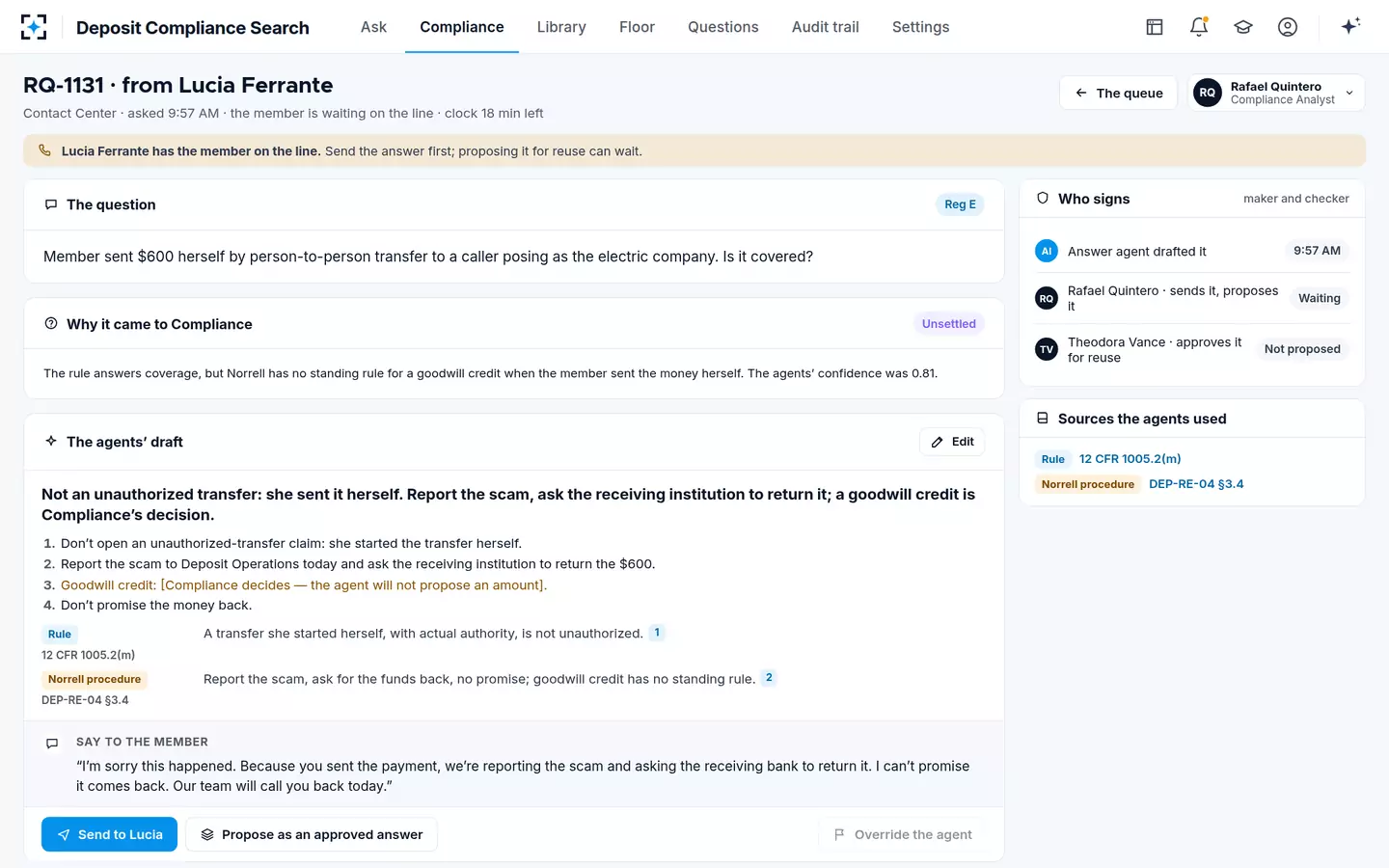
A routed question: the rule answers part of it, and the procedure is silent on the rest
Questions people ask
What is Supplement I to Part 1005?
It is the official interpretations of Regulation E, published after the regulation's appendices: the numbered comments that explain each section, such as comment 2(m)-3 on access devices obtained by fraud. Good-faith reliance on it is protected under section 916(d) of the Electronic Fund Transfer Act.
Is the Reg E commentary the same as the CFPB FAQs?
No. The commentary is the official interpretation of the rule; the FAQs are labeled Compliance Aids and are not rules under the Administrative Procedure Act. FAQs often cite the commentary, and when they do, the comment is the stronger citation.
Does a withdrawn CFPB circular change Regulation E?
No. Withdrawing guidance does not amend the rule or its commentary; it removes the CFPB's stated reading and its reliance on it. Practices the guidance addressed can still be judged under the statute and the unfair, deceptive or abusive practices standard.
Do NCUA examiners treat CFPB guidance the same way?
The NCUA codified the same interagency statement on supervisory guidance in 12 CFR Part 791, subpart D, and "provides that the Statement is binding on the NCUA". Regulation E and its commentary apply to credit unions directly; CFPB guidance carries no more force at a credit union than at a bank.
What did Loper Bright change for Regulation E?
It ended the rule that courts defer to an agency's reasonable reading of an ambiguous statute; courts now decide the best reading themselves, though they may still draw on agency interpretations. It did not repeal Regulation E or its commentary, and it did not touch the good-faith defense in section 916(d).