Yes, the CFPB overdraft rule was repealed: Congress disapproved it under the Congressional Review Act, and Public Law 119-10, approved May 9, 2025, says the rule "shall have no force or effect". It never applied to anyone, because its effective date was October 1, 2025. What the repeal did not touch matters more to a compliance officer. The Regulation E opt-in for ATM and one-time debit card fees, the Truth in Savings totals on every statement and the statutory ban on unfair practices are unchanged, and the FDIC's authorize-positive, settle-negative guidance and the OCC's 2023 overdraft bulletin are still posted. Botminds' Overdraft Compliance tests every courtesy pay and NSF fee against that standing set of rules, so this page is the map of what binds now, what was withdrawn, and what that changes in a testing program.
Every status below was checked on the regulator's own page or in the Federal Register on October 26, 2026. Where a document has left a regulator's site without a notice saying why, the page says so rather than guess.
Four dates that reset overdraft compliance
Jan 142025
the CFPB withdrew its proposal to ban NSF fees on instantly declined transactions
May 92025
Public Law 119-10 voided the CFPB overdraft rule for institutions over $10 billion
May 122025
the CFPB withdrew 67 guidance documents, its two overdraft circulars among them
Apr 102026
the FDIC rescinded its multiple re-presentment NSF fee guidance
Was the CFPB overdraft rule repealed? Yes, by Public Law 119-10
The rule was repealed by statute, not by the CFPB. Senate Joint Resolution 18 disapproved "Overdraft Lending: Very Large Financial Institutions" (89 FR 106768, December 30, 2024), and the resolution became Public Law 119-10 on May 9, 2025. The operative words are short: the rule "shall have no force or effect". Because the rule's effective date was October 1, 2025, no institution ever had to comply with it, and no examiner can cite it.
The Congressional Research Service's summary is the clearest account of the sequence. The House and Senate committee chairs introduced the joint resolutions on February 13, 2025; the Senate passed S.J.Res. 18 in March and the House in April; the President signed it (CRS Insight IN12513). For anyone searching for a "rescinded" or "overturned" overdraft rule, this is the same event: Congress used a disapproval resolution, and the result is a rule that is void.
What the 2024 overdraft rule would have required, and from whom
The rule would have applied only to "very large financial institutions": an insured bank or credit union "with total assets of more than $10 billion and any affiliate thereof" (89 FR 106768). For those institutions it narrowed the long-standing exception that keeps overdraft fees out of the Truth in Lending Act. An overdraft fee could stay outside Regulation Z only if it was a small amount that covered costs and losses: a $5 benchmark fee, or a higher fee the institution justified as breakeven. Above that, overdraft became credit, with Regulation Z's disclosures and protections.
Two consequences follow for a compliance officer today. First, an institution of $10 billion or less was never in scope, so for most banks and credit unions nothing about their own obligations changed in 2025. Second, the market data the CFPB assembled to justify the rule are still the best public picture of who earns overdraft revenue. The preamble estimated market-wide overdraft revenue in 2022 at $9.1 billion, of which "an estimated $6.16 billion, or 68 percent, was earned by financial institutions with above $10 billion in assets".
Bank overdraft and NSF revenue halved before any rule took effect
Which CFPB overdraft guidance was withdrawn in May 2025?
On May 12, 2025 the CFPB withdrew 67 guidance documents in one notice (90 FR 20084). Three bear directly on overdraft and deposit fees: Circular 2022-06 on unanticipated overdraft fee practices, which is where the CFPB set out its view of authorize-positive, settle-negative fees; Circular 2024-05 on improper overdraft opt-in practices; and Bulletin 2022-06 on returned deposited item fees. The 2023 policy statement on abusive acts or practices went on the same list.
Two sentences in that notice set the terms. The first says what withdrawal means for enforcement: "the Bureau will deprioritize enforcement against regulated parties whose conduct does not conform to the guidance during the pendency of any withdrawal". The second says it may not be the end of the story: "Such withdrawal is not necessarily final." A compliance program that deleted every overdraft test the circulars inspired read the first sentence and not the second.
Four months earlier, on January 14, 2025, the CFPB had also withdrawn its January 2024 proposal to prohibit NSF fees on transactions declined instantly, such as a declined debit card purchase or ATM withdrawal (90 FR 3044). The withdrawal notice said the CFPB would consider "a more comprehensive approach" to NSF fees; no such proposal has appeared in the Federal Register since.
What was not withdrawn is as important. Supervisory Highlights are reports of what examiners found, not guidance, and none appears on the withdrawal list. Issue 29 (2023) and Issue 37 (January 2025) remain the public account of the findings that drove nearly $250 million in refunds, and they are the source this series leans on for the core processor and re-presentment findings in NSF representment fees and the core's default setting.
Overdraft rules and guidance, item by item, on October 26, 2026
| Item | What it covered | Status today |
|---|---|---|
| CFPB rule, 89 FR 106768 (Dec. 30, 2024) | Overdraft as credit above a $5 or breakeven fee, institutions over $10 billion | Void: Public Law 119-10, May 9, 2025. Never took effect. |
| CFPB proposed rule, 89 FR 6031 (Jan. 31, 2024) | NSF fees on instantly declined transactions | Withdrawn January 14, 2025 (90 FR 3044). |
| CFPB Circular 2022-06 | Unanticipated overdraft fees, including APSN | Withdrawn May 12, 2025 (90 FR 20084). |
| CFPB Circular 2024-05 | Improper overdraft opt-in practices | Withdrawn May 12, 2025. |
| CFPB Bulletin 2022-06 | Returned deposited item fees | Withdrawn May 12, 2025. |
| FDIC FIL-32-2023 (replaced FIL-40-2022) | Multiple re-presentment NSF fees | Rescinded April 10, 2026 (FIL-14-2026). |
| FDIC FIL-19-2023 | Authorize positive, settle negative | Posted; page last updated April 26, 2023; no rescission notice. |
| FDIC FIL-81-2010 | Overdraft payment supervisory guidance | In effect; attachment amended February 3, 2026 to remove reputation risk references. |
| OCC Bulletin 2023-12 | APSN and representment fees, risk management | In effect; not on the OCC rescinded list; reputation risk references removed March 20, 2025. |
| Joint Guidance on Overdraft Protection Programs (2005) | Safety and soundness, legal risks, best practices; OCC, Fed, FDIC, NCUA | Relied on by FIL-81-2010 (amended 2026) and OCC Bulletin 2023-12; OCC Bulletin 2005-9 is not on the OCC rescinded list. |
| NCUA Letter 24-CU-03 (December 2024) | Overdraft and NSF practices at credit unions | No longer on NCUA’s live list of letters; status unconfirmed. |
| Regulation E, 12 CFR 1005.17 | Opt-in for ATM and one-time debit card fees | Unchanged. |
| Regulation DD 1030.11 and NCUA 707.11 | Statement totals, overdraft advertising, balance display | Unchanged. |
Did the FDIC rescind its overdraft guidance? Only the re-presentment letter
The FDIC rescinded one overdraft document, not its overdraft guidance as a whole. On April 10, 2026 it withdrew FIL-32-2023, the 2023 restatement of its multiple re-presentment NSF fee guidance, "effective immediately" (FIL-14-2026). Its stated reason was that the guidance was "overly broad in scope and has raised uncertainty regarding when, for instance, disclosures regarding re-presentments may result in “unfairness” concerns". The same letter keeps one expectation: that what institutions tell consumers matches what they actually do (NSF representment fees quotes it).
Two FDIC overdraft documents remain. FIL-19-2023, the authorize-positive, settle-negative guidance, is still on the FDIC's site with no rescission notice; its attachment warns that an institution which does not avoid such fees raises its risk of violating the Dodd-Frank Act and Section 5 of the FTC Act (FIL-19-2023 attachment; the practice itself is traced in authorized positive, settle negative). And FIL-81-2010, the overdraft payment supervisory guidance, was amended on February 3, 2026 to remove references to reputation risk, which means the FDIC reviewed it this year and kept it. Its expectations are concrete: daily limits on fees, a look at de minimis overdrafts, follow-up with customers who pay a fee more than six times in a rolling twelve months, and transaction processing not designed "to maximize the cost to consumers".
Management should be especially vigilant with respect to product over-use that may harm consumers, rather than providing them the protection against occasional errors or funds shortfalls for which the programs were intended.
FDIC, FIL-81-2010 summary, as amended February 3, 2026
Does the OCC overdraft bulletin still apply? Bulletin 2023-12 is in force
Yes. OCC Bulletin 2023-12, "Overdraft Protection Programs: Risk Management Practices", is not on the OCC's list of rescinded bulletins, and the one change noted on its page is the removal of reputation risk references on March 20, 2025. It names the two practices that produced most of the refunds: authorize-positive, settle-negative fees and "representment fees". It also goes further than most guidance on disclosure: the OCC has found APSN fees unfair even where the bank's disclosures explained when they could be charged.
The bulletin's risk management list is the closest thing a national bank has to an overdraft testing standard, and one line in it describes the control most programs lack: periodic testing of the core's settings and parameters to check that postings match what the bank disclosed (how that test is run is in overdraft protection compliance, tested on last year's postings). The 2005 Joint Guidance on Overdraft Protection Programs, issued by the OCC, the Federal Reserve, the FDIC and the NCUA, sits underneath both: the OCC bulletin builds on it, and the FDIC's 2010 guidance, amended this year, still expects institutions to manage overdraft programs in accordance with it.
What never moved: the opt-in, the statement totals and the unfairness standard
The rules that bind by force of law were never part of the rollback. Regulation E, 12 CFR 1005.17, still bars a fee for paying an ATM or one-time debit card overdraft unless the institution gave a segregated notice, a reasonable opportunity to opt in, obtained affirmative consent and confirmed it in writing. Regulation DD, at 12 CFR 1030.11, and the NCUA's parallel rule at 12 CFR 707.11 still require "Total Overdraft Fees" and total returned-item fees on each statement, for the period and the year to date, and still forbid an automated balance that includes the overdraft limit unless a second balance is prominently labelled as including it.
The unfairness standard is statute, not guidance: an act or practice is unfair when it causes or is likely to cause substantial injury, the injury is not reasonably avoidable, and it is not outweighed by benefits to consumers or competition. The APSN and re-presentment findings published since 2022 rest on that three-part test, applied to the facts of each program. The withdrawn circulars explained how the CFPB applied it; withdrawing them did not change the test or the facts, which is why the FDIC and OCC documents that apply the same test still stand.
What Overdraft Compliance tests against: a program before and after the 2025 rollback
What a program leaned on in 2024: CFPB Circular 2022-06, FDIC FIL-19-2023, OCC 2023-12
What it can lean on in 2026: FDIC FIL-19-2023 and OCC 2023-12, both still posted; the unfairness statute
What a program leaned on in 2024: FDIC FIL-32-2023, OCC 2023-12, Supervisory Highlights
What it can lean on in 2026: OCC 2023-12; Supervisory Highlights 29 and 37 as findings; FDIC asks that disclosures match practice
What a program leaned on in 2024: Regulation E 1005.17 and CFPB Circular 2024-05
What it can lean on in 2026: Regulation E 1005.17 and its official interpretations, unchanged
What a program leaned on in 2024: CFPB final rule, effective October 1, 2025
What it can lean on in 2026: No federal cap; the rule is void
What a program leaned on in 2024: FDIC FIL-81-2010, 2005 Joint Guidance
What it can lean on in 2026: The same two documents, FIL-81-2010 amended in February 2026
Can the CFPB reissue the overdraft rule?
Not in the same form without a new law. Under the Congressional Review Act, once a joint resolution of disapproval is enacted, an agency may not issue a rule in "substantially the same form" unless a later law authorizes it. The Congressional Research Service notes that the Act "does not define the phrase substantially the same" and that no court has interpreted it, so the boundary is untested.
Because a joint resolution of disapproval was enacted, the CFPB may not issue a rule in "substantially the same form" in the future absent authorization in a subsequent law.
Congressional Research Service, Insight IN12513 (updated September 10, 2025)
What remains open to the CFPB is supervision and enforcement under the statute itself, against the institutions it supervises, those over $10 billion and their affiliates. Its April 2025 statement of supervision and enforcement priorities puts refunds to consumers ahead of penalties, a shift whose cost to a bank is worked through in bank overdraft fee refunds. Orders show how fast the posture changed: the November 2024 order against Navy Federal Credit Union over surprise overdraft fees was terminated on July 1, 2025, with the CFPB waiving "any alleged non-compliance therewith" (CFPB enforcement page).
Which overdraft rules apply to banks under $10 billion?
The same ones that applied before 2024, because the voided rule never reached them. A bank or credit union of $10 billion or less is examined for consumer compliance by its prudential regulator, not the CFPB: the FDIC for state non-member banks, the OCC for national banks, the Federal Reserve for state member banks, the NCUA for federally insured credit unions. Each applies Regulation E, Truth in Savings and Section 5 of the FTC Act, and each has its own overdraft documents in the table above.
For a credit union the picture is thinner. The NCUA's December 2024 letter on overdraft and NSF practices, 24-CU-03, no longer appears on the NCUA's live list of letters, and the NCUA has not published a notice saying why, so its status cannot be confirmed. What a credit union can rely on is set out in NCUA overdraft guidance when you are the whole compliance department.
What changes in an overdraft compliance program now
Less than the headlines suggest. The tests that matter were never anchored on the rule: whether a fee was charged on a card or ATM item the available balance covered when the customer paid, whether a re-presented check or ACH debit was charged again, whether a valid Regulation E opt-in sits behind every ATM and one-time debit fee, and whether the fee schedule's promises match what the core does. What changed is the citation behind each finding, and the evidence an examiner will want to see that the institution found it first.
Five updates to an overdraft compliance program after the rollback
- Re-cite every finding to a standing source
Replace references to CFPB Circulars 2022-06 and 2024-05 with Regulation E, the unfairness statute, FDIC FIL-19-2023 or OCC Bulletin 2023-12, as your regulator applies them.
- Keep the APSN test
The FDIC and OCC documents that call these fees a heightened unfairness risk are both still posted.
- Test re-presentment against your own disclosures
FIL-14-2026 drops the FDIC’s guidance but keeps the expectation that disclosures accurately reflect practice; the OCC bulletin still calls repeat fees a Section 5 risk.
- Test the opt-in itself, not the core’s flag
Regulation E 1005.17 is unchanged, and the withdrawn opt-in circular was never the source of the obligation.
- Date-stamp the status of every source
A credit union citing 24-CU-03 should say it is a December 2024 letter whose current status is unconfirmed.
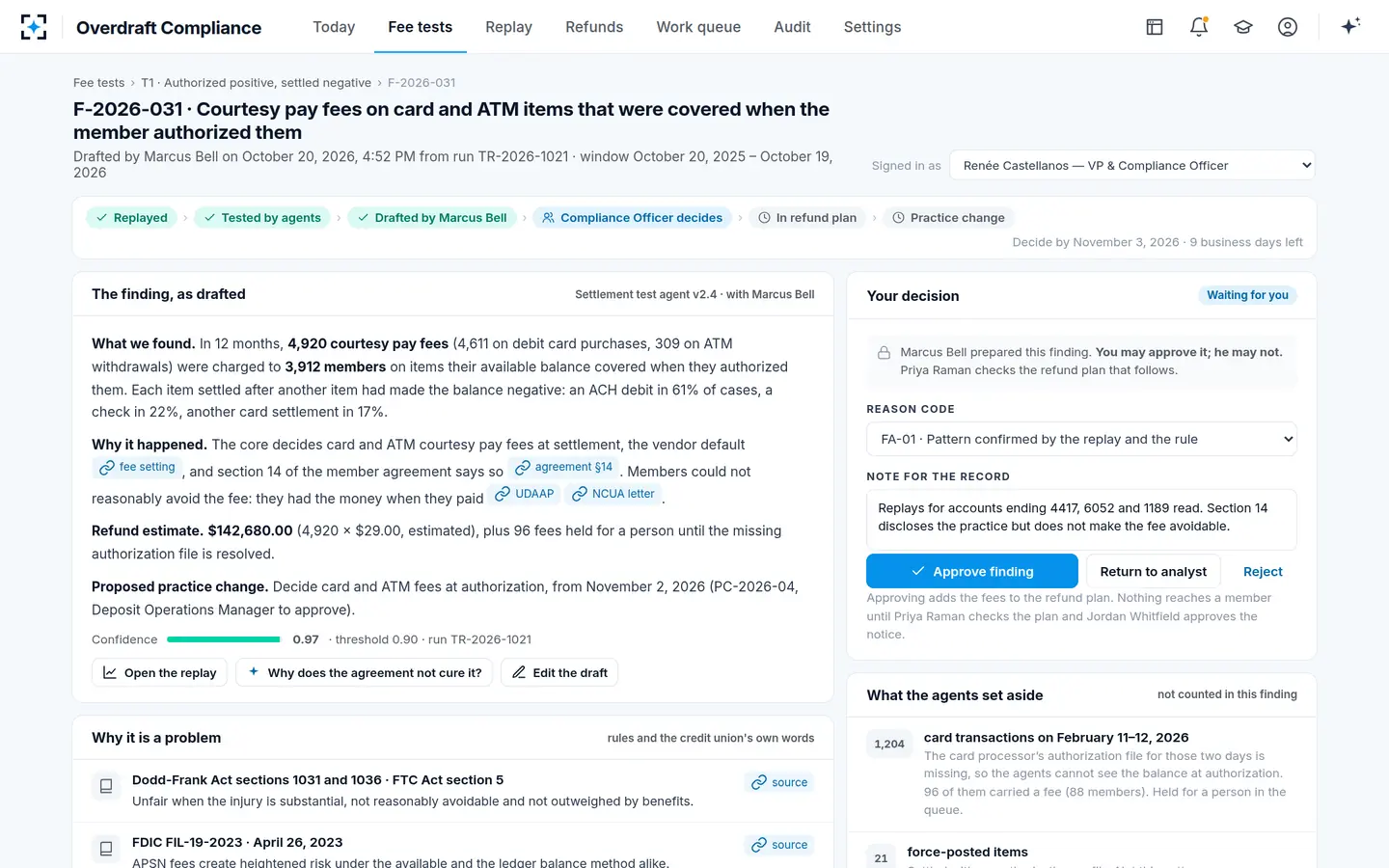
Botminds' Overdraft Compliance keeps that discipline in the finding itself. Each finding names the rules behind it, and the screen below shows the cited rules for an authorize-positive, settle-negative finding on the fictional sample credit union the solution runs on: the unfairness standard and FDIC FIL-19-2023, with the credit union's own member agreement beside them.
Overdraft Compliance: a finding cites the rules that still stand
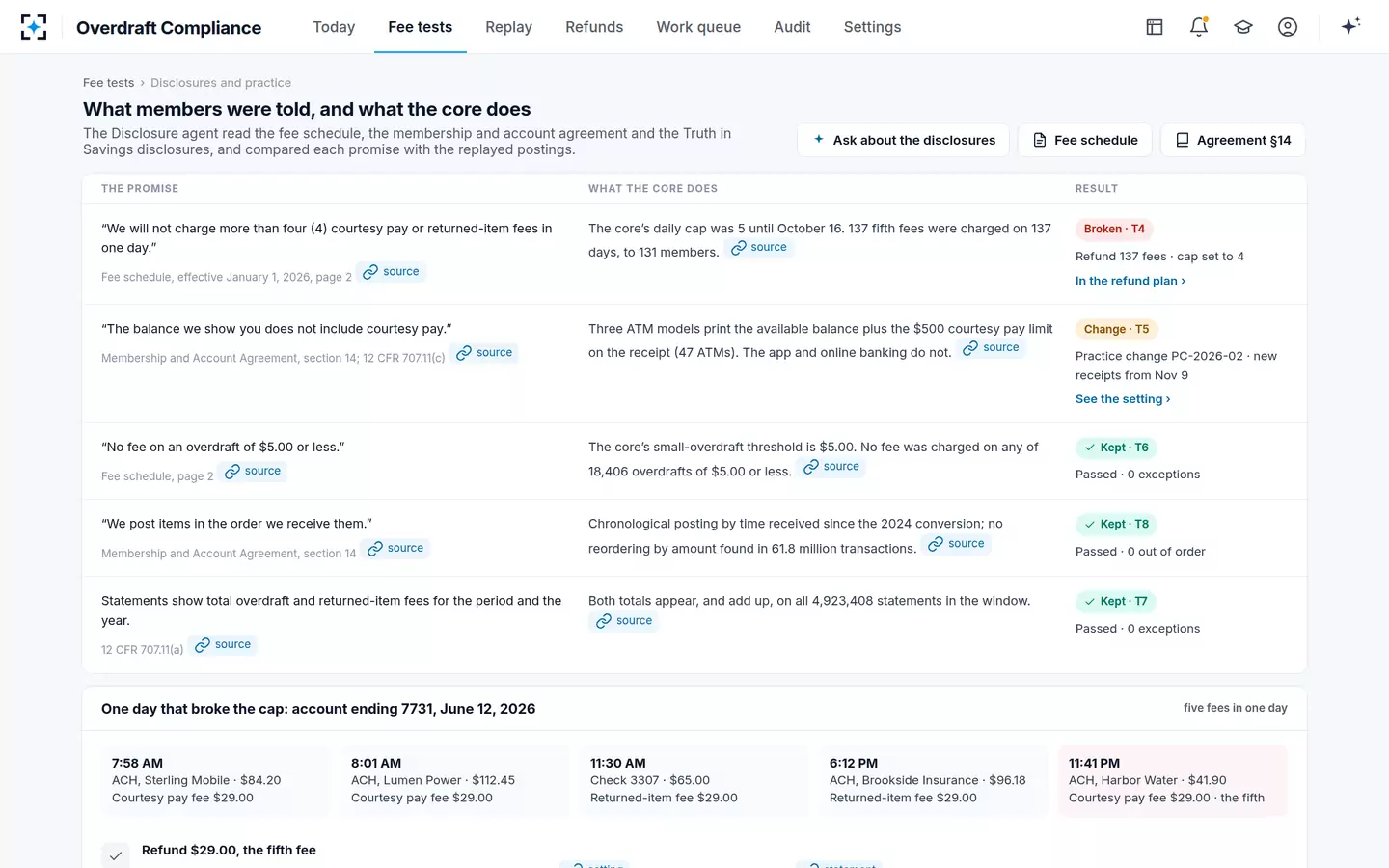
The same discipline applies to disclosures. The FDIC's April 2026 rescission and the OCC bulletin both point at the gap between what the fee schedule says and what the core does, so the solution reads each promise in the fee schedule and member agreement and tests it against the year's postings.
What members were told, and what the core does
Questions people ask
When was the CFPB overdraft rule overturned?
On May 9, 2025, when the President signed S.J.Res. 18, which became Public Law 119-10. The Senate had passed it in March and the House in April. The rule had been published on December 30, 2024 with an effective date of October 1, 2025, so it never took effect.
What replaced the CFPB overdraft rule?
Nothing replaced it. Overdraft fees remain outside the Truth in Lending Act under the long-standing exception, and the obligations that existed before 2024 still apply: Regulation E's opt-in, Truth in Savings disclosures and the ban on unfair or deceptive practices as each prudential regulator applies it.
Is the CFPB APSN circular still in effect?
No. Circular 2022-06 was withdrawn on May 12, 2025 in 90 FR 20084. The FDIC's own APSN guidance, FIL-19-2023, is still posted, and OCC Bulletin 2023-12 still names APSN fees as a heightened Section 5 risk, so the practice remains a supervisory concern at banks those agencies examine.
Did the FDIC rescind FIL-19-2023?
No rescission notice has been published. The FDIC rescinded FIL-32-2023, its re-presentment NSF fee guidance, on April 10, 2026, and amended FIL-81-2010 on February 3, 2026. FIL-19-2023's page was last updated April 26, 2023 and carries no rescission note.
Is the NCUA overdraft letter 24-CU-03 still in effect?
Its status cannot be confirmed. The December 2024 letter's page no longer resolves on ncua.gov and the letter is missing from the live list, but the NCUA has not published a rescission. A credit union should treat it as a statement of the NCUA's 2024 view and anchor its program on Regulation E, Part 707 and the FTC Act.
Can a future CFPB bring back overdraft limits?
Not in substantially the same form without new legislation, under the Congressional Review Act. A different rule, or enforcement under the unfair, deceptive or abusive standard, remains possible, and the withdrawal notice itself says the 2025 withdrawals are "not necessarily final".