No, overdraft fees are not illegal in the United States. A bank or credit union may charge a fee for paying an item that overdraws an account, and since Congress voided the CFPB's 2024 overdraft rule in May 2025 no federal cap on the amount applies. What is illegal is charging them in certain ways: an ATM or one-time debit card overdraft fee without a valid Regulation E opt-in, a fee on a card purchase the balance covered when the customer paid, a second NSF fee each time a merchant re-presents the same item, or a fee the disclosures misdescribe. Those practices have produced nearly $250 million in refunds since 2022. Botminds' Overdraft Compliance tests every fee a bank or credit union charges against exactly those lines; this page sets out six things front-line staff and customers commonly believe about overdraft fees, and what the rules actually say.
Six beliefs about overdraft fees, and what the rules say
Belief 1
Overdraft fees are illegal, or capped by federal law.
What the rules sayLegal, and uncapped. The CFPB’s 2024 rule would have limited fees at institutions over $10 billion; Congress voided it in May 2025 before it took effect.
Belief 2
A bank cannot charge an overdraft fee without my consent.
What the rules sayTrue only for ATM withdrawals and one-time debit card purchases, under Regulation E. Checks, ACH and recurring payments can be paid and charged without an opt-in.
Belief 3
If I had the money when I paid, the fee is a mistake.
What the rules sayOften right. Regulators found fees on card items the balance covered at authorization unfair; but a fee on the item that actually overdrew the account can stand.
Belief 4
NSF fees are illegal.
What the rules sayLegal, and now rare at large banks. A second NSF fee on the same item when the merchant tries again is what examiners found unfair.
Belief 5
If the fee is in the account agreement, it is fair.
What the rules sayNot for the practices regulators examined: APSN and re-presentment fees were found unfair even when disclosed.
Belief 6
Most customers pay overdraft fees.
What the rules sayAbout 9% of accounts pay 79% of overdraft and NSF fees, and those accounts overdraw more than ten times a year.
Are overdraft fees illegal? No, but some ways of charging them are
Federal law treats an overdraft fee as a deposit account fee, not a finance charge, under an exception the Federal Reserve created in 1969 and the CFPB inherited. The Congressional Research Service puts it plainly: that rule "stated that overdraft was not credit and as a result exempted overdraft fees from being characterized as finance charges" (CRS Insight IN12513). The fee is subject to disclosure rules and to the ban on unfair and deceptive practices, but not to a federal price limit.
The law that does constrain overdraft fees works practice by practice. Regulation E governs consent for ATM and one-time debit card overdrafts. Truth in Savings governs how fees are disclosed and totalled on statements. The unfairness standard governs the way fees are triggered: whether a customer could reasonably avoid one. Each of the six beliefs below collides with one of those three.
Belief one: there is a federal limit on overdraft fees
There is not. The CFPB finalized a rule in December 2024 that would have required institutions with more than $10 billion in assets either to keep overdraft fees to a $5 benchmark or a breakeven amount, or to treat overdraft as credit under the Truth in Lending Act. Congress disapproved it, and Public Law 119-10 of May 9, 2025 voids the rule (Public Law 119-10). It never took effect, and under the Congressional Review Act the CFPB cannot reissue it in substantially the same form without new legislation. The full status of the rules after 2025 is in CFPB overdraft rule repealed: what still binds banks in 2026.
Fees have fallen anyway. Banks with more than $1 billion in assets reported $5.83 billion in overdraft and NSF revenue in 2023, 51 percent less than the $11.96 billion of 2019, though the CFPB noted that "some banks continue to charge overdraft fees as high as $37 each" (CFPB Data Spotlight, April 2024).
Belief two: a bank cannot charge an overdraft fee without my consent
That is true for two kinds of transaction and false for the rest. Regulation E says an institution "shall not assess a fee or charge on a consumer's account for paying an ATM or one-time debit card transaction pursuant to the institution's overdraft service" unless it gave a notice, obtained the customer's affirmative consent and confirmed it in writing (12 CFR 1005.17(b)(1)). For checks, ACH payments and recurring debit card payments there is no federal opt-in, and the bank may pay them into overdraft and charge for it under its account terms.
Which overdraft fees need the customer's opt-in
Opt-in required before any fee: ATM withdrawals; one-time debit card purchases in store, online or by phone
No federal opt-in needed: Checks; ACH payments, including one-time ACH from an account number; recurring debit card payments
Opt-in required before any fee: Segregated notice, a reasonable opportunity to opt in, affirmative consent, written confirmation
No federal opt-in needed: Disclose the fee in the account terms; follow the unfairness and deception standards
Opt-in required before any fee: The bank may still pay the item, but may not charge an overdraft fee for it
No federal opt-in needed: The bank may pay and charge, at its discretion
Opt-in required before any fee: Consumer testing found many people would rather have card and ATM transactions declined than pay a fee
No federal opt-in needed: Testing found people preferred important bills paid by check, ACH and recurring debit to be honored
The opt-in has to be real, not just recorded. A pre-ticked box, preprinted language on a signature card, or a yes given before the customer saw the notice does not count, and a fee charged on that basis is charged without consent. How a bank proves the order of consent is covered in Reg E opt-in confirmation letter: proving the order of consent.
Belief three: if I had the money, the fee is a mistake
Often the customer is right, and regulators agree. A debit card purchase is authorized when the customer pays but settles days later; if another item posts first, the purchase can settle against a negative balance and draw a fee the customer could not have seen coming. That practice, authorize positive, settle negative, is what the FDIC says creates "heightened risks of violations" of federal law (FDIC FIL-19-2023), and what the CFPB's examiners found unfair, with redress going to more than 170,000 consumers after the first examinations (Supervisory Highlights 29).
The customer is not always right, though. If the item that pushed the balance below zero was a check or an ACH payment that the balance did not cover, the fee on that item can stand. In the fictional sample credit union the solution runs on, a member's $38.12 grocery purchase was covered when she paid on Saturday; a $250.00 car payment posted first on Monday; the fee on the car payment stood and the $29.00 fee on the groceries was refunded. CFPB complaint data show how often this confuses people: in 2025 consumers "reported being charged overdraft fees despite having enough money in their accounts to cover charges" (CFPB Consumer Response Annual Report 2025). The full trace is in authorized positive, settle negative: one debit card fee, traced.
Belief four: NSF fees are illegal
A non-sufficient funds fee for returning an item unpaid is legal, though it has become rare at large banks: the CFPB reported in October 2023 that "the vast majority of NSF fees have been eliminated" among the banks it tracks. The CFPB also proposed banning NSF fees on transactions declined instantly, such as a declined card swipe, and then withdrew the proposal in January 2025 (90 FR 3044).
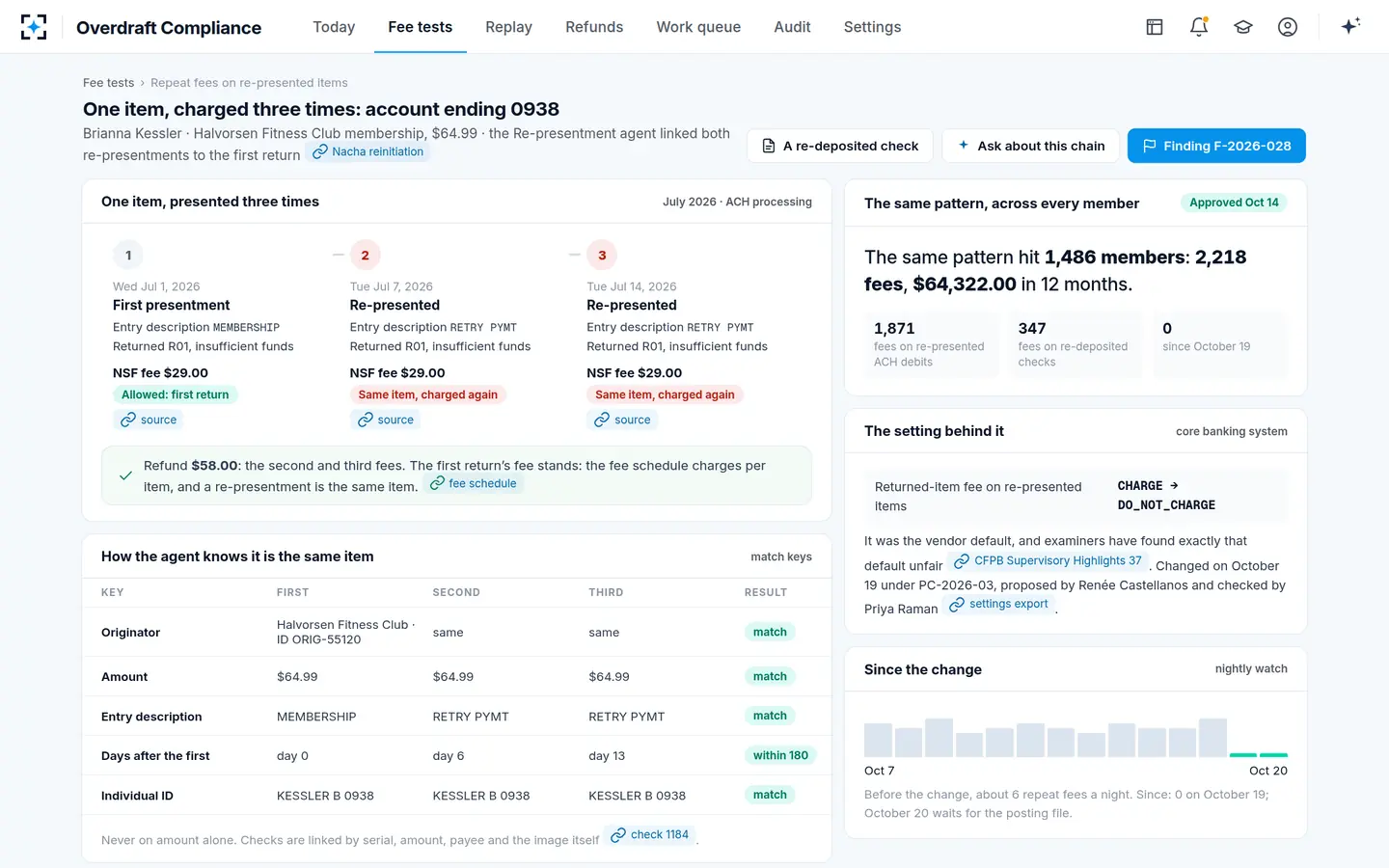
What examiners found unfair is the repeat fee: charging a second or third NSF fee when a merchant presents the same returned check or ACH debit again. Institutions agreed to refund about $66 million of those fees after the CFPB's 2022 supervisory push (Supervisory Highlights 37). The screen below shows one such chain at the sample credit union: one $64.99 membership payment, returned three times, three $29.00 fees, two of them refunded.
Overdraft Compliance on one payment and three NSF fees: the first stands
Belief five: a fee in the account agreement is always fair
Disclosure is necessary, and for the two practices regulators examined most closely, it is not enough. CFPB examiners found that consumers could avoid neither APSN fees nor repeat NSF fees, whatever the account-opening disclosures said (Supervisory Highlights 29). The OCC went further for national banks, finding APSN fees unfair even where the disclosures described when they could be charged (OCC Bulletin 2023-12). Each regulator's words are set side by side in authorized positive, settle negative: one debit card fee, traced.
The reason is in the unfairness test. A fee is avoidable only if the customer can see it coming and act, and a customer who checks the app, sees enough money, pays, and is charged later because of posting order had no moment to act. A disclosure that explains the posting order tells the customer the fee is possible; it does not give them a way to avoid it.
Belief six: most customers pay overdraft fees
Most do not. CFPB data summarised by the Congressional Research Service show that "Roughly 9% of accounts comprise 79% of overdraft and insufficient funds fees, and these consumers overdraft more than 10 times a year" (CRS Insight IN12513). In a 2023 survey, about a quarter of consumers, 26.5 percent, lived in households charged an overdraft or NSF fee in the past year (CFPB, December 2023).
Who pays overdraft fees
9%
of accounts pay 79% of overdraft and NSF fees, overdrawing more than ten times a year
26.5%
of consumers lived in households charged an overdraft or NSF fee in the past year
$5.83B
overdraft and NSF fees reported by banks over $1 billion in 2023, down 51% from 2019
Surprise is concentrated among the occasional overdrafter. Among consumers in households charged an overdraft fee, 43 percent were surprised by their most recent overdraft, and among those in households charged one to three fees, 51 percent were surprised, falling to 16 percent among those charged more than ten. The customers least able to see a fee coming are the ones who rarely see one, which is the population an APSN or repeat NSF fee hits hardest.
How consumers charged an overdraft fee felt about their most recent overdraft
How many overdraft fees can a bank charge you in a day?
As many as its own terms allow; no federal rule sets a number. What federal rules require is that the number be disclosed. The Regulation E opt-in notice must give the most fees the institution may charge in a day, or say that there is no limit (12 CFR 1005.17(d)(3)), and the model form's example line takes the second option (Model Form A-9; the line is annotated in the Reg E opt-in model form A-9).
Supervisors expect a limit even though the law does not require one. The FDIC's overdraft payment guidance, amended in February 2026 and still in force, asks institutions to "Institute appropriate daily limits on overdraft fees" (FDIC FIL-81-2010), and the OCC says a high limit or none at all "has contributed to determinations that banks' overdraft protection programs as a whole were unfair". A disclosed limit then has to hold in the core: at the sample credit union, the fee schedule promised four fees a day and the core allowed five, which put 137 fifth fees in a refund.
Can I get overdraft fees refunded?
Sometimes by asking, and sometimes without asking. A bank can waive a fee on request at its discretion; that is a customer service decision, not a legal right. Where a fee was charged in breach of the rules, the remedy is a refund to every customer affected, which is what the nearly $250 million reported by the CFPB represents: refunds institutions agreed to pay after examinations, found through lookbacks rather than individual requests.
Customers who disagree can complain to the bank's regulator. The CFPB received about 104,200 checking or savings complaints in 2025, and its report notes that some who asked for overdraft refunds "received partial refunds or were informed that there was a cap on refunds annually" (CFPB Consumer Response Annual Report 2025). The FDIC's consumer response unit closed 32,128 complaints and calls in 2025, and its work produced $1,666,946 in voluntary restitution and compensation for consumers (FDIC Consumer Compliance Supervisory Highlights, March 2026). What a refund program costs the bank is the subject of bank overdraft fee refunds: what one wrong core setting costs.
What a bank should test before a customer asks
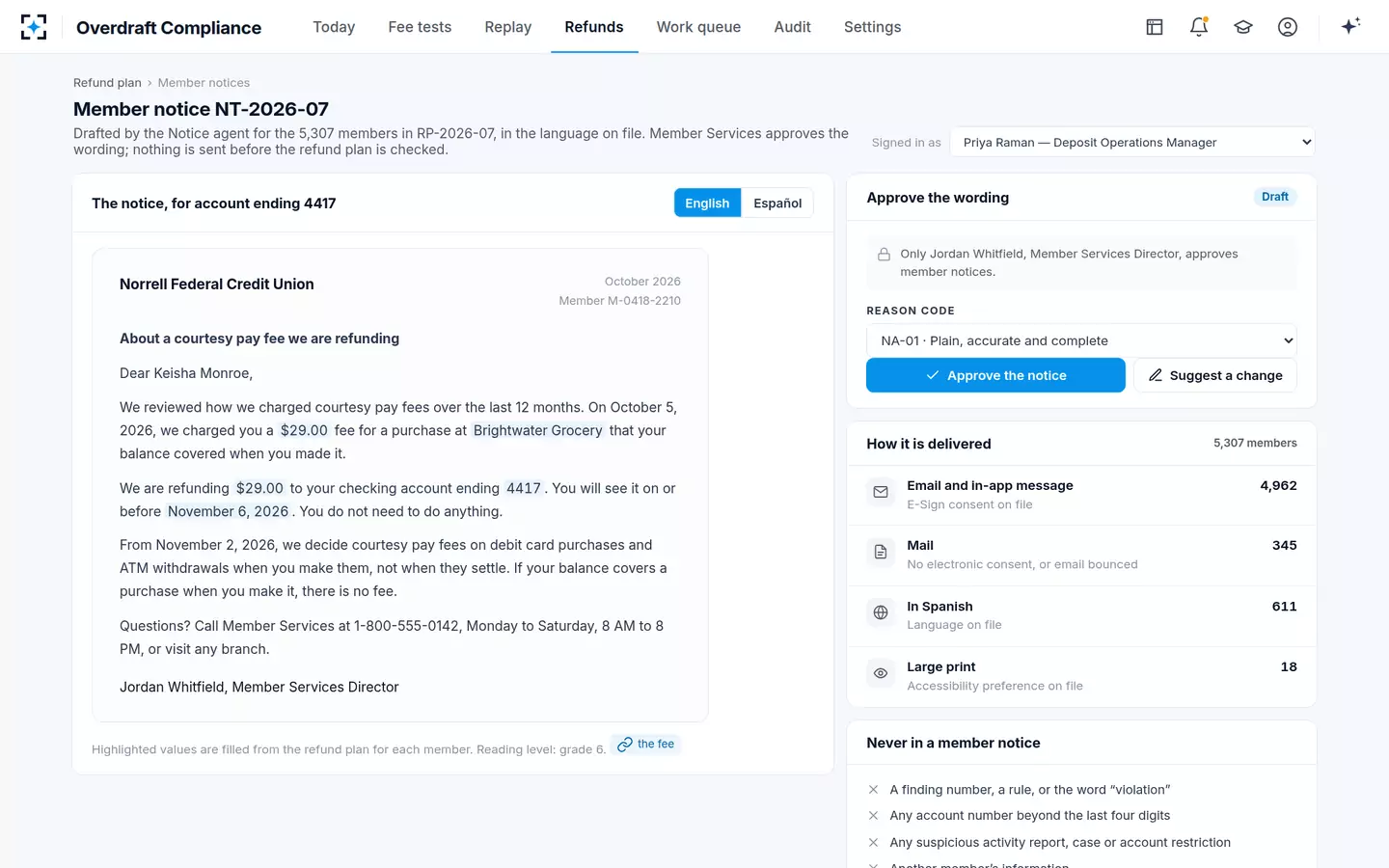
Every belief above maps to a test a bank or credit union can run on its own fees: is there a valid opt-in behind every ATM and one-time debit fee, was any card fee charged on an item the balance covered at authorization, was any NSF fee charged twice on one item, and do the fee schedule's promises, including its daily limit, match what the core did. Overdraft Compliance runs those tests on every fee for a year, not on a sample, and drafts a plain-language notice for each member owed money, approved by a person before anything is sent.
Overdraft Compliance drafts the refund notice in plain words
Questions people ask
Can a bank charge an overdraft fee on a pending transaction?
Fees are charged when items post, not while they are pending, but a pending debit card hold reduces the available balance and can cause a later item to overdraw. If a card purchase was covered when authorized and settles negative because of other items, regulators have found the fee on that purchase unfair; the fee on the item that actually overdrew the account may stand.
Can a bank close my account for overdrafts?
Generally yes, under the account agreement, and Regulation E lets an institution end the overdraft service, for example for excessive use (comment 17(g)-1). The CFPB has noted that overdraft fees can lead to account closures, which is one reason supervisors ask banks to monitor heavy users and offer cheaper alternatives.
Do credit unions follow the same overdraft rules as banks?
Yes for Regulation E's opt-in and for the unfairness standard. Credit unions follow the NCUA's Truth in Savings rule, Part 707, instead of Regulation DD, with the same statement totals, and federal credit unions must also have a written overdraft policy under 12 CFR 701.21(c)(3).
Is overdraft protection the same as an overdraft fee?
Not always. A linked savings transfer or an overdraft line of credit is an alternative way of covering overdrafts and is not an overdraft service under Regulation E; the A-9 notice must mention such plans if the institution offers them. Standard overdraft practices, sometimes called courtesy pay, are the fee-based service the opt-in rules govern.
Does a bank have to warn me before a transaction overdraws my account?
No federal rule requires a real-time warning. The 2005 Joint Guidance on Overdraft Protection Programs recommends alerting consumers "before a transaction triggers any fees" where feasible, and the FDIC's 2010 guidance asks banks to consider text, e-mail or phone alerts when a balance is at risk of a fee; both are supervisory expectations, not law.