NCUA overdraft guidance today is mostly regulation, not letters. A federal credit union that pays overdrafts must have a written overdraft policy under 12 CFR 701.21(c)(3); every federally insured credit union must show "Total Overdraft Fees" on statements and follow the overdraft advertising and balance rules in 12 CFR 707.11; and Regulation E's opt-in, 12 CFR 1005.17, governs every ATM and one-time debit card courtesy pay fee. The NCUA's December 2024 letter on overdraft and NSF fee practices, 24-CU-03, said examiners viewed authorize-positive, settle-negative fees and repeat fees on re-presented items as likely unfair; that letter no longer appears on the NCUA's site, and its status cannot be confirmed. For a compliance officer who is the whole department, the safe course is to anchor the program on the rules that bind and test them on the fees members actually paid. Botminds' Overdraft Compliance does that testing on every courtesy pay and NSF fee; this page sets out what to rely on and what one person can realistically own.
A credit union may advance money to a member to cover an account deficit without having a credit application from the borrower on file if the credit union has a written overdraft policy.
12 CFR 701.21(c)(3), NCUA rules for federal credit unions
Does NCUA have overdraft guidance? Yes, but most of it is regulation
The NCUA's binding overdraft requirements are in its rules and in Regulation E, not in a letter. Regulation E applies to credit unions directly: its definition of a financial institution names credit unions alongside banks and savings associations (12 CFR 1005.2). Part 707 is the NCUA's own Truth in Savings rule, written for share accounts. Section 701.21 is written for federal credit unions and is an overdraft rule written only for credit unions.
The guidance layer is thinner. The NCUA was one of the four agencies that issued the 2005 Joint Guidance on Overdraft Protection Programs, with the OCC, the Federal Reserve and the FDIC, and that text noted that the NCUA's advertising rules "prohibit federally insured credit unions from using advertisements or other representations that are inaccurate or misrepresent the services or contracts offered". The NCUA also sits on the FFIEC, whose consumer compliance rating system, revised effective March 31, 2017, was designed to reward institutions that prevent compliance problems, or find and fix them before an examiner does (81 FR 79473; what that reward is worth in a refund program is in bank overdraft fee refunds).
NCUA overdraft guidance and rules a credit union can rely on, with their status
| Source | What it requires or says | Status on October 26, 2026 |
|---|---|---|
| 12 CFR 701.21(c)(3) | Federal credit unions: a written overdraft policy with an overall cap, a per-member limit, a repayment time limit of no more than 45 days, and the fee | In force |
| 12 CFR 707.11(a) | “Total Overdraft Fees” and total returned-item fees on each statement, for the period and year to date | In force |
| 12 CFR 707.11(b) and (c) | Disclosures in overdraft advertising; balances shown by automated systems may not include the courtesy pay limit | In force |
| Regulation E, 12 CFR 1005.17 | Notice, opt-in and written confirmation before any ATM or one-time debit card overdraft fee | In force, unchanged |
| FTC Act Section 5 and the unfairness standard | Substantial injury, not reasonably avoidable, not outweighed by benefits | In force; the basis of every APSN and re-presentment finding |
| Joint Guidance on Overdraft Protection Programs (2005) | Best practices: daily limits, monitoring excessive use, explaining clearing order, alerts | Issued by the NCUA with three other agencies; still relied on by the FDIC and OCC |
| NCUA Letter 24-CU-03 (December 2024) | APSN, repeat NSF and returned deposited item fees likely unfair; uncapped daily fees; high-to-low ordering | Page returns “Page not Found”; absent from the live list of letters; status unconfirmed |
Is NCUA letter 24-CU-03 still in effect?
Nobody outside the NCUA can say for certain. The letter, "Consumer Harm Stemming from Certain Overdraft and Non-Sufficient Funds Fee Practices", was dated December 2024. On October 26, 2026 its page on ncua.gov returned "Page not Found", and the NCUA's live list of letters to credit unions runs from 25-CU-01 straight to 24-CU-02. No rescission notice has been published. A credit union citing it in a finding should date it December 2024, describe it as the NCUA's view at the time, and rest the finding on the rule or statute it applied.
What the letter said is still worth knowing, because it shows what examiners looked at. It reported that NCUA examiners reviewed overdraft programs at federal credit unions over $500 million in 2023 and between $100 million and $500 million in 2024. It called APSN fees "likely unfair under both the FTC Act and the CFPA" where members had a sufficient balance at authorization, and it said a policy of charging on each re-presentment "is likely unfair" even when disclosed. It also listed high or no daily limits, inaccurate fee disclosures and "Structuring the transaction processing order so the largest debit item processes first" as heightened risks. None of those positions depends on the letter for its legal footing: each is the unfairness test applied to a fee practice.
What a federal credit union overdraft policy must include
Four things, under 12 CFR 701.21(c)(3). The rule lets a federal credit union cover an account deficit without a credit application only if it has a written overdraft policy that sets the limits below. It is the one overdraft rule specific to credit unions, and a policy that has drifted from the core's settings fails it as surely as a missing policy.
The written overdraft policy 12 CFR 701.21(c)(3) requires, and the test for each line
- A cap on the total dollar amount of all overdrafts the credit union will honor
Set “consistent with the credit union’s ability to absorb losses”. Test: the core’s aggregate limit and the month-end total of negative balances.
- A time limit of no more than 45 calendar days to cover each overdraft
For the member to deposit funds or obtain an approved loan. Test: accounts negative longer than the policy allows, and what the core does on day 46.
- A limit on the dollar amount of overdrafts honored per member
Test: the courtesy pay limits loaded in the core against the policy, and any members above them.
- The fee and interest rate, if any
Test: the fee the core charges against the policy, the fee schedule, the opt-in notice and the Part 707 disclosures.
Does Part 707 require total overdraft fees on statements?
Yes. Under 12 CFR 707.11(a), a credit union "must separately disclose on each periodic statement" the total of fees for paying overdrafts, "using the term “Total Overdraft Fees;”", and the total of fees for returning items unpaid, each for the statement period and the calendar year to date. The totals must sit near the fee itemisation, in a format substantially similar to Sample Form B-10.
Two neighbouring paragraphs catch credit unions more often than the statement totals. Section 707.11(b) requires any advertisement promoting the payment of overdrafts to disclose the fee, the transactions it applies to, the time to repay and when the credit union will not pay. Section 707.11(c) forbids an automated balance, at an ATM, by phone or online, that includes the courtesy pay limit, unless a second balance is shown and prominently labelled. In the fictional sample credit union the solution runs on, three ATM models still printed the available balance plus the $500 courtesy pay limit on receipts at 47 ATMs, which became a practice change.
Are APSN fees unfair for credit unions?
The test is the same as for banks, and the answer the regulators reached is the same. An authorize-positive, settle-negative fee is charged on a card or ATM item the member's balance covered when they paid; under the unfairness standard the question is whether the member could reasonably have avoided it, and regulators that examined the practice concluded they could not, whatever the account agreement said. The FDIC and OCC guidance saying so is still posted (OCC Bulletin 2023-12), and the NCUA's 2024 letter took the same view. The mechanics, and how one fee is proved, are in authorized positive, settle negative: one debit card fee, traced.
For members who never opted in to courtesy pay on card and ATM items, there is no unfairness question at all. Regulation E's official interpretation says an institution that authorizes a one-time debit card transaction on a reasonable belief of sufficient funds may not charge an overdraft fee when intervening transactions leave the account short at settlement, unless the member has opted in (12 CFR 1005.17 and comment 17(b)-1.iv).
Can a credit union charge NSF fees on re-presented items?
A first NSF fee on a returned item is not in question. A second fee when the merchant presents the same item again is where every published finding lands: CFPB examiners called it unfair, as did OCC examiners at national banks and the NCUA in its 2024 letter, because the member does not control whether or when the merchant tries again (CFPB Supervisory Highlights 37). The CFPB also found that core platforms went on charging these fees by default until the client institution switched them off, which is why the setting, not the policy, is what to test; see NSF representment fees and the core's default setting.
Credit unions also have a third fee in this family that banks often do not: the returned deposited item fee, charged to a member whose deposited check bounced. The CFPB's bulletin on that fee was withdrawn in May 2025, and the NCUA's 2024 letter called blanket policies of charging it unfair. With both documents gone or unconfirmed, the remaining test is the unfairness standard and whether the fee schedule describes the fee accurately.
Who at a small credit union owns overdraft compliance?
The compliance officer owns the testing and the findings, but at least four other seats touch every fee: whoever controls the core's fee settings, whoever talks to members about fees, whoever approves the money going back, and whoever audits the lot for the Supervisory Committee. In a small credit union those five seats can be two or three people. The figure shows them as they appear at the fictional sample credit union, and what each keeps when agents take the mechanical work.
Five seats around one overdraft finding, and what each keeps
Today
Signs findings built on a 40-account sample, with the refund population a guess
With agents
Opens a finding with one member’s week replayed and the population in one sentence, and approves it with a reason code
Still theirs: The decision on every finding
Today
Requests posting history for a sample, matches card authorizations by hand and finds re-presented items by eye
With agents
Drafts findings from tests run on every fee and works the items the agents hold for a person
Still theirs: Judgment on held fees; cannot approve own drafts
Today
Asked to change a core setting or pull a refund population with no record of why
With agents
Sees the setting behind each finding and a 12-month what-if before touching the core
Still theirs: Every core change, as the second signature
Today
Writes refund letters once a population exists
With agents
Approves notices drafted for each member in the language on file
Still theirs: The words members read
Today
Rebuilds who decided what, and why, from memos and a shared folder
With agents
Reads everything, changes nothing, and exports the examiner pack
Still theirs: Independence; reports to the Supervisory Committee
The cost of doing this by hand falls hardest on the smallest institutions. The Federal Reserve Bank of St. Louis found that in 2014 banks under $100 million in assets spent an average of $163,800 on compliance, 8.7 percent of their noninterest expense, against 2.9 percent at banks of $1 billion to $10 billion, with personnel more than 60 percent of the cost in every size group (Regional Economist, July 2016). Those are bank figures, but a small credit union faces the same fixed list of rules with the same handful of people.
Compliance cost as a share of noninterest expense, by bank size, 2014
How often should a credit union review its overdraft program?
None of the NCUA documents available today sets a frequency. The nearest benchmark comes from the FDIC, whose 2010 overdraft payment guidance, amended in February 2026 and still in force for FDIC-supervised banks, calls for board oversight with "an annual review of an overdraft program's key features" and monitoring of members who pay a fee on "more than six occasions" in a rolling twelve months (FDIC FIL-81-2010). The 2005 Joint Guidance the NCUA signed asks institutions to "Monitor excessive consumer usage" and to "Consider daily limits on the consumer's costs".
The settings need a different rhythm: after every core conversion, release or fee schedule change. The Federal Reserve's advice to internal auditors applies directly: test hardest when a platform is new or has just been upgraded (Consumer Compliance Outlook, 2013; what software banks use for compliance testing quotes it). In the sample, a 2024 core conversion is where both the vendor-default fee setting and the 52 lost opt-ins came from.
What Overdraft Compliance takes off one person's desk
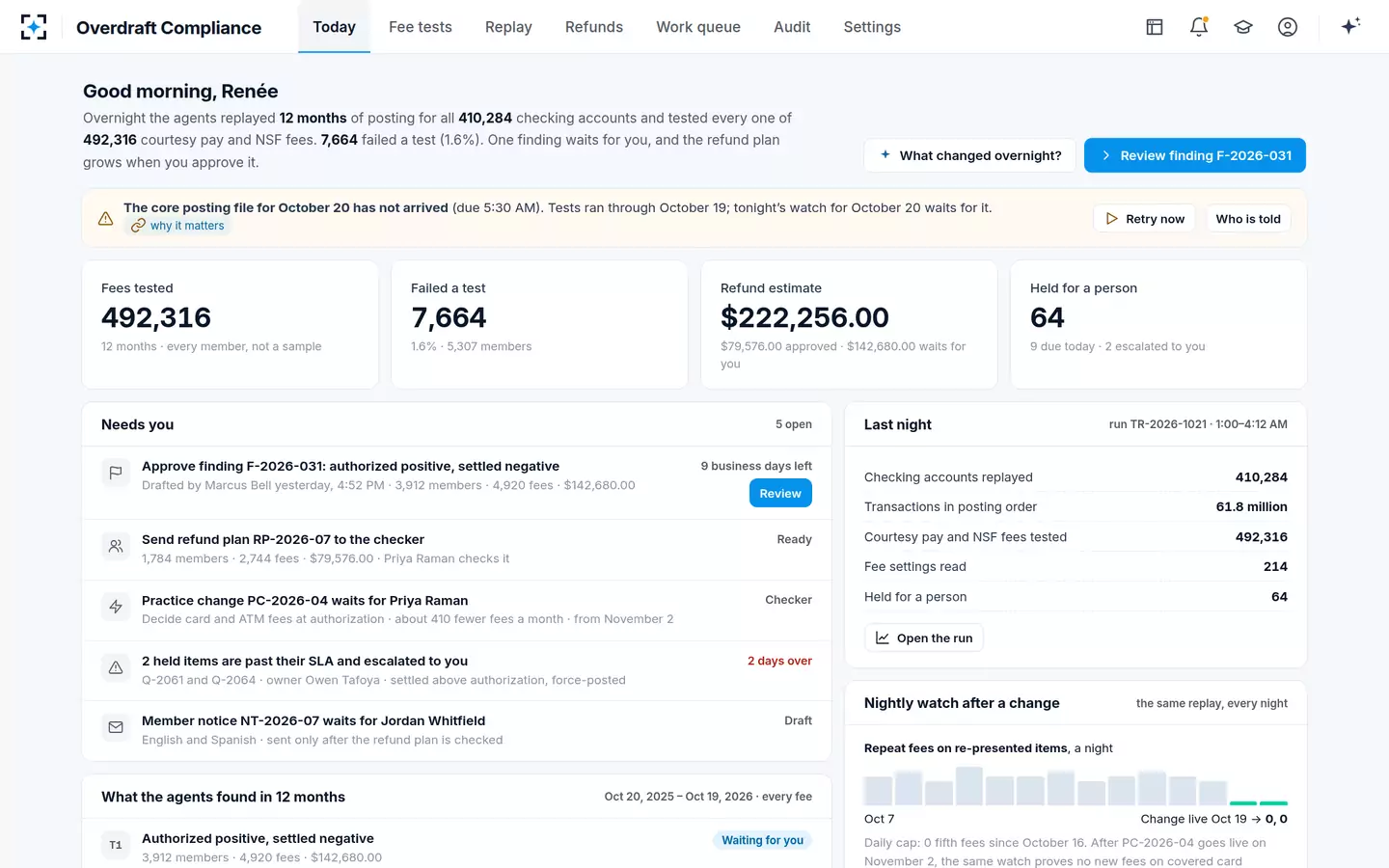
The mechanical half of overdraft testing is data work: pulling posting history, matching card authorizations to settlements, linking re-presented items, opening opt-ins, sizing refunds. The judgment half is deciding what is a finding, what the credit union will refund, and what changes in the core. Botminds' Overdraft Compliance gives the first half to eight agents and leaves the second with named people, so a compliance officer working alone starts the morning with decisions rather than data requests.
A compliance officer's morning in Overdraft Compliance
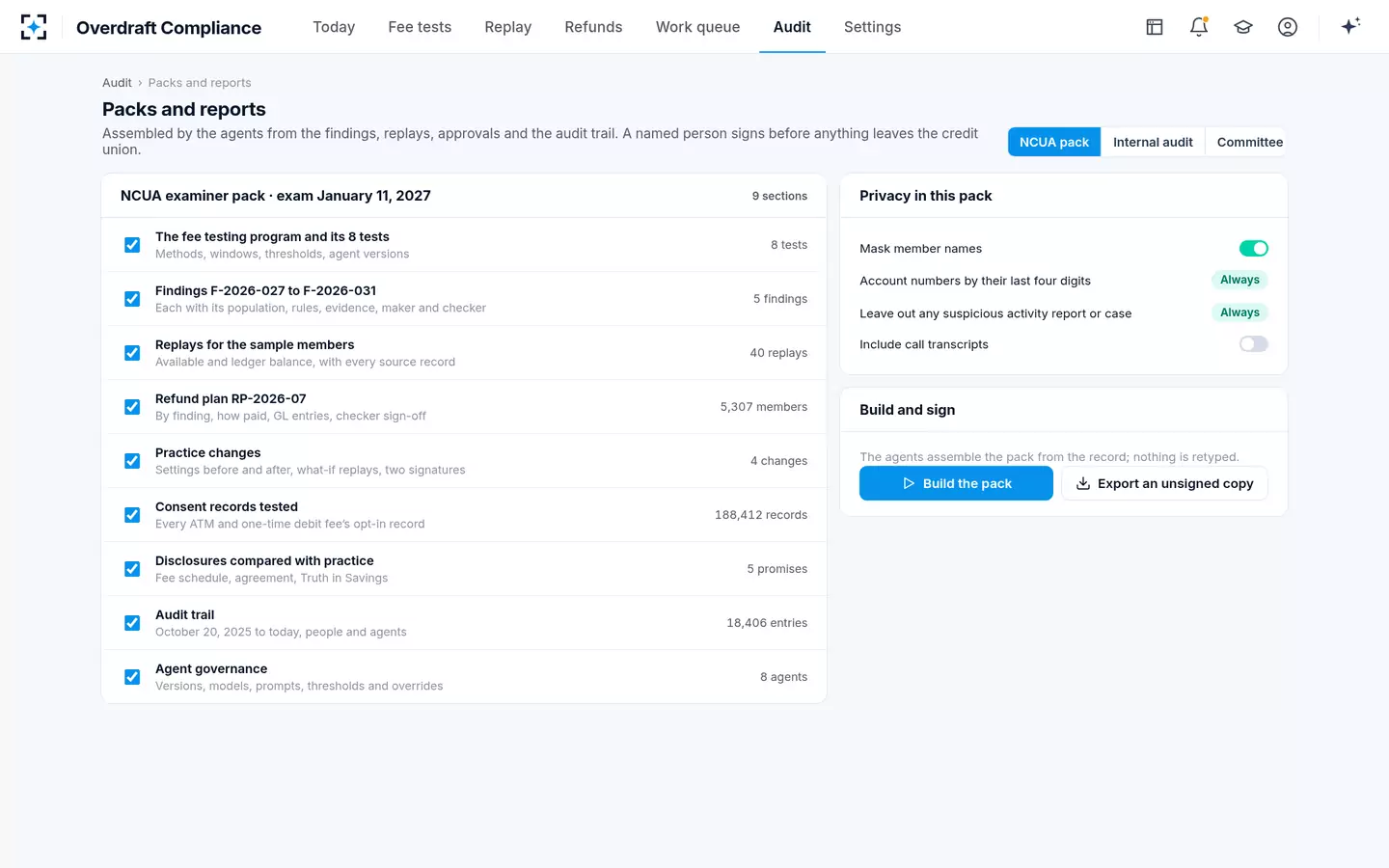
The exam is where a one-person shop is most exposed, because the examiner asks for who decided what, on what evidence, and the answer is usually in emails. In the sample, the NCUA exam is scheduled for January 11, 2027, and the examiner pack is assembled from the work itself: the testing program, the findings with their makers and checkers, 40 replays, the refund plan, the practice changes and the 188,412 opt-ins tested. Member names are masked and account numbers show their last four digits. The Navy Federal Credit Union order of November 2024 over surprise overdraft fees was terminated by the CFPB on July 1, 2025 (CFPB enforcement page); the NCUA remains the examiner for credit unions of every size, and the evidence it will ask for has not changed.
The NCUA examiner pack, assembled from the work
Questions people ask
What do NCUA examiners look for in courtesy pay?
The binding items are the Regulation E opt-in behind ATM and one-time debit fees, the Part 707 statement totals, advertising and balance rules, and for federal credit unions the written policy under 701.21(c)(3). The NCUA's 2024 letter added APSN fees, repeat NSF fees, returned deposited item fees, daily limits and posting order as areas of heightened risk; its current status is unconfirmed, but the unfairness standard it applied is statute.
Does the NCUA require a daily limit on courtesy pay fees?
No rule requires one. The 2005 Joint Guidance the NCUA issued asks institutions to "Consider daily limits on the consumer's costs", and Regulation E requires the opt-in notice to state the maximum number of fees per day, or that there is no limit. Whatever limit the credit union discloses, the core must apply.
Does the CFPB examine credit unions for overdraft fees?
Only those with more than $10 billion in assets, which the CFPB supervises for federal consumer financial law. Every other credit union is examined by the NCUA or its state regulator. The CFPB's November 2024 order against Navy Federal Credit Union over overdraft fees was terminated on July 1, 2025.
Should a credit union self-report overdraft fee problems?
The FFIEC consumer compliance rating system the NCUA applies was built to reward institutions that prevent compliance problems, or find and fix them on their own initiative. The NCUA's 2024 letter went further and said examiners would generally not cite violations self-identified and fully corrected before an exam; with that letter's status unconfirmed, the rating system is the footing to rely on.
Do state-chartered credit unions follow 701.21(c)(3)?
The overdraft policy requirement in 701.21(c)(3) sits in the NCUA's rules for federal credit unions, so a state-chartered credit union should check its own state's rules for the equivalent. Regulation E applies to every credit union that holds consumer accounts, and Part 707 is the Truth in Savings rule for federally insured credit unions.