An NSF representment fee is a non-sufficient funds fee charged again when a merchant presents the same returned check or ACH debit a second or third time. Each return looks like a new item to the posting engine, so unless the core is set to recognise the re-presentment, it charges again. CFPB examiners found the practice unfair, institutions have agreed to refund about $66 million of these fees since 2022, and in January 2025 the CFPB reported that core processors had configured their platforms to keep charging the fees "by default" unless the bank acted. The FDIC rescinded its own re-presentment guidance in April 2026, but the OCC's bulletin calling the practice a Section 5 risk is still in force. Botminds' Overdraft Compliance treats the control for what it is: a setting in the core, the history of when it changed, and a test every night that it still holds.
Repeat NSF fees in four numbers
$66M
refunded for NSF fees charged on a transaction that already drew one when it was declined, since 2022
58%
of all FTC Act Section 5 violations the FDIC cited in 2023 were re-presentment NSF fee disclosures
2
the maximum re-presentment attempts ACH network rules generally allow after an NSF return
$80.4M
repeat NSF fees Bank of America was ordered to refund in July 2023, beside $120 million in penalties
What is an NSF representment fee?
It is the second fee on one payment. The CFPB's definition is exact: re-presentments "occur when, after declining a transaction because of insufficient funds and assessing an NSF fee for the transaction, the consumer's account-holding institution returns the transaction to the merchant's depository institution, and the merchant presents the same transaction to the consumer's account-holding institution for payment again" (Supervisory Highlights, Issue 37). If the balance is still short, the bank returns it again and, absent a rule against it, charges again, "without providing consumers a reasonable opportunity to prevent another fee after the first failed presentment attempt".
The fee can take two forms. If the bank returns the re-presented item, it is a second NSF fee. If the bank pays it into overdraft, it is an overdraft fee on an item that already drew an NSF fee. The OCC's bulletin names both, and the OCC's order against Bank of America describes the bank doing either: it "either charged an additional $35 NSF fee or paid the transaction and charged a $35 overdraft fee" (OCC News Release 2023-71).
Are representment fees allowed after the FDIC rescission?
The FDIC withdrew its guidance, not the law the guidance applied. On April 10, 2026 the FDIC rescinded FIL-32-2023, its supervisory guidance on multiple re-presentment NSF fees as too broad, and kept one expectation: institutions "should ensure their disclosures to consumers accurately reflect their practices" (FIL-14-2026). That is not a small residue. In 2023 the FDIC "frequently cited" institutions whose disclosures did not explain that "the same unpaid transaction might result in multiple NSF fees", and those citations were 58 percent of all its Section 5 violations that year (FDIC Consumer Compliance Supervisory Highlights, March 2024).
For national banks the position is firmer. OCC Bulletin 2023-12 is in force and goes past disclosure: "Even when customer disclosures explain that a single check or ACH transaction may result in more than one fee, a bank's practice of assessing fees on each representment may also be unfair". The Federal Reserve's examiners reached the same conclusion at more than one state member bank, for the reason the next figure sets out (Consumer Compliance Outlook, 2023).
Why a customer cannot avoid a representment fee: who controls each step
What the merchant controls: Decides whether to present the declined transaction again
What the bank controls: Nothing: the bank cannot stop a merchant re-presenting
What the merchant controls: Chooses the timing, potentially as soon as the next day
What the bank controls: Nothing about the timing
What the merchant controls: Nothing
What the bank controls: Pays it into overdraft or returns it
What the merchant controls: Nothing
What the bank controls: Whether the core charges an NSF or overdraft fee on the re-presented item
The core default examiners called unfair
The most consequential finding about representment fees was about software. In Supervisory Highlights 37, CFPB examiners reported that core processors had enhanced their platforms so client institutions could stop charging re-presentment NSF fees and APSN fees, but "configured their platforms so that the platforms would continue to assess the fees by default unless the client institutions took affirmative action to avoid assessing these fees". The examiners concluded the core processors themselves had engaged in an unfair act or practice.
Where the platforms were configured to assess the fees by default, it was foreseeable to the core processors that their clients would fail to take affirmative action to cease charging these fees and thus continue to assess these fees.
CFPB, Supervisory Highlights Issue 37 (90 FR 607, January 6, 2025)
The fix the processors made says where the risk now sits. They changed their platforms "to ensure that clients would not assess these fees by default if the clients did not take action to prevent their assessment". A bank on a current release may therefore be protected by the new default, while a bank that converted, upgraded or customised its fee tables may carry whichever value was set at the time. Only reading the setting, and testing the fees it produces, tells which. The Federal Reserve has made the same point about platforms generally since 2013: internal audit should test deposit platform settings, above all after a new platform or an upgrade goes in (Consumer Compliance Outlook, 2013).
How does a bank identify a re-presented item?
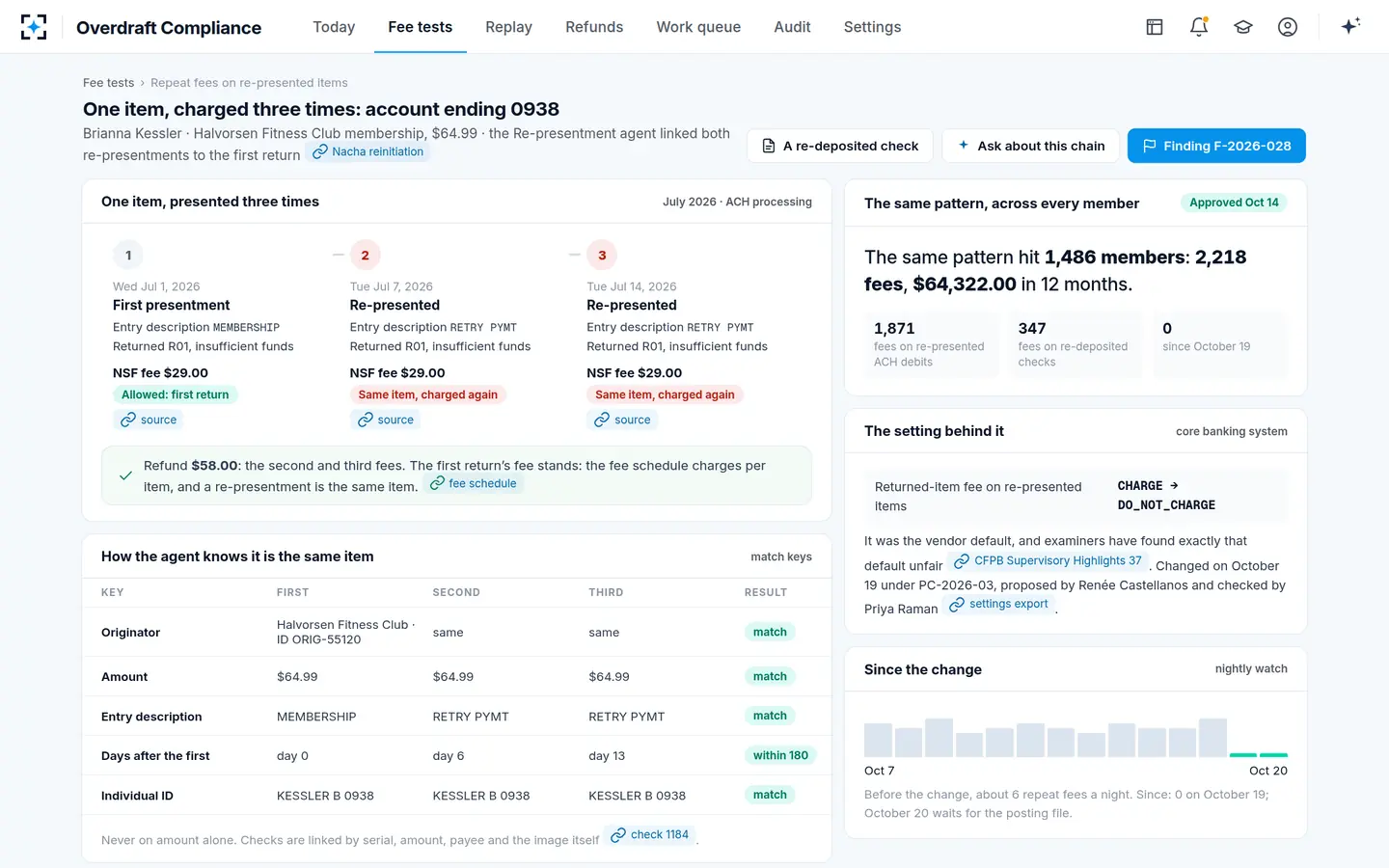
By matching, not by amount alone. The ACH network rules "impose certain formatting and processing requirements to identify re-presentment transactions", and the CFPB reports that core platforms were enhanced to avoid NSF fees "on readily identifiable re-presentment transactions". A properly formatted re-presentment carries the same originator and the same amount as the first presentment and is identifiable as a retry; in the sample below, the merchant's entry description changed from MEMBERSHIP to RETRY PYMT on each retry. Checks are harder: a re-deposited check has to be tied back to its first return by serial number, amount, payee and the image.
How Overdraft Compliance knows a returned debit is the same item: the match keys
| Key | First presentment | Second | Third | Result |
|---|---|---|---|---|
| Originator | Halvorsen Fitness Club | same | same | Match |
| Amount | $64.99 | $64.99 | $64.99 | Match |
| Entry description | MEMBERSHIP | RETRY PYMT | RETRY PYMT | Match |
| Days after the first presentment | day 0 | day 6 | day 13 | Within the agent’s window |
| Individual ID | KESSLER B 0938 | KESSLER B 0938 | KESSLER B 0938 | Match |
The harder cases are the ones the merchant miscodes. When a re-presentment arrives formatted as a new payment, nothing in the entry description says so, and the fee the core waives for a properly labelled re-presentment is charged on the unlabelled one. That is why the test cannot rely on the core's own flag, and why the CFPB turned to the merchant's bank, the next section's subject. The ACH return code itself has to be right too; a return coded for the wrong reason starts the chain on the wrong footing, which ACH return codes: how to know the code on each return was right covers from the operations side.
One returned membership payment, charged three times
Take a fictional sample credit union, Norrell Federal Credit Union, as it runs through the solution. A member's $64.99 fitness club membership debit was returned for insufficient funds on July 1, 2026, re-presented on July 7 and again on July 14, and returned each time, with a $29.00 NSF fee on each return. The first fee stands: the fee schedule charges per item, and the first return is the item. The second and third are the same item charged again, and the refund is $58.00.
One item, three presentments, thirteen days
- Day 0 · returned · $29 fee allowedDay 0 · fee allowed
- Day 6 · re-presented · $29 fee refundedDay 6 · refunded
- Day 13 · re-presented · $29 fee refundedDay 13 · refunded
Overdraft Compliance links a re-presented debit to its first return
How many times can a merchant re-present an ACH debit?
Twice, under the ACH network rules as the CFPB summarises them: they generally limit "an ODFI and its clients to a maximum of two re-presentment attempts after the initial presentment is returned for insufficient funds". The limit caps the chain at three presentments of one item, which is the chain in the sample. It does not say anything about fees; that is the account-holding bank's decision, and the decision the unfairness findings were about.
Checks have no equivalent cap in that summary. A paper check returned for insufficient funds can be deposited again, and each re-deposit can draw a fee unless the core recognises it, which is why the sample's 347 re-deposited check fees were found by linking images and serial numbers rather than by any entry description.
Can a bank be liable for improper re-presentments as ODFI?
Yes, on the other side of the payment. CFPB examiners found depository institutions "engaged in an unfair act or practice in their capacity as ODFIs by processing transactions for payment as initial presentments when the transactions were in fact re-presentments without taking steps to address indicia of inaccuracy" (Supervisory Highlights 37). The indicia were plain in the bank's own data: entries "from the same payee, in the same amount, made close in time, which lacked indications that the transactions were recurring payments".
The harm ran through the consumer's bank. A miscoded re-presentment cannot be recognised by the receiving bank's core, so the NSF fee its platform would have waived was charged; and if the originator had already used its two attempts, the payment should not have been sent at all. The ODFIs' fix was monitoring: "regularly monitoring and auditing ACH transactions to identify any re-presented items that are miscoded as initial presentments". A bank that originates for merchants and also holds consumer accounts has to test both sides.
How do you test representment fee settings?
Test the setting, its change history and its output, in that order. The Federal Reserve's examiners listed what worked: institutions "refrained from assessing an NSF fee on a represented transaction after the bank assessed an NSF fee on the transaction when it was initially presented", and those relying on a vendor kept watch on the vendor's system settings themselves (Consumer Compliance Outlook, 2023; overdraft protection program vendors covers that oversight). The OCC's version is one line in Bulletin 2023-12, asking banks to test their core settings periodically against their disclosures.
A representment fee test Overdraft Compliance runs every night
- Read the setting, not the policy
Which value does the core hold for fees on re-presented items, since when, and who changed it? In the sample, the returned-item fee on re-presented items was CHARGE, the vendor default, until October 19.
- Read the match keys the core uses
Originator, amount and entry description for ACH; serial, amount and payee for checks. A setting that waives fees only on labelled retries misses miscoded ones.
- Link every return to its first return
Every ACH chain and every re-deposited check, with the first fee allowed and each later one tested.
- Compare with the fee schedule
If the schedule charges per item, a re-presentment is the same item; the FDIC’s remaining expectation is that disclosures match practice.
- Replay the year under the proposed change
Before the core changes, see how many fees and how much income the change removes.
- Watch every night after the change
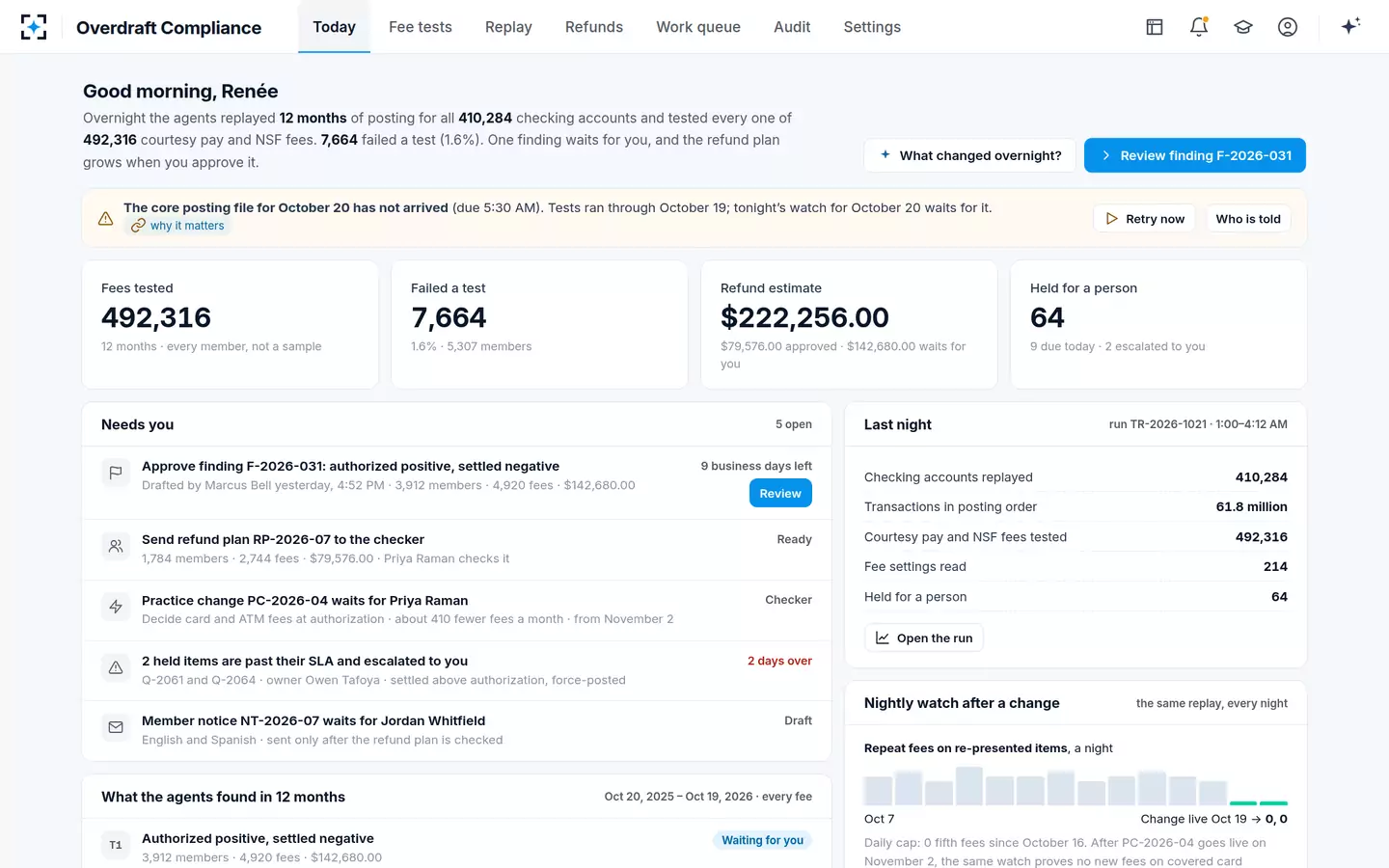
In the sample, about six repeat fees a night before the change, none since. A release or conversion that resets the default shows up the next morning.
The last item is the one sampling cannot replace. A setting changed in October can be reset by a release in March, and a quarterly sample of 40 accounts is unlikely to include the first week of repeat fees. The nightly watch on the solution's home screen is the same replay run on one day's fees, reporting only failures; how the full-year version of that test compares with a sample is set out in overdraft protection compliance, tested on last year's postings.
The nightly watch after a change, on the Compliance Officer's home screen
What repeat NSF fees have cost banks
Bank of America charged a $35 NSF fee on returned checks and ACH debits until February 2022 and charged again when the same item came back, "potentially as soon as the next day after the initial transaction". From September 2018 to February 2022 the practice "generated hundreds of millions of dollars in such fees". The CFPB ordered it to refund all repeat NSF fees collected since September 2018 and not yet refunded, about $80.4 million, and to pay a $60 million penalty; the OCC separately imposed its own $60 million penalty the same day (CFPB enforcement page; OCC).
Across supervision the totals were smaller per institution and wider. Supervisory Highlights 29 described institutions that charged "several million dollars to tens of thousands of consumers over the course of several years", agreed to stop charging NSF fees on unpaid transactions entirely, and were directed to refund. "Virtually all institutions that Supervision has engaged with on this issue reported plans to stop charging NSF fees altogether." The cumulative figure the CFPB reported in January 2025 was about $66 million for re-presentment NSF fees. How those refunds are calculated, and what a lookback costs to run, is the subject of bank overdraft fee refunds.
Questions people ask
Is a re-presented item a new transaction?
No. The CFPB describes a re-presentment as the merchant presenting "the same transaction" for payment again after it was declined and returned. That is why a fee schedule that charges per item supports one NSF fee for the item, not one per presentment, and why the sample's refund kept the first fee and returned the later ones.
Did the FDIC ever require a lookback for re-presentment fees?
Not as a rule. Its June 2023 revision, FIL-32-2023, said the FDIC would not request a lookback for re-presentment violations "absent a likelihood of substantial consumer harm", citing challenges in identifying harmed consumers. That guidance was itself rescinded on April 10, 2026, so it no longer sets the FDIC's approach either way.
Who sets the NSF fee rules in the core?
The bank does, through its core processor's fee tables, but examiners found many banks never chose: the platforms charged re-presentment fees by default unless the bank acted. Ownership of the setting belongs with deposit operations, with compliance testing what it produces and approving any change.
Do disclosures make representment fees acceptable?
Not in the OCC's view: Bulletin 2023-12 says the practice may be unfair even when disclosures explain that one item can draw more than one fee. At the FDIC, the April 2026 rescission leaves disclosure accuracy as the stated expectation, and the FDIC's own 2023 citations were about disclosures that did not explain multiple fees.
Can a merchant re-present a check as well as an ACH debit?
Yes: a returned check can be deposited again, and a check can also be converted to an ACH debit. The CFPB's and OCC's findings cover both, and in the sample year 347 of the 2,218 repeat fees were on re-deposited checks, found by linking the image and serial number to the first return.