Bank overdraft fee refunds have run to nearly $250 million since 2022 for two practices alone, according to the CFPB: about $184 million for fees on card transactions the customer's balance covered when they paid, and about $66 million for repeat NSF fees when a merchant re-presented the same item. Part of the cause, the CFPB found, was a setting in core banking platforms that kept charging those fees by default unless the institution switched it off. What one wrong setting costs is the sum of three things: every fee charged since the setting went wrong, the program that finds the customers and pays them, and, if a regulator finds it first, a penalty and an order that dictates how the refund is run. Botminds' Overdraft Compliance is built to size the first two before the third arrives. This page sets out what banks have refunded and paid, how refunds are calculated and paid out, and what it costs to find the problem yourself.
What overdraft fee errors have cost, in four public figures
$250M
nearly, refunded since 2022 for APSN and repeat NSF fees after CFPB supervision
$141M
APSN fees Regions Bank was ordered to refund, beside a $50 million penalty
$120M
penalties on Bank of America for repeat NSF fees: $60 million each to the CFPB and the OCC
$1.2B
restitution ordered by the FDIC in 2025 across all consumer protection laws
How much have banks refunded for overdraft fees?
The CFPB's running total is the best single figure: "Since the CFPB heightened its supervisory attention on overdraft and NSF fees in 2022, financial institutions have agreed to refund nearly $250 million to consumers", about $184 million for unanticipated overdraft fees and about $66 million for NSF fees on items already returned once (Supervisory Highlights 37). That figure covers supervisory findings at institutions the CFPB examines. Public enforcement orders sit on top of it.
The orders show the range. Regions Bank was ordered to refund at least $141 million of authorized-positive overdraft fees; Bank of America about $80.4 million of repeat NSF fees; TD Bank an estimated $97 million over opt-in failures; Atlantic Union Bank at least $5 million, also over opt-in. The Congressional Research Service totals the CFPB's overdraft actions against Wells Fargo, Navy Federal Credit Union and Regions at "roughly $491 million for overdraft-related issues" (CRS Insight IN12513).
Public overdraft orders: refunds, penalties and status
| Institution, date | Practice | Redress | Penalty | Status on the CFPB’s page |
|---|---|---|---|---|
| Regions Bank, Sept. 2022 | Fees on card and ATM items authorized with sufficient funds, Aug. 2018 – July 2021 | At least $141 million | $50 million | Terminated July 21, 2025, after redress payments were issued |
| Bank of America, July 2023 | Repeat $35 NSF fees on re-presented items, Sept. 2018 – Feb. 2022 | About $80.4 million | $60 million CFPB; $60 million OCC | Post Order |
| TD Bank, Aug. 2020 | Overdraft fees on ATM and one-time debit without affirmative consent; misleading marketing | Estimated $97 million | $25 million | Expired, terminated or dismissed |
| Atlantic Union Bank, Dec. 2023 | Oral opt-ins before written notice; misleading phone enrolment | At least $5 million | $1.2 million | Post Order |
| Wells Fargo, Dec. 2022 | Among many products, overdraft fees when the customer had enough funds when they paid | More than $2 billion across all products | $1.7 billion across all products | Expired, terminated or dismissed |
| Navy Federal Credit Union, Nov. 2024 | Surprise overdraft fees | None: order terminated July 1, 2025, non-compliance waived | — | Terminated |
Why do banks refund overdraft fees?
Because a fee charged in breach of a rule is consumer harm, and every supervisor's remedy for harm starts with getting the money back. In the first APSN examinations, institutions "were directed to cease charging APSN overdraft fees and to conduct lookbacks and issue remediation to consumers who were assessed these fees" (Supervisory Highlights 29). The OCC says its overdraft violation findings "have typically led to corrective action, including remediation to harmed consumers" (OCC Bulletin 2023-12).
The CFPB's 2025 priorities lean further the same way: the Bureau "will focus on redressing tangible harm by getting money back directly to consumers, rather than imposing penalties on companies" (CFPB Supervision and Enforcement Priorities, April 2025). Its 2020 bulletin on responsible business conduct, which was not among the 67 guidance documents withdrawn in May 2025, sets the questions every remediation is judged by: whether the institution worked out how many consumers were affected and how badly, and whether it made them whole (CFPB Bulletin 2020-01; the bulletin's full list, and how a program answers it, is in what customer remediation in banking is).
What one wrong core setting costs, term by term
Most of the published refunds trace back to a fee decision a core platform makes on every item. The CFPB found that core processors had set their platforms to keep charging the fees by default until each client institution acted to stop them (NSF representment fees and the core's default setting quotes the finding). A setting that is wrong charges every eligible customer every day until someone changes it, so its cost grows with time, not with any single error. The four terms below price it.
The cost of one wrong overdraft fee setting
Refund
fees charged under the setting × fee amount, back to the start of the lookback
Less fees already refunded and fees the order excludes, such as those a daily cap would have displaced
Compliance, checked by deposit operations
Program
staff days to find, size, approve, pay and notify, plus data retrieval
Personnel is more than 60% of compliance cost at banks of every size
Compliance and operations
Penalty
set by an order if a regulator finds it; weighed against self-identification if the institution does
Regions $50 million; Bank of America $120 million across two agencies; TD $25 million
The board
Revenue after the fix
fees the corrected setting no longer charges, per month
Not a cost of the error but of ending it; size it before the change, so the decision is made with the number
Finance and deposit operations
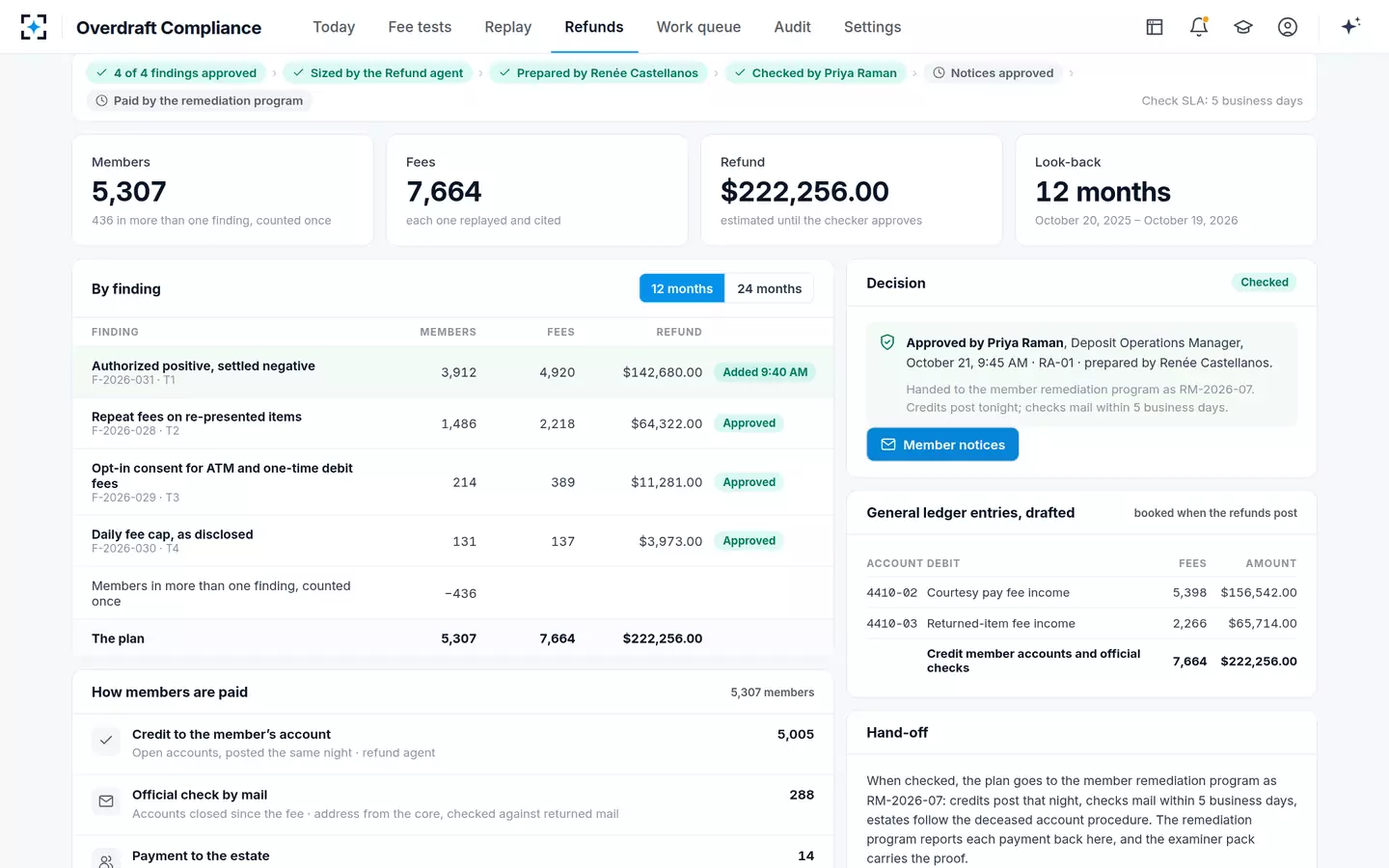
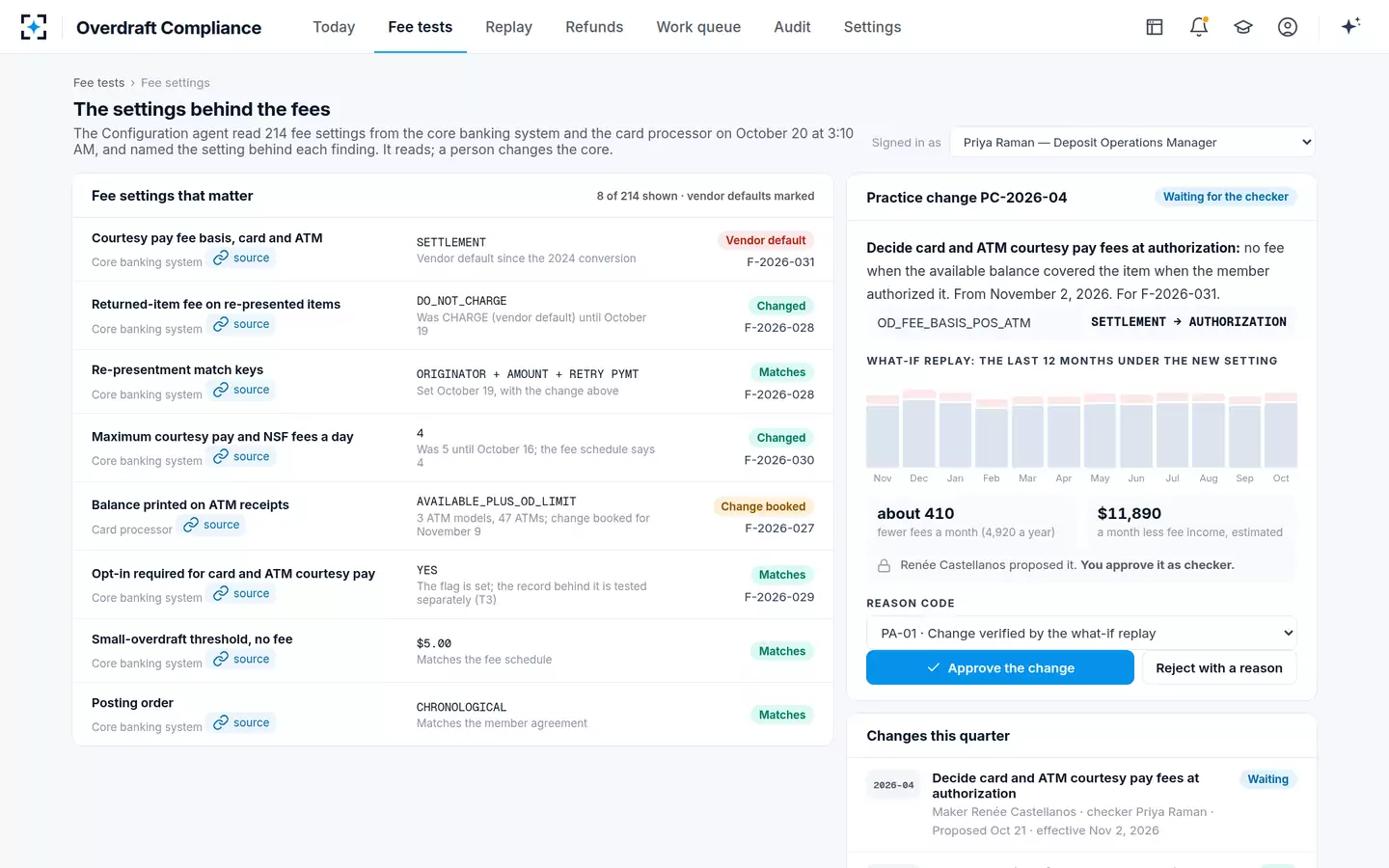
Take the fictional sample credit union the solution runs on. Its core decided card and ATM courtesy pay fees at settlement, the vendor default since a 2024 conversion, and a second setting charged a returned-item fee on re-presented items. Replaying 12 months found 4,920 authorized-positive fees and 2,218 repeat fees, $142,680.00 and $64,322.00 at $29.00 a fee. Changing the first setting would remove, by the solution's estimate, about 410 fees a month, $11,890.00 of monthly fee income. A 24-month lookback across all four findings is estimated at $280,836.00 against $222,256.00 for 12 months.
Where a $222,256 refund comes from: four findings at a sample credit union
Refund by finding
- Authorized positive, settled negative · $142,680 · 64.2%
- Repeat fees on re-presented items · $64,322 · 28.9%
- Opt-in · $11,281 · 5.1%
- Daily cap · $3,973 · 1.8%
How 5,307 members are paid
- Credit to the account · 5,005 · 94.3%
- Official check · 288 · 5.4%
- Estate · 14 · 0.3%
How are overdraft refunds calculated?
Fee by fee, with exclusions written down before the first payment. The Regions order is the clearest public template. It required redress of "all unreimbursed Authorized-Positive Overdraft Fees" over the relevant period, except four classes: fees included in balances charged off when the account closed, provided the bank did not collect them; fees on transactions without enough funds "at authorization for the amount of the final purchase"; overdraft protection transfer fees that would have been charged anyway; and fees "that displaced other overdraft or non-sufficient funds fees that would have occurred but for Respondent's daily cap on such fees" (CFPB Consent Order 2022-CFPB-0008).
That last exclusion shows why refund arithmetic needs the replay, not a query. If a daily cap of four stopped a fifth fee, and the APSN fee is refunded, the fifth fee would have been charged in its place; refunding both overpays. The same logic removes fees already refunded at a branch and counts a customer in two findings once. In the sample, 436 members were in more than one finding and were counted once. The order also required a written redress plan that would "Describe the methodology Respondent proposes to use to identify Affected Consumers and the amount of redress to be provided to each", submitted within 90 days for the CFPB's non-objection.
Overdraft Compliance sizes the refund plan, and a second person checks it
Can a bank refund overdraft fees to closed accounts?
It has to, and orders spell out how. The Regions order required redress "by direct deposit whenever feasible", otherwise by paper check, and a plan describing how the bank would find current mailing addresses, with "reasonable efforts to identify current addresses prior to mailing redress checks and once any redress checks are returned as undeliverable". Money that could not be delivered did not stay with the bank: if redress paid fell short of the plan, the shortfall went to the Bureau.
In the sample, 288 members had closed their accounts since the fee and are paid by official check to the address on the core, checked against returned mail; 14 are deceased members whose refunds go through the credit union's deceased account procedure. Checks that are never cashed still need an answer, which is why the refund program needs an end date and a reconciliation, not just a payment run.
Who pays for an overdraft lookback, and what does it cost?
The institution pays, and the cost is mostly people. The Federal Reserve Bank of St. Louis found that staff costs were above 60 percent of compliance spending in every size group of community banks it studied (Regional Economist, July 2016). A lookback done by hand is weeks of that time: requesting posting history, matching card authorizations to settlements, linking returned items, sizing the refund and drafting letters.
The solution's own estimate, for one quarterly test at a credit union the size of the sample, puts the manual work at about 25 business days on a sample of accounts, eight of them on sizing the refund, entries and letters, against about four and a half with the agents on every fee. It is an estimate, kept deliberately modest, not a measured result. The bigger saving is the one a sample cannot deliver at any price: the population, counted, before the refund has to be rebuilt for an examiner. How that full-year test works is in overdraft protection compliance, tested on last year's postings.
Finding it yourself or being told: why the order matters
The same refund costs less when the institution finds it. The FFIEC's consumer compliance rating system, used by the FFIEC's member agencies, was revised to "establish incentives for institutions to promote consumer protection by preventing, self-identifying, and addressing compliance issues in a proactive manner" (81 FR 79473). The Regions order documents the opposite path: the bank's executives decided by July 2019 to stop the fees but waited for a posting order change, while compliance staff warned that regulators "will likely expect" refunds of the fees charged in the meantime.
The same refund, found by the institution or by the examiner
Self-identified and fixed: The institution, documented and approved internally
Found at examination: Written into a plan the regulator must not object to
Self-identified and fixed: Chosen from the data and the start of the practice
Found at examination: Set or negotiated with the regulator; Regions ran three years
Self-identified and fixed: Credit for self-identification in the rating system
Found at examination: Civil money penalties: $1.2 million to $120 million in the orders above
Self-identified and fixed: Paid when ready, with notices the institution approves
Found at examination: Deadlines in the order, such as 60 days after non-objection at Regions
Self-identified and fixed: Built as the work is done
Found at examination: Rebuilt from memos after the fact
FDIC data put the voluntary side in proportion. In 2025 the FDIC ordered about $1.2 billion in restitution across all consumer laws, while supervised institutions "provided voluntary restitution payments totaling $4.7 million to 47,902 consumers" (FDIC, March 2026); in 2023, voluntary restitution was $10.6 million to more than 130,000 consumers (FDIC, March 2024). The money is small next to the orders; the difference is who decided how to pay it.
Sizing a refund before the exam
Botminds' Overdraft Compliance does the refund arithmetic as soon as a finding is approved. Its refund agent adds the finding's fees to the plan, removes overlaps and fees already refunded, splits credits, checks and estates, and drafts the general ledger entries. The Compliance Officer prepares the plan and the Deposit Operations Manager checks it; the agent never posts a refund. A notice agent drafts a plain-language notice for every member in the language on file, which only the Member Services Director approves, and nothing is sent before the plan is checked.
Before you approve an overdraft refund plan
- Is every fee in the plan tied to a replayed posting?
A refund built from a query on fee codes includes fees that should stand and misses ones that should not.
- Are the exclusions written down?
Charged-off balances, fees a daily cap would have displaced, fees already refunded. Regions’ order listed four.
- Is each member counted once across findings?
Overlaps inflate the count and confuse the notice.
- Has the lookback window been decided, and by whom?
The sample keeps 12 months until its Supervisory Committee decides on 24.
- Do closed accounts and estates have a route?
Direct deposit where feasible, checks to verified addresses, the deceased account procedure for estates.
- Has the setting been changed, and is it watched?
A refund without the fix is the first of several.
- Does the notice say what happened in plain words?
The amount, the date, what changed; no finding number, rule or the word violation.
The setting change is priced the same way before it is made. In the sample, the replay of 12 months under the proposed setting shows the fees and income it removes, so the decision to change it is taken with the number in front of the person who signs it. Why so many of these settings were vendor defaults, and what to ask the vendor, is in overdraft protection program vendors and your core: what agents add.
Overdraft Compliance prices the setting change behind the refund
Questions people ask
What does an overdraft remediation cost?
The refund itself, which is every affected fee in the lookback window; the people and data work to find and pay it; and any penalty if a regulator finds it first. The refunds in public orders ranged from at least $5 million at Atlantic Union to at least $141 million at Regions, and the penalties from $1.2 million to $120 million across two agencies at Bank of America.
Do banks have to notify customers about overdraft refunds?
Orders usually require it. The Regions order required a notification explaining that the payment was made under the consent order, with an exemplar submitted for review. Outside an order, a short notice saying what was charged, what is being refunded and what changed is what lets a customer recognise the credit.
How far back do overdraft fee refunds go?
To the start of the practice or as far as the regulator sets. Remediation plans reported to the CFPB for APSN fees covered periods starting in 2018 or 2019; Regions' covered about three years, and Bank of America's repeat NSF refunds went back to September 2018. Data retention, at least two years under Regulations E and DD, often sets the practical limit.
Are refunded overdraft fees reported anywhere?
Supervisors report totals, not individual refunds: the CFPB's Supervisory Highlights gives the running figure for APSN and repeat NSF refunds, and the FDIC's annual highlights report restitution ordered and paid voluntarily. Inside the institution, the refund reverses fee income, which is why the plan drafts the general ledger entries against the fee income accounts.
Which overdraft fees are excluded from a refund?
Whatever the methodology says, and it should say. The Regions order excluded fees in charged-off balances the bank did not collect, fees on transactions without enough funds for the final amount at authorization, transfer fees that would have been charged anyway, and fees that displaced others under the bank's daily cap.