Authorized positive, settle negative (APSN) describes an overdraft fee charged on a debit card or ATM transaction that the customer's available balance covered when the bank authorized it, but that settled days later against a negative balance because other items posted in between. The FDIC's guidance on the practice, FIL-19-2023, is still posted and says that failing to avoid these fees "results in heightened risks of violations" of the Dodd-Frank Act and Section 5 of the FTC Act; CFPB examiners have cited them as unfair, and institutions have agreed to refund about $184 million of them since 2022. The hard part is not the definition but the proof: whether one fee is APSN depends on the balance at authorization, the holds, and the order items posted afterwards. Botminds' Overdraft Compliance replays that sequence for every fee. This page follows one fee through it, step by step.
In the case of APSN transactions, which involve consumers being assessed overdraft fees for transactions where they had sufficient account balances at the time the transactions were initiated, it may not be possible for consumers to determine when fees will be assessed and how they may be avoided.
FDIC, Supervisory Guidance on Charging Overdraft Fees for Authorize Positive, Settle Negative Transactions (FIL-19-2023)
What is authorize positive settle negative?
It is a timing gap turned into a fee. A debit card purchase is authorized in seconds, and the bank places a hold for its amount. The merchant sends the transaction for settlement later, and the bank decides overdraft fees when it posts. If, between those two moments, another item posts first, the purchase can settle against a negative balance and draw a fee even though the customer had the money when they paid. The OCC's bulletin describes the same sequence: "a customer's account has a sufficient available balance to cover a debit card transaction when the transaction is authorized but, due to one or more intervening transactions, has an insufficient available balance to cover the transaction at the time it settles" (OCC Bulletin 2023-12).
Some banks then charge twice. The OCC and the FDIC both describe the pattern: the bank reduces the available balance for the authorized card purchase, an intervening transaction pushes the balance below zero and draws its own fee, and the card purchase draws another when it settles. The first fee can be legitimate. The second is the APSN fee, and separating the two is most of the work of a test.
Why authorization and settlement drift apart by days
The gap is set by the payment networks and the merchant, not the customer. The CFPB's 2022 order against Regions Bank explains the timing: PIN-based debit card transactions and ATM withdrawals "generally settle on the night that the transaction occurred", while signature-based transactions "typically settle one-to-three days later". The order adds the point every APSN analysis turns on: "Consumers do not control, and have no way to know, when a particular transaction they executed will settle because the merchant controls this process" (CFPB Consent Order 2022-CFPB-0008).
The bank's own nightly posting decides the rest. Until July 2021, Regions reduced the balance for pending transactions and then "settled all credits, followed by debits in different batches"; it later moved to all credits first, then all debits "in near chronological order". A posting order that is neutral for checks can still produce APSN fees on cards, because the card purchase's place in the queue is set by when the merchant settles, not when the customer paid.
One APSN fee traced through a sample member's week
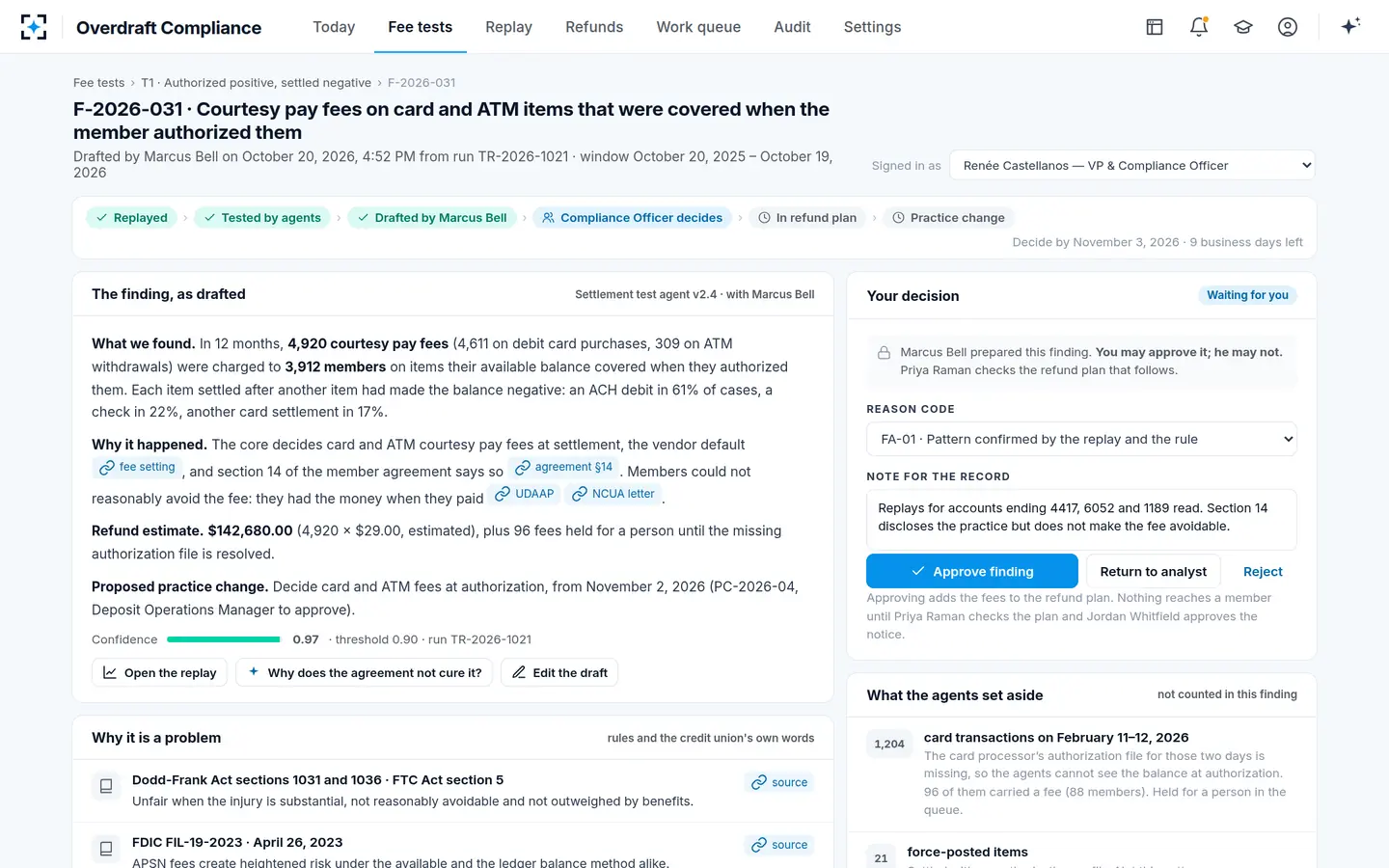
The trace below uses fictional sample data: Norrell Federal Credit Union, a $6.8 billion credit union with 520,000 members, as it runs through Overdraft Compliance. Member account ending 4417 had a quiet week until a Saturday grocery run.
How Overdraft Compliance tests one card fee: four moments in one member's week
| When | What happened | What the test reads | Verdict |
|---|---|---|---|
| Saturday, October 3, 5:48 PM | A $38.12 purchase at Brightwater Grocery is authorized with $61.40 available; a hold for $38.12 is placed | The card processor’s authorization message and the available balance at that minute | Covered when authorized |
| Monday, October 5 | A $250.00 ACH debit to Fairmont Auto Finance posts first and takes the account below zero | The core’s posting history, in the order items posted | Fee on the ACH debit allowed: it overdrew the account itself |
| Monday night | The grocery purchase settles against the negative balance; a $29.00 courtesy pay fee is charged | The settlement, matched to Saturday’s authorization | Fails: authorized positive, settled negative |
| The same pattern, 12 months | 4,920 fees on 3,912 members, $142,680.00 | Every card and ATM fee in the year, replayed the same way | One finding, for a person to approve |
Two details make the trace useful. The fee on the car payment stays, because the ACH debit itself overdrew the account, so the refund is targeted rather than blanket. And the replay names what came in between. Across the sample year, an ACH debit was the intervening item in 61% of these fees, a check in 22% and another card settlement in 17%, which tells the credit union that changing check posting order alone would not have fixed it.
What posted in between: the intervening item behind 4,920 APSN fees
Does APSN risk exist under the ledger balance method?
Yes. The FDIC's guidance was written precisely to say so: it "expands on the 2019 Supervisory Highlights article by discussing the FDIC's concerns with both the available and ledger balance methods". Its words are that the risks "exist in both available balance and ledger balance methods of assessing overdraft fees, but may be more pronounced in situations where institutions use available balance methods" (FIL-19-2023). CFPB examiners reached the same conclusion in the field, citing unfair APSN fees decided on the available balance and on the ledger balance (Supervisory Highlights, Issue 29).
Two ways a core decides an overdraft fee, and where APSN hides in each
Ledger balance method: Only transactions settled during the period; authorization holds are ignored
Available balance method: Settled transactions, pending deposits and authorized but unsettled debits the bank must pay
Ledger balance method: The balance on the periodic statement
Available balance method: The balance online, in the app, at the ATM or by phone
Ledger balance method: An intervening item settles first and the ledger balance goes negative before the card item posts
Available balance method: The hold reduces the balance, an intervening item takes it below zero, and the card item settles negative
Ledger balance method: Lower: the card item is not held against the balance
Available balance method: Higher: the FDIC notes temporary holds may lead to multiple fees where the customer expected one
Is APSN an unfair practice if the account agreement discloses it?
A disclosure does not cure it, in the view of every regulator that has written on it. CFPB examiners found that consumers "could not reasonably avoid the substantial injury, irrespective of account-opening disclosures". The OCC found APSN fees unfair "even when disclosures described the circumstances under which consumers may incur overdraft fees". The FDIC's guidance says "disclosures generally do not fully address Dodd-Frank UDAAP and FTC UDAP risks associated with APSN transactions". The CFPB circular that set out its own analysis was withdrawn in May 2025 (90 FR 20084), but the FDIC and OCC documents quoted here remain posted.
The reason is in the unfairness test's second limb. A fee is avoidable only if the customer can see it coming and act. A customer who checks the app, sees enough money, pays, and is charged three days later because a car payment posted first had no point at which to act. In the sample finding the analyst put the same argument in one line: section 14 of the member agreement discloses the practice but does not make the fee avoidable. For the other practices that do and do not survive a disclosure, see are overdraft fees illegal? Six beliefs the rules do not support.
The finding a Compliance Officer approves, with its cause and its rules
The hold-expiry fix that still charged APSN fees
Banks that tried to stop APSN fees found the obvious fix leaks. Supervisory Highlights 29 describes institutions that skipped the overdraft fee on a transaction that authorized positive "as long as the initial authorization hold was still in effect at or shortly before the time of settlement". Some transactions settled after the hold dropped off, and were charged. Examiners issued matters requiring attention and found "inadequate compliance management systems where institutions failed to maintain records of transactions sufficient to ensure overdraft fees would not be assessed".
That finding is the strongest argument for testing the fee, not the policy. A setting that skips the fee whenever an item authorized positive is only as good as the data the core keeps to apply it: the authorization, the hold, the hold's expiry, and the settlement that may arrive after it. A test that replays the actual postings catches the late settlements the setting misses; a test that reads the setting and stops does not.
When the member never opted in, APSN is a Regulation E problem too
For a customer who has not opted in to overdraft coverage of ATM and one-time debit card transactions, there is no unfairness argument to have: Regulation E forbids the fee. The official interpretation gives the APSN case as its example. If an institution authorizes a one-time debit card transaction "on the reasonable belief that the consumer has sufficient funds" and, at settlement, the account is short "due to intervening transactions that post to the consumer's account", the institution "is not permitted to assess an overdraft fee or charge for paying that transaction" (Regulation E, comment 17(b)-1.iv).
So an APSN test has two branches. For opted-in customers, the question is the unfairness standard as the institution's regulator applies it. For everyone else, any courtesy pay fee on a one-time card or ATM item is a Regulation E violation regardless of the balance at authorization, and the test that catches it is the opt-in test described in Reg E opt-in confirmation letter: proving the order of consent.
How do you find APSN fees in core data?
You need four inputs that rarely sit in one system: the card processor's authorization messages, the core's posting history in the order items posted, the holds and when they expired, and the fee schedule. The test then rebuilds the available balance at the minute of each authorization and asks one question per fee: did the balance cover this item when the customer paid? Most fees answer themselves. The ones that do not are where a person is needed, and the flow below shows the split the solution uses.
Overdraft Compliance on an APSN fee: what agents decide and what a person does
Agent
Replay agentRebuilds available and ledger balance minute by minute for 12 months, in posting order, from posting history, card authorizations and ACH returns
Never: Never fills a gap in source data
Agent
Settlement test agentAsks of each card and ATM fee whether the available balance covered the item at authorization, and names the item that posted in between
Never: Below 0.90 confidence, holds the fee for a person
A person decides
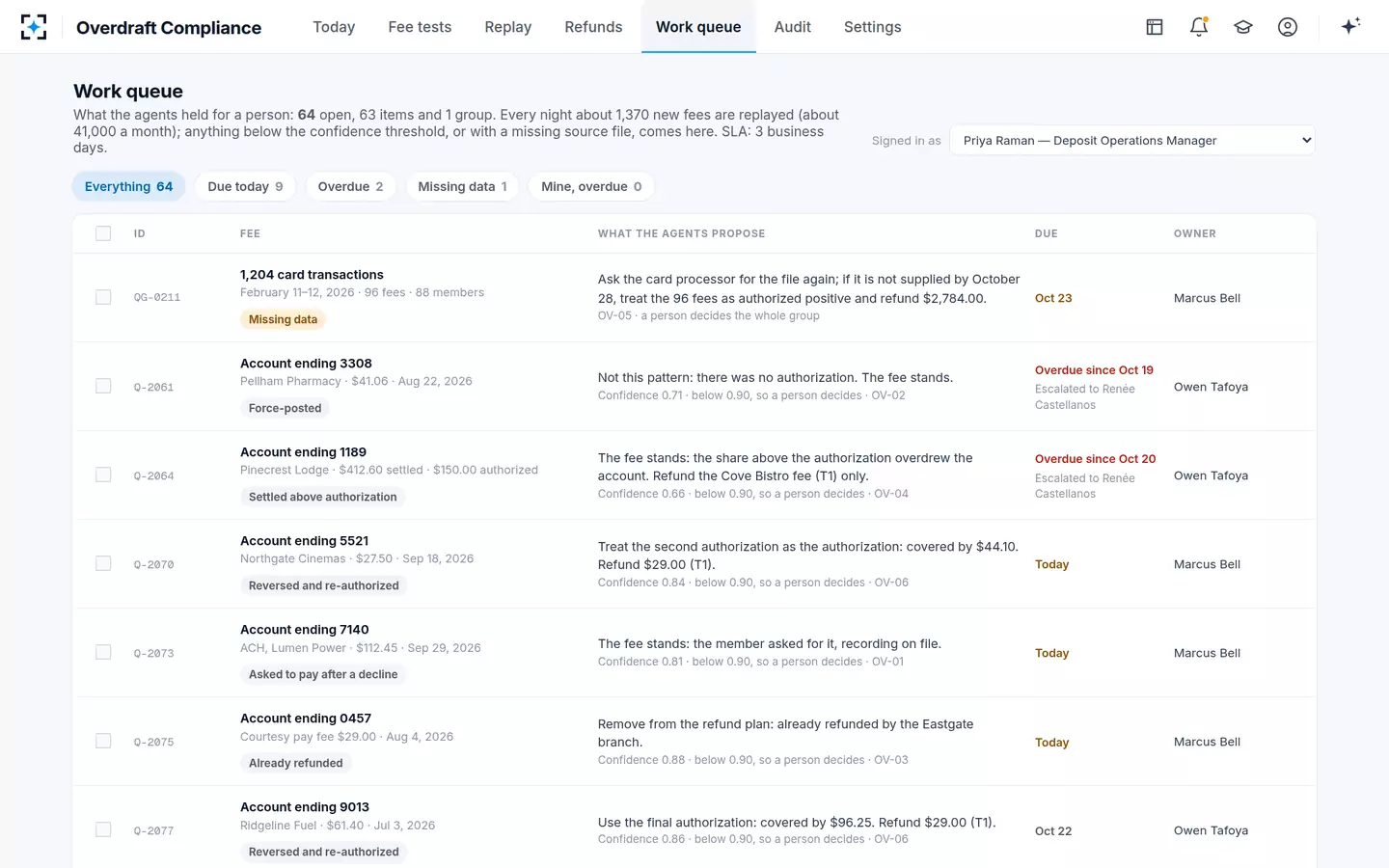
Compliance testing analystWorks the held fees: force-posted items, settlements above the authorized amount, reversed and re-authorized purchases, missing files
Agent
Configuration agentNames the core or card processor setting behind the finding and replays 12 months under a proposed change
Never: Read only on the core
A person decides
Compliance OfficerApproves or returns the finding with a reason code; the analyst who drafted it cannot approve it
The held cases are the instructive ones, because each is a judgment the replay cannot make alone. A force-posted transaction had no authorization at all, so the fee stands. A purchase authorized for $150.00 that settled at $412.60 overdrew the account by the difference, so the fee on it stands while an earlier APSN fee in the same chain is refunded. A purchase reversed and re-authorized needs a decision about which authorization counts. Regulators drew similar lines: the Regions order left out of redress fees on purchases "authorized for $0" and on purchases the balance could not cover, at authorization, for their final amount (bank overdraft fee refunds lists all four exclusions).
What the agents hold for a person, with their proposal and a due date
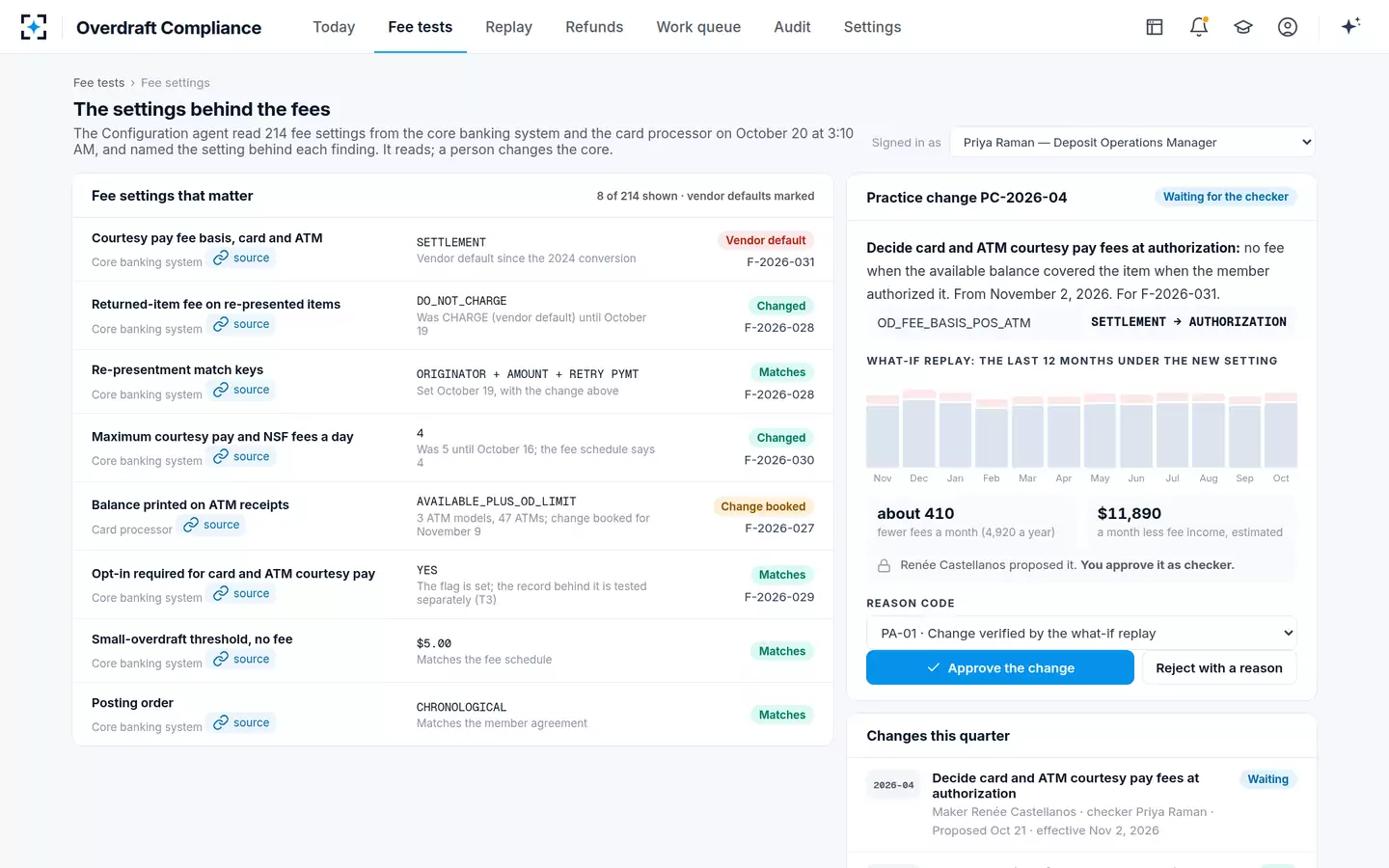
The last step is the setting. In the sample, the core decided card and ATM courtesy pay fees at settlement, the vendor default since a 2024 conversion. The proposed change decides them at authorization, and the replay of the past year under the new setting estimates about 410 fewer fees a month before the Deposit Operations Manager approves it as checker. Why that default existed at all, and what examiners said about it, is the subject of overdraft protection program vendors and your core.
The setting behind the APSN finding, replayed before it changes
What APSN fees have cost: $141 million at one bank
The public orders price the practice. Regions Bank charged consumers at least $141 million in authorized-positive overdraft fees from August 2018 through July 2021, at $36 a fee; the CFPB ordered it to refund them and pay a $50 million civil money penalty. The order's own example shows how fast the fees stack: a customer with $100 makes five $10 debit card purchases, a $120 check posts the next day and draws a fee, and when the five purchases settle on day three "all five of them also incur overdraft fees for a total of $180 in fees" (CFPB Consent Order 2022-CFPB-0008).
The bill for authorized positive, settle negative fees
$184M
refunded for unanticipated overdraft fees on transactions authorized with sufficient funds, since CFPB supervision stepped up in 2022
$141M
APSN fees Regions Bank charged from August 2018 to July 2021, ordered refunded
$50M
civil money penalty in the Regions order
170,000+
consumers receiving redress after the first APSN examinations
The Regions order also records the decision that made it expensive. By July 2019 the bank's executives had decided to stop the fees but delayed until a posting order change that was "expected to generate new overdraft fees that would fully offset the expected revenue loss". Its compliance staff had warned that waiting meant regulators "will likely expect" refunds of the fees charged in the meantime. Wells Fargo's December 2022 order covered the same practice among many others, finding the bank "unfairly charged overdraft fees even if the consumer had enough funds available" (CFPB enforcement page). How refunds like these are sized, and what the lookback costs, is the subject of bank overdraft fee refunds: what one wrong core setting costs.
Questions people ask
Are APSN fees still cited after 2025?
The CFPB withdrew its APSN circular on May 12, 2025, but the FDIC's FIL-19-2023 and OCC Bulletin 2023-12 are still posted, and both describe APSN fees as a heightened risk under Section 5 of the FTC Act. Banks examined by the FDIC or the OCC should expect the practice to be reviewed under those documents and the statute they apply.
Does the NCUA treat authorize positive, settle negative fees the same way?
The NCUA's December 2024 letter to credit unions said APSN fees were likely unfair under both federal unfairness statutes when members had enough money at authorization (NCUA overdraft guidance covers what else it said). That letter no longer appears on the NCUA's site and its status is unconfirmed, so a credit union should rest its testing on the unfairness standard and Regulation E rather than on the letter.
How do pending holds cause APSN fees?
A hold reduces the available balance at authorization. If an intervening item then takes the balance below zero, the held purchase can settle negative and draw its own fee, and under the available balance method the intervening item may draw one too. The FDIC notes that temporary holds may lead to multiple fees where the customer reasonably expected one.
What data do you need to test for APSN?
Card authorizations with timestamps and amounts, the core's posting history in posting order, holds and their expiry, ACH returns, and the fee schedule. Without the authorization file for a day, the balance at authorization cannot be rebuilt; in the sample, 1,204 card transactions over two days were set aside for exactly that reason rather than guessed.
How long does it take to review one overdraft fee by hand?
There is no regulator benchmark. The steps are the same for every fee: pull the authorization, the posting history around it and the holds, rebuild the balance, and decide. The solution's own estimate for a quarterly test at the sample credit union puts matching card authorizations to settlements at about four business days by hand on a sample of accounts, and about a tenth of a day with the agents on every fee.