Regulation E does not apply to business accounts. It protects consumers, meaning natural persons, and only accounts "established primarily for personal, family, or household purposes" under 12 CFR 1005.2(b)(1), so an account opened by a company, a partnership or a business owner for the business sits outside its error-resolution clocks and liability limits. The hard part is not the rule but the fact behind it: an account's label, the member's job or the word "business" in a question does not decide coverage, and a representative who guesses wrong either turns away a consumer claim or opens one the institution never owed. Botminds' Deposit Compliance Search is built for that moment: when the fact that decides the answer is missing, its agents ask for it first, then answer with the rule, the official interpretation and the institution's own procedure.
The screens below come from a fictional sample credit union as it runs through the solution; the rules are quoted from the regulations themselves and linked where they appear.
Does Reg E apply to business accounts? No, and the reason is one phrase
Regulation E reaches an account only if two things are true: it belongs to a consumer, and it was set up for personal, family or household purposes. The regulation defines a consumer as "a natural person" (12 CFR 1005.2(e)), and the statute behind it defines an account as an asset account "established primarily for personal, family, or household purposes" (15 U.S.C. 1693a(2)). An LLC's operating account fails the first test; a business owner's separate account for the business fails the second.
That is also the CFPB's own summary. Its Electronic Fund Transfers FAQs open with the coverage question and answer it with the same definition, then apply it to person-to-person, ACH and debit card transfers "to or from a consumer account" (CFPB EFT FAQs, Coverage: Transactions Q1). The transfer type matters for whether a payment is an electronic fund transfer; the account decides whether Regulation E is in the room at all.
A transfer that is requested to be sent from an account that was not established primarily for personal, family, or household purposes, such as an account that was established as a business or commercial account or an account held by a business entity such as a corporation, not-for-profit corporation, professional corporation, limited liability company, partnership, or sole proprietorship, is not requested primarily for personal, family, or household purposes.
Comment 30(g)-3, Regulation E official interpretation (remittance transfers)
That passage comes from the commentary on the remittance-transfer subpart, not the core definition, but it is the clearest statement in Regulation E of how the CFPB reads the phrase: an account set up as a business account, or held by a business entity, is not a personal-purpose account.
Why does Reg E not apply to business accounts?
Because Congress wrote the Electronic Fund Transfer Act as a consumer statute, and the regulation follows the statute's definition. Businesses moving money electronically are left to other law: Article 4A of the Uniform Commercial Code governs funds transfers, and it steps aside only where the federal act applies. Section 4A-108 keeps the article away from any funds transfer that the Electronic Fund Transfer Act governs, even in part (UCC 4A-108; whether UCC 4A applies to consumer transactions works through the hard cases), so one statute or the other governs, rarely both.
The practical difference is large. A consumer who reports an unauthorized transfer gets an investigation within 10 business days, or provisional credit and up to 45 days, and a liability cap that depends on how quickly she reported. A business customer gets what its deposit agreement, the payment network's rules and state commercial law provide. Neither the clock nor the cap applies, and the conversation on the phone should not suggest they do.
Is a sole proprietor account covered by Reg E?
Usually not, but the reason is purpose, not ownership. A sole proprietor is a natural person, so the "consumer" half of the test is met; what fails is the "established primarily for personal, family, or household purposes" half when the account was opened for the business. Regulation E's core definitions do not mention sole proprietors at all. The clearest guidance sits elsewhere: the remittance commentary quoted above lists the sole proprietorship among business holders, and the Truth in Savings commentary excludes sole proprietor accounts from its consumer definition (Regulation DD, comment 2(h)-3).
So the question for a representative is not "is he a sole proprietor?" but "what was this account opened for?" A plumber's personal checking account is a consumer account even though he owns a business; the account he opened in his trade name for invoices is not, even though no company stands between him and it.
What if a personal account is used for business?
Regulation E's text looks back to why the account was opened: "established primarily for" personal purposes. Neither the regulation nor its official interpretation addresses an account whose use drifted after opening, such as a personal checking account that now receives business payments. That makes it an unsettled point, and an honest answer says so rather than guessing in either direction.
The remittance commentary shows how the CFPB handled a similar question for one kind of transfer. A provider "may generally deem" a transfer from a personal-purpose account to be for personal purposes, "But if the consumer indicates that he or she is requesting the transfer primarily for other purposes, such as business or commercial purposes", the consumer is not a sender under that subpart (comment 30(g)-2). That is a rule about remittances, not about account coverage, but it is a reason to record what the member actually said. In the solution, a question like this one goes to Compliance with a drafted answer and the reason it was routed.
Reg E, Reg CC and Reg DD draw the line in three different places
The three deposit rules do not share one definition, and the difference is in the verb. Regulation E asks what the account was established for. Regulation CC asks what it is used for: a consumer account is "any account used primarily for personal, family, or household purposes" (12 CFR 229.2(n)). Truth in Savings asks who holds it and why: a consumer is a natural person holding the account mainly for personal, family or household purposes (12 CFR 1030.2(h)).
Does the rule apply to a business account? Three deposit rules, three answers
| Rule | The test in the text | Business accounts |
|---|---|---|
| Regulation E (electronic transfers) | Account "established primarily for personal, family, or household purposes"; consumer is a natural person | Not covered: no error-resolution clocks, no liability caps |
| Regulation CC (funds availability) | Consumer account is one "used primarily for" those purposes, but the availability schedules apply to all accounts | Covered: holds, schedules and disclosures apply; a few notice rules differ |
| Truth in Savings, Regulation DD | Consumer "holds an account primarily for" those purposes; sole proprietor accounts excluded by commentary | Not covered: no account disclosures or change-in-terms notices required |
| NCUA Part 707 (credit unions) | Member is a natural person holding an account primarily for those purposes | Not covered, as under Regulation DD |
Regulation CC is the one to watch, because it does apply to business accounts. Its commentary is direct: "Both consumer and nonconsumer accounts are subject to the requirements of this regulation, including the requirement that funds be made available according to specific schedules and that the bank make specified disclosures of its availability policies" (appendix E, comment 2(n)-1). The differences are in the notices: the lobby posting and the 30-day notice of a policy change cover consumer accounts only, while the one-time exception notice and calculated availability are for nonconsumer accounts. A representative who learns "business accounts aren't covered" from a Reg E lesson and applies it to a check hold has learned the wrong rule.
Does Reg E apply to wires and commercial cards?
Not to Fedwire-type wires, and not to cards on business accounts. Regulation E leaves out transfers over Fedwire and similar wire systems used mainly between banks or between businesses (12 CFR 1005.3(c)(3)), even from a consumer account, although an ACH credit that follows a Fedwire transfer into a consumer account is covered (comment 3(c)(3)-1). Whether international wires are covered under Reg E is a separate question with its own subpart.
A debit card is an access device to whatever account it draws on, so a card on a business account inherits the account's answer: no Regulation E. For ACH, the private network rules add a layer that turns on the entry type rather than only the account, which is why the Nacha 60-day return rule can answer differently from Regulation E for the same business customer.
What protects a business account instead
The deposit agreement, the network rules and commercial law. For wires and many commercial payments that means Article 4A and the security procedures the business agreed to; for ACH it means the network's operating rules; for everything else it means the account agreement. An institution can also choose to give business customers more than the law requires. The Electronic Fund Transfer Act bars waiving consumer rights but allows agreements that give consumers more than the Act does (15 U.S.C. 1693l; the official staff commentary guide quotes the clause), and nothing stops a bank from writing generous terms into a commercial agreement.
That is the point a front-line answer most often misses. "Reg E doesn't apply" is true and incomplete; the useful answer is "Reg E doesn't apply, and here is what our business account agreement and procedure say we do". An answer that cites only the rule leaves the representative with nothing to tell the customer.
What an answer to a business customer's dispute should contain
- The deciding fact, recorded
Who holds the account and what it was opened for, from the core banking system or the customer, and the date it was checked.
- The rule that excludes it
12 CFR 1005.2(b)(1), labeled as rule, so a reviewer can see why no Reg E claim was opened.
- What applies instead
The institution's business-account procedure and agreement terms, with their version, or the network rule for the payment type.
- What not to say
No mention of 10-business-day investigations, provisional credit or liability caps unless the procedure grants them.
- The route for mixed cases
A personal account used for business, or a joint account with a business partner, goes to Compliance with the facts as the customer stated them.
The question an agent asks before answering
An assistant that answers "does Reg E cover this?" without knowing whose account it is will be wrong a predictable share of the time, and confidently. The design choice in Deposit Compliance Search is to treat coverage facts as deciding facts: when one is missing and it would change the answer, the Question agent asks for it, says why it is asking, and waits. In the solution this behavior is a setting, switched on for the sample credit union, and like every setting it changes only with the Compliance Officer's approval.
How Deposit Compliance Search handles a business owner's unauthorized ACH claim
Agent
Question agentReads the representative's words: "business owner says $3,100 left his account by ACH and he never authorized it". Finds the rule area, Regulation E, and the facts present: an ACH debit, a claim of no authority, a date.
Never: Never stores member identifiers in the question
Agent
Question agentSees the fact that decides coverage is missing: who holds the account and what it was opened for. Asks one question, and says why: "Is this his personal checking account, or an account opened for the business?"
Never: Never guesses a deciding fact
A person decides
RepresentativeChecks the account type and owner in the core banking system, or asks the member, and answers the question.
Agent
Rule agentPersonal account: cites 12 CFR 1005.2(b)(1) and the error-resolution rule, and the answer becomes a Reg E claim. Account opened for the business: cites the same definition to show why Reg E does not apply, and the institution's own business-account procedure.
Never: Never treats regulator guidance as rule
A person decides
ComplianceTakes the mixed cases the rule does not settle, such as a personal account the member now runs a business through, with the agents' draft and a clock.
The same pattern runs on consumer questions, where the deciding fact is often authority rather than purpose. On the fictional sample credit union's floor, a representative asked whether a member's husband taking $400 at an ATM with her card was unauthorized. Before answering, the agents asked one question: had she given him the card and PIN to use before? Under 12 CFR 1005.2(m)(1) the answer flips on that fact, and the screen says so.
One clarifying question first, with the reason it matters
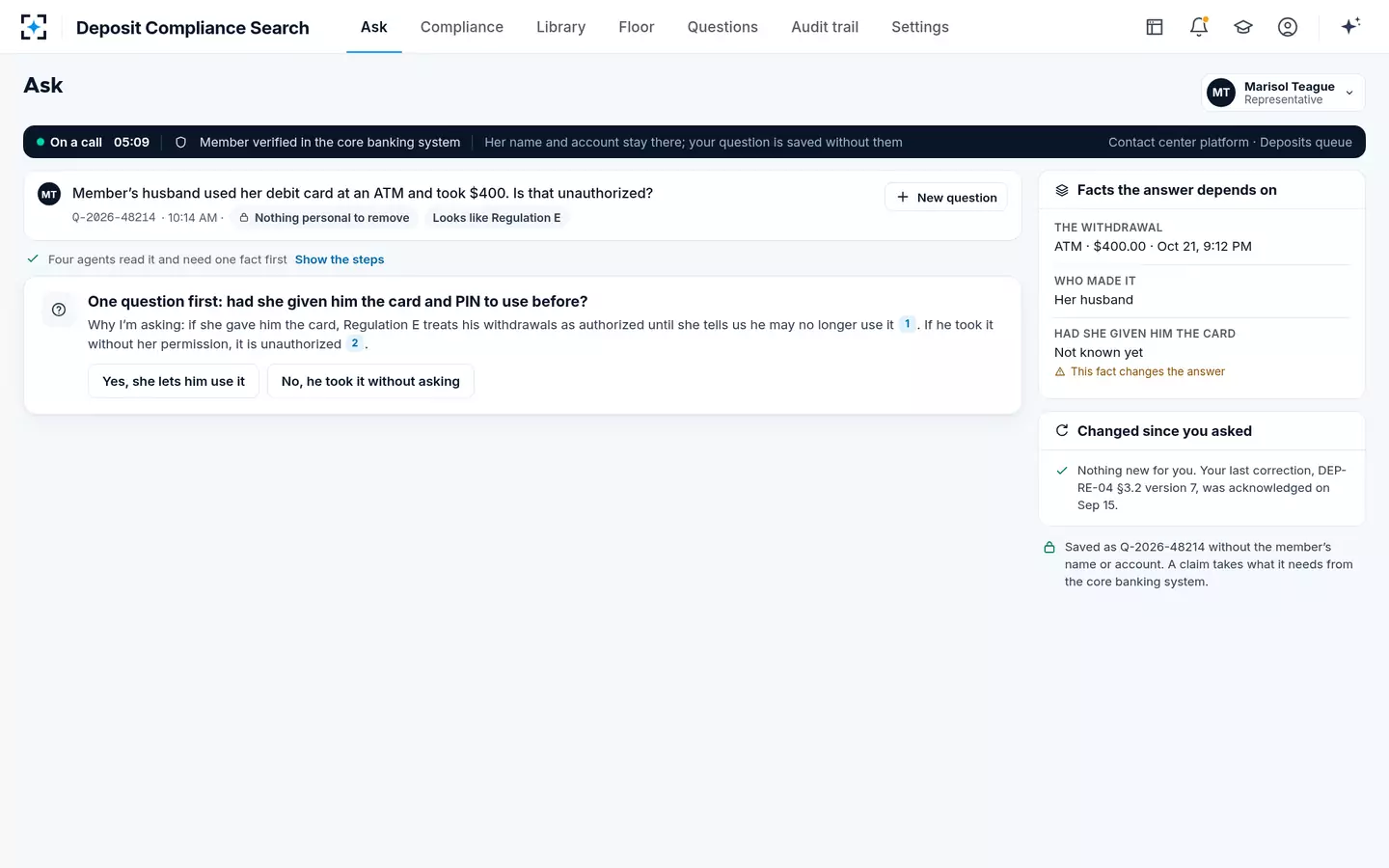
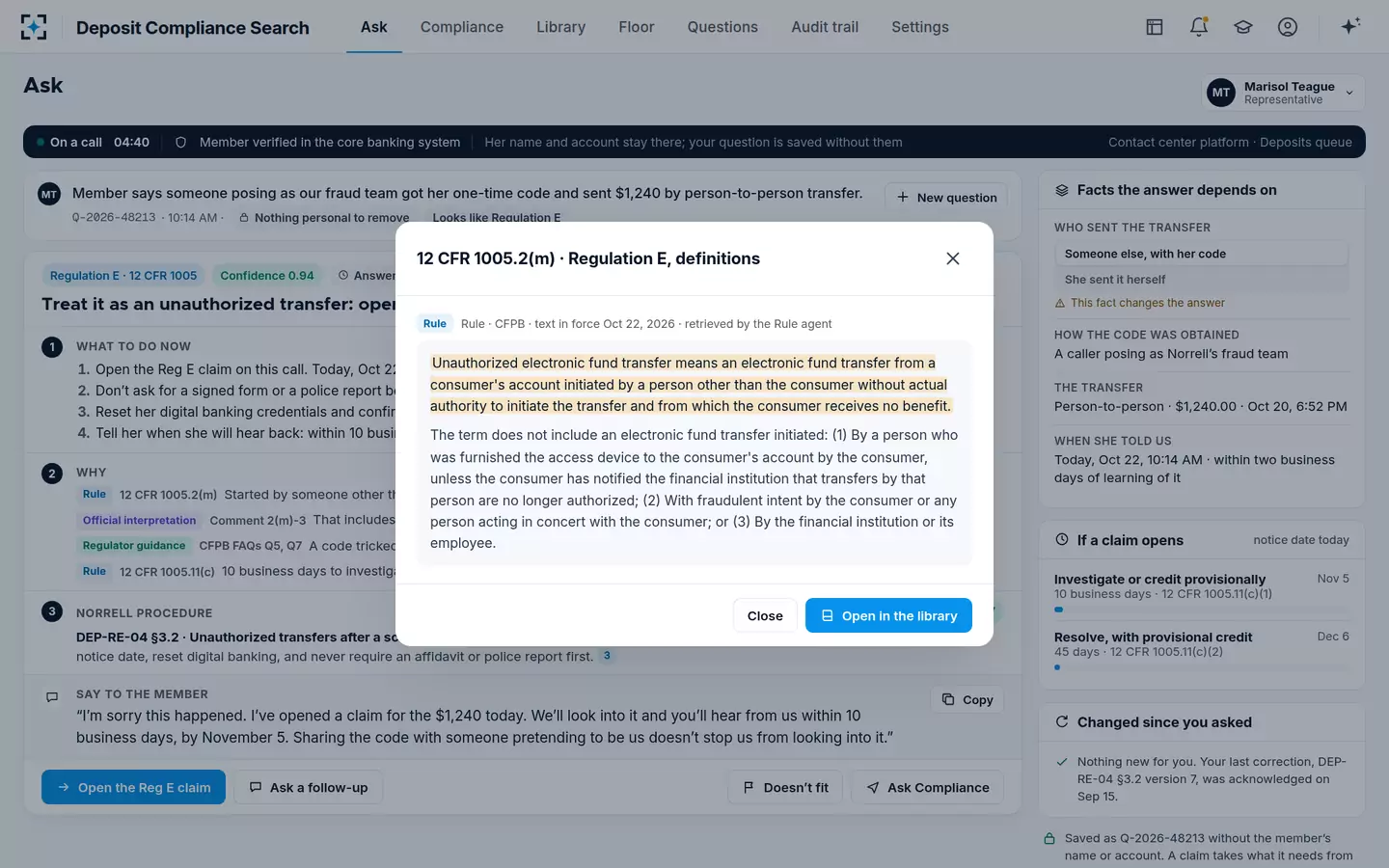
Every citation in the answer that follows opens the passage it relied on. For a coverage question that means the definition itself, highlighted, labeled as rule and shown in the version in force on the day, so a representative reading "not covered" to a business customer can see exactly which words say so. How the rule, its official interpretation and CFPB guidance rank against each other matters for exactly this kind of answer.
The rule behind a citation, in the words the answer relied on
Questions people ask
Does Reg E apply to commercial accounts?
No. Regulation E covers only accounts established primarily for personal, family or household purposes and held by natural persons, so commercial accounts are outside its error-resolution and liability rules. Their transfers are governed by the account agreement, network rules and, for funds transfers, UCC Article 4A.
Does Reg CC apply to business accounts?
Yes. Regulation CC's availability schedules, exception holds and availability-policy disclosures apply to consumer and nonconsumer accounts alike. Only a few notice rules differ: the branch posting and the 30-day notice of a policy change apply to consumer accounts, and the one-time exception notice is for nonconsumer accounts.
Does Reg DD apply to business accounts?
No. Truth in Savings protects consumers who hold an account primarily for personal, family or household purposes, and its official interpretation excludes accounts held by individuals as sole proprietors. Credit unions follow the same line under NCUA Part 707.
Is Reg E consumer only?
Yes, in what it protects: its definitions of consumer and account limit it to natural persons and personal-purpose accounts. It applies to every kind of financial institution that holds such accounts, including credit unions, and to non-bank payment providers that meet its definition of a financial institution.
Can a bank give business customers Reg E-style protection anyway?
Yes, by agreement. Nothing prevents an institution from promising business customers an investigation timeline or a loss cap in its account agreement, and some do. Staff should then answer from that agreement and the institution's procedure, not from Regulation E.
Does Reg E apply to a joint account with a business partner?
It depends on what the account was established for, not on how many owners it has. A joint personal account is covered; an account two partners opened to run their business is not. Where the facts are mixed, the answer should be routed to Compliance with what the customer said recorded.